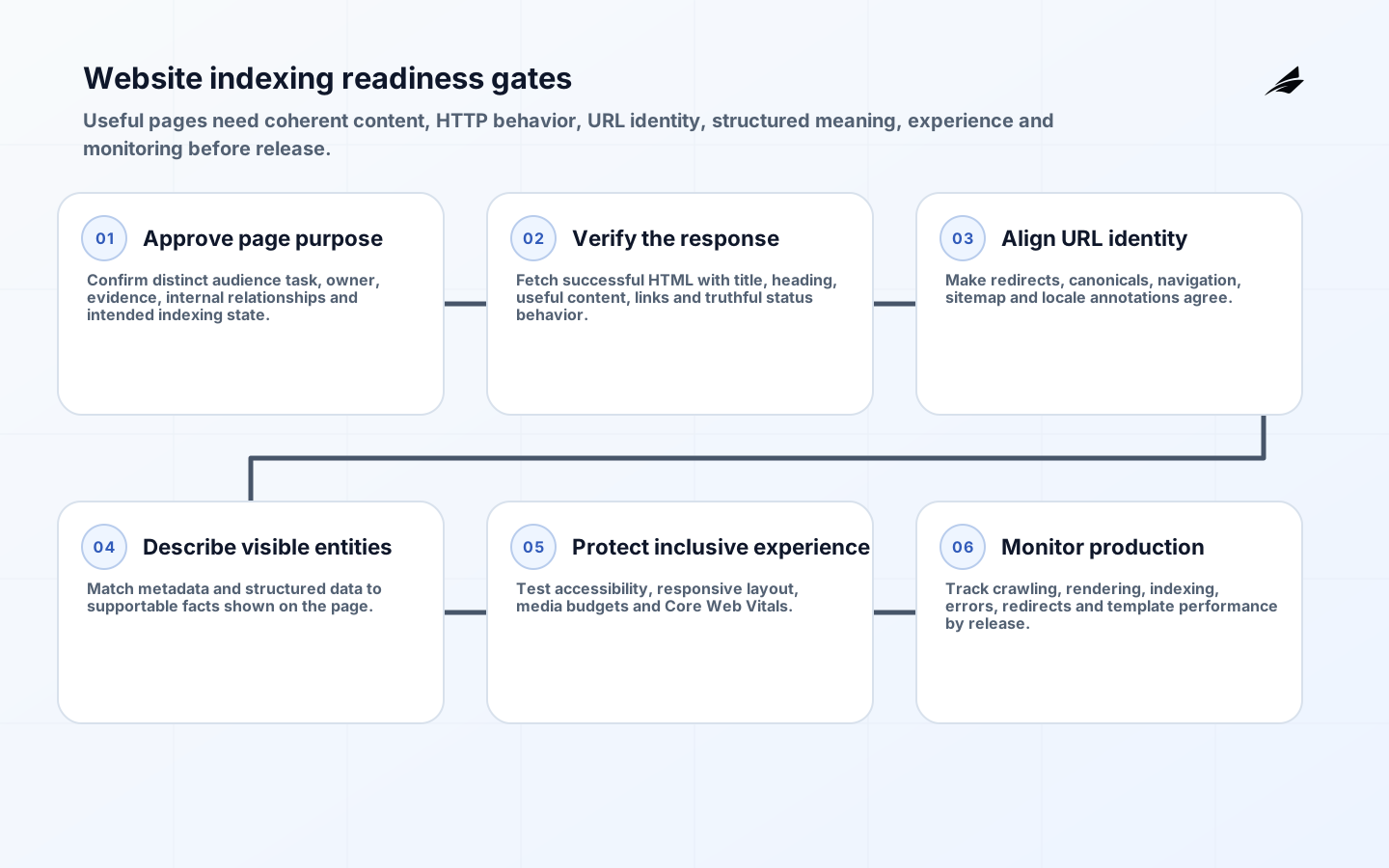
SEO-ready website development implementation means the site can be discovered, rendered, understood and maintained without relying on hidden text or crawler-only experiences. Readiness is a release property: important URLs return successful responses, meaningful content appears in accessible HTML, canonical signals agree, internal links expose the information architecture, and post-launch monitoring can detect indexing or performance regressions. It does not guarantee rankings. It removes preventable technical ambiguity while supporting people who need the page.
Use this checklist with the broader scope, cost and risk plan, the implementation FAQ and the focused website implementation checklist. Assign an owner to every failed gate and preserve evidence from the production-like build. A green design review is not enough if the deployed server returns thin markup, conflicting canonical tags or blocked assets.
Confirm every indexable page has a distinct purpose
Map services, products, locations and resources to real audience tasks. Each page needs a clear owner, primary question, evidence, next action and relationship to nearby pages. Avoid generating many routes that repeat the same promise with small wording changes. Consolidate overlap before launch or define why separate pages are useful. Titles and headings should describe the visible content naturally; they are labels for readers and systems, not containers for long lists of phrases.
Review page families as a set. Confirm templates allow unique introductions, examples, constraints, FAQs and links rather than forcing identical sections everywhere. Verify archive, filter, tag, search and parameter pages have an intentional indexing policy. A sitemap should contain canonical URLs the organization wants discovered, but it cannot compensate for weak content or contradictory navigation.
| Page gate | Pass evidence | Common failure |
|---|---|---|
| Distinct purpose | Unique audience task and useful content | Near-duplicate route created from a phrase list |
| Clear ownership | Named content and service owner | Outdated page remains published after the offer changes |
| Internal discovery | Crawlable contextual links from relevant pages | URL exists only in a sitemap |
| Conversion path | Accessible action with truthful expectations | Form or contact route fails without client script |
| Indexing intent | Template rule for canonical, index and archive behavior | Every generated page defaults to indexable |
Verify crawlable HTML and HTTP behavior
Fetch representative URLs without a browser session. The initial response should contain the correct title, description where used, canonical link, main heading, useful body text and crawlable links. JavaScript can enhance interaction, but server rendering or pre-rendering reduces dependence on later execution for core content. Google documents JavaScript rendering considerations, but teams should also test other crawlers, link unfurlers, assistive technology and slow devices. Do not serve materially different claims to crawlers and people.
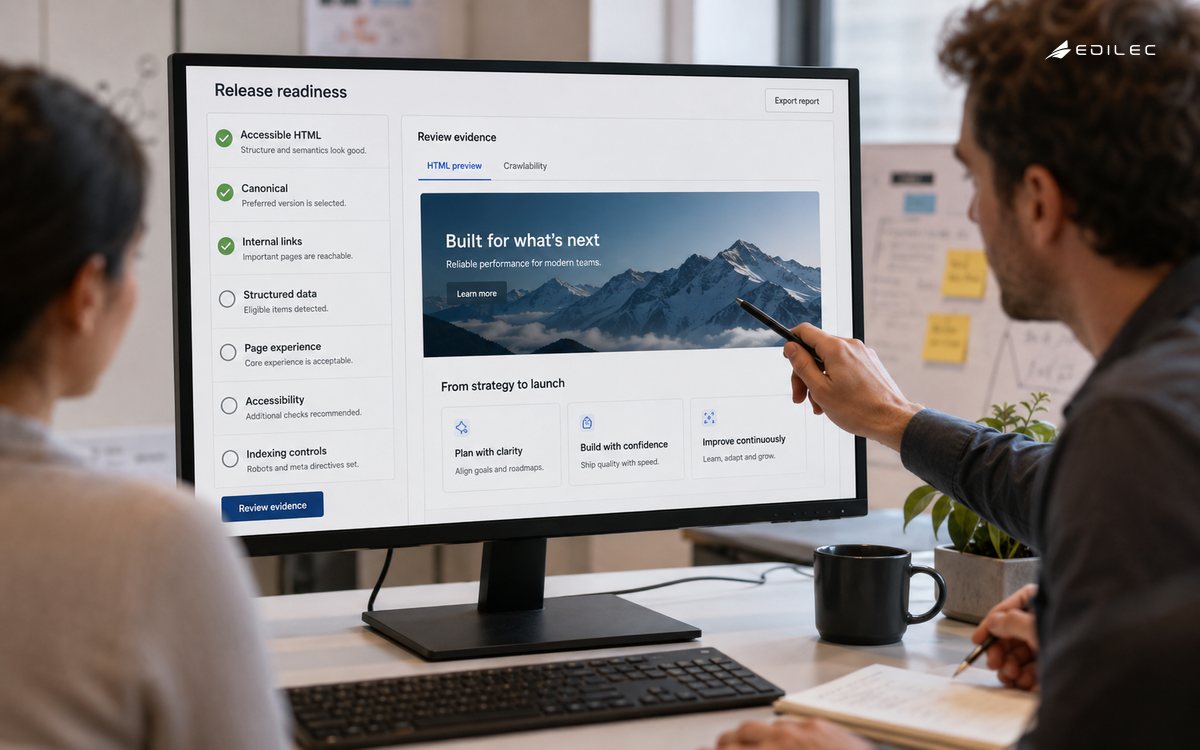
Test status codes and headers from the edge, not only the application. Valid pages return 200; removed pages return a truthful 404 or 410 unless a close replacement justifies a redirect. Redirects should be direct, stable and free of loops. Temporary failures should not masquerade as successful empty pages. Confirm robots.txt is reachable and does not block assets needed to understand the page. Use robots directives to control indexing carefully; blocking crawling is not the same as requesting removal from an index.
Make URL identity and canonical signals agree
Choose one preferred protocol, host, path style and trailing-slash policy. Normalize case and parameters where the platform permits. Each indexable page should self-canonicalize unless it is a deliberate duplicate pointing to a representative URL. Internal links, redirects, sitemap entries, hreflang annotations and canonical elements should agree. Google treats redirects and canonical annotations as stronger signals than sitemap inclusion; conflicting signals make selection less predictable.
Audit migrations with an old-to-new map. Preserve valuable paths through one-hop permanent redirects and update internal links rather than relying on redirects forever. Check uppercase variants, query strings, legacy files, alternate hosts and locale routes. A canonical tag is not a substitute for access control, nor should it point every weak page to the home page. Pages in a canonical group should be genuinely equivalent.
Align visible content, metadata and structured data
Structured data should describe entities and facts that readers can verify on the page. Choose only types supported by the content, include required properties and use stable identifiers. Validate syntax and rendered eligibility, but remember that valid markup does not guarantee a rich result. Organization, service, product, article, breadcrumb or FAQ data may be appropriate depending on the page; adding every possible type weakens clarity and can create unsupported claims.
Metadata should also remain truthful at scale. Build title and description rules with explicit fallbacks and length-aware review, then inspect edge cases. Social preview tags need absolute image URLs and suitable dimensions. Image filenames and alternatives should describe the actual subject; alternative text is for equivalent meaning, not repetition. Keep author, publication and update information consistent with visible content and structured data.
Test accessibility and page experience together
WCAG organizes accessibility around perceivable, operable, understandable and robust experiences. Test keyboard navigation, focus visibility, heading structure, form labels, errors, contrast, target size, motion and media alternatives. Responsive layouts should preserve reading order and prevent text or controls from overlapping. Accessibility is not separate from discoverability: clear structure, descriptive links and meaningful alternatives improve both human navigation and machine interpretation.
Measure Core Web Vitals with field data when available and lab tests during delivery. Current stable metrics include Largest Contentful Paint, Cumulative Layout Shift and Interaction to Next Paint. Identify the actual LCP element, reserve media dimensions, reduce main-thread work and avoid interaction handlers that block feedback. Set page-family budgets for scripts, fonts and images. A fast empty shell that later shifts into place is not a good result.
| Experience check | Test method | Release decision |
|---|---|---|
| LCP | Lab trace plus field percentile by template | Optimize server response, critical media and render path |
| CLS | Load and interact across breakpoints | Reserve dimensions and remove unexpected insertion |
| INP | Exercise navigation, menus and forms | Split long tasks and provide immediate feedback |
| Keyboard access | Complete every journey without a pointer | Fix focus order, visibility and trapped controls |
| Forms | Submit valid and invalid cases with assistive technology | Expose labels, errors, status and recovery |
Rehearse launch and indexing monitoring
Run a production-like crawl before release and compare discovered URLs with the approved inventory. Validate robots, sitemap, canonical, status, metadata, structured data, images, links and response timing. Test contact, checkout or demo journeys with analytics consent states. At launch, monitor error rates, redirect misses, rendered HTML, sitemap processing, indexed-page trends and template performance. Submit sitemaps as discovery hints, not as proof that pages will be indexed.
Define triage. A sudden decline may come from deployment, DNS, authentication, robots, canonical templates, rendering, content changes or reporting delay. Preserve release identifiers in page output and monitoring so teams can correlate symptoms. Review sampled URLs rather than only aggregate counts. Continue content ownership, broken-link checks, dependency updates and performance budgets after launch; readiness expires when the system changes without review.
Audit images and other indexable media as first-class pages of information. Use stable, descriptive file paths, correct MIME types, responsive sources, explicit dimensions and meaningful alternatives. Place an image beside text that establishes its subject, and keep captions factual. If the image is licensed from elsewhere, retain source and license records. Verify that image URLs are reachable to intended crawlers and are not blocked by authentication, robots rules or a delivery configuration that returns an empty placeholder.
International sites need an additional gate. Each locale should have a stable URL, translated visible content and correct language metadata; hreflang groups must include valid reciprocal references and an appropriate default when used. Do not redirect users or crawlers solely from assumed location in a way that hides alternatives. Review canonicals within each locale and test that navigation, structured data, currency, legal copy and contact routes stay coherent.
Establish content-change controls for high-value page families. A CMS publish action can alter headings, links, structured data, image references or canonical behavior without a software deployment. Use preview and validation for representative templates, retain revision history and require review for material claims. Monitor orphaned pages and broken assets after editorial changes. Technical readiness depends on the content operating model continuing to respect the same release assumptions. Include scheduled publication and rollback in rehearsal because timing rules can expose incomplete pages or stale metadata. Sample rendered pages after each bulk content operation. Check both mobile and desktop output before publication. Record the result.
Key takeaways
- Give every indexable page a distinct audience purpose and owner.
- Verify meaningful HTML, links, metadata and status codes in the deployed response.
- Align redirects, canonicals, internal links and sitemaps around one URL identity.
- Use structured data only for visible, supportable facts.
- Treat accessibility, performance and post-launch monitoring as release requirements.
Frequently asked questions
| Question | Answer |
|---|---|
| Does server rendering guarantee indexing? | No. It improves content availability, but usefulness, access, canonical signals and search-system decisions still matter. |
| Should every page be in the sitemap? | Include canonical URLs intended for discovery; exclude redirects, errors, duplicates and pages deliberately kept out of search. |
| Can a canonical fix duplicate templates? | Only when pages are genuinely equivalent. Consolidating routes and content is often the cleaner solution. |
| Is structured data a ranking shortcut? | No. It describes eligible page entities and may support search features, but it cannot replace visible content or quality. |
| When is implementation ready? | When representative production URLs pass content, HTTP, canonical, accessibility, experience and monitoring gates with owned exceptions. |
Conclusion
SEO-ready website development implementation is disciplined web delivery. Build pages people need, return them reliably, keep URL identity coherent, describe entities honestly and verify inclusive performance. Launch with monitoring and ownership rather than assuming a sitemap completes the work. These controls give useful content a fair technical path to discovery without turning the site into a collection of crawler-facing artifacts.