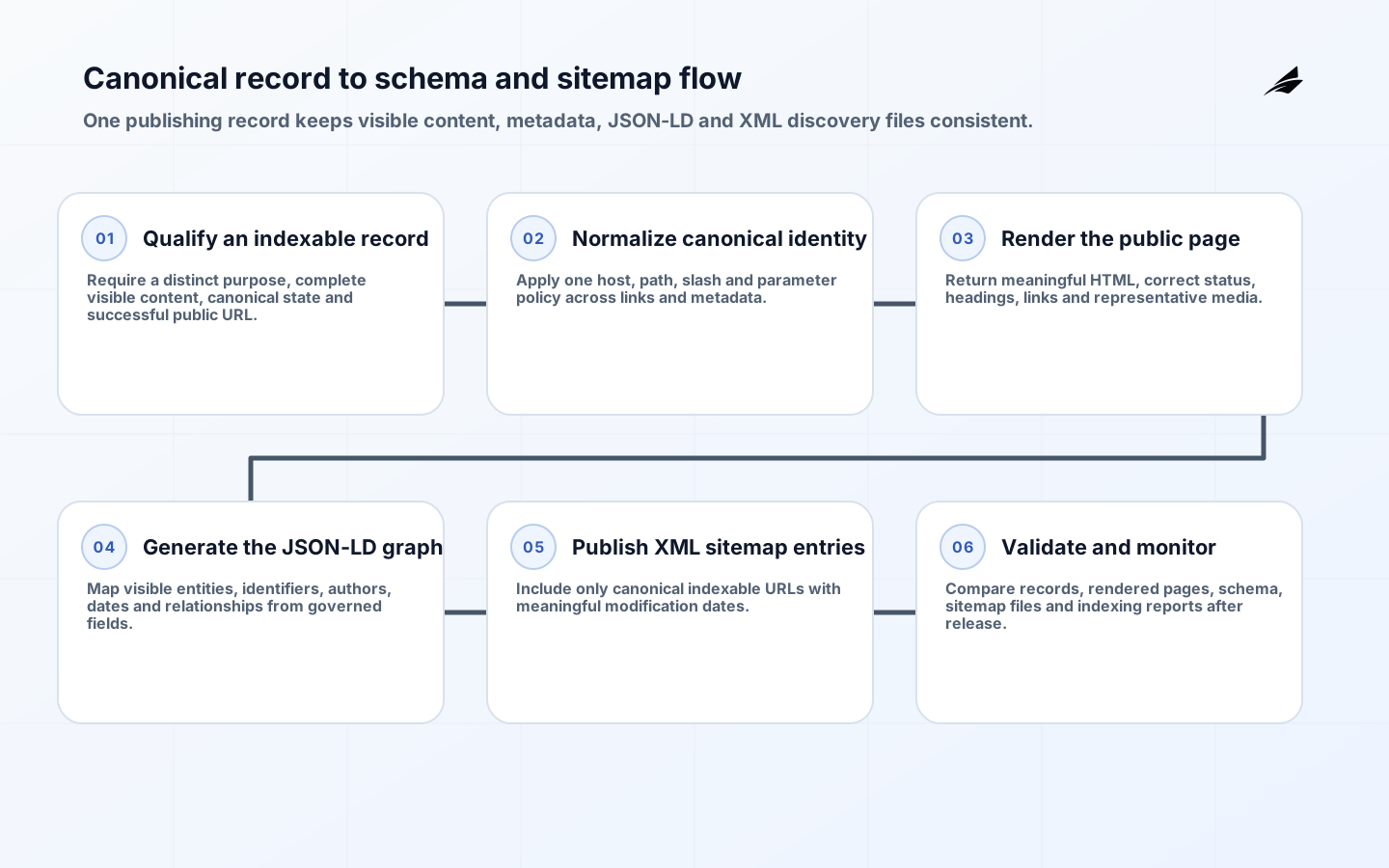
Structured data and XML sitemaps describe different parts of a website. Structured data expresses entities and page-specific facts in a machine-readable vocabulary. A sitemap lists canonical URLs the site wants search engines to discover, with optional metadata such as a meaningful last modification time. Neither creates quality, guarantees indexing or replaces crawlable content.
Implementation should follow the publishing system, not sit as a disconnected SEO export. The same canonical URL, title, author, date, image and status should drive rendered content, metadata, schema and sitemap records. This checklist focuses on that consistency and on evidence that search engines can retrieve the intended page.
1. Inventory indexable page types
List every template: home, service, product, article, author, category, location, FAQ and utility pages. For each, decide whether it has distinct user value and should be canonical and indexable. Record rendering method, status code, canonical, robots directives and owning data source. Exclude search results, private pages, duplicate filters and thin generated combinations.
Resolve URL policy before sitemap generation. Choose HTTPS, hostname, trailing-slash and parameter rules. Every internal link, canonical and sitemap entry should converge on the same final URL without a redirect. A sitemap full of redirected, duplicate or non-indexable addresses consumes attention and obscures real coverage problems.
| Page type | Canonical source | Schema candidate | Sitemap rule |
|---|---|---|---|
| Article | Published article record | Article or BlogPosting | Published canonical only |
| Service | Service catalog | Service and BreadcrumbList | Canonical active page |
| Product | Product catalog | Product when requirements are met | Canonical available page |
| Author | Author profile | ProfilePage or Person where accurate | Include only substantive profiles |
| Filter/search | Usually none | None | Exclude |
2. Select schema that matches visible content
Choose the most specific supported type that accurately describes the page. Article markup should identify the headline, dates, author, image and publisher from visible, authoritative data. Product markup must represent a real product and current offer or review information where applicable. FAQ markup should not be added to content that is absent from the page.
Google's general guidelines require structured data to represent the page and not mislead. Do not mark hidden keyword lists, invented ratings, fake prices or organization-wide FAQs on unrelated pages. Eligibility for a rich result can change and does not guarantee display. Schema remains useful when it expresses a clean entity graph, but enhancement-specific requirements must be checked in current documentation.
3. Generate one coherent JSON-LD graph

JSON-LD is usually easier to generate and maintain than distributed microdata. Use stable HTTPS identifiers for the website, organization, person and primary page entities. Connect them with @id rather than emitting unrelated duplicates. A BlogPosting can reference its author and publisher; BreadcrumbList can describe the page's actual navigation path.
Serialize with a structured library and safely escape user-supplied data. Never assemble JSON through fragile string concatenation. Keep types and values valid: dates in ISO format, absolute image URLs, correct arrays and distinct identifiers. If client rendering injects markup, verify that crawlers receive it reliably and that hydration does not remove or duplicate the graph.
4. Build XML sitemaps from canonical records
Generate sitemaps from the same set that publishes canonical pages. Include absolute URLs returning a successful status and allowed for indexing. Split large libraries by stable content type or logical collection and expose them through a sitemap index. Follow protocol limits and encode XML correctly. Compression is useful for large files.
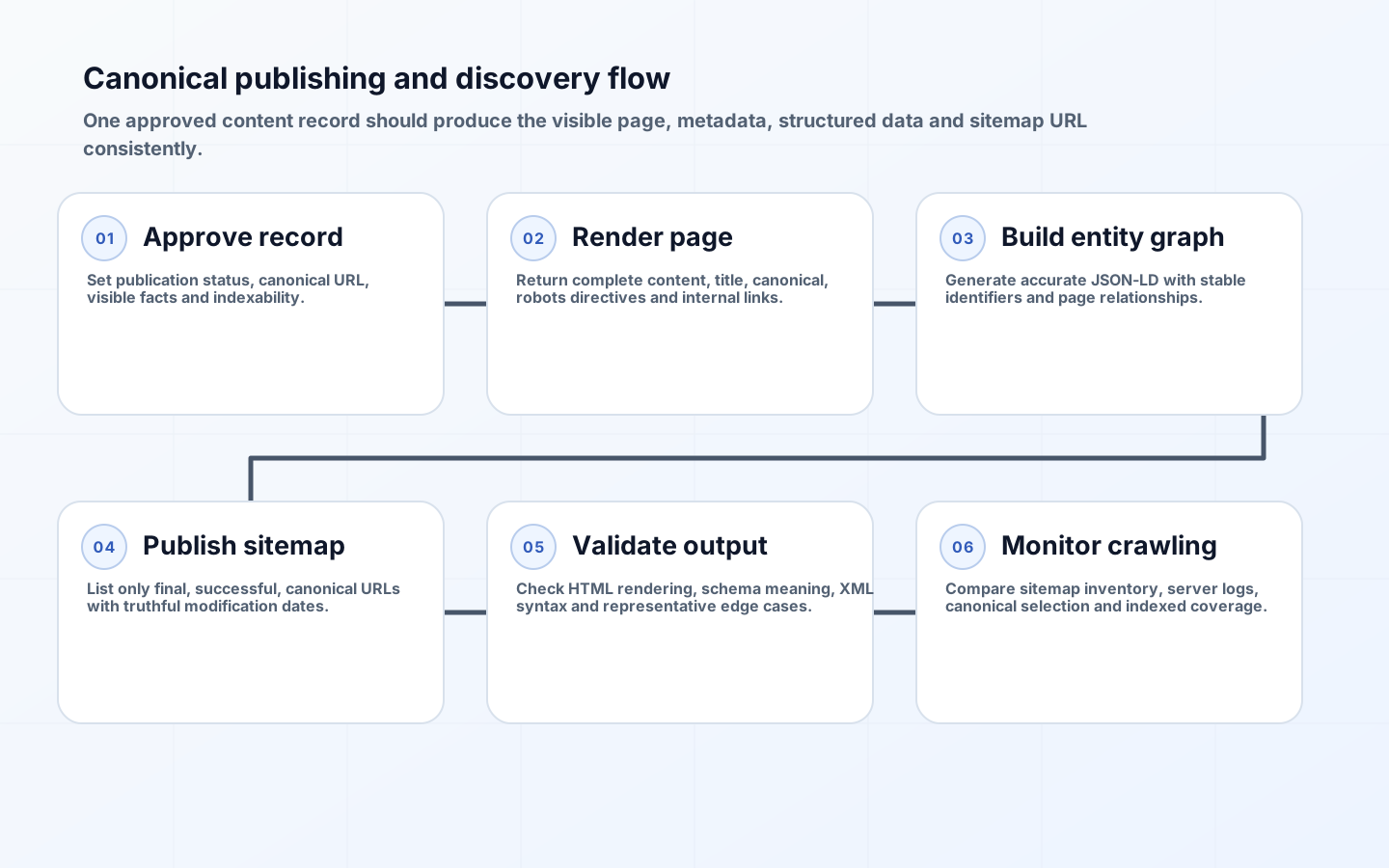
Use lastmod only when the page's substantive content changed, and express the correct date or date-time. Do not rewrite every timestamp on every build. Search engines may ignore untrustworthy values. Changefreq and priority do not force crawling; invest instead in accurate canonical URLs, internal links and meaningful modification data.
| Check | Pass condition | Why it matters |
|---|---|---|
| URL status | Direct 200 response | Avoid redirect and error chains |
| Canonical | Self-canonical final URL | Reduce duplicate signals |
| Indexability | No noindex or robots conflict | Keep intent consistent |
| Last modification | Changes only with substantive update | Preserve trust in freshness |
| Coverage | Matches published canonical inventory | Reveal missing and orphaned pages |
5. Verify rendering and crawl paths
Fetch representative pages as an unauthenticated client and inspect the final HTML. Confirm title, canonical, robots, visible heading, primary content, image metadata and JSON-LD. Test with JavaScript disabled where server rendering or prerendering is intended. A loading shell that never resolves for a crawler cannot be repaired by a sitemap entry.
Ensure important pages have contextual internal links from crawlable hubs. Sitemaps support discovery but do not communicate information architecture as effectively as links. Avoid orphaned articles and endlessly generated URL spaces. Check robots.txt access to required scripts and images, and return accurate 404 or 410 responses for removed content.
6. Validate syntax and meaning
Run schema syntax validation and enhancement-specific tests during development. Unit-test required fields and entity relationships for each template. Validate XML against the sitemap protocol and sample every generated partition. Then manually compare markup with what a reader sees. Tools can detect shape errors but not an invented claim or wrong author.
Create regression fixtures for sparse and edge records: no image, multiple authors, updated article, unavailable product and non-indexable draft. Reject publication or omit unsupported markup when the data is incomplete. It is better to publish accurate basic markup than invalid rich-result markup padded with defaults.
7. Monitor indexing and enhancement evidence
Submit sitemap indexes through search-engine tools and retain deployment counts. Monitor fetched sitemap status, discovered and indexed URLs, canonical selection, enhancement errors and server logs. Sample excluded URLs by reason. “Discovered, currently not indexed” may indicate crawl demand or quality issues; adding more keywords to metadata is not a diagnosis.
Track template changes against shifts in valid items and crawl responses. Compare sitemap inventory with analytics and log data to find orphaned or never-fetched sections. Investigate clusters, not isolated URLs only. A redirect error across one template may reflect a shared routing rule; duplicate canonical selection may expose substantially repeated content.
8. Use a repeatable release checklist
- Canonical URL policy is documented and tested
- Only useful, indexable final URLs enter sitemaps
- Structured data matches visible page facts
- Stable entity identifiers connect the graph
- HTML, JSON-LD and XML pass automated and manual checks
- Representative mobile and desktop pages render fully
- Internal links reach every priority page
- Monitoring owners and rollback criteria are named
Release a small template cohort first when changing a large library. Compare old and new canonicals, schema entities and sitemap membership. Preserve previous sitemap files long enough for safe transition when URLs migrate, and use direct redirects from old canonical URLs to their closest replacement. Do not chain migrations.
Operate schema and sitemaps for a large content library
Large sites need inventory controls before they need more URLs. Partition sitemap indexes by stable content family, not arbitrary batches that change on every build. Publish counts for canonical, indexable, redirected, removed and draft records. Compare those counts with sitemap output in CI. A sudden expansion should fail review until the publisher can explain the source and quality of the new pages.
Use content fingerprints or canonical relationships to identify near-duplicate pages, but keep editorial judgment in the decision. Pages targeting different labels with substantially identical answers should be consolidated or materially improved. Do not hide duplicates from the interface while exposing them to crawlers. Search engines evaluate the retrieved page, and concealed keyword content violates the principle that markup and metadata represent users' content.
For image discovery, use crawlable image URLs, descriptive filenames and accurate alt text where the image conveys content. Include images in the rendered article and allow fetching. Image sitemap extensions can help discovery in some architectures, but they do not make generic or duplicated imagery valuable. Preserve licensing and attribution records outside the alt text and display a natural caption when attribution or explanation belongs on the page.
Treat migrations as data operations. Create old-to-new mappings, direct redirects, updated links and replacement sitemap entries. Keep removed URLs out of active sitemaps. Monitor server logs and canonical reports until major crawlers converge, then retire transitional rules deliberately. This prevents a temporary redirect layer from becoming permanent architecture.
Assign ownership for each template and generated feed. Content owners approve visible claims; engineering owns rendering and status behavior; the structured-data owner maintains mappings and tests; operations monitors crawl failures. Record significant changes and expected URL counts. This division makes it possible to distinguish a content-quality issue from a routing, rendering or serialization defect and route remediation quickly.
Include non-HTML assets in release verification when they support the page. Confirm that featured images resolve on a public HTTPS URL, return the intended content type, have stable dimensions and are referenced consistently by visible markup and structured data. Avoid substituting one generic image across hundreds of articles. Image relevance, licensing and descriptive context remain editorial requirements even when the technical feed is valid.
Related reading
Read Schema and Sitemap Optimization: Practical Guide, the companion Schema and Sitemap FAQ, and Technical SEO Services for Enterprise Teams for broader planning.
Frequently asked questions
Does an XML sitemap guarantee indexing? No. A sitemap supports URL discovery. Indexing still depends on crawl access, canonicalization, substantive content, duplication and search-engine decisions.
Does every page need structured data? No. Add only markup that accurately represents useful visible content and a supported entity. Basic, correct markup is better than enhancement fields padded with invented defaults.
Should lastmod change on every deployment? No. Update it when substantive page content changes. Automatically refreshing every timestamp makes the signal unreliable and does not force recrawling.
Can schema describe information that users cannot see? JSON-LD is machine-readable, but its claims must match the page's visible facts and follow applicable guidelines. It is not a place for hidden keyword lists, fabricated reviews or unrelated FAQs.
Key takeaways
- Resolve canonical and indexability policy before generating feeds.
- Mark up only facts visible and specific to the page.
- Build schema and sitemaps from the same publishing records.
- Use truthful lastmod values and direct final URLs.
- Validate rendering, internal links and server responses alongside syntax.
Conclusion
Schema and sitemap optimization is reliable publishing engineering. A consistent content source produces the page, canonical, entity graph and URL inventory; validation catches malformed output; monitoring reveals how crawlers respond. That approach helps search systems understand a site without hidden text, fabricated markup or a flood of low-value URLs, and it remains maintainable as the library grows.