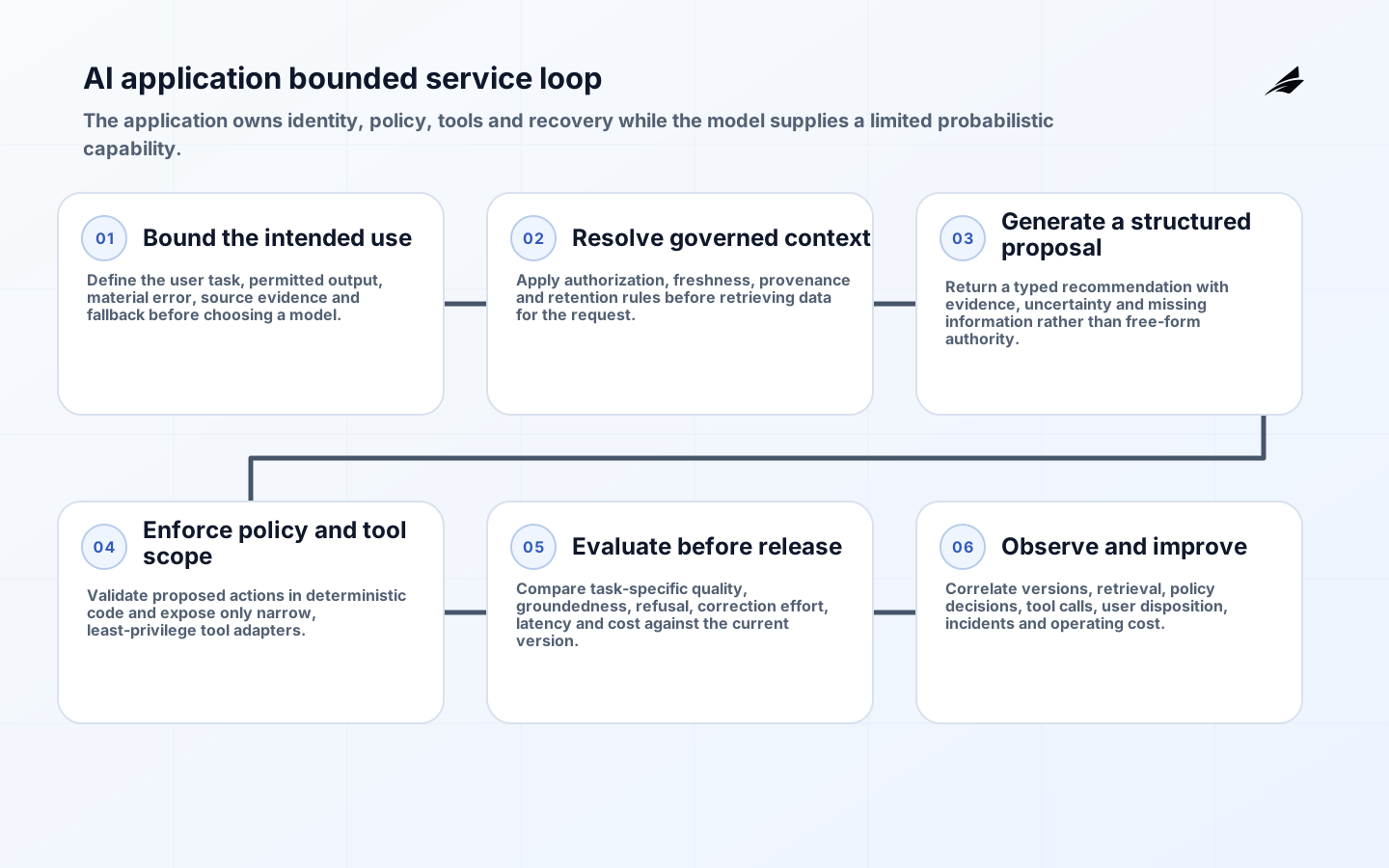
AI-led application services combine ordinary software engineering with probabilistic components that can classify, retrieve, summarize, generate, or select tools. The delivery challenge is not simply choosing a model. Teams must decide where uncertainty belongs, which actions remain deterministic, how evidence reaches users, and how model, prompt, retrieval, policy, and application releases are operated together. This FAQ answers those architecture and service questions directly. The primary planning lens is AI-led application services, with decisions expressed in language that product users and operating teams can verify.
Nearby planning resources include AI-Led Application Services Implementation Checklist, AI-Led Application Services: Scope, Cost, Risks and Delivery Plan, Application Services Blockchain: Scope, Cost, Risks and Delivery Plan, Application Services Blockchain Implementation Checklist. Those pages provide companion scope and checklist views; this article develops the technical and operating evidence for the topic here.
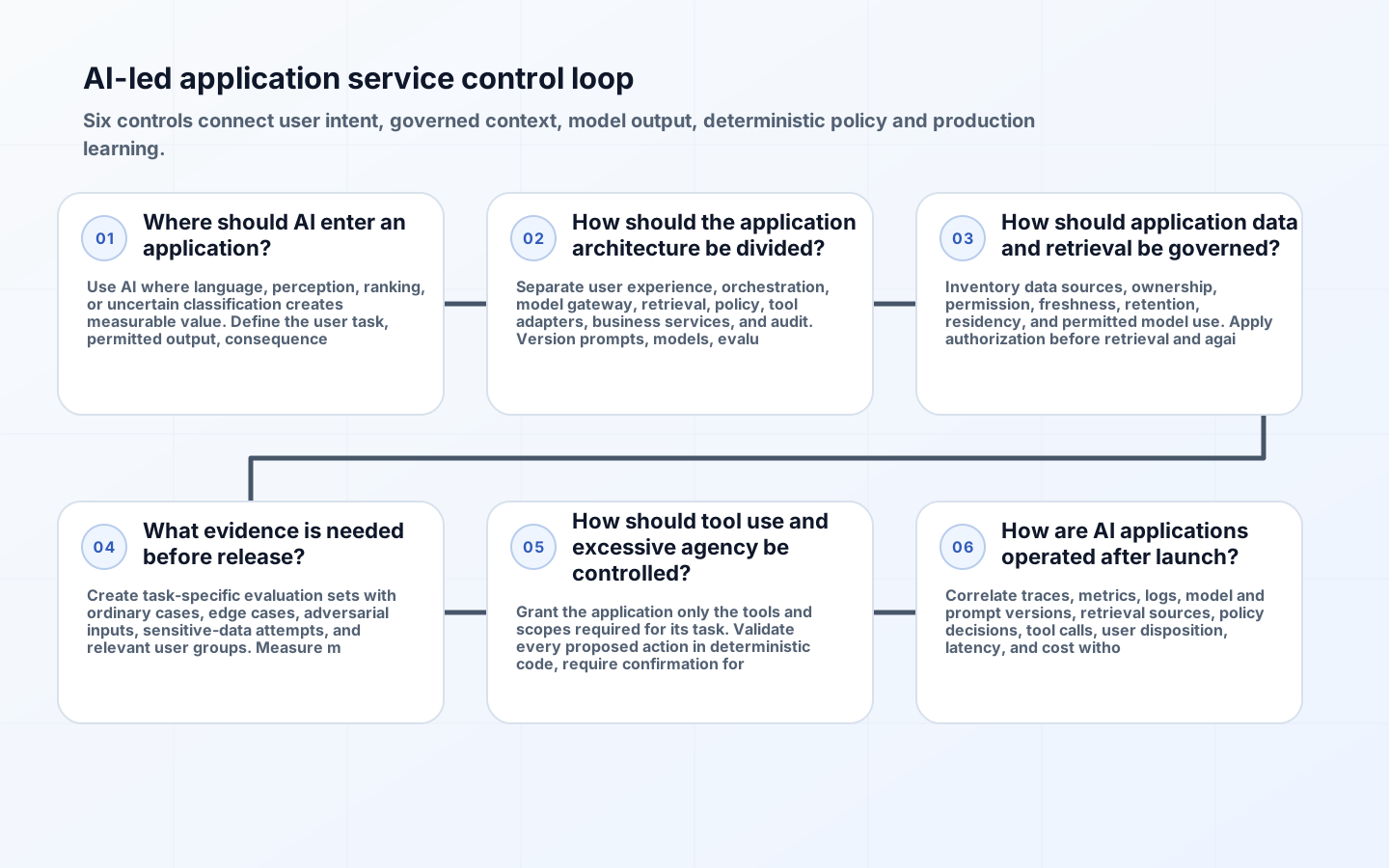
Where should AI enter an application?
Use AI where language, perception, ranking, or uncertain classification creates measurable value. Define the user task, permitted output, consequence of error, source evidence, and fallback before selecting a provider or model.
Keep authentication, authorization, financial limits, data validation, retention, and irreversible business rules in deterministic services. Treat model output as untrusted input to those controls. A general assistant attached to every workflow increases attack surface and makes ownership harder to explain.
How should the application architecture be divided?

Separate user experience, orchestration, model gateway, retrieval, policy, tool adapters, business services, and audit. Version prompts, models, evaluation sets, knowledge indexes, and tool schemas as deployable dependencies.
Use narrow APIs with typed requests, explicit tenant and user context, timeouts, idempotency, and response validation. Preserve a deterministic route for degraded or manual operation. Embedding provider calls throughout application code makes model replacement, testing, cost control, and incident isolation unnecessarily difficult.
| Decision area | Required decision | Acceptance evidence |
|---|---|---|
| Where should AI enter an application? | Use AI where language, perception, ranking, or uncertain classification creates measurable value. Define the user task, permitted output, consequence of error, source evidence, and fallback before selecting a provider or model. | Keep authentication, authorization, financial limits, data validation, retention, and irreversible business rules in deterministic services. Treat model output as untrusted input to those controls. |
| How should the application architecture be divided? | Separate user experience, orchestration, model gateway, retrieval, policy, tool adapters, business services, and audit. Version prompts, models, evaluation sets, knowledge indexes, and tool schemas as deployable dependencies. | Use narrow APIs with typed requests, explicit tenant and user context, timeouts, idempotency, and response validation. Preserve a deterministic route for degraded or manual operation. |
| How should application data and retrieval be governed? | Inventory data sources, ownership, permission, freshness, retention, residency, and permitted model use. Apply authorization before retrieval and again before presenting or acting on results; do not rely on a vector search score as access control. | Store provenance for retrieved passages and show useful evidence to reviewers. Test stale, contradictory, malicious, and missing documents, including indirect prompt injection from content. |
How should application data and retrieval be governed?
Inventory data sources, ownership, permission, freshness, retention, residency, and permitted model use. Apply authorization before retrieval and again before presenting or acting on results; do not rely on a vector search score as access control.
Store provenance for retrieved passages and show useful evidence to reviewers. Test stale, contradictory, malicious, and missing documents, including indirect prompt injection from content. Retrieval can produce confident answers from outdated policy or expose information across users and tenants when filtering is incomplete.
What evidence is needed before release?
Create task-specific evaluation sets with ordinary cases, edge cases, adversarial inputs, sensitive-data attempts, and relevant user groups. Measure material error, groundedness, correction effort, refusal quality, latency, and cost.
Use offline evaluation, red-team testing, shadow mode, and limited production rollout with predefined stop conditions. Compare versions before changing a model, prompt, retrieval source, or tool. A benchmark score cannot establish whether the complete application helps users or behaves safely inside the real workflow.
| Control area | Failure to prevent | Production proof |
|---|---|---|
| What evidence is needed before release? | A benchmark score cannot establish whether the complete application helps users or behaves safely inside the real workflow. | Use offline evaluation, red-team testing, shadow mode, and limited production rollout with predefined stop conditions. Compare versions before changing a model, prompt, retrieval source, or tool. |
| How should tool use and excessive agency be controlled? | A model should never be expected to enforce its own permissions or recognize every malicious instruction. | Threat-model prompt injection, insecure output handling, sensitive disclosure, denial of service, supply-chain compromise, and excessive agency using OWASP guidance. Maintain a kill switch and bounded fallback. |
| How are AI applications operated after launch? | Availability alone can look healthy while answers degrade, review queues grow, or an integration silently rejects actions. | Define SLOs around user-visible completion, acceptable latency, exception age, and safe fallback. Establish incident classes for provider outage, data leakage, quality regression, cost anomaly, and unauthorized action. |
How should tool use and excessive agency be controlled?
Grant the application only the tools and scopes required for its task. Validate every proposed action in deterministic code, require confirmation for consequential effects, and prevent untrusted content from changing system policy.
Threat-model prompt injection, insecure output handling, sensitive disclosure, denial of service, supply-chain compromise, and excessive agency using OWASP guidance. Maintain a kill switch and bounded fallback. A model should never be expected to enforce its own permissions or recognize every malicious instruction.
How are AI applications operated after launch?
Correlate traces, metrics, logs, model and prompt versions, retrieval sources, policy decisions, tool calls, user disposition, latency, and cost without recording unnecessary sensitive content.
Define SLOs around user-visible completion, acceptable latency, exception age, and safe fallback. Establish incident classes for provider outage, data leakage, quality regression, cost anomaly, and unauthorized action. Availability alone can look healthy while answers degrade, review queues grow, or an integration silently rejects actions.
What a production AI application service should expose
A service review should show the intended-use statement, system and data-flow diagrams, model and prompt registry, retrieval permissions, tool scopes, evaluation coverage, threat model, release comparison, SLOs, budget alerts, and incident playbooks. The product owner accepts user outcomes; security accepts privilege and data controls; domain owners accept quality thresholds; platform teams own provider, capacity, telemetry, and fallback.
Exercise the complete path with a poisoned document, conflicting policy, missing context, provider timeout, rate limit, invalid model output, unauthorized tool request, user rejection, and rollback to a previous version. The system should identify the affected tenant and version, preserve evidence for investigation, and recover without replaying an action or exposing hidden reasoning.
Taken together, the decision for AI-led application services must connect where should ai enter an application?, how should the application architecture be divided?, how should application data and retrieval be governed?, what evidence is needed before release?, how should tool use and excessive agency be controlled?, how are ai applications operated after launch?. The release review should show which owner accepts each decision, where its source evidence is stored, which threshold blocks production, and how a failed dependency or incorrect result is contained. It should also explain how changes to data, policy, integrations, identities, customer scope, or software versions trigger renewed testing. That linkage matters because controls assessed independently can still conflict in operation: a secure interface may carry stale data, a reliable service may enforce the wrong authority, and a useful workflow may become uneconomic when review or support demand rises. Record these dependencies as maintained product artifacts, not one-time project notes, so later operators can distinguish an approved constraint from an accidental behavior.
The control chain starts with where should ai enter an application?: Use AI where language, perception, ranking, or uncertain classification creates measurable value. Define the user task, permitted output, consequence of error, source evidence, and fallback before selecting a provider or model. Evidence must explicitly guard against A general assistant attached to every workflow increases attack surface and makes ownership harder to explain. Next, how should the application architecture be divided?: Separate user experience, orchestration, model gateway, retrieval, policy, tool adapters, business services, and audit. Version prompts, models, evaluation sets, knowledge indexes, and tool schemas as deployable dependencies. Evidence must explicitly guard against Embedding provider calls throughout application code makes model replacement, testing, cost control, and incident isolation unnecessarily difficult. Next, how should application data and retrieval be governed?: Inventory data sources, ownership, permission, freshness, retention, residency, and permitted model use. Apply authorization before retrieval and again before presenting or acting on results; do not rely on a vector search score as access control. Evidence must explicitly guard against Retrieval can produce confident answers from outdated policy or expose information across users and tenants when filtering is incomplete. Next, what evidence is needed before release?: Create task-specific evaluation sets with ordinary cases, edge cases, adversarial inputs, sensitive-data attempts, and relevant user groups. Measure material error, groundedness, correction effort, refusal quality, latency, and cost. Evidence must explicitly guard against A benchmark score cannot establish whether the complete application helps users or behaves safely inside the real workflow. Next, how should tool use and excessive agency be controlled?: Grant the application only the tools and scopes required for its task. Validate every proposed action in deterministic code, require confirmation for consequential effects, and prevent untrusted content from changing system policy. Evidence must explicitly guard against A model should never be expected to enforce its own permissions or recognize every malicious instruction. Next, how are ai applications operated after launch?: Correlate traces, metrics, logs, model and prompt versions, retrieval sources, policy decisions, tool calls, user disposition, latency, and cost without recording unnecessary sensitive content. Evidence must explicitly guard against Availability alone can look healthy while answers degrade, review queues grow, or an integration silently rejects actions. Reading these checks as one chain prevents a local pass from hiding an end-to-end failure. The accountable owners should review the chain after any material incident or change and record whether the original assumptions, thresholds, and fallback remain valid.
Implementation takeaways
- Place AI only where probabilistic interpretation adds measurable value.
- Keep permissions and irreversible rules in deterministic services.
- Version models, prompts, retrieval, policy, tools, and evaluations together.
- Measure user outcome, correction, latency, cost, and unsafe behavior.
- Operate provider failure and quality regression as distinct incidents.
Frequently asked questions
| Question | Answer |
|---|---|
| Does AI-led mean an autonomous agent? | No. Many valuable applications use bounded classification, retrieval, drafting, or ranking without autonomous tool selection. |
| Can retrieval prevent hallucinations? | It can ground answers in approved sources, but permissions, freshness, conflicting evidence, and unsupported conclusions still require testing. |
| What should be logged? | Versions, timings, policy results, tool calls, disposition, and correlation context, while minimizing sensitive prompts and outputs. |
| How often should evaluation run? | Before every material model, prompt, retrieval, policy, or tool change and periodically against production-derived error patterns. |
Conclusion
AI-led application services are dependable when the application, not the model, owns identity, permissions, workflow state, validation, and recovery. The model supplies bounded probabilistic capability inside that system. This architecture makes quality, security, cost, and provider changes testable rather than mysterious.
Production maturity comes from versioned evidence and disciplined operation. Teams should be able to reproduce why an answer or action occurred, compare it with an approved threshold, stop the affected path, and restore a safe service. That is the difference between an AI demo and an application people can rely on.