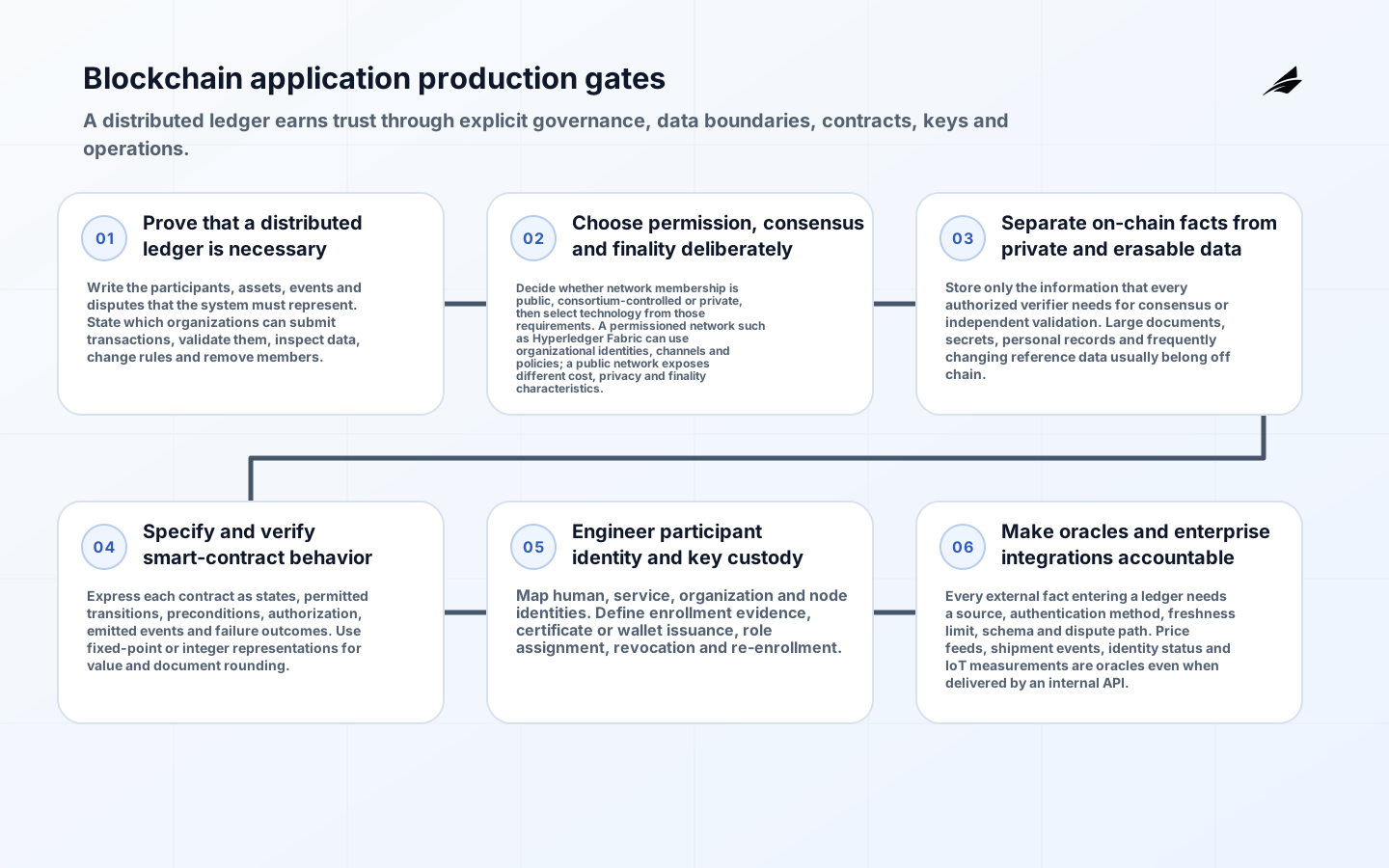
A blockchain application should be selected because several parties need a shared, tamper-evident record without granting one participant unilateral control over accepted history. It should not be selected because the word blockchain appears in a procurement brief. This blockchain application implementation checklist starts with the trust problem, then tests whether a conventional signed database or governed integration would be simpler. When a distributed ledger is justified, the checklist covers consensus membership, identity, privacy, smart contracts, off-chain data, integration, key custody and production operations.
The hardest failures usually occur outside the chain. A private key is lost, an oracle reports the wrong event, two organizations interpret a business rule differently, personal data cannot be removed, or an upgrade changes contract behavior while older transactions remain final. Blockchain application services must therefore treat the ledger as one component of a socio-technical system. NIST's blockchain technology overview is useful for separating cryptographic primitives and consensus from business claims that the technology cannot guarantee by itself.
Use the companion blockchain application scope and cost guide, blockchain application FAQ, and enterprise application-services checklist to compare delivery models and integration responsibilities before committing to a ledger.
Prove that a distributed ledger is necessary
Write the participants, assets, events and disputes that the system must represent. State which organizations can submit transactions, validate them, inspect data, change rules and remove members. A ledger is plausible when independent parties need a consistent history and do not accept a single operator as the sole authority. It is weak when one organization already controls every writer, reader and business rule; a signed append-only database may then provide the needed audit evidence with less complexity.
Describe the adversary and the legal governance separately. Consensus can make accepted records hard to alter, but it cannot prove that a physical shipment arrived or that an authorized employee entered truthful data. Define how off-chain evidence is verified, how disputes are decided, and which contract or policy binds participants. Reject vague goals such as transparency unless the team can name who gains visibility, which fields they see and what decision becomes safer.
| Decision | Evidence required | Reason to stop |
|---|---|---|
| Multiple writers | Independent organizations with legitimate write authority | All writers report to one system owner |
| Shared history | Material disputes about sequence or ownership | Ordinary replication already resolves the need |
| Reduced central trust | Participants reject unilateral record control | A neutral operator is contractually accepted |
| Programmable settlement | Rules are deterministic and testable | Outcome depends mainly on subjective judgment |
Choose permission, consensus and finality deliberately
Decide whether network membership is public, consortium-controlled or private, then select technology from those requirements. A permissioned network such as Hyperledger Fabric can use organizational identities, channels and policies; a public network exposes different cost, privacy and finality characteristics. Document node operators, endorsement or validation rules, failure tolerance, transaction throughput, expected confirmation time and the conditions under which an event is considered final by downstream systems.
Benchmark complete transactions, not empty-chain throughput. Include signature checks, endorsement, ordering, contract execution, persistence, indexing and integration callbacks. Test the largest realistic payload and concurrent participant behavior. Plan for network partitions and a member that is unavailable or malicious. If the business process requires immediate revocation or reversal, define compensating transactions and legal procedures because an immutable history does not mean every business outcome is irreversible.
Separate on-chain facts from private and erasable data
Store only the information that every authorized verifier needs for consensus or independent validation. Large documents, secrets, personal records and frequently changing reference data usually belong off chain. Put a content hash, stable identifier, version and authorization reference on chain when that creates useful integrity evidence. Define canonical serialization before hashing; semantically identical documents with different whitespace or field order otherwise produce different digests.
Map privacy, retention, correction and deletion obligations before committing data. Encryption does not make immutable personal data erasable if ciphertext and key relationships remain sensitive. Use private-data collections, channels or off-chain stores according to the platform, but verify metadata leakage such as transaction timing and participant addresses. Keep a data-classification table that identifies controller, processor, lawful purpose, retention and disclosure for each field.
| Data type | Preferred location | Ledger record |
|---|---|---|
| Asset state needed for validation | On chain when all validators may see it | Identifier, owner, version and transition |
| Commercial document | Controlled off-chain repository | Hash, document ID and signer |
| Personal or regulated data | Erasable access-controlled store | Minimal reference only when justified |
| External event | Authoritative source or oracle log | Signed assertion, source and timestamp |
Specify and verify smart-contract behavior
Express each contract as states, permitted transitions, preconditions, authorization, emitted events and failure outcomes. Use fixed-point or integer representations for value and document rounding. Prevent replay and duplicate processing with unique transaction references. Treat time, randomness and external prices as explicit dependencies rather than ambient facts. Ethereum's smart-contract documentation notes that deployed programs execute as written; production teams need equivalent discipline on any platform.

Test unit behavior, property invariants, authorization boundaries, reentrancy or callback risks, denial-of-service conditions, numeric limits and upgrade paths. Independent review should focus on business invariants as well as common vulnerability classes. Keep compiler, dependency and deployment hashes. An upgrade mechanism needs governed proposers, reviewers, activation delay, rollback or migration rules, and notice to participants. An immutable vulnerable contract is not a control.
Engineer participant identity and key custody
Map human, service, organization and node identities. Define enrollment evidence, certificate or wallet issuance, role assignment, revocation and re-enrollment. A decentralized identifier can help describe identifiers and verification methods, but governance still decides which issuer and credential are trusted. Separate transaction-signing authority from network administration, deployment and data access. Require stronger controls for keys that can move value, admit members or change contract code.
Choose custody according to consequence: hardware security modules, managed key services, multi-signature approval or offline recovery may be appropriate. Document backup, quorum recovery, employee departure, device loss and suspected compromise. Test revocation propagation and what downstream systems do with transactions signed before revocation. Never copy production seed phrases into tickets, chat or ordinary secrets files. Key recovery is a business-continuity process, not a developer convenience.
Make oracles and enterprise integrations accountable
Every external fact entering a ledger needs a source, authentication method, freshness limit, schema and dispute path. Price feeds, shipment events, identity status and IoT measurements are oracles even when delivered by an internal API. Decide whether multiple sources or human approval are required for consequential events. Record the assertion and its provenance so a later reviewer can distinguish a contract bug from incorrect source data.
Use an outbox or equivalent durable pattern when enterprise systems react to ledger events. Consumers must be idempotent because delivery can repeat, and they must reconcile missed events after downtime. Define system of record for each field: the ledger may own asset transfer while ERP owns invoices and a document store owns evidence. Avoid circular updates in which each system overwrites the other without a clear authority.
Test governance, operations and exit before launch
Run failure exercises for node loss, network partition, invalid endorsement, certificate expiry, contract exception, stalled ordering, indexer lag and compromised participant credentials. Monitor consensus health, transaction latency, rejection reasons, peer state, storage growth, certificate validity and integration queues. Logs should correlate a business request with proposal, endorsement, commit and downstream processing without exposing secret material.
Publish operating rules for membership, voting, emergency pause, software versions, contract upgrades, data access, incident response and cost allocation. Define how an organization leaves and how records remain interpretable after a network or vendor is retired. Export schemas, contracts, keys under lawful control and verified history snapshots. A viable production network has a dissolution plan; otherwise participants may be locked into infrastructure long after the business collaboration ends.
| Gate | Release evidence | Owner |
|---|---|---|
| Contract behavior | Invariant tests, review findings and deployment hash | Application and security leads |
| Network readiness | Failure and capacity results across member nodes | Consortium operations |
| Key custody | Issuance, recovery and revocation exercise | Identity and risk owners |
| Business governance | Signed operating rules and dispute path | Participant governance body |
Key takeaways
- Use a distributed ledger only for a real multi-party trust and shared-history problem.
- Keep private, erasable and bulky data off chain unless consensus genuinely requires it.
- Specify smart contracts as state machines with tested invariants and governed upgrades.
- Treat keys, oracles and integrations as primary security boundaries.
- Launch only after participant governance, operations, reconciliation and exit are exercised.
Frequently asked questions
When is a database better than blockchain?
Use a conventional database when one accountable organization controls writers and rules, participants accept that authority, records can be protected with signatures and audit logs, and the operational simplicity matters more than independent validation.
Does a permissioned blockchain make data private?
Not automatically. Membership controls who can join, but transaction payloads and metadata may still be visible to peers. Channels, private collections and off-chain storage require a field-level privacy design.
Can blockchain records be deleted?
Many ledgers are intentionally append-only. Corrections are usually new transactions. Data with deletion obligations should generally remain in an erasable off-chain store, with only minimal justified evidence on chain.
What drives production cost?
Cost comes from participant onboarding, nodes, key custody, contract engineering, security review, integration, monitoring, governance and upgrades. Public-chain transaction fees are only one possible component.
Conclusion
A production blockchain application is a governed network of identities, rules, keys, data and integrations, not merely a ledger deployment. The implementation earns trust when every accepted state change can be authorized, validated, reconciled and disputed under rules that all participants understand. If those rules can be delivered more safely with a conventional system, choosing the simpler architecture is a successful outcome.