Application services and solutions cover the work required to assess, build, integrate, modernize, operate and improve business applications. The phrase can hide very different obligations, from a temporary migration team to a provider that owns daily support under service levels. A useful engagement starts by defining the application outcome, service boundary, decision rights and evidence expected across change and operation. This FAQ gives business, technology and procurement leaders a common set of questions.
The Application Services and Solutions Implementation Checklist is the companion for mobilization and release. The blockchain-focused scope guide and production checklist show how the same operating principles apply when an application introduces specialized distributed-ledger dependencies.
What belongs in an application service?
Define the application portfolio, user journeys, interfaces, environments, data, hours and geographies. Then identify service components: product discovery, development, testing, release, monitoring, incident and request handling, vulnerability remediation, platform administration, data operations, continuity and improvement. A provider may own some and support others. State which systems and versions are excluded, how newly acquired applications enter scope and how technical debt is treated.
Use a service catalog with request and response expectations. Separate incidents, service requests, defects, small enhancements and product changes so work is prioritized appropriately. A fixed support fee rarely includes unlimited modernization. Name the product owner, service owner, technical authority and risk owner on the client side. The provider can execute and recommend, but business priority and residual-risk acceptance require customer authority.
| Service layer | Primary output | Acceptance evidence | Owner decision |
|---|---|---|---|
| Discover | Validated problem and target outcome | User research, baseline and option test | Fund, refine or stop |
| Build or modernize | Operable application increment | Working path, tests and architecture record | Release or revise |
| Integrate | Reliable data and process exchange | Contract tests, reconciliation and failure handling | Enable dependent workflow |
| Operate | Service meeting agreed objectives | Telemetry, incident, request and recovery results | Accept service risk or improve |
| Improve | Reduced friction, risk, cost or obsolescence | Before-after outcome and regression evidence | Scale, continue or retire |
How should modernization options be chosen?
Begin with business capability, constraints and quality attributes. Options include retaining, retiring, replacing, rehosting, replatforming, refactoring or rebuilding. Evaluate user value, change frequency, reliability, security exposure, skill availability, vendor support, data gravity, integration coupling and total cost. Rehosting can reduce data-center dependency but leaves code and operating constraints; a rewrite can remove limits but introduces replacement and migration risk.
Use thin vertical slices to test the riskiest assumption, such as identity integration, data reconciliation or peak performance. Define coexistence and rollback. Do not decommission the source until data, operational history, legal retention and user acceptance are complete. Cloud well-architected frameworks from AWS, Microsoft and Google offer structured perspectives on reliability, security, cost, performance and operations, but the application’s business context determines the target.
Who owns the application after release?
Assign one service owner accountable for end-to-end performance and clear component owners for application, platform, data and integrations. Build and run responsibilities should overlap enough to prevent handoff loss. The delivery team must produce telemetry, runbooks, recovery and support guidance as part of the increment. If a managed provider operates the service, define customer participation in major incidents, change approval and risk exceptions.
Establish service-level indicators around user success, latency, correctness, freshness or completion, then set objectives and response policies. Infrastructure uptime alone can hide broken business processing. OpenTelemetry’s traces, metrics and logs help connect a user transaction across services, but instrumentation needs stable identifiers and ownership. Include synthetic tests and business reconciliation where technical telemetry cannot prove the result.
How are security and compliance built into the service?
Integrate requirements into architecture, backlog, definition of done and release gates. NIST SSDF recommends preparing the organization, protecting software, producing well-secured software and responding to vulnerabilities. Require threat modeling for material changes, protected source and pipelines, code and dependency review, test evidence, secrets handling, least privilege, logging and a vulnerability process. Clarify software component inventories and supplier notification duties.
Map regulatory and contractual controls to evidence the application service can produce. Avoid a separate compliance process that examines stale screenshots after delivery. Automate repeatable evidence where appropriate, protect audit records and assign exceptions an owner and expiration. Define security incident cooperation, forensic access, notification, remediation and communication. Provider access must be named, strongly authenticated, limited and reviewed.
How are application services priced and governed?
Pricing may combine transition fees, fixed service charges, consumption, project work and service credits. Make volume assumptions explicit: users, tickets, applications, interfaces, releases, data and service hours. Separate baseline operation from discretionary change while preserving a route for small improvements. A low support price can conceal deferred maintenance, off-hours gaps or expensive changes. Compare total cost over transition, operation, modernization and exit.
Govern monthly through outcomes, service health, change, risk, cost and improvement. Working-level reviews should handle incidents, backlog, dependencies and decisions weekly or more often. DORA’s current delivery metrics can indicate throughput and instability, but interpret them with service objectives, user result, security and cost. Do not reward ticket closure that increases recurrence or deployment frequency that does not improve the product.
| Metric group | Useful measure | Avoided distortion |
|---|---|---|
| User outcome | Completion, correctness or time for the key journey | Equating server uptime with success |
| Reliability | SLO attainment and error-budget consumption | Treating every incident as equal |
| Delivery | Lead time, deployment frequency and failed-change result | Ranking individuals by output |
| Support | Time to useful response, recurrence and backlog age | Rewarding premature closure |
| Economics | Unit cost and avoidable demand | Optimizing invoice total without service context |
What makes transition and exit credible?
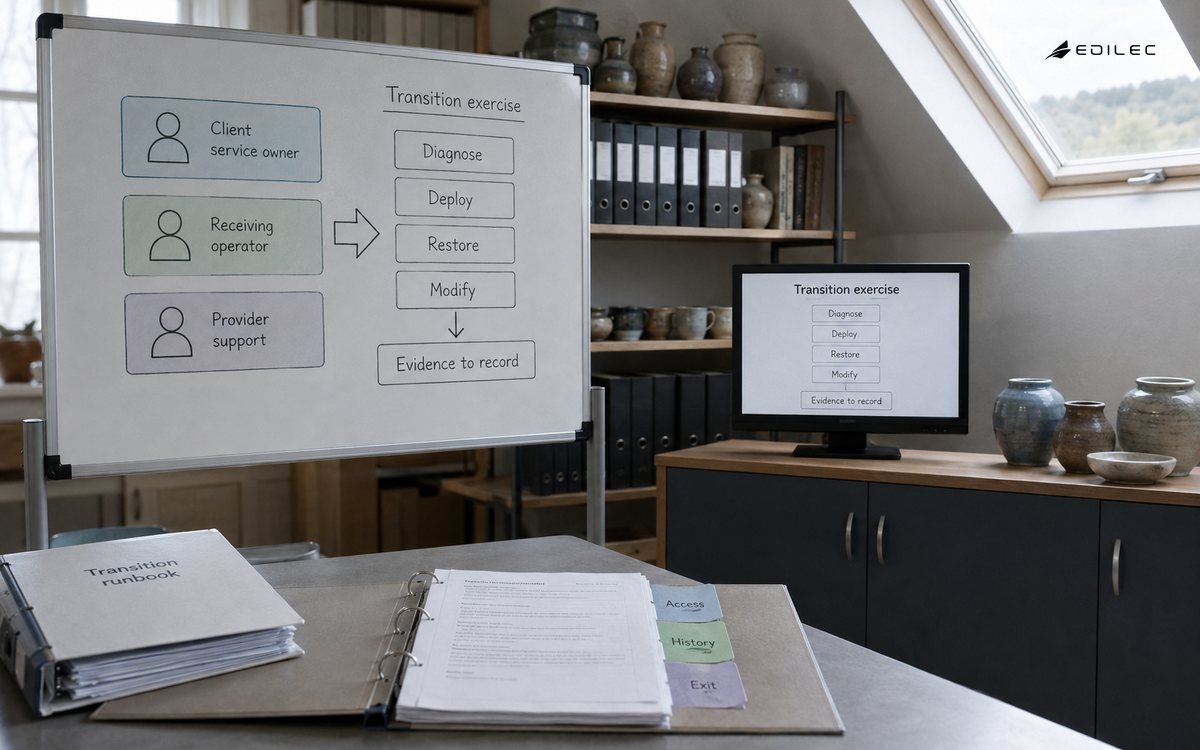
Plan transition by application wave. Inventory assets, interfaces, jobs, credentials, certificates, licenses, environments, known defects, commitments and support history. Establish service baselines before responsibility changes. Shadow, reverse-shadow and rehearse incidents. Acceptance should prove the new team can deploy, restore, diagnose and modify the application, not merely that documents were delivered.
Contract data and code ownership, export formats, repository control, tool licenses, termination assistance, credential revocation and deletion evidence. Keep architecture decisions and operational history in accessible systems. Avoid an exit plan that depends on the departing provider’s goodwill. Periodically test continuity when the provider or a critical subcontractor is unavailable.
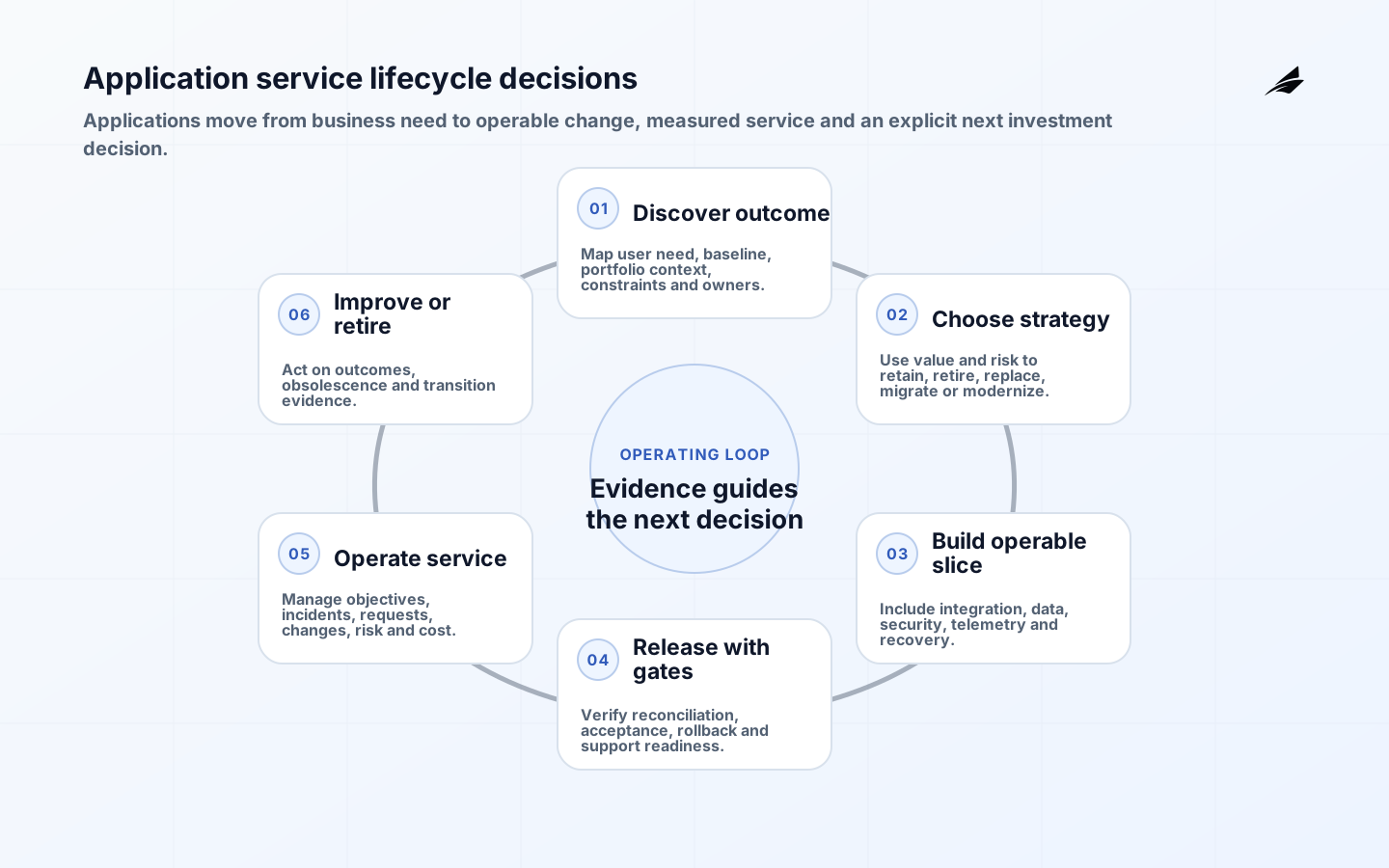
Manage the application through six lifecycle decisions
- Discover the user outcome, portfolio context, baseline, constraints and accountable owners.
- Choose retain, retire, replace, migrate or modernize using tested risk and value evidence.
- Build and integrate a thin operable slice with security, data and observability included.
- Release gradually with reconciliation, user acceptance, recovery and rollback gates.
- Operate against user-centered objectives while managing incidents, requests, change and cost.
- Improve, re-source or retire based on outcomes, obsolescence, risk and transition readiness.
Engineer continuity and recoverability by service tier
Classify applications by business impact and dependency, then define recovery time and recovery point objectives with business owners. Architecture, backup frequency, replication, support hours and exercise depth should follow that tier. Inventory upstream identity, network and data services and downstream consumers. A recovery plan that restores a server but misses a queue, certificate, interface or manual reconciliation step does not restore the business service.
Test restore and failover using representative data and operational roles. Verify access to backup credentials when primary identity is impaired, integrity after recovery and the ability to process accumulated work. Record actual recovery time and unresolved assumptions. For software-as-a-service dependencies, understand provider recovery commitments, data export and the customer tasks required to resume. Retain a manual or degraded mode for critical workflows where practical.
Govern the application portfolio, not only individual tickets
Maintain a portfolio view of business capability, lifecycle state, owner, vendor support, technology risk, data classification, operating cost and modernization intent. This reveals duplicate applications and components approaching end of support. Use the view to set investment waves and to distinguish strategic products from systems that should be contained or retired. Service providers should report emerging obsolescence and concentration risk rather than maximizing support duration.
At least quarterly, examine whether each major application should receive feature investment, reliability work, risk remediation, replacement or retirement preparation. Include user demand and process change, not only defect backlog. Tie modernization funding to explicit retirement of old components where feasible; otherwise the company pays for both estates indefinitely. Portfolio decisions also keep scarce specialist skills focused on applications that still matter.
Define request triage across help desk, application team, product owner and business process owner. A password reset, data correction, integration failure and feature request require different authority and evidence. Publish intake fields, priority rules and escalation, then analyze avoidable demand. Repeated requests may indicate poor interface design, missing automation or a training gap. The service should remove root causes while preserving a clear route for exceptional and urgent work.
Key takeaways
- Define the application, service components, authority and exclusions precisely.
- Select modernization paths from business and quality evidence, not fashion.
- Make observability, recovery, security and support part of each increment.
- Govern user outcomes, service health, delivery, risk and unit cost together.
- Prove transition capability and asset portability throughout the relationship.
Frequently asked questions
Must every legacy application be modernized?
No. A stable, supported application with low change demand and acceptable risk may be retained with targeted controls. Modernize when the expected value, risk reduction or avoided obsolescence justifies migration and transition risk. Retirement or replacement may be better than refactoring.
Can application ownership be fully outsourced?
Operational tasks can be contracted extensively, but the customer retains accountability for business purpose, risk, priority, legal obligations and supplier oversight. Maintain enough internal architecture, product and service knowledge to make decisions and change providers without losing control.
Conclusion
Application services create value when they connect product change to reliable operation. Define the service boundary, choose modernization from evidence, build security and observability into delivery, govern outcomes and preserve transition capability. That lifecycle view prevents modernization from ending at deployment and support from becoming mere ticket processing.