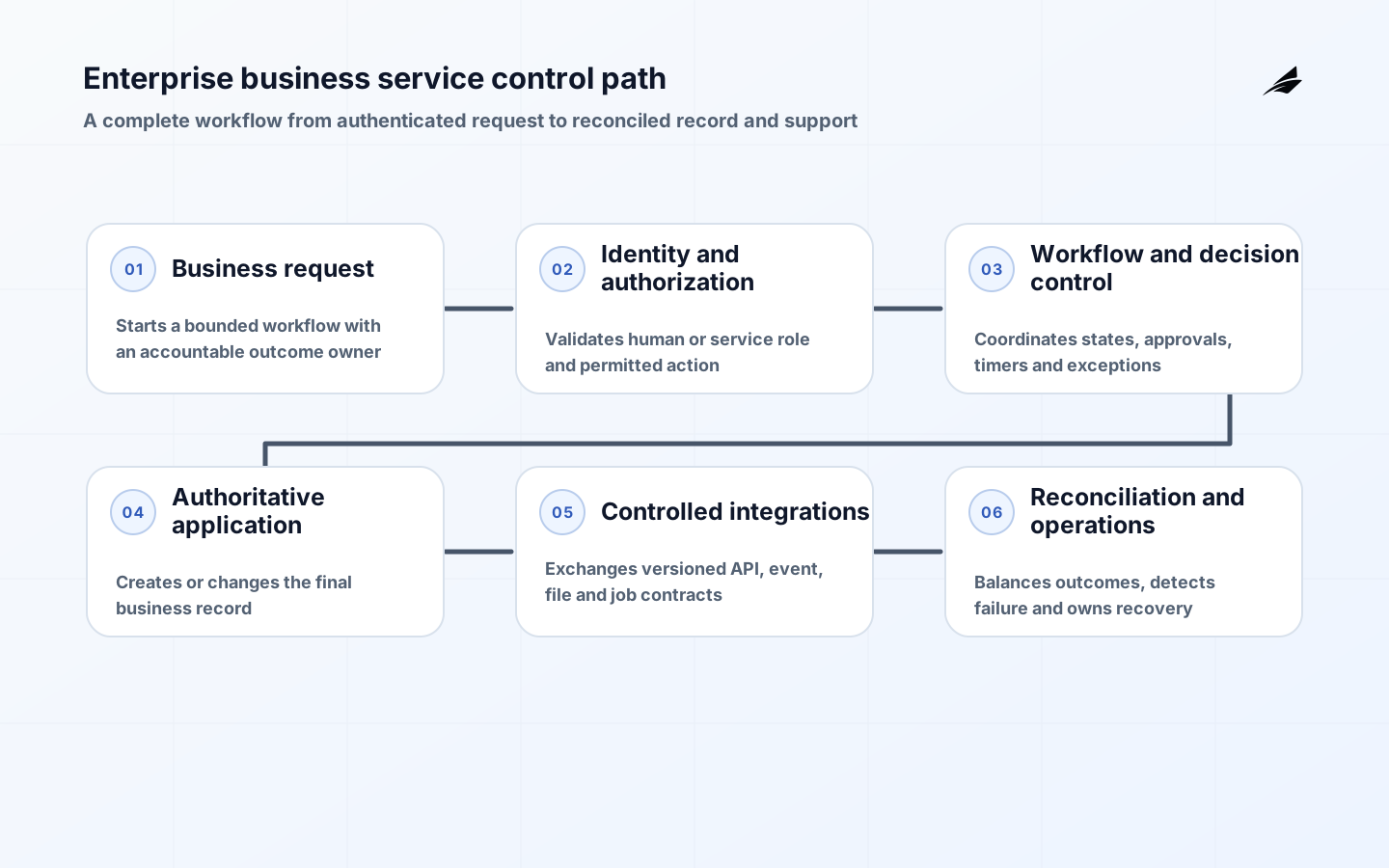
Enterprise application services cover discovery, implementation, integration, modernization and operation of software that supports core business work. The useful unit of scope is not a product license or an application inventory row; it is a business service with people, decisions, records, controls and dependencies. A technically healthy ERP module can still fail the business if an approval queue, identity provider, file exchange or reconciliation task breaks. Planning must therefore connect workflow outcomes to architecture, transition, security and support evidence from the beginning.
Define the business service and ownership boundary
Choose a bounded service such as order-to-cash, employee onboarding or supplier approval. Map trigger, participants, normal path, exceptions, deadlines and final record. BPMN can provide a consistent notation, but the purpose is shared understanding rather than diagram perfection. Include manual work, email, spreadsheets, scheduled jobs and third parties. Name the accountable business owner, system owners and control owners. Record what the first release changes, what remains authoritative elsewhere and how old and new paths will coexist.

Inventory dependencies by tracing representative transactions rather than trusting a stale catalog. Identify systems of record, identifiers, interfaces, batch windows, user populations, privileged roles, reporting consumers and recovery order. Sample existing incidents and support tickets; they reveal hidden coupling and operational work. Define service outcomes and tolerances in business terms: which activities must continue, which can queue, and when delayed or incorrect records become harmful. These facts shape integration, resilience, cutover and support more reliably than a generic availability percentage.
| Scope area | Questions | Evidence |
|---|---|---|
| Workflow | Where does work start, pause, escalate and finish? | Process map with exceptions and owners |
| Records | Which system owns each state and identifier? | Data authority and reconciliation map |
| Integration | Which APIs, events, files and jobs participate? | Contract, frequency and failure inventory |
| Access | Which human and service roles can act? | Role matrix and approval rules |
| Transition | How will old and new paths coexist? | Migration, rollback and retirement criteria |
| Operation | Who detects, responds and communicates? | Service objectives, runbooks and support rota |
Make authority and failure behavior explicit
Architecture should state which component may create or change each business fact. Avoid uncontrolled bidirectional synchronization. Where multiple systems require a copy, identify the authority, transformation, delivery guarantee, conflict rule and reconciliation process. API and event contracts need versioning, authentication, authorization, timeouts, retry limits, idempotency and error semantics. File integrations require the same rigor: naming, encryption, completeness markers, cutoffs, duplicate detection and quarantine. Design visible queues and exception work so failures do not disappear into middleware.
Separate user identity, service identity and privileged administration. Federate workforce access where practical, use least privilege and make approval changes reviewable. Protect secrets outside source code and rotate them through controlled mechanisms. Capture audit events for high-impact state changes with actor, time, prior state, result and correlation identifier. NIST SP 800-53 offers a broad catalog that organizations can tailor to risk; it is not a reason to implement every control identically. The design must connect selected controls to the service and its consequences.
Choose buy, configure, build or modernize by capability
Evaluate each capability rather than forcing one answer across the estate. Standard functions with mature market support may suit configuration; differentiating workflows or unusual constraints may justify custom software. Modernization may mean upgrading, re-platforming, wrapping, extracting a capability or replacing it. Compare functional fit, integration, data portability, accessibility, security, resilience, operating skill, roadmap and exit. CISA's Secure by Demand guidance encourages buyers to examine product security outcomes and supplier transparency, not rely only on enterprise certifications.
Run a proof against a difficult representative workflow, not a polished demonstration. Include a complex role, historical record, integration failure, accessibility path, report and administrative task. Ask suppliers to show logging, vulnerability handling, security defaults, identity integration, backup restoration and export behavior. Record configuration and extension boundaries. Excess customization can recreate a legacy system inside a packaged platform, while rigid adherence to defaults can break important work. The decision should preserve a clear upgrade and support path.
| Cost area | Drivers | Common omission |
|---|---|---|
| Discovery | Workflow variation, estate condition, jurisdictions | Operations observation and record profiling |
| Configuration and build | Rules, roles, extensions, interfaces | Administrative and exception screens |
| Data transition | Quality, history, volume, cutover window | Repeated rehearsal and reconciliation |
| Assurance | Threat modeling, accessibility, testing, evidence | Remediation and retesting |
| Change adoption | Role changes, training, communications | Temporary productivity loss and local workarounds |
| Run and exit | Licenses, support, consumption, suppliers | Egress, archive and decommission work |
Build a whole-life cost and service model
Do not estimate from screen count or license price alone. Build ranges from workflows, interfaces, records, roles, migration waves, assurance needs and service objectives. Separate implementation, transition and recurring costs. Include internal subject-matter experts, environments, test data, provider coordination, dual running, monitoring, incident response and future upgrades. State assumptions and confidence. Reforecast after discovery and a proof slice. A low initial bid can be expensive when data repair, operational readiness or mandatory extensions appear later.
Contracts should name service boundaries, responsibilities and evidence. Define incident notification, vulnerability response, maintenance, data location, subprocessors, support hours, audit access, portability and termination assistance. Match service levels to the complete business service, while recognizing a supplier controls only part of it. Establish governance for demand, architecture, security, releases and service improvement. Avoid a vague shared-responsibility statement; map every important operational and control task to a party, method and escalation route.
Deliver through reversible service slices
- Frame the business service, owner, outcome, tolerance and first-release boundary.
- Discover workflows, records, integrations, controls, volumes and failure history.
- Design authority, contracts, access, resilience, migration and support together.
- Prove one complete workflow with realistic roles, data, failures and reports.
- Pilot a bounded population or unit with enhanced reconciliation and support.
- Expand only when operational, control and adoption evidence meets agreed gates.
- Retire old access, interfaces, jobs and licenses after consumers and retention are verified.
Migration needs its own product backlog. Profile and cleanse data, define transformations and rejection behavior, preserve provenance, rehearse at realistic volume and reconcile counts plus business totals. Decide how in-flight transactions are handled and freeze only what is necessary. A rollback plan must account for records created after cutover, not merely restore a backup. During pilot and parallel operation, define which system is authoritative for each action. Do not allow users to choose casually between old and new paths when that can create conflicting state.
Acceptance should cover workflow completion, data reconciliation, authorization, auditability, accessibility, performance, recovery and support. Test with representative roles and assistive technology where applicable; WCAG 2.2 supplies testable criteria for web content, but usability also requires observing real tasks. Exercise a dependency outage and degraded mode. Confirm alerts reach an owner, runbooks work with production permissions and business communications are ready. A release gate should be a documented evidence decision, not a meeting that substitutes confidence for results.
Transition knowledge and operate the service
Support readiness includes service maps, dashboards, alert thresholds, known errors, escalation, emergency access, vendor contacts, recovery procedures and ownership of queued work. Delivery teams should shadow operations and operations should reverse-shadow incident and routine tasks before handover. Track complete-service indicators such as transaction age, exception backlog, reconciliation difference, user completion and dependency health. Review changes to integrations and roles as service changes, not isolated tickets. Schedule resilience exercises and verify restored data through business reconciliation.
Plan the first month of production as a controlled transition, not ordinary operation. Set daily reviews for reconciliation, queue age, access exceptions, integration failures and user support. Keep decision makers available to pause expansion or extend coexistence. Compare application state with authoritative downstream records and investigate unexplained differences before decommissioning anything. Capture configuration changes made during early life through the normal release process. This period proves whether the service can absorb real workload and organizational handoffs without relying on the implementation team's informal knowledge.
Key takeaways
- Scope a complete business service, including manual work and third parties.
- Make record authority, integration failure and reconciliation explicit.
- Evaluate capabilities individually across buy, configure, build and modernize options.
- Include transition, assurance, operation and exit in cost and contracting.
- Use reversible slices and evidence-based gates before retiring old paths.
Frequently asked questions
Are enterprise application services the same as ERP implementation?
No. ERP may be a major component, but enterprise services can span CRM, HR, content, workflow, custom applications, integration and managed operations. Scope should follow the business service and its records rather than one product category.
How much customization is too much?
Customization becomes risky when ownership is unclear, upgrades repeatedly break it, testing is weak or the extension duplicates a standard capability without measurable benefit. Track each extension's rationale, owner, dependencies and lifecycle cost, then review it at every major upgrade.
Can migration be deferred until late delivery?
No. Source condition, mapping and reconciliation often determine feasibility and schedule. Profile representative data during discovery and run a vertical migration early. Detailed waves can follow, but treating data as a final upload hides major risk.
What should success measures include?
Measure the service outcome and its health: completion time, correct final state, exception age, reconciliation, user adoption, access-control effectiveness, recovery performance, support demand and whole-life cost. Milestone completion alone says little about production value.
Conclusion
Enterprise application services succeed when they preserve the integrity of a complete business service while changing its technology. That requires owned workflows, authoritative records, controlled integrations, secure and accessible interfaces, rehearsed migration and a support model that can diagnose the real service. A narrow end-to-end proof reveals more than a broad configuration phase. Expand through reversible waves, require evidence at each gate and retire legacy paths only when records, controls and operations are demonstrably ready.