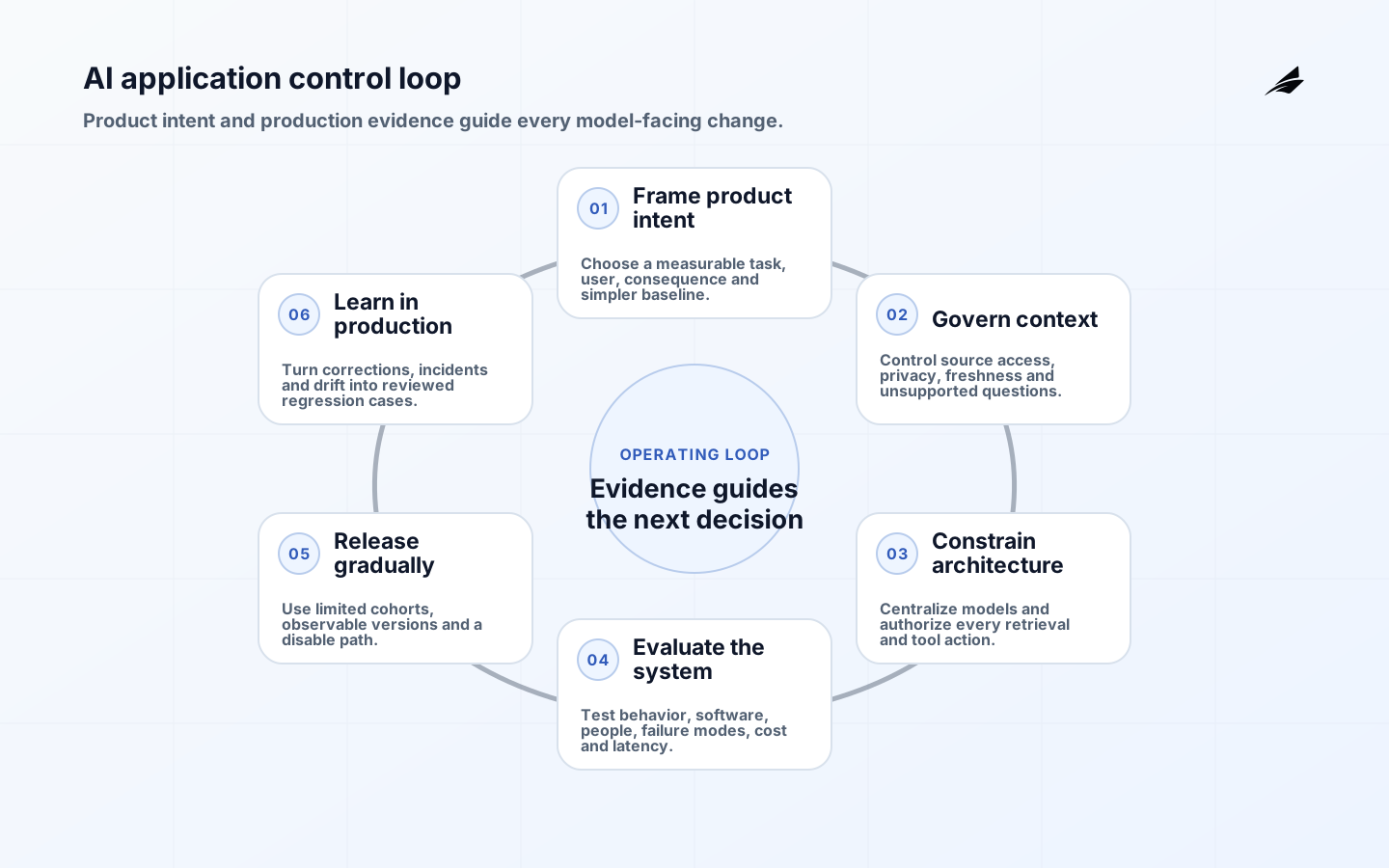
AI application development combines ordinary software engineering with probabilistic components, changing data and new security failure modes. The product still needs clear users, permissions, state, reliability and support, but a model output cannot be treated like a deterministic function. This AI application development FAQ explains how teams select an appropriate use case, assemble the architecture, evaluate behavior and operate it with accountable controls.
For project framing, use the AI application development scope and delivery plan. Teams ready to build should follow the production implementation checklist and the AI and data implementation checklist. The central design question is not which model appears strongest in a general benchmark. It is which controlled system can improve a defined user decision under representative conditions.
What is an AI application?
An AI application is a software product in which a machine learning or generative model materially contributes to a user-facing or operational result. A production system usually includes an interface, identity, business rules, source data, model gateway, prompts or features, retrieval, tools, persistence, observability and human review. Calling a model API is therefore an integration task, not a complete application. The surrounding system determines what context the model receives and what can happen next.
Classify the model's role: summarize, extract, classify, rank, predict, recommend, generate or act. Then identify the consequence of error and the party responsible for the final action. The NIST AI RMF provides a voluntary structure for governing, mapping, measuring and managing risk. Use it to connect product requirements with affected people, operating context, test evidence and residual-risk decisions.
| Pattern | Good first use | Control emphasis |
|---|---|---|
| Extraction | Turn known document fields into a review queue | Schema validation, confidence and source display |
| Retrieval-assisted answer | Answer from an approved knowledge collection | Access filtering, citations and injection resistance |
| Prediction | Prioritize cases for a trained reviewer | Population coverage, calibration and drift |
| Content generation | Draft text that an owner edits before release | Claims, provenance, policy and approval |
| Tool-using agent | Perform narrow reversible tasks with confirmation | Authorization, isolation, limits and audit |
When is AI application development worth doing?
Start when the workflow contains a repeatable judgment or language task, enough representative examples exist to test it, and improvement has measurable value. AI is a poor default for exact calculations, simple rules or requirements that cannot tolerate nondeterminism. Compare against a non-AI baseline such as search, templates, rules or better workflow design. The AI option should earn its additional evaluation, latency, cost and governance burden.
A useful proof of concept tests the hardest assumption with real users and de-identified or approved data. It should not optimize a polished chat interface while ignoring source access, review time or downstream integration. Define a stop rule: for example, abandon the approach if the system cannot reach the required recall without creating an unaffordable review queue. A negative result is valuable when it prevents an unsafe or uneconomic production build.
How should the architecture be designed?

Keep model access behind a server-side gateway that centralizes approved models, credentials, timeouts, rate limits, input and output policy, tracing and cost attribution. Version the prompt, model, retrieval configuration, tool definitions and policy as one release. Use structured output with schema validation when software consumes model results. Treat generated text as untrusted input: escape it for its destination and never concatenate it into commands, database queries or privileged instructions.
For retrieval, enforce the user's access before documents reach the model. Preserve document identifiers, versions and passages so the interface can show supporting context. Segment sources by authority and freshness, and define what happens when no source is sufficient. Retrieval improves access to context; it does not guarantee truth. Test source conflict, stale content, malicious instructions embedded in documents and questions whose answer is absent.
- Use workload identity and a secret manager for every model and tool credential.
- Apply authorization in application code before retrieval and before each action.
- Constrain tools to typed parameters, narrow permissions and explicit time or value limits.
- Separate user content, trusted instructions and retrieved untrusted content in the prompt design.
- Record model, prompt, source and policy versions for consequential outputs.
- Provide a deterministic fallback or review queue for unavailable or low-confidence paths.
How do teams evaluate an AI application?
Build a versioned test set from production-like tasks with expected outcomes, scoring rubrics and important slices. Include ordinary cases, boundary cases, unsupported requests, sensitive data, malformed files, adversarial instructions and dependency failure. Use deterministic assertions for schema, permissions and tool parameters; statistical metrics for classification or prediction; and carefully defined rubric scoring plus human review for open-ended output. The automation testing services FAQ provides a broader release-testing comparison. Track uncertainty and disagreement rather than forcing every case into a pass.
The NIST Generative AI Profile describes risks such as confabulation, harmful bias, information integrity and data privacy that require context-specific measurement. Averages can conceal severe errors, so define critical classes that must pass individually. Re-run the suite whenever the model, prompt, retrieval collection, policy, tool or significant dependency changes. Sample production cases for newly observed failure modes and add reviewed examples back into regression testing.
| Layer | Test | Example release threshold |
|---|---|---|
| Deterministic software | Contracts, access, state and failure handling | All critical authorization and state tests pass |
| Model behavior | Task score, critical errors and slices | Approved minimum by scenario and subgroup |
| Grounding | Claim support and correct source use | Unsupported material claims remain below limit |
| Human review | Detection, correction and completion study | Reviewers catch seeded critical errors |
| Operations | Load, timeout, fallback and rollback drill | Service meets objectives under dependency failure |
| Economics | Cost and latency by completed task | Unit cost fits the approved business case |
What security risks are different from conventional software?
Conventional risks remain: broken access control, injection, vulnerable components, secret exposure and insecure deployment. The OWASP Application Security Verification Standard provides testable requirements for web application controls, while the NIST SSDF integrates secure practices into development. AI adds model and data supply chains, prompt injection, training or retrieval poisoning, model extraction, sensitive-output leakage and unsafe use of generated instructions.
NIST's adversarial machine learning taxonomy organizes attacks by lifecycle stage, attacker goal, capability and knowledge and discusses mitigations and limitations. Threat-model the specific architecture instead of purchasing a generic AI firewall. An attacker who can submit a document has different leverage from one who can change training data or invoke an action tool. Reduce authority, isolate untrusted data, validate transitions and monitor unusual use.
Where should human review sit?
Place review before an action when consequences exceed the approved automation boundary or the model lacks reliable evidence. Show the reviewer source context, model uncertainty, changed fields and policy reason, not only a persuasive answer. Give reviewers authority to reject and a clear escalation route. Measure correction and override patterns by scenario; frequent silent editing may indicate that the model adds little value or that the task should be redesigned.
Avoid automation bias by testing the combined human-system process. Seed known errors in a controlled study and observe whether reviewers find them. Rotate or sample reviews when fatigue is likely. High-volume queues require capacity planning, service levels and prioritization. Calling a step human-in-the-loop does not make it effective if the person lacks time, information or decision rights.
What changes in production?
Deploy to a limited population or advisory mode first. Monitor availability, latency, model and tool errors, safety blocks, retrieval coverage, correction rate, task completion and unit cost. Define alert thresholds and owner actions. Preserve privacy in logs by using references or redaction and restricting access. Keep a feature-level disable switch and a known-good configuration so one failing AI capability does not disable the surrounding product.
Production use can change the input population and user behavior, while vendor models can change under managed service policies. Track provider notices and evaluate changes before promotion where version controls permit. If the application reaches regulated contexts, classify legal roles and obligations early; the EU AI Act, for example, assigns obligations based on system category and operator role rather than the team's preferred product description.
Key takeaways
- Choose AI only when it beats a simpler baseline on a measurable workflow outcome.
- Design the application around permissions, evidence, review and failure behavior, not a model endpoint.
- Evaluate representative tasks, critical failure classes and the complete human-system process.
- Keep generated content untrusted and authorize every retrieval and action outside the model.
- Version model, prompt, data, tools and policy together and re-run regression tests on change.
- Release gradually with observable decisions, bounded cost and a tested disable path.
How should AI application cost be estimated?
Estimate cost per completed business task, including input and output processing, retrieval, tools, retries, evaluation, observability, human review and support. Model several input sizes and concurrency levels. A cheaper model can increase total cost if poor output creates more retries or review. Set budgets and rate limits by user or workflow and monitor actual unit economics after release.
Should the team fine-tune a model?
Fine-tuning is appropriate when a stable task, representative examples and a clear evaluation show that prompt, retrieval or workflow changes are insufficient. It can improve consistency or task behavior, but adds dataset governance, training reproducibility and model lifecycle work. Use the smallest intervention supported by evidence, and keep an evaluation set that was not used to construct the tuning examples.
What should teams verify when buying a model service?
Verify supported versions, data-use terms, retention, regions, security controls, availability, rate limits, change notice, abuse handling, incident communication, export and termination. Determine whether prompts or outputs can be used for provider training under the selected service terms. Test actual limits and failure behavior before architecture approval. Keep a provider abstraction only where it supports a plausible transition; a lowest-common-denominator wrapper that hides useful controls can reduce reliability without delivering real portability.
Conclusion
Good AI application development is disciplined product engineering around an uncertain component. A bounded purpose, enforceable permissions, representative evaluation and observable production behavior matter more than a dramatic demo. When those controls travel with each release, teams can improve capability without losing the ability to explain, stop or recover the service.