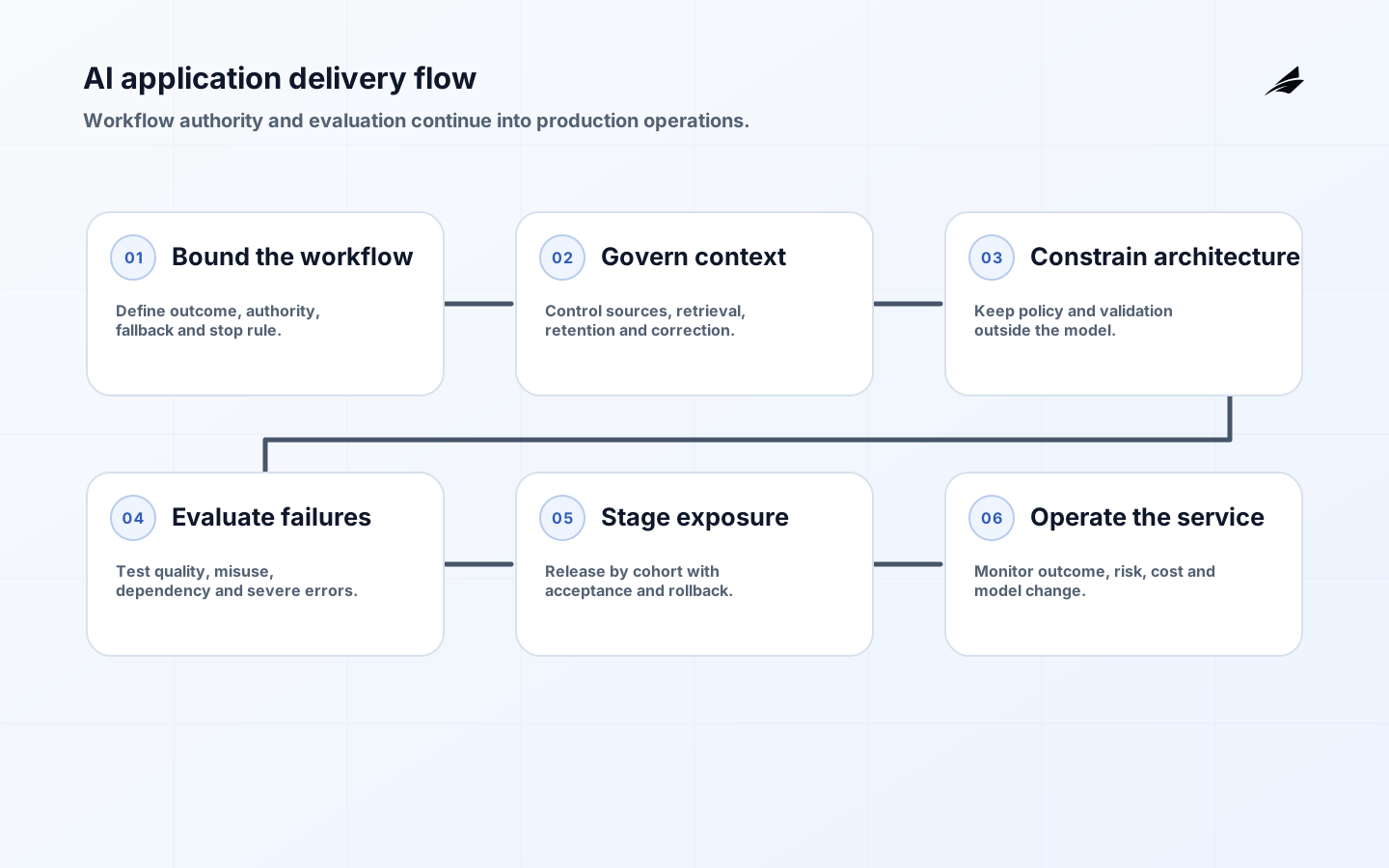
An AI-led application service uses models inside a complete business workflow rather than presenting a model demo as a finished system. The service still needs identity, data controls, deterministic software, integration contracts, evaluation, human authority, monitoring, recovery and support. This AI-led application services implementation checklist is organized around evidence: each stage should leave a decision record, test result or operating artifact that the permanent owner can use after the project team leaves.
Begin with the companion AI-led application services scope and risk guide to choose a bounded workflow, then use the architecture and operations FAQ for design decisions. The checklist below is intentionally model-independent. Models, prices and capabilities change; the business boundary, evidence requirements and recovery duties must remain legible through those changes.
1. Define the outcome, boundary and accountable decision
Write the workflow before selecting a model. Name trigger, inputs, user, current method, proposed assistance, actions, systems changed, decision deadline and measurable outcome. Distinguish advice, content generation, classification, extraction and action. If the system can create a customer commitment, move money, alter access, modify a regulated record or trigger an irreversible process, identify the authorized human or deterministic control that must approve it.
- Document the current baseline for time, quality, cost, backlog and exceptions.
- State included users, regions, languages, data classes and channels.
- List prohibited uses and conditions requiring immediate fallback.
- Assign business, product, technical, data, security and risk owners.
- Set a stop condition when benefit, safety or operating cost misses tolerance.
Use NIST's AI Risk Management Framework to connect governance, context mapping, measurement and risk treatment across the lifecycle. Create a concise use-case profile rather than applying generic controls with equal weight. Record affected people, expected benefit, reasonably foreseeable misuse, failure consequence, available recourse and relevant obligations. Approval should cover the workflow and deployment context, not simply a named model.
| Boundary decision | Required artifact | Acceptance question | Owner |
|---|---|---|---|
| Business outcome | Baseline and target | Can improvement be measured? | Business owner |
| AI role | Workflow and authority map | Where can probabilistic output influence action? | Product owner |
| Population | Included and excluded cohorts | Are material groups represented? | Risk owner |
| Fallback | Manual or deterministic path | Can work continue safely? | Operations |
| Stop rule | Threshold and decision route | Who can pause the service? | Service owner |
2. Prepare governed data and knowledge
Inventory every data path: user input, retrieval corpus, conversation history, model request and response, feedback, tool result, telemetry, evaluation set and export. For each, record authority, classification, purpose, consent or lawful basis where applicable, access, retention, residency, redaction and deletion. Minimize context before it reaches the model. Treat prompts, embeddings and generated summaries as potentially sensitive derived data rather than harmless technical exhaust.
For retrieval, define document eligibility, source authority, chunking, refresh, revocation and citation behavior. Preserve document and index revision so an answer can be reconstructed. Test stale, contradictory, malicious and access-restricted content. Retrieval authorization must filter before content enters model context, not after generation. Give users source and effective-date cues when the decision depends on current policy. Create an owner-visible path for correcting bad knowledge.
3. Design the service and control boundaries
Separate deterministic orchestration from probabilistic generation. Validate typed input and output, constrain tool parameters, enforce authorization outside the model, set time and action budgets, and make retries idempotent. Store workflow state explicitly rather than relying on conversation text as the record of authority. A model may propose an action; a policy component should decide whether the authenticated user and service may perform it. Use queues and compensating actions where downstream work can partially succeed.

Define model abstraction only where it supports a real fallback, evaluation or commercial need. Models differ in tool calling, context, safety features and output behavior, so a superficial common interface can hide consequential differences. Pin model and prompt revisions, record configuration, and route changes through evaluation. Protect system instructions, credentials, connectors and build pipelines. The NIST Secure Software Development Framework provides practices for preparing, protecting, producing and responding across the software lifecycle.
4. Threat-model prompts, tools and supply chain
Threat-model direct and indirect prompt injection, sensitive disclosure, insecure output handling, excessive agency, poisoned retrieval, tool misuse, denial of service, model theft and dependency compromise. The OWASP LLM Top 10 is a useful starting taxonomy, not a substitute for the workflow's own abuse cases. Assume retrieved documents, web pages, email, tickets and tool metadata can contain hostile instructions. Keep untrusted content distinguishable and prevent it from changing system policy.
Grant each connector the narrowest identity, scope and environment. Separate read from write tools and low-impact from consequential actions. Require confirmation based on action effect, not on the model's confidence wording. Canonicalize and validate parameters, constrain destinations, cap transactions, and log approvals. Test cross-user and cross-tenant memory, hidden instructions, compromised tool output, replay and confused-deputy paths. Maintain software and model component inventories with vulnerability and update routes.
| Risk | Preventive control | Evaluation case | Runtime response |
|---|---|---|---|
| Prompt injection | Trust separation and constrained instructions | Hostile retrieved document | Block tool use and flag |
| Excessive agency | Least-privilege tools and approval | Irreversible action request | Require authorized review |
| Data disclosure | Minimization and output policy | Cross-user secret probe | Redact, deny and investigate |
| Invalid output | Schema and business validation | Malformed or unsafe parameter | Reject and use fallback |
| Resource exhaustion | Budgets, limits and circuit breakers | Recursive or oversized task | Stop, preserve state and alert |
5. Build evaluation around workflow failure
Create an evaluation plan before prompt optimization. Use representative cases by language, complexity, user role, data quality and consequence. Include ordinary success, boundary cases, prohibited requests, adversarial content, unavailable dependencies and human disagreement. Keep a fixed regression set, a recent-production sample reviewed under policy, and targeted challenge sets. Prevent test contamination where possible and record dataset provenance, revision and limitations.
Score the smallest meaningful units: extraction fields, classification decisions, citations, tool choice, parameter validity, policy adherence, completion and human correction. Pair automated graders with calibrated human review; evaluate graders against expert judgments before trusting them. Report distributions and high-consequence failure counts, not only an average. NIST's Generative AI Profile highlights risks such as confabulation, information integrity, privacy and value-chain dependencies that should inform scenarios.
6. Release through staged exposure and explicit acceptance
Promote immutable application artifacts with pinned prompts, policies, model configuration and evaluation evidence. Run component, contract, security, workflow and recovery tests. Start with internal or low-consequence users, compare against the baseline, and expand by cohort only when thresholds hold. Feature flags must support rapid disablement without losing in-flight state. Communicate limitations and review responsibilities in the workflow itself, where users make decisions.
Acceptance should prove authentication and authorization, restricted-data handling, evaluation thresholds, tool approval, observability, cost limits, support routing, fallback, rollback and record reconciliation. Have the receiving operations team run the final scenario. Transfer architecture, data map, prompt and policy versions, eval datasets, dashboards, runbooks, supplier contacts, open risks and change calendar. A launch date without day-two ownership is a pilot ending, not a service beginning.
Operate model behavior, service health and business outcomes
Monitor workflow completion, correction and override, abstention, groundedness where relevant, tool errors, policy blocks, latency, token and infrastructure cost, model revision, retrieval freshness and customer outcome. OpenTelemetry's semantic conventions support consistent telemetry, but content fields can be sensitive. Prefer identifiers, categories and sampled redacted traces; define who may inspect full prompts or outputs and for how long.
Classify incidents by business impact, data exposure, unsafe action, systemic quality change and dependency failure. Preserve evidence, disable the narrowest capability, notify owners, reconcile affected records and communicate with users where needed. Re-evaluate after model, prompt, tool, corpus, policy or material workflow changes. Review cost per successfully completed outcome rather than tokens alone. Retire prompts, indexes, connectors and evaluation cases through controlled lifecycle management.
Control model and prompt changes as service releases
Maintain a change matrix for model, system prompt, retrieval settings, tools, policies and evaluation data. A provider-side model update can alter quality without an application deployment, so pin versions where possible and monitor announced lifecycle dates. Compare candidate and current configurations on the same representative and adversarial sets, inspect severe regressions, and run a shadow or limited cohort before promotion. Preserve the exact configuration and rollback target used for every production decision record.
Emergency changes still need bounded authority and after-action review. If a safety issue requires disabling a tool or tightening policy, record the trigger, affected cohort, temporary behavior and owner. Verify that queued work and partially completed actions reconcile under the new rule. Remove obsolete model credentials and prompt assets after retention needs are met. This discipline prevents prompt edits in a vendor console from bypassing software release, evaluation and operational acceptance.
AI-led application services implementation FAQ
How small should the first production scope be?
Small enough that owners can inspect failures and use a safe fallback, but representative enough to exercise real data, integration and authority. A low-value toy proves little; a bounded step inside an important workflow is better.
What accuracy is good enough?
There is no universal threshold. Set criteria by task, segment and consequence, including severe-error limits and human correction. Compare the complete workflow with the current baseline, not the model with an abstract benchmark.
Does human review remove AI risk?
No. Reviewers may lack time, context, authority or independence, and automation bias can reduce challenge. Test whether the interface exposes evidence and whether reviewers actually catch seeded failures. Monitor overrides and missed escalations.
Key takeaways
- Define the workflow, authority and stop rule before choosing a model.
- Govern every data path, including retrieval, prompts, feedback and telemetry.
- Keep authorization and business validation outside probabilistic model behavior.
- Evaluate representative failures, adversarial inputs and fallback end to end.
- Release by cohort and operate quality, security, cost and outcomes together.
Conclusion: accept an operated service, not an impressive demo
AI-led application services succeed when a bounded workflow is surrounded by durable software and accountable operations. Make data and authority explicit, constrain tools, evaluate consequential failures, stage exposure and rehearse fallback. Where immutable inter-organization records are a real requirement, compare the blockchain application services checklist rather than adding a ledger by default. The resulting service can adapt as models change because its safety, evidence and business outcome do not depend on a single provider's behavior.