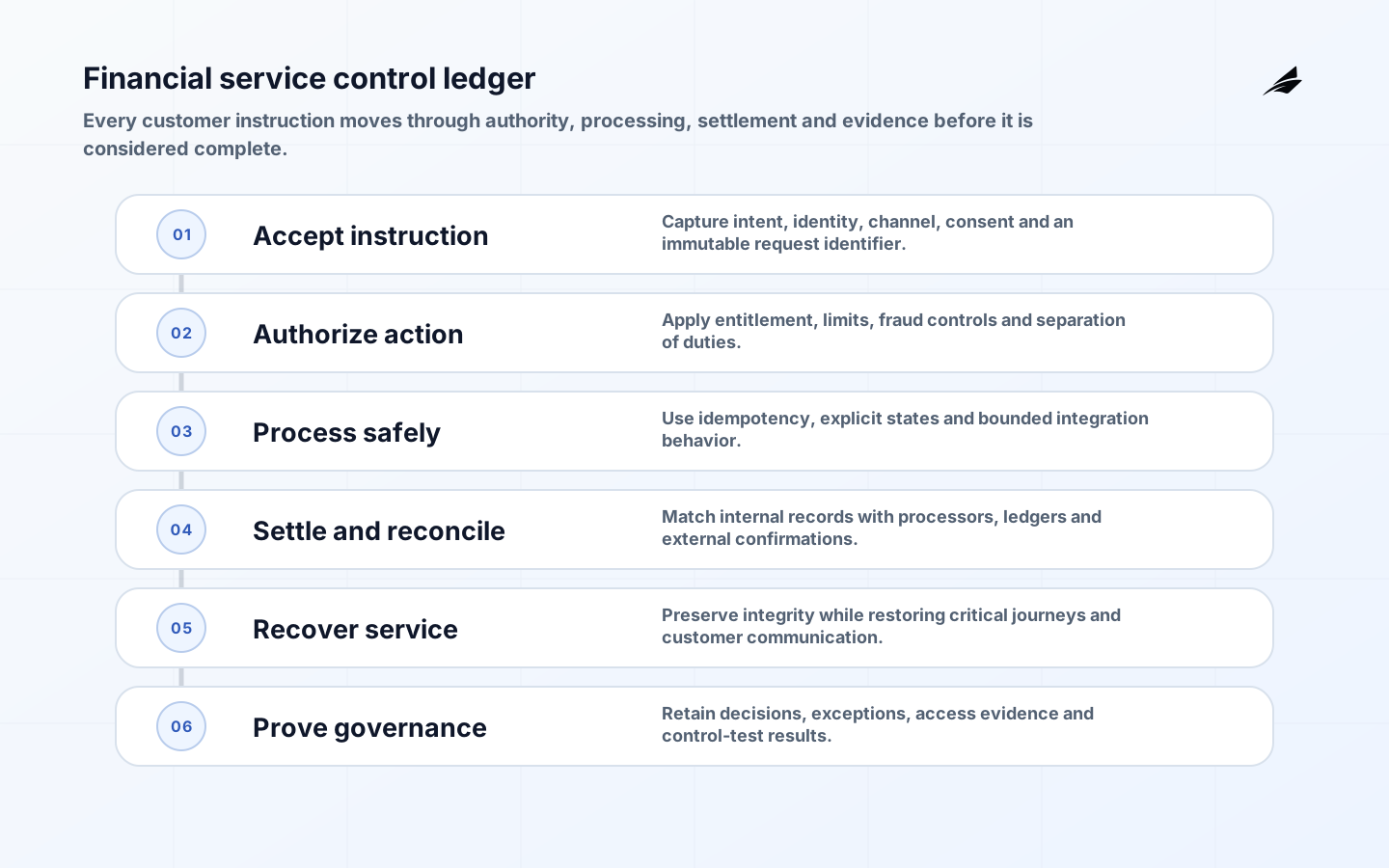
Financial services software is business infrastructure for accepting instructions, moving or representing value, enforcing policy and producing records that can withstand customer, finance, risk and regulatory scrutiny. A polished interface is not enough. The system must preserve transaction integrity through retries and partial failure, distinguish authorization from settlement, protect privileged actions, reconcile independent records and recover without inventing or losing money. The exact obligations depend on jurisdiction and product, so legal and compliance specialists must define the applicable rules. Engineering still needs a general operating model that makes those rules executable and testable.
This FAQ is for product owners, architects and delivery leaders evaluating a new financial workflow or replacing a fragile one. It focuses on controls that apply broadly to payments, lending, insurance, wealth, treasury and internal finance operations. The financial services implementation checklist provides a companion delivery sequence, while the banking software delivery plan helps teams frame a larger transformation.
What belongs inside the financial transaction boundary?
Begin with one customer or operator instruction and follow it until every authoritative system agrees on the outcome. Capture an immutable request identifier, actor, account or tenant, channel, timestamp, amount or value, currency or unit, relevant policy version and consent or mandate. Treat authentication, business authorization, fraud decisions and transaction limits as separate checks. A person can be strongly authenticated yet not entitled to approve a payment, refund, credit change or policy exception. The server must make the final authorization decision using current data; an interface must never be the enforcement boundary.

Model business states explicitly. Received, validated, authorized, submitted, accepted, settled, reversed, rejected and unknown are different conditions. A timeout does not prove failure, and a provider acceptance does not prove settlement. Preserve the provider reference and reconcile later instead of repeating an ambiguous command. Idempotency keys should represent one business intent, not merely one HTTP request. Define how long they remain valid, what response a duplicate receives and what happens when the same intent arrives with different details.
| Control point | Question the system must answer | Required evidence |
|---|---|---|
| Instruction | Who requested exactly what? | Immutable request ID, actor, channel and payload hash |
| Authorization | Why was this actor permitted? | Role, limits, policy version and approval trail |
| Execution | What did each dependency accept? | Attempt, idempotency key, provider reference and response |
| Settlement | Did the authoritative money record change? | Ledger or processor confirmation and effective date |
| Reconciliation | Do independent records agree? | Matched totals, exceptions, owner and resolution |
Does every product need a double-entry ledger?
Not every financial application is the book of record, but every application must know which system is. If the product creates balances, liabilities, entitlements or money movements, a balanced journal model is often safer than mutating totals because it preserves the reason for change and supports correction through new entries. Do not silently edit posted history. Separate pending from posted entries, business event time from processing time, and operational status from accounting status. Define precision and rounding once per monetary rule; floating-point arithmetic is unsuitable for authoritative currency calculations.
Reconciliation is a product capability, not a spreadsheet afterthought. Match internal transaction records with payment processors, banks, core ledgers, invoices and settlement reports using stable references. Run both event-level matching and aggregate control totals. Surface missing, duplicate, late and value-mismatched records in an owned queue. Define tolerance, ageing and escalation. A dashboard that says totals match is useful only when operators can trace the population, source files, exclusions and last successful run.
How should identity, access and payment data be protected?
Use risk-based identity assurance and separate customer, workforce, service and emergency identities. Require phishing-resistant multifactor authentication for high-impact workforce access where feasible, and apply step-up checks to consequential customer actions. Privileged access should be time-bounded, approved, attributable and visible to the customer organization where the operating model permits. Separate creating a payee, changing a limit and approving a payment when the risk justifies it. Recovery is part of authentication: weak password resets or support overrides can defeat strong sign-in controls.
Minimize the cardholder and sensitive-data footprint. Tokenize payment credentials through an appropriate provider and keep secrets out of logs, analytics, support tools and test fixtures. PCI DSS applies according to the actual payment architecture and responsibilities; it is not a general certificate for the whole product. Use the PCI SSC notice for PCI DSS v4.0.1 and assessor guidance for current scope. For web controls, the OWASP ASVS provides verifiable requirements that can be selected according to risk.
What does operational resilience require beyond uptime?
Availability is only one concern. A service can return successful responses while posting duplicate entries, using stale limits or losing evidence. Define critical business services and impact tolerances before choosing infrastructure targets. Map people, applications, data stores, providers and manual workarounds needed to deliver them. The CPMI-IOSCO cyber resilience guidance is written for financial market infrastructures, but its emphasis on governance, identification, protection, detection, response, recovery, testing and learning is a useful lens for high-consequence systems more broadly.
Design retries according to side effects. Read operations can often retry automatically; commands require idempotency and an outcome lookup. Use queues to absorb bursts only when ordering, expiry and duplicate behavior are defined. Test provider slowness, dropped acknowledgements, corrupted files, expired certificates, unavailable identity services and regional loss. Recovery must include business reconciliation after technology restoration. Backups are not proven until representative data can be restored within the agreed objective and the restored service can rejoin transaction processing without replaying completed work.
| Scenario | Safe system behavior | Acceptance evidence |
|---|---|---|
| Provider timeout | Record outcome as unknown; query before retry | No duplicate value movement in fault test |
| Queue redelivery | Deduplicate by business intent and preserve attempt history | Repeated messages produce one posting |
| Regional outage | Invoke tested failover or controlled suspension | Recovery drill plus reconciled records |
| Compromised administrator | Revoke access, preserve evidence and limit blast radius | Attributed actions and emergency review |
| Settlement mismatch | Quarantine exception without hiding customer status | Owned case resolves to traceable correction |
Can cloud and managed providers carry the responsibility?
Cloud and managed services can improve resilience and security, but they divide work rather than remove accountability. Document who configures identity, encryption, network exposure, logging, backups, vulnerability response, keys and incident communication. A provider may operate infrastructure while the financial firm remains responsible for data use, business authorization, customer outcomes and supplier oversight. Keep authoritative architecture, contracts, runbooks, source code and evidence in accounts the organization can access during a dispute or supplier outage.
Assess concentration and exit risk. Identify shared dependencies across supposedly independent services, including identity, DNS, networking, observability and support channels. Contract for incident notification, subcontractor transparency, evidence access, data return and deletion. Periodically exercise export, credential return and a bounded migration. The goal is not to eliminate every dependency; it is to know which business service can fail, how quickly the organization will know, and what action remains possible without the supplier.
How should financial software be delivered and accepted?
Deliver one end-to-end slice through identity, authorization, transaction state, dependency, reconciliation and support. Use production-like but synthetic data to test normal, boundary and failure cases. NIST’s Secure Software Development Framework organizes practices around preparing the organization, protecting software, producing secure releases and responding to vulnerabilities. Translate those practices into repository protection, reviewed changes, dependency evidence, artifact provenance, secret scanning, security testing and a supported vulnerability process.
Acceptance should be evidence-based. Product confirms the customer outcome; operations resolves a failed and ambiguous transaction; finance reconciles totals; security inspects privileged activity; support explains status without database access; and recovery restores a representative service. Release gradually with clear rollback or suspension rules. Some schema and ledger changes cannot be reversed safely, so use forward-compatible migrations and compensating entries rather than assuming every deployment can simply roll back.
How should high-risk changes be governed?
Classify changes by business consequence rather than code size. A one-line limit, rounding or routing change may carry more risk than a large reporting feature. Require peer review, representative test evidence, segregation of duties where appropriate and a named approver for policy or financial behavior. Schedule changes around settlement, reporting and customer-critical periods. Preserve the rule version and deployment reference with affected transactions so later investigation can reconstruct behavior.
Use progressive exposure with value, customer and region limits when feasible. Define the telemetry, reconciliation checks and stop thresholds before release. Emergency changes need an expedited but recorded path, with retrospective review and removal of temporary access. Maintain a calendar of provider, certificate, regulatory and data-format changes. A release is not complete until operations confirms stable processing and finance confirms expected control totals.
Key takeaways
- Model transaction intent, authorization, execution and settlement as distinct states.
- Use immutable references, idempotency and reconciliation to survive ambiguous outcomes.
- Protect recovery and privileged support paths as strongly as ordinary sign-in.
- Define resilience around critical business services and data integrity, not uptime alone.
- Accept releases through operational, finance, security and recovery evidence.
Frequently asked questions
Should a team buy a core platform or build custom software?
Buy mature commodity capabilities when they meet the operating and regulatory boundary; build where the workflow, integration or customer experience creates material differentiation. Compare total change, control, data, integration and exit cost rather than license price alone. A hybrid architecture is common, but every boundary still needs ownership and reconciliation.
Is blockchain required for an auditable ledger?
No. An append-only journal with strong access control, balanced entries, immutable identifiers, backups and independent reconciliation can provide excellent auditability. Distributed consensus is useful only when the business genuinely needs multiple parties to share control without one accepted authority.
What is the safest first production scope?
Choose a bounded journey, customer cohort and value limit with clear manual review and suspension. Prove transaction integrity, reconciliation, support and recovery before expanding products, channels or geographies.
Conclusion
Dependable financial services software makes value movement explainable under normal work, peak demand and partial failure. Clear transaction states, server-side authority, reconciliation, protected identities and tested recovery turn architecture into operational trust. The strongest delivery teams make these properties visible in acceptance evidence before volume or product scope grows.