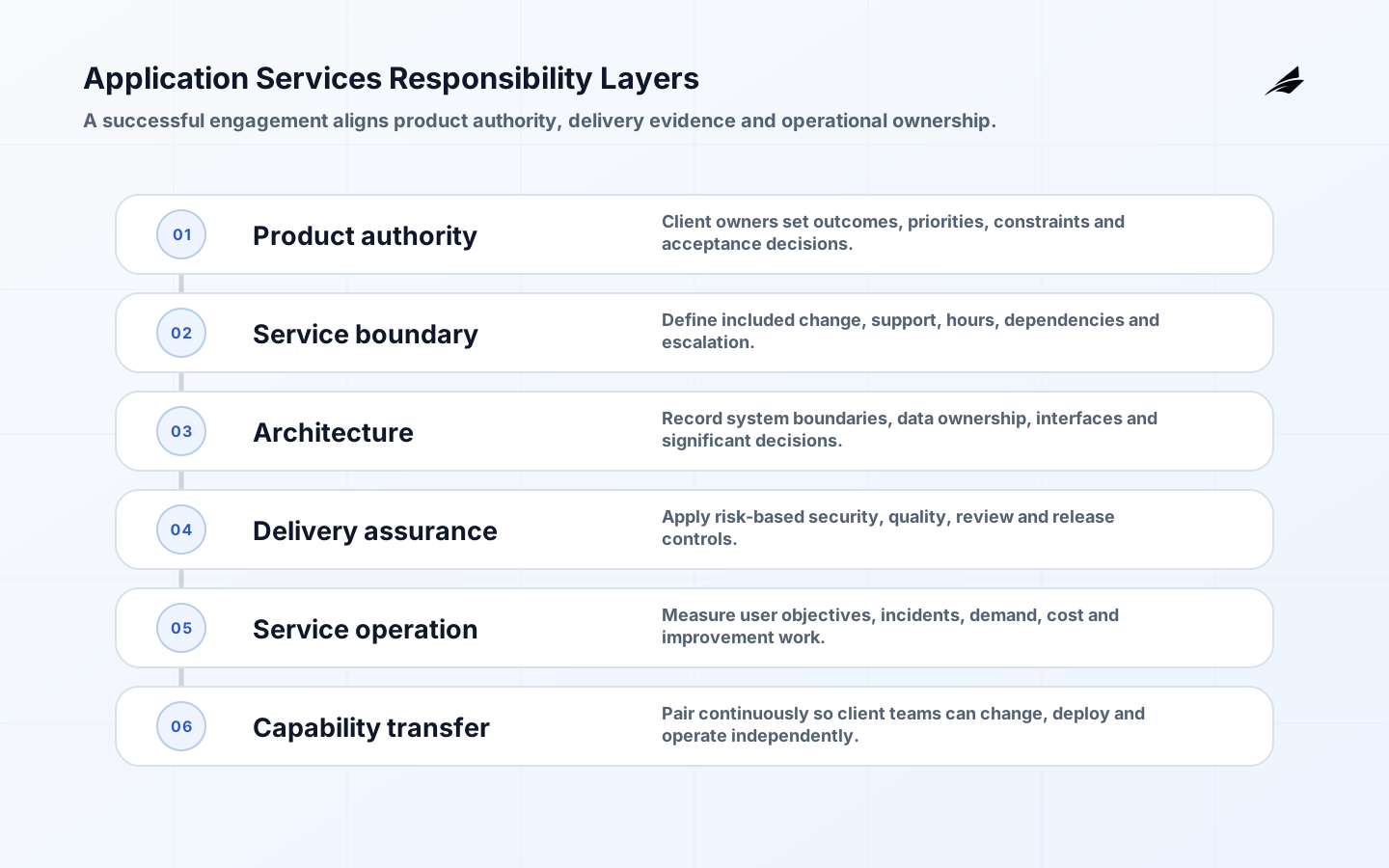
Consulting application services combine specialist advice with hands-on work across an application's life cycle. Depending on the need, an engagement may cover discovery, architecture, product delivery, integration, modernization, quality engineering, security, reliability, support or continuous improvement. The useful unit of scope is not a generic pool of developers. It is an owned application outcome with clear boundaries, service expectations, decision rights and evidence.
What consulting application services should include
The right service shape depends on the application stage and the client's internal capability. A product still searching for workflow fit needs discovery and iterative delivery. A mature revenue system may need reliability, security and controlled modernization. A newly acquired application may need an architecture and operational assessment before any change. Package the work around that context rather than buying every capability at once.
| Service area | Typical deliverables | Acceptance evidence |
|---|---|---|
| Discovery and advisory | Workflow map, application assessment, target outcomes and decision record | Validated constraints, prioritized risks and an approved roadmap |
| Delivery and integration | Product slices, APIs, data flows, tests and deployment pipeline | Working journeys, contract tests and production release evidence |
| Modernization | Disposition decisions, architecture changes, migration and decommissioning | Reconciled data, stable service indicators and retired legacy cost |
| Quality and security | Risk-based tests, threat models, dependency controls and findings | Traceable requirements, remediation decisions and release gates |
| Reliability and support | Service objectives, observability, incident response and runbooks | Measured service behavior, exercised recovery and owned alerts |
| Capability transfer | Documentation, pairing, training and transition plan | Client team can deploy, operate and change the application |
Choose an engagement model that matches the uncertainty
Fixed scope works when requirements, interfaces and acceptance conditions are stable. Time-and-materials fits discovery and evolving product work, but still needs outcome checkpoints and spending controls. A dedicated team supports a continuing roadmap when priorities change frequently. Managed application services can cover defined operational and improvement responsibilities, provided service boundaries, escalation and change funding are explicit. A blended model often uses a time-boxed assessment, milestone-based first slice and then a capacity or service arrangement informed by real demand.
- Name one accountable client product or service owner; a provider cannot resolve internal priority conflicts alone.
- Document who decides architecture, backlog priority, production release, risk acceptance and emergency change.
- Separate included maintenance from enhancement demand and project work.
- State working hours, on-call expectations, severity definitions, dependencies and exclusions.
- Keep source code, pipelines, environments, artifacts and operational records accessible to authorized client owners.
- Define transition assistance, documentation standards and exit steps before delivery begins.
Baseline the application before committing the plan
A short paid assessment is often the most honest starting point. Review architecture, repositories, release history, incidents, vulnerabilities, user feedback, data, interfaces, cloud or infrastructure consumption, supplier commitments and team responsibilities. Test access to a nonproduction environment and observe one deployment and one support workflow. Record confidence for each finding. A proposal based only on interviews and slideware may hide the work needed to make the application buildable, testable and operable.
Turn findings into a service backlog with three layers: immediate risk reduction, outcome delivery and capability improvement. Immediate work might rotate exposed credentials or restore backup testing. Outcome work delivers the prioritized user or operational change. Capability work improves pipelines, test data, observability or documentation so future changes become safer. This prevents foundational work from becoming an endless precondition while avoiding a feature-only engagement that accumulates fragility.
Make architecture, security and quality part of delivery
Use a recurring architecture review rather than a one-time target diagram. AWS Well-Architected organizes review questions around operational excellence, security, reliability, performance efficiency, cost optimization and sustainability. The framework is provider-specific in implementation, but the balanced review principle is broadly useful: a cheaper design that cannot recover, or a highly available design that nobody can securely change, is not well governed. Record significant choices and revisit assumptions when demand, regulation or dependencies change.
For software assurance, NIST SSDF supplies a common vocabulary across producer and purchaser, while OWASP SAMM offers measurable maturity paths that are technology and process agnostic. Choose practices according to application risk: protected source and build access, reviewed dependencies, threat analysis, secure defaults, automated checks, manual specialist testing where needed, vulnerability handling and traceable release artifacts. OWASP ASVS can provide a basis for testing web application controls and expressing verifiable security requirements in contracts and acceptance criteria.
Understand price and total cost drivers
Day rates and team size do not make proposals comparable. Compare the responsibility boundary, seniority mix, delivery method, environments, specialist work, support coverage, tooling, transition and expected client contribution. A lower delivery price may require more product management, testing, security or operations from the client. Conversely, a broad service can be poor value if the application does not need every included role. Ask for assumptions, ranges and cost-to-complete forecasts linked to accepted increments.
| Cost driver | Why it changes effort | How to make it visible |
|---|---|---|
| Requirement uncertainty | More discovery, prototyping and decision cycles are needed | Time-box discovery and track unresolved decisions |
| Legacy condition | Build, test and dependency problems slow every change | Run a representative change during assessment |
| Integration and data | External coordination and reconciliation expand the test surface | Map contracts, owners, volumes and failure paths |
| Assurance level | Critical systems require stronger evidence and independent review | Define controls and acceptance artifacts by risk |
| Availability and support | Extended coverage needs redundancy, observability and rehearsed response | Specify service objectives, hours and escalation |
| Knowledge concentration | Specialist dependence creates delay and transition risk | Measure review participation, documentation and client ownership |
Example: stabilizing and extending a customer operations platform
A service company needs to add contract renewal workflows to an internal customer operations platform. Releases are monthly and stressful, support requests are rising, and the only engineer who understands billing integration is leaving. A useful engagement does not start by promising a replacement platform. The assessment maps the renewal journey, reproduces the build, traces billing and identity dependencies, samples incidents and measures current release and service behavior.
The first delivery slice adds a renewal queue for one customer segment, plus contract tests for billing, audit events, role checks, deployment automation and journey monitoring. The client product owner accepts workflow behavior; security reviews access and audit requirements; operations rehearses rollback. Provider and client engineers pair on support and code review. After the slice, the roadmap can price broader rollout using observed throughput and known integration constraints rather than speculative screen counts.
Application services risk register
| Risk | Control | Evidence to review |
|---|---|---|
| Output without business value | Outcome backlog and user acceptance by vertical slice | Adoption, journey completion and outcome trend |
| Provider lock-in | Client-controlled assets, open documentation and continuous pairing | Client can build, deploy, operate and approve changes |
| Weak security accountability | Named risk owners, secure development practices and release gates | Threat decisions, findings and remediation records |
| Support noise consumes roadmap | Demand categories, problem management and reserved improvement capacity | Repeat incidents, ticket aging and interrupt load |
| Hidden scope growth | Decision log, assumptions, backlog boundaries and forecast updates | Variance by cause rather than undifferentiated overrun |
| Handover cliff | Progressive ownership transfer and readiness checks | Client-led releases, incidents and roadmap decisions |
A practical engagement and rollout plan
- Qualify: define the application outcome, urgency, stakeholders, constraints and procurement route.
- Assess: establish access, baseline architecture, delivery, security, reliability, demand and cost; list unknowns explicitly.
- Mobilize: agree governance, roles, environments, controls, backlog, service measures and communication cadence.
- Deliver a proof slice: complete one representative journey through design, build, assurance, release, monitoring and support.
- Scale deliberately: add work based on measured demand and bottlenecks; keep changes small, reviewable and recoverable.
- Operate and improve: review service objectives, incidents, delivery performance, vulnerabilities, cost and user outcomes together.
- Transition or renew: test client readiness, transfer remaining responsibilities and decide the next service period from evidence.
Use a compact scorecard. Google SRE distinguishes indicators, objectives and agreements, helping teams start from behavior users care about. DORA's application-level metrics cover delivery throughput and instability. Add product adoption, unresolved risk, incident recurrence, support demand, forecast accuracy and capability transfer. Avoid judging the service by utilization, story points, ticket closure or code volume alone; those can rise while the application outcome deteriorates.
Questions to ask an application services provider
- What evidence will the initial assessment produce, and which assumptions remain ours to validate?
- Who owns product decisions, architecture, production access, risk acceptance and incident command?
- How are maintenance, support, enhancement and project work distinguished and priced?
- Which secure development, testing and release controls are included for this application's risk level?
- How will service objectives and delivery performance be measured from systems we can inspect?
- Where will source, documentation, pipelines, artifacts, runbooks and decision records live?
- How will our team gain the ability to operate and change the application without you?
- What happens to open work, credentials, data and support responsibility when the engagement ends?
Application services takeaways
- Buy an owned application outcome rather than an undifferentiated capacity pool.
- Baseline the real system before fixing scope, price and service commitments.
- Make decision rights, assets, controls and operational boundaries explicit.
- Measure user service, delivery performance, risk and cost together.
- Transfer knowledge and operational ownership throughout the engagement.
Frequently asked questions
What is the difference between consulting and managed application services?
Consulting usually addresses a defined decision, change or capability gap. Managed services assume continuing responsibility for an agreed service boundary. An engagement can combine both, but advisory deliverables, project outcomes and ongoing operational obligations should be separately identifiable.
How much do application services cost?
Cost depends on application condition, uncertainty, integrations, assurance, support coverage, team composition and client responsibilities. Compare proposals through a common responsibility matrix and paid assessment, then forecast from accepted slices and observed demand.
Which service levels should be included?
Use user-centered availability, latency, correctness or freshness objectives where appropriate, plus support response and restoration commitments. Define measurement sources, windows, exclusions, dependencies and escalation. Ticket response alone is not a service outcome.
How can a client avoid provider dependency?
Keep authorized control of repositories, cloud accounts, pipelines, artifacts and records; require reviewable documentation; pair teams continuously; rotate operational responsibility; and test transition readiness before the final month. Contract language matters, but working access and practiced capability matter more.
Conclusion
Effective consulting application services connect advice, delivery and operation around one inspectable application outcome. Scope the responsibility boundary, baseline the real system, build security and reliability into each change, and measure service and delivery behavior together. The engagement has done its job when the application is better, the evidence is clear and the client retains informed control of what happens next.