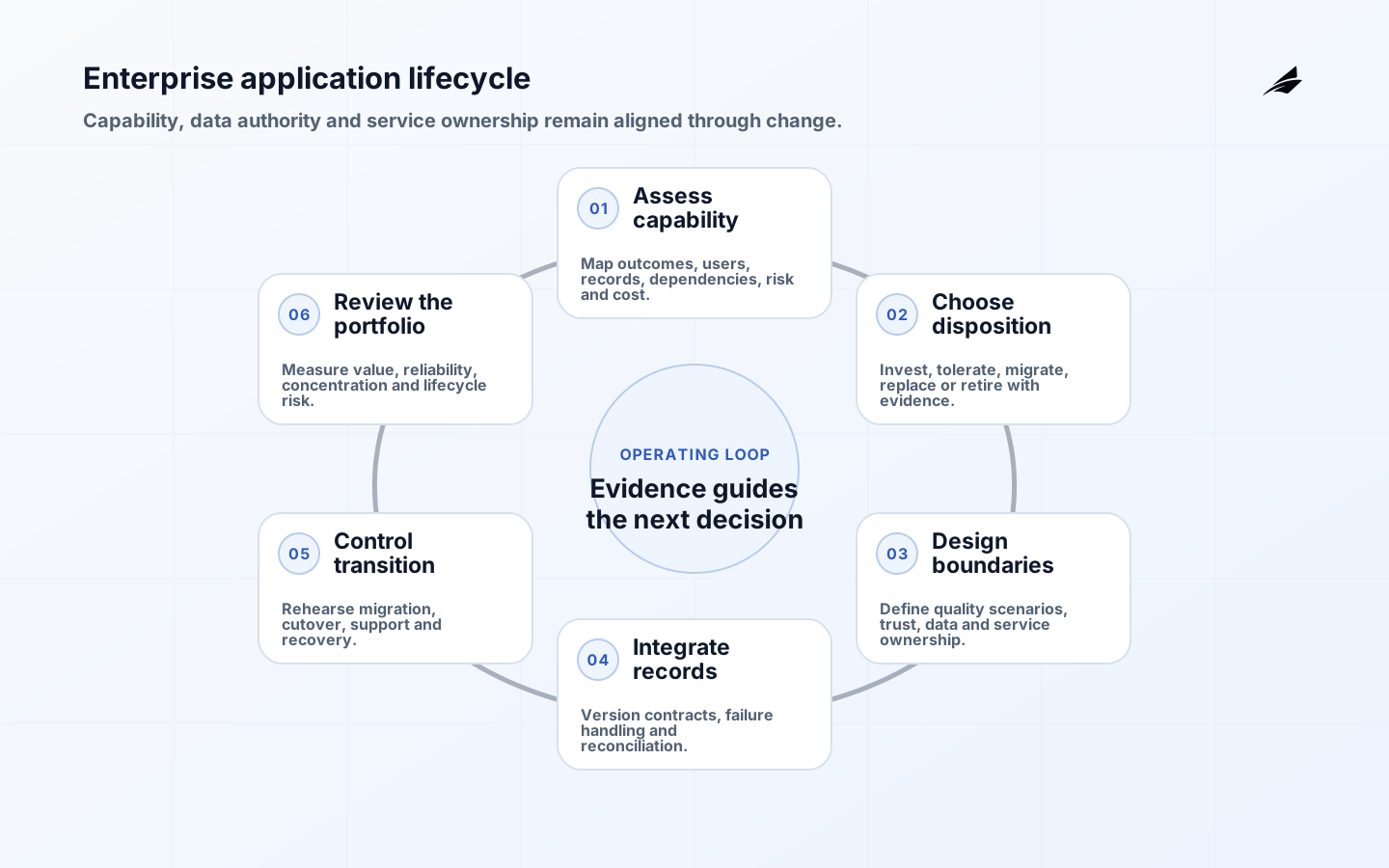
Enterprise application services cover the lifecycle work needed to plan, build, integrate, modernize, operate and retire business applications. They may support ERP, CRM, finance, HR, supply chain, portals, workflow and custom systems. The useful service boundary is not a catalog of technologies; it is a set of business capabilities, records and service levels with accountable ownership.
This FAQ complements the enterprise application services delivery plan and implementation checklist. The application services lifecycle operating model helps teams coordinate change and support after transition.
What do enterprise application services include?
A complete scope may include portfolio assessment, architecture, configuration, custom development, integration, data migration, testing, release, monitoring, support, security, vendor coordination, licensing and retirement. Specify which applications, countries, business units, interfaces, environments and support windows are covered. Separate project outcomes from recurring managed service obligations. Without that boundary, enhancement work and incident support compete invisibly.
The service should name business and technical owners. Business capability owners decide outcomes, process and acceptable disruption. Application owners manage roadmap and lifecycle. Data owners define authority and correction. Platform and integration owners manage shared services. Security and risk owners set controls. A provider can perform many activities, but the customer retains accountability for business risk and supplier oversight.
How should the application portfolio be assessed?
| Portfolio decision | Evidence to examine | Likely action |
|---|---|---|
| Invest | Strategic capability, healthy architecture, adoption and measurable value | Improve product and platform |
| Tolerate | Stable low-change service with acceptable risk and cost | Maintain with explicit constraints |
| Migrate | Valuable capability constrained by platform or operating model | Move or replatform with tested equivalence |
| Replace | Commodity capability, unsustainable customization or vendor risk | Select product and redesign process |
| Retire | Duplicate, unused or superseded capability | Archive records, remove access and decommission dependencies |
Inventory applications with capability, users, records, interfaces, technology, vendor, cost, incidents, recovery objectives, data classification and lifecycle status. Map dependencies before assigning a disposition. The TOGAF Standard provides common enterprise architecture methods and communication structures; use only the artifacts needed to make portfolio and transition decisions, and keep them tied to actual ownership.
Do not call every old system legacy or every cloud move modernization. A stable mainframe transaction may be less risky than a poorly understood replacement. Modernization should improve a measurable constraint such as change lead time, resilience, security, supportability, data access or total cost. Preserve valuable domain rules and records while changing the implementation.
How should enterprise integration be designed?
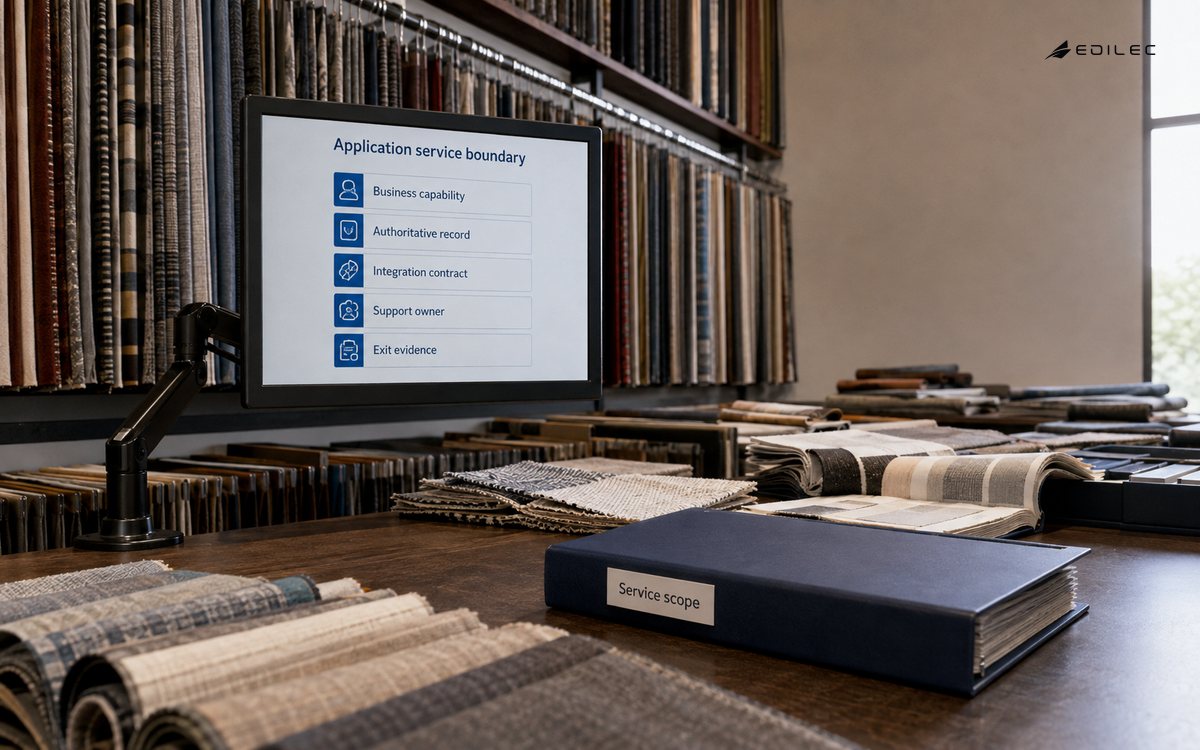
Begin with record authority and interaction requirements. For each entity and field, name the system that can create or correct it. Then choose synchronous APIs for immediate decisions, asynchronous messaging for decoupled state changes, files for bounded bulk exchange, or replication for governed analytical copies. Microsoft's integration architecture guidance distinguishes styles and services; the important decision is the contract and failure behavior, not the brand.
Version interfaces, validate payloads, authenticate workloads, set timeouts and make retryable operations idempotent. Store correlation identifiers and expose failed handoffs to operators. Define what happens when one side accepts a transaction and the other does not. Reconciliation, compensating action and human exception queues are first-class parts of enterprise integration. A success response from middleware is not proof that the business state completed.
Who owns enterprise application data?
Ownership is split by decision. A business data owner defines meaning, permitted use and quality; a system owner operates controls; a steward resolves issues; application teams implement contracts. Record the authoritative source, identifiers, validation, retention, lineage and correction path. During migration, define which system is authoritative at each cutover phase and freeze or reconcile changes accordingly.
Migration needs profiling, mapping, cleansing rules, trial runs, control totals and business validation. Preserve source extracts and transformation evidence under retention policy. Test historical dates, currencies, attachments, inactive accounts and relationships, not just current happy paths. After cutover, reconcile counts and financial or operational totals, then keep a controlled correction window.
What security controls should be built into the service?
Use federated identity, strong authentication, least privilege, separation of duties, secure workload identities, secret management, encryption, vulnerability management and auditable administrative actions. NIST Zero Trust Architecture rejects implicit trust based solely on network location. Apply explicit authentication and authorization to users, services and administrative tools across on-premises and cloud boundaries.
Evaluate product security as well as the supplier's corporate controls. CISA's Secure by Demand Guide asks software buyers to examine secure defaults, multifactor authentication, logging, vulnerability disclosure and security outcomes. Require notice and remediation terms for vulnerabilities and material subcontractor or platform changes.
How are availability and recovery defined?
| Service measure | Definition detail | Required evidence |
|---|---|---|
| Availability | Business function, observation window, exclusions and data source | Synthetic or transaction signal and incident record |
| Response | Severity, clock start, acknowledgment and ownership | Ticket and communication timestamps |
| Recovery time | Time from disruption to restored business service | Exercise or incident result |
| Recovery point | Maximum acceptable data loss by record class | Backup, replication and reconciliation test |
| Change success | Changes without rollback, incident or urgent remediation | Deployment and incident correlation |
Design service levels around user-visible work rather than server uptime. An ERP host can be up while posting is blocked. Document dependency objectives and degraded modes. The AWS Well-Architected Framework organizes operational excellence, security, reliability, performance efficiency, cost optimization and sustainability questions; use comparable cross-cutting review even when the application is not on AWS.
Backups are not recovery evidence. Restore applications and data into an isolated environment, verify credentials and keys, execute critical transactions and reconcile state. Exercise provider outage, network partition, corrupted deployment and unavailable identity service. Record decision authority for failover and the route back to normal operation.
What observability and support model are useful?
Instrument business transactions across application and integration boundaries. OpenTelemetry describes traces, metrics, logs and baggage as related signals. Use correlation IDs to follow a workflow while keeping personal data out of metric dimensions. Dashboards should show completion, error, backlog, latency, dependency health and reconciliation, not only infrastructure utilization.
Define support tiers by work, not vendor labels. State who receives users, diagnoses application behavior, changes configuration, fixes code, engages product vendors and owns a major incident. Maintain a service catalog, on-call contacts, known-error records and escalation clocks. Product teams should review recurring support demand because repeated manual fixes often reveal missing product or process work.
How should costs and contracts be compared?
Normalize one-time discovery, migration and transition separately from recurring application management. Model licenses, environments, integration transactions, data volume, observability, support coverage, enhancement capacity, vendor pass-through and exit assistance. Per-ticket pricing can discourage prevention; fixed fees can conceal assumptions. Tie commercial units to an agreed application and workload inventory, with review rules when it changes.
Contracts need service boundaries, security duties, data locations, subcontractors, evidence rights, change control, intellectual property, source access, incident notification, continuity and exit. Require export formats, documentation, credential transfer and reasonable transition support. Test exit before dependence becomes critical: can the customer retrieve code, configuration, tickets, telemetry, data and current runbooks?
What should be accepted at transition?
- Approve the application, interface, data, environment, supplier and lifecycle inventory.
- Assign business, application, data, security, platform and support decisions.
- Rehearse deployment, rollback, migration reconciliation, restore and major-incident escalation.
- Prove identity, privileged access, logging, vulnerability and administrative evidence controls.
- Validate dashboards against real transactions and route failed integrations to owned queues.
- Deliver source, configuration, architecture decisions, test assets, runbooks and exit artifacts.
Example: replacing a finance approval application
A finance team wants to replace a custom approval application while keeping ERP posting and audit history. First map request, approval, delegation, rejection, posting and correction states. Name the old application as record authority until cutover and the ERP as authority for posted accounting entries. Define API and event contracts, role separation and control totals. Migrate reference data and open requests in several rehearsals; archive closed history in an accessible, retention-controlled store.
Pilot one business unit with dual reconciliation rather than letting both systems accept unrestricted edits. Exercise unavailable ERP, duplicate posting callback, expired approver, period-close load and rollback before any irreversible state. During stabilization, compare approved requests, posted entries, failures and manual corrections every day. Handover requires the finance service owner to deploy, triage a failed handoff, revoke provider access and restore the application from documented assets.
This approach separates process redesign from technical migration. Unused custom steps can be retired, while mandatory controls remain explicit. It also creates an evidence trail for the business decision: which records moved, which rules changed, which exceptions remain and who can correct them. That is more valuable than declaring success because users can log in to the replacement.
Key takeaways
- Define enterprise application services around capabilities, records and service outcomes.
- Make portfolio disposition and modernization decisions from evidence, not application age.
- Give every integration a contract, failure policy, reconciliation and owner.
- Measure complete business service and tested recovery, not server uptime alone.
- Design supplier handover and exit before transition is accepted.
Frequently asked questions
Should an enterprise product be customized?
Customize only where the capability creates real differentiation or a mandatory requirement cannot be met through configuration. Record upgrade, testing and support consequences. Redesigning an unusual process may be cheaper and safer than preserving it in code.
Should one provider manage the whole portfolio?
A lead provider can simplify coordination but creates concentration and knowledge risk. Retain customer architecture, data, security and service ownership. Make interfaces between providers explicit and preserve independent access to code, telemetry and documentation.
Conclusion
Enterprise application services succeed when business capability, data authority and technical operation stay aligned through change. Build a factual portfolio, choose integration boundaries deliberately, rehearse transition and recovery, and keep ownership visible. The result is not merely maintained software; it is an enterprise service that can evolve without losing control of records or risk.