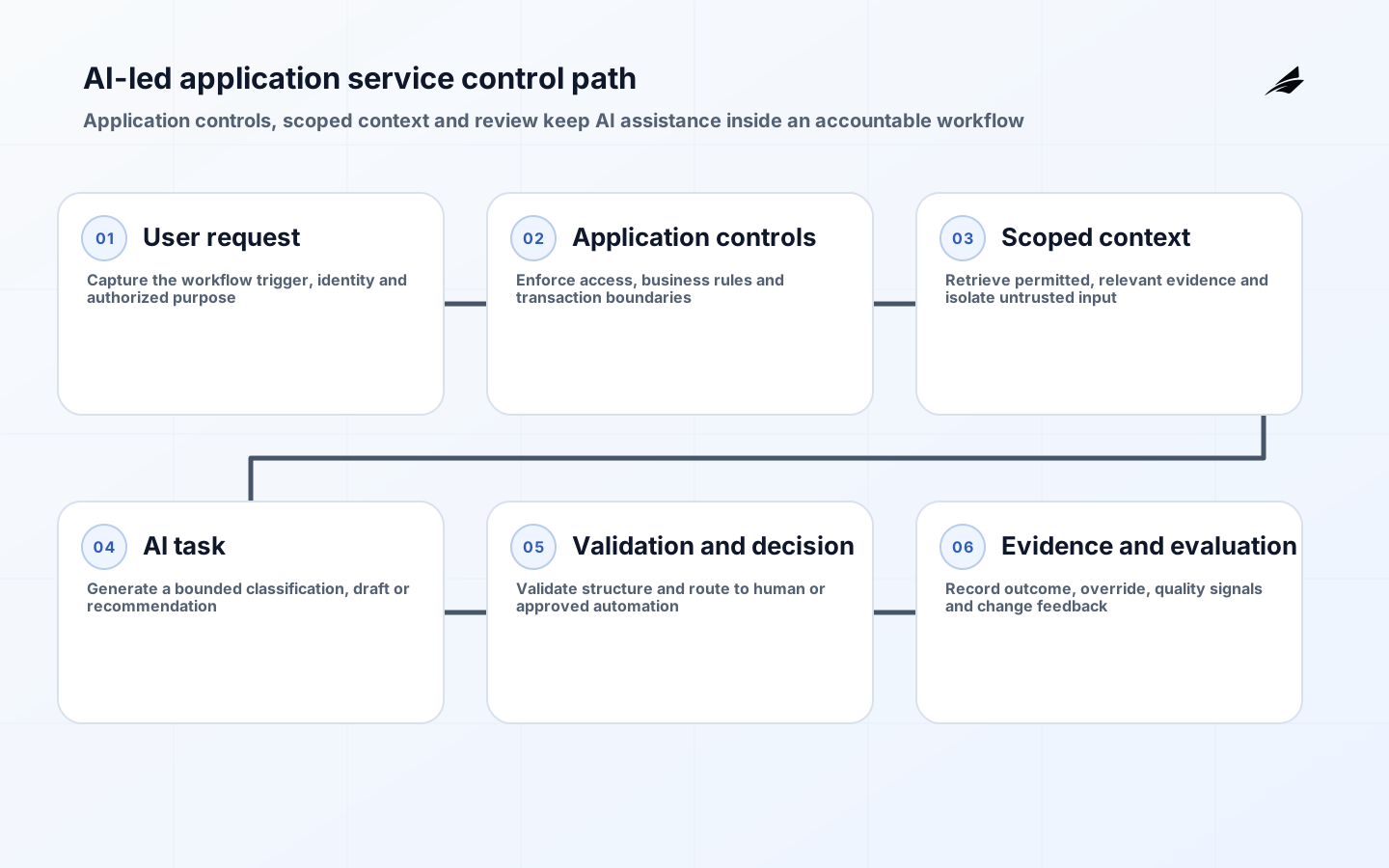
AI-led application services combine application engineering, data and model capabilities, workflow design and operational support to improve a defined business process. The useful unit of work is not "add AI"; it is a bounded decision or task whose inputs, authority, failure modes and expected benefit are understood. An assistant may help a service agent summarize a case, a developer analyze a change request or an operations team classify incoming work. In every case, the surrounding application remains responsible for records, permissions, transactions and customer commitments. Treating the model as a detached feature creates uncertainty about who owns an outcome when a suggestion is wrong, a source is missing or a downstream action should not occur.
Choose a workflow with accountable value
Start with a workflow map. Identify the user, trigger, inputs, current decisions, systems of record, exceptions, human expertise and outcome measure. Then identify where an AI capability could assist: retrieval, extraction, classification, drafting, prioritization or a constrained recommendation. The candidate is strongest when the benefit can be measured without pretending the model caused every result. A drafting aid might reduce time to prepare a response while preserving human approval; a classification aid might route work more consistently while retaining an override. Avoid beginning with broad autonomous action in a high-impact process. The first service should create evidence about usefulness and risk while keeping decisions reversible.
| Workflow question | Design implication | Evidence to seek |
|---|---|---|
| What is the trigger? | Define the event, queue or user request that starts work | Representative input examples |
| Which record is authoritative? | Keep system-of-record updates outside ambiguous model output | Source and write-path ownership |
| Who makes the final decision? | Place review or approval where impact requires it | Named role and override path |
| What can go wrong? | Specify bad output, missing context and unsafe action cases | Test scenarios and refusal behavior |
| What value is expected? | Choose a measurable operational outcome | Baseline and review cadence |
Design the application and AI boundary
The application should enforce identity, authorization, business rules, transaction boundaries and audit records. The AI component should receive only the context it needs for its bounded task and return a structured result that the application can validate. That separation is important even when a conversational interface makes the process appear seamless. A generated recommendation should not obtain rights that the requesting user lacks. A tool invocation should be constrained by an allowlist, argument validation, transaction safeguards and a record of who initiated it. Where the service retrieves enterprise content, permissions must filter retrieval before content is placed into a model context; hiding a citation after generation is not an access control.

Decide whether the capability is assistive, supervised or automated for each action. Assistive output remains a suggestion. Supervised output may prepare an action that a qualified person approves. Automated output should be restricted to cases with clear policy, bounded impact, reversibility and monitoring. These labels are not marketing tiers; they are control choices. The same component may be assistive for customer communication and automated for routine metadata tagging. Document the condition that changes the tier, such as a monetary threshold, sensitive data category, confidence signal or regulatory obligation. This lets the service evolve without silently expanding its authority.
| Boundary | Application responsibility | AI service responsibility |
|---|---|---|
| Identity and access | Authenticate user and enforce entitlements | Use only context allowed for that requester |
| Business process | Validate inputs, state and policy | Assist with a bounded interpretation or draft |
| External tools | Authorize, validate and record operations | Request allowed tool actions with structured arguments |
| Evidence | Retain transaction and decision history | Return sources, confidence signals or refusal reason |
| Failure handling | Stop, retry or route to a human | Avoid unsupported claims and unsafe continuation |
Ground data and control model behavior
Model output should be grounded in approved information where the task requires facts. Build an inventory of source systems, data classifications, freshness expectations and owners before connecting a corpus or API. Use retrieval that can preserve document-level access controls, cite the supporting material where useful and return an explicit uncertainty state when evidence is absent or conflicting. Keep instructions separate from untrusted content. Retrieved documents, user-provided attachments and tool responses may contain text that tries to redirect the model, so treat them as data rather than authority. Test for prompt injection, data leakage, unexpected tool calls and output that violates required formats or policy.
Plan integration and operational evidence
AI-led services often fail at the seams between a prototype and a business application. Plan integrations as contracts: define request and response shape, idempotency, timeout, retries, validation errors, versioning and ownership. Determine which service records the final outcome and what happens when a model call or dependent system is unavailable. A case workflow, for instance, may need to preserve the original request, the retrieved evidence, the proposed classification, human override and final status. This creates a basis for debugging and review without storing more personal or sensitive data than the process requires. Retention and access choices should be made before logs become a second uncontrolled data store.
Instrument the service around useful operating questions. Capture request type, application version, model or prompt version, source selection, tool outcome, latency, cost signals, validation results, human overrides and incident markers. Do not collect raw prompts or records indiscriminately; apply minimization, redaction and access controls. Evaluation needs both pre-release and in-production forms. A curated test set can check expected behavior before change, while sampled review and operational metrics reveal drift, new language, changing source data or misuse. Connect a poor result to a change process so teams can fix source quality, policy, prompt, integration or workflow instead of merely lowering a score.
Estimate cost and stage delivery
Cost is shaped by more than model usage. Budget for discovery, process redesign, data preparation, identity integration, retrieval or tool development, security review, evaluation, observability, user training, support and ongoing change. Per-request cost may be modest while the surrounding integration and assurance work is substantial. Compare options by total operating model: managed capability, hosted model, self-managed components or a non-AI workflow improvement can have different data, control and staffing consequences. Avoid forecasts that assume a stable input length, traffic pattern or human-review rate before the workflow has been observed in practice.
| Delivery wave | Purpose | Exit evidence |
|---|---|---|
| Discovery | Confirm workflow, authority, sources and risks | Approved boundary and representative test cases |
| Prototype | Test task utility without production authority | Documented results and failure observations |
| Pilot | Integrate a limited audience with review | Access controls, metrics and override path working |
| Production release | Operate a defined service level and change path | Acceptance tests, runbook and ownership complete |
| Expansion | Add workflows or automation only with evidence | Review of outcomes, exceptions and new risks |
Govern change and human oversight
Assign ownership across business process, application, data, model behavior, security and operations. A single product owner can coordinate the service, but no one role should quietly inherit every specialized decision. Establish review triggers for a material model change, new source, expanded tool access, altered retention, high-impact failure or changed use case. The review should ask whether the original task boundary still holds and whether current evidence supports the authority level. Human oversight works only when reviewers have the context, time and ability to challenge the result. A nominal approval click after a long queue is not a meaningful control.
Make ownership visible in the service runbook. It should identify the business owner who can change the workflow, the engineering owner for integration failures, the data owner for source issues, the security contact for suspected misuse and the operational lead who coordinates an incident. Include escalation routes for a model outage, an unsafe output, a failed downstream action and a significant quality regression. This detail prevents a common failure during early adoption: every team assumes another team owns the condition because the system spans several disciplines.
Include a service sunset path in that ownership model. When a workflow is retired, decide how users are notified, whether generated artifacts must be retained, how integrations and credentials are removed and how unresolved feedback is closed. Retirement is a normal product event, and planning it prevents obsolete AI access from remaining after the business use has ended.
Key takeaways
- Select a narrow workflow with a user, record owner, final decision maker and measurable operational outcome.
- Keep identity, authorization, business rules and transactions in the application boundary.
- Use grounded evidence, structured validation and safe refusal where factual or sensitive work is involved.
- Budget for integration, evaluation, review and support, not only model requests.
- Expand authority in stages only after operating evidence shows that the current boundary is working.
Frequently asked questions
Where should an organization start with AI-led application services?
Start with a repeated workflow where inputs, decision ownership and a useful baseline are already visible. A narrow, supervised task usually teaches more about the real process than a broad autonomous promise.
When is human review necessary?
Review is appropriate when the impact is high, evidence is uncertain, policy is contextual or an action is difficult to reverse. The design should state who reviews, what they see and how an override improves the service.
Does choosing a model determine the architecture?
No. Model choice is one component. The workflow, data boundary, application integration, access controls, evaluation and operating ownership determine whether a service can be run responsibly.
Conclusion
AI-led application services create value when they make a real workflow more capable without making accountability disappear. Keep the task boundary explicit, let applications enforce the rules that matter and treat operating evidence as part of the product. That discipline lets a team improve automation over time while preserving the controls and human judgment the business needs.