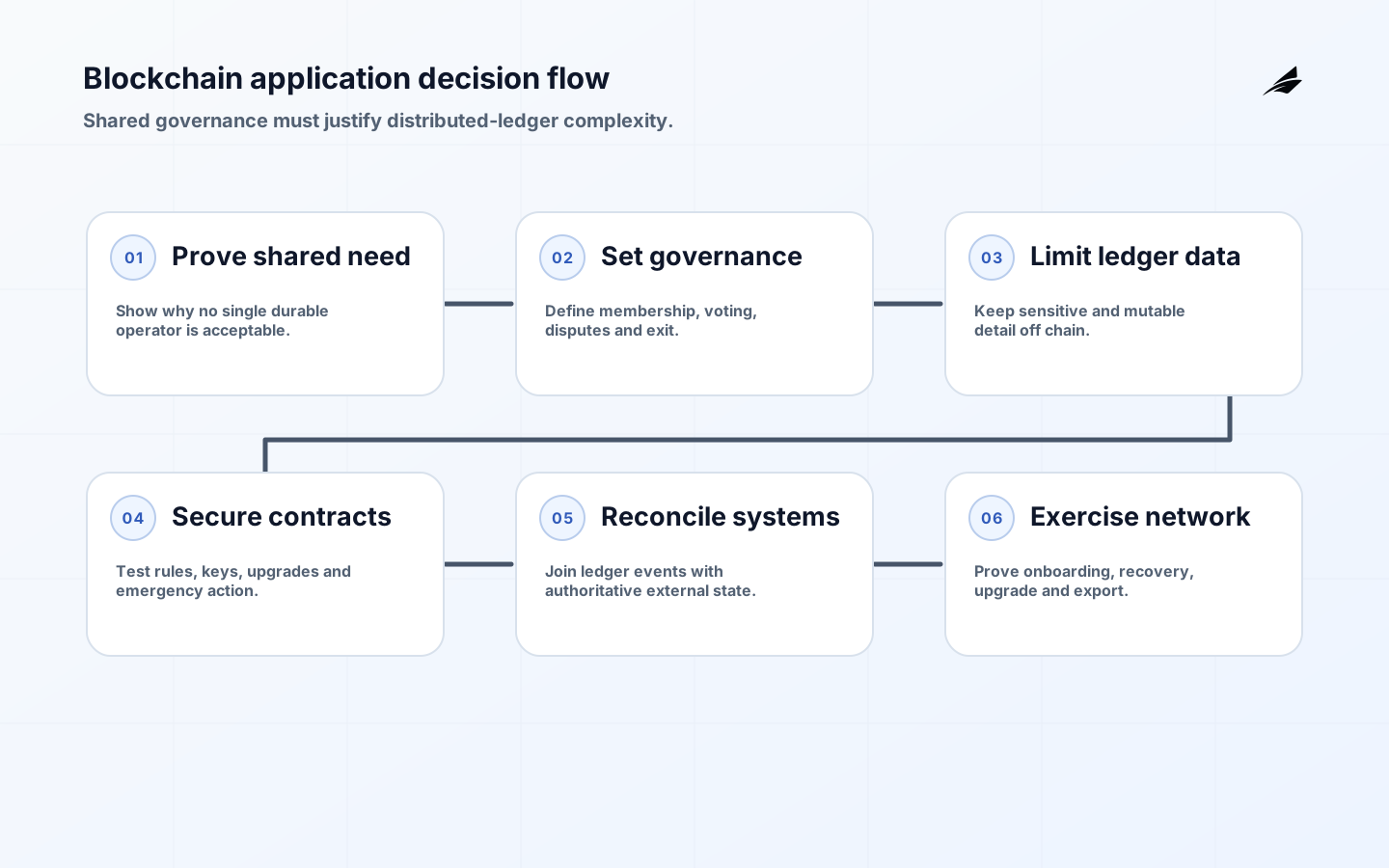
Blockchain application services are justified only when multiple parties need to coordinate records or rules, no single party should control the accepted history, and conventional shared infrastructure cannot meet the trust and governance requirement more simply. A distributed ledger adds consensus, key management, privacy, upgrade and multi-party operating costs. The buying decision should begin with those tradeoffs, not with a platform demonstration or token model.
Leaders evaluating blockchain application services can use this guide to settle scope, cost, risk, and delivery-plan decisions. The blockchain production checklist covers execution, while the blockchain application FAQ addresses focused architecture and procurement questions.
Prove that a distributed ledger fits the problem
Map participants, records, decisions, incentives, disputes and existing authorities. Ask who writes, who validates, who reads, who can correct an error and who pays. If one trusted operator can run a database with appropriate audit and access controls, that is usually easier to govern and change. Blockchain becomes more plausible when independently governed parties require a common tamper-evident sequence and cannot appoint one durable operator.
NIST's Blockchain Technology Overview describes blockchains as tamper-evident and tamper-resistant distributed ledgers and explains consensus, cryptography and limitations. Tamper resistance does not make input true. An authorized participant, compromised key or faulty sensor can record bad information. The operating model still needs identity assurance, source validation, dispute handling and correction without pretending that history can be silently erased.
| Fit question | Blockchain-favorable condition | Conventional alternative | Evidence required |
|---|---|---|---|
| Control | Several independent parties reject one owner | Shared database with neutral operator | Signed governance commitment |
| History | Common ordered record has material value | Append-only audit log | Dispute scenarios and retention need |
| Rules | Participants can agree deterministic shared rules | Workflow or integration service | Approved rule and exception model |
| Privacy | Permitted disclosure can be technically enforced | Access-controlled data exchange | Data classification and threat model |
| Performance | Required throughput tolerates consensus design | Transactional database or message bus | Representative load and finality test |
| Change | Participants can govern upgrades and exits | Single-owner product roadmap | Voting, emergency and migration procedure |
Design governance before network topology
A consortium agreement should define membership, identity authority, node obligations, software versions, endorsement or validation policy, fees, service levels, data responsibility, audit, intellectual property, incident coordination, sanctions and exit. Specify who can pause or upgrade the network and what happens when a member is unavailable or disputes a transaction. Technical decentralization without decision governance merely hides centralized power in administrators and release maintainers.
Permissioned networks can identify organizations and restrict participation, but they still need certificate issuance, revocation, key custody and separation of duties. Hyperledger Fabric's security model illustrates identity, policies and membership services in one permissioned design. Treat the documentation as platform-specific architecture, not proof that default deployment meets the consortium's legal, privacy or resilience needs.
Keep sensitive and mutable data off the ledger
Classify every proposed field. Permanent replication can conflict with confidentiality, minimization, correction, retention and deletion requirements. Prefer recording a minimal identifier, event, commitment or hash while keeping detailed records in governed systems of record. A hash can still be personal or commercially sensitive when it is linkable, and it proves correspondence only if the verifier can trust the source, canonicalization and key material.

Define the authoritative relationship between on-chain and off-chain state. Store the source system, version, timestamp, signer and retrieval rules. Plan for unavailable external data and changed schemas. If decentralized identifiers are relevant, the W3C DID Core recommendation supplies an interoperable data model, but identifier technology does not establish the truth of a credential or the governance of its issuer.
Engineer smart contracts as consequential software
Write business rules in plain language before code. Define state transitions, permissions, numerical precision, time assumptions, external dependencies, dispute paths and emergency action. Keep contracts small and deterministic. Use reviewed libraries, explicit upgrade policy, automated tests, static and dynamic analysis and independent assessment proportional to value at risk. NIST's SSDF applies to the surrounding development and vulnerability process even when execution is distributed.
Public-chain contracts have irreversible and adversarial characteristics. Ethereum's smart contract security guidance emphasizes careful design, testing, audits and disaster recovery. An audit is a point-in-time assessment, not a warranty. Protect deployment and upgrade keys, verify released bytecode, monitor privileged actions and rehearse pause, migration or compensation. Never rely on a secret embedded in contract state or code.
Scope integration and operating architecture
The ledger is one component. Scope participant applications, wallets or signing services, identity, APIs, event processing, off-chain stores, analytics, monitoring, support and interfaces to ERP, payments or physical systems. Define delivery semantics and idempotency when ledger events update external systems. An accepted transaction may still fail downstream; preserve a correlation identifier and reconciliation process rather than treating consensus as end-to-end completion.
Model failure of nodes, ordering or validation services, certificate authorities, key vaults, RPC providers, indexers and external oracles. Set finality assumptions and behavior during partitions. Back up configuration, membership and off-chain state, then test rebuild and resynchronization. Decide how a participant exits without abandoning records or private data. The enterprise blockchain scope guide adds consortium-scale planning considerations.
| Risk | Failure mechanism | Control | Acceptance test |
|---|---|---|---|
| False source data | Authorized party records an incorrect claim | Source evidence and dispute workflow | Challenge and correct a bad assertion |
| Key compromise | Attacker signs valid-looking action | Hardened custody, limits and revocation | Revoke key and preserve continuity |
| Privacy leakage | Replicated or observable metadata reveals activity | Minimized data and access design | Unauthorized participant sees no protected field |
| Contract defect | Code permits unintended state transition | Formalized rules, tests and review | Adversarial transition suite passes |
| Integration divergence | Ledger succeeds while system of record fails | Idempotent consumer and reconciliation | Replay restores equal business state |
| Governance deadlock | Members cannot approve urgent change | Emergency authority and voting rules | Exercise patch under unavailable member |
Estimate total cost and commercial exposure
Cost includes business analysis, consortium negotiation, legal review, architecture, contract and application development, security assessment, participant integration, nodes or service fees, key custody, observability, support, upgrades and dispute handling. Public networks add variable transaction fees and dependency on external infrastructure. Permissioned networks add membership and shared-operation overhead. The largest uncertainty is often participant alignment and integration, not ledger code.
Price a discovery and proof around the riskiest assumptions, then fund production in acceptance stages. State throughput, storage, participant count, transaction size, support hours and external-service assumptions. Model a conventional alternative over the same period. Require source, build instructions, contract addresses or network configuration, keys under client governance, dependency licenses, data export and an exit plan. Avoid economics that require speculative token appreciation to justify an operational service.
Deliver from governance proof to production
Stage one validates problem fit and participant commitment. Stage two specifies governance, identity, data and threat boundaries. Stage three prototypes the hardest rule and integration with representative failure. Stage four builds production controls and migrates real participants in a limited cohort. Stage five exercises operations, dispute, recovery and upgrade. Stage six expands only after service and business measures hold under actual use.
Acceptance should include onboarding and revoking a participant, submitting valid and invalid transactions, protecting private data, rotating a key, recovering a node, replaying an integration, reconciling off-chain state, applying a governed upgrade and exporting records. Client and consortium operators should perform the work. The enterprise blockchain implementation checklist provides additional production gates.
Exercise economic and governance abuse, not only technical faults. Test a member withholding validation, flooding low-value transactions, exploiting fee asymmetry, refusing an upgrade or leaving with unresolved obligations. Determine whether policies, limits and voting rules produce a timely outcome without one administrator informally taking control. Record minority rights and appeal routes. A network can remain technically available while its operating agreement becomes unusable, so consortium health needs its own measures and escalation. Track onboarding time, unresolved disputes, concentration of validation power, failed votes and overdue duties. Review whether fees and responsibilities still align with usage as membership changes. Publish these measures to members on an agreed cadence and require corrective decisions when thresholds persist. Independent review may be appropriate where one member supplies most technical operation.
Key takeaways
- Use blockchain only when shared control and shared history solve a demonstrated coordination problem.
- Set membership, voting, emergency, dispute and exit rules before platform selection.
- Minimize on-ledger data and define authority between ledger and source systems.
- Treat smart contracts, deployment keys and upgrade paths as high-consequence software.
- Test integration reconciliation and governance failure, not only consensus operation.
- Compare full lifecycle cost with a conventional architecture using the same assumptions.
Blockchain application services FAQ
Is blockchain data immutable? Published history is designed to be tamper-evident or resistant under the network's assumptions. Governance may still add corrective transactions, migrate networks or alter software. Describe the precise guarantee rather than promise absolute immutability.
Does a permissioned blockchain remove the need for trust? No. It changes how trust is distributed across identified members, policies and operators. Identity issuers, administrators, developers and governance bodies remain trusted roles.
Should personal data be stored on-chain? Usually minimize or avoid it. Assess replication, visibility, linkability, correction, retention and deletion with qualified privacy and legal advisers for the specific jurisdiction and design.
Is a smart contract audit enough for launch? No. Secure development, key custody, integration tests, monitoring, incident response, governance and recovery remain necessary before and after an audit.
Conclusion: buy shared governance, not ledger novelty
Blockchain application services earn their complexity when independent parties can operate a shared record and rule set more credibly than one owner could. Prove that need, establish governance, minimize replicated data, secure the code and keys, reconcile external systems and exercise recovery. If those conditions cannot be met, a simpler architecture is not a compromise; it is the better engineering decision.