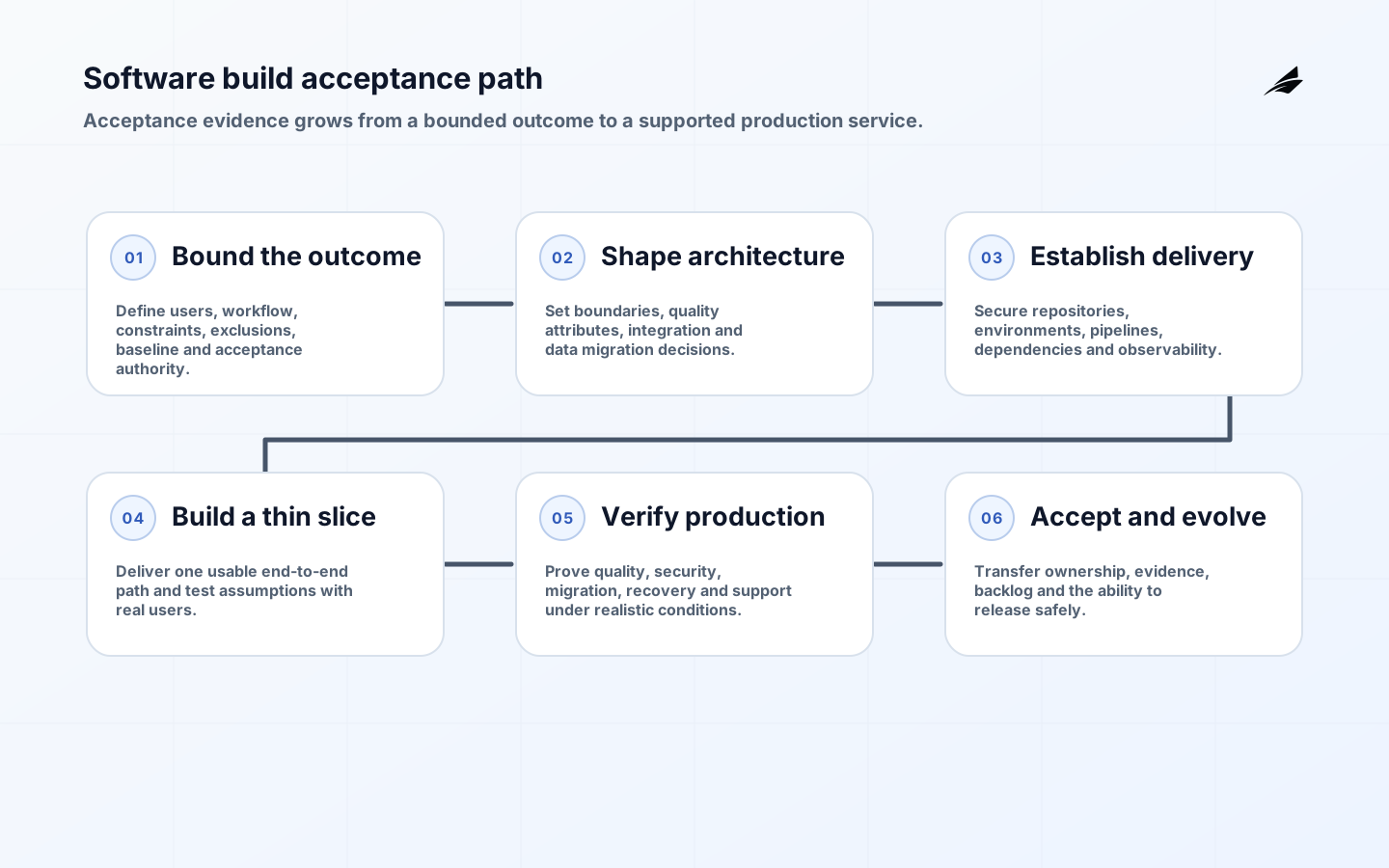
A software engineering services build should produce an operable business capability, not merely code that passes a demonstration. The build includes discovery, experience design, architecture, data and integration work, secure delivery, testing, migration, observability, release, support and knowledge transfer. Buyers need acceptance criteria for those lifecycle outcomes before work begins; otherwise schedule pressure turns missing evidence into post-launch risk.
This software engineering services build FAQ complements the scope, cost and delivery plan and software build implementation checklist. The product engineering FAQ helps when the work also needs an enduring product operating model.
What should be included in software build scope?
Define the user groups, complete workflow, business rules, records, integrations, environments, migration, controls, service levels and operating roles. Record exclusions and assumptions. Separate desired outcomes from a provisional feature list, because discovery may reveal a simpler path. Establish the baseline for task success, cycle time, error, support volume and cost so the team can prove improvement rather than only delivery activity.
Use a traceable backlog: each substantial item links to a user or control need, acceptance example and owner. Include non-functional work visibly. The ISO/IEC 25010:2023 quality model offers a vocabulary for product quality; select context-specific characteristics and turn them into measurable requirements. “Fast, secure and scalable” is not testable until workload, response, threat and growth conditions are defined.
| Scope area | Decision before build | Acceptance evidence |
|---|---|---|
| Workflow | Roles, normal path, exceptions and approvals | Observed task completion and scenario tests |
| Data | Authority, migration, retention and reconciliation | Counts, samples, lineage and signed exceptions |
| Integration | Contract, ownership, limits and failure behaviour | Contract tests and dependency-failure rehearsal |
| Quality | Performance, reliability, security and accessibility thresholds | Versioned test results in representative environments |
| Operations | Service owner, support, monitoring and recovery | Runbooks, alerts, restoration exercise and handover |
Which delivery model works best?
Use a multidisciplinary team delivering small end-to-end increments. Begin with a walking skeleton that passes through interface, service, data, integration, deployment and observation. It exposes architectural and organizational risk while changes are cheap. Then add slices by outcome and risk. Separate environments sufficiently to protect production and sensitive data, while keeping deployment mechanisms consistent.

DORA describes continuous delivery as capabilities including version control, continuous integration, deployment automation, test automation, security and observability. The objective is to keep software deployable through small, repeatable changes. A vendor sending periodic code drops into a different customer process delays integration evidence and makes final acceptance needlessly risky.
How should architecture and integrations be governed?
Create a small set of architecture decisions for system context, service boundaries, identity, data ownership, interfaces, deployment and failure handling. Record options and consequences. Prefer stable contracts over shared internal databases. APIs and events need versioning, authentication, authorization, idempotency, timeouts, retry policy, rate limits, observability and deprecation. Identify which party operates each side and who coordinates incidents.
Treat migration as a product capability. Profile source data, define transformations and exception ownership, rehearse with production-like volume, reconcile totals and critical records, and preserve rollback. Decide how changes during migration are captured. A successful import count is insufficient if balances, permissions or history have changed meaning.
What secure engineering evidence should a buyer require?
The NIST Secure Software Development Framework covers organizational preparation, protection of software, production of well-secured releases and vulnerability response. Require protected repositories, reviewed changes, least-privilege build identities, managed secrets, dependency inventory, protected artifacts, provenance, risk-based tests and a disclosure and patch process. Include infrastructure definitions, containers and pipeline code.
For web applications, agree applicable requirements from the OWASP Application Security Verification Standard before testing. Findings need reproducible evidence, context and retest. Contracts should state vulnerability notification, supported versions, third-party component duties and remediation targets. Security acceptance is a bounded evidence claim, never a guarantee of no vulnerabilities.
| Build risk | Preventive practice | Recovery evidence |
|---|---|---|
| Dependency compromise | Approved sources, inventory and artifact verification | Affected-release query and replacement drill |
| Duplicate transaction | Idempotent command and durable receipt | Replay test and reconciliation |
| Unsafe release | Automated gates, progressive rollout and rollback | Failed-release exercise |
| Data corruption | Validation, backups and change audit | Point-in-time restore and business reconciliation |
| Knowledge concentration | Shared ownership, runbooks and pairing | Independent internal release and incident exercise |
How should testing and acceptance be structured?
Use layered evidence. Unit and component tests provide fast feedback; contract tests protect boundaries; a small set of journeys verifies critical outcomes; exploratory, accessibility, performance and security testing address risks automation misses. Test degraded states and recovery. Keep test data lawful and representative. Record environment, build, data and tool versions so results can be interpreted and reproduced.
Make acceptance incremental. Demonstrate each slice to authorized business and technical owners, while reserving final acceptance for production readiness and transition. Acceptance should not waive concealed defects or unsupported operation. Define severity, warranty, remediation and dispute processes in the contract, but keep the working relationship centered on shared evidence rather than adversarial ticket accounting.
What must be ready before production and handover?
Name the service owner and on-call or support paths. Configure user-centered service indicators, actionable alerts, dashboards, logs, traces, capacity limits, runbooks and status communication. Rehearse deployment, rollback, backup restoration, dependency outage and security escalation. Confirm privacy retention, access reviews, licenses, domains, certificates and renewal ownership. Production access must use named, time-bound identities rather than shared vendor credentials.
Handover is demonstrated capability. Internal staff should build locally, review architecture, deploy, investigate an alert, restore data and make a small change before supplier departure. Transfer repositories, artifact histories, accounts, contracts, diagrams, decisions, test suites, known risks and backlog. The enterprise digital engineering checklist provides a broader transition reference.
How should cost and progress be measured?
Estimate by outcome slice and uncertainty, not false precision. Include discovery, environments, migration, integration, assurance, licenses, support and customer participation. Track burn against delivered and accepted capability. Manage scope by exchanging lower-value work rather than silently removing quality. Fixed price can suit bounded, understood work; uncertain product development needs explicit assumptions, review gates and commercial mechanisms for learning.
Use outcome, service and flow measures. The current DORA delivery metrics cover change lead time, deployment frequency, failed deployment recovery time, change fail rate and deployment rework rate. Add user task success, defects escaping, availability, support demand and unit cost. Measures belong to the service and team, not individual performance targets.
Set a governance cadence that is fast enough for delivery. Daily technical choices stay with the team; weekly demonstrations settle workflow and acceptance detail; architecture and risk reviews occur when a consequential decision is ready; monthly commercial reviews examine forecast, evidence and dependencies. Maintain one decision and risk record rather than parallel supplier and customer versions. Escalate based on impact and decision latency, not on whether an issue fits an organizational reporting line.
Control change without freezing discovery. Maintain a product backlog for outcomes and a contractual baseline for material obligations. When evidence changes the solution, document impact on value, schedule, cost, risk and acceptance, then exchange or approve scope explicitly. A change mechanism should protect both parties from hidden work while allowing the team to stop low-value features. Measure unresolved decisions and external dependency age because they often constrain delivery more than coding throughput.
After launch, run a stabilization period with explicit entry and exit criteria. Monitor journeys, incidents, support demand, performance, data reconciliation and security findings at higher frequency. Keep build specialists available while the receiving team leads diagnosis and release. Exit stabilization when service objectives are sustained, critical defects are closed or accepted, documentation is verified through use, and ordinary ownership no longer depends on exceptional supplier access.
Keep an evidence index for acceptance. It should link requirements to demonstrations, automated results, security findings, migration reconciliations, accessibility reviews, operational exercises, residual risks and approvals for the exact release. Record limitations and expiry where evidence depends on a temporary environment or supplier version. This prevents a final scramble through chat threads and makes later audits or enhancements much easier.
Key takeaways
- Scope the entire operable workflow, including data, controls, exceptions and support.
- Deliver a production-shaped thin slice early and integrate continuously.
- Turn quality and security expectations into versioned, testable acceptance evidence.
- Rehearse migration, failure, rollback and restoration before launch.
- Complete handover only when the receiving team can operate and change the service.
Frequently asked questions
Can a custom software build use a fixed price?
Yes for well-understood scope with stable dependencies and testable acceptance. For uncertain work, fix time or investment around discovery and staged options. Hidden contingency and rigid change control can make a nominal fixed price more expensive than transparent learning.
Who should own the source code?
The contract should state rights clearly. Most buyers also need continuous repository access, build instructions, dependency rights and the ability to operate and modify the service. Source ownership alone is weak if artifacts, accounts or knowledge remain inaccessible.
When is the software build done?
When agreed user outcomes and quality thresholds are met, production operation is evidenced, residual risks are accepted, and ownership is transferred. Products continue evolving, so “done” usually closes the build engagement while opening a funded operating lifecycle.
Conclusion
A software engineering services build succeeds when scope, delivery and acceptance describe the same operable outcome. Early end-to-end delivery exposes risk; secure automated pipelines make change repeatable; layered testing makes quality visible; rehearsed operations and handover preserve value. Contract for evidence and capability, then govern the build through working software and production-shaped demonstrations.