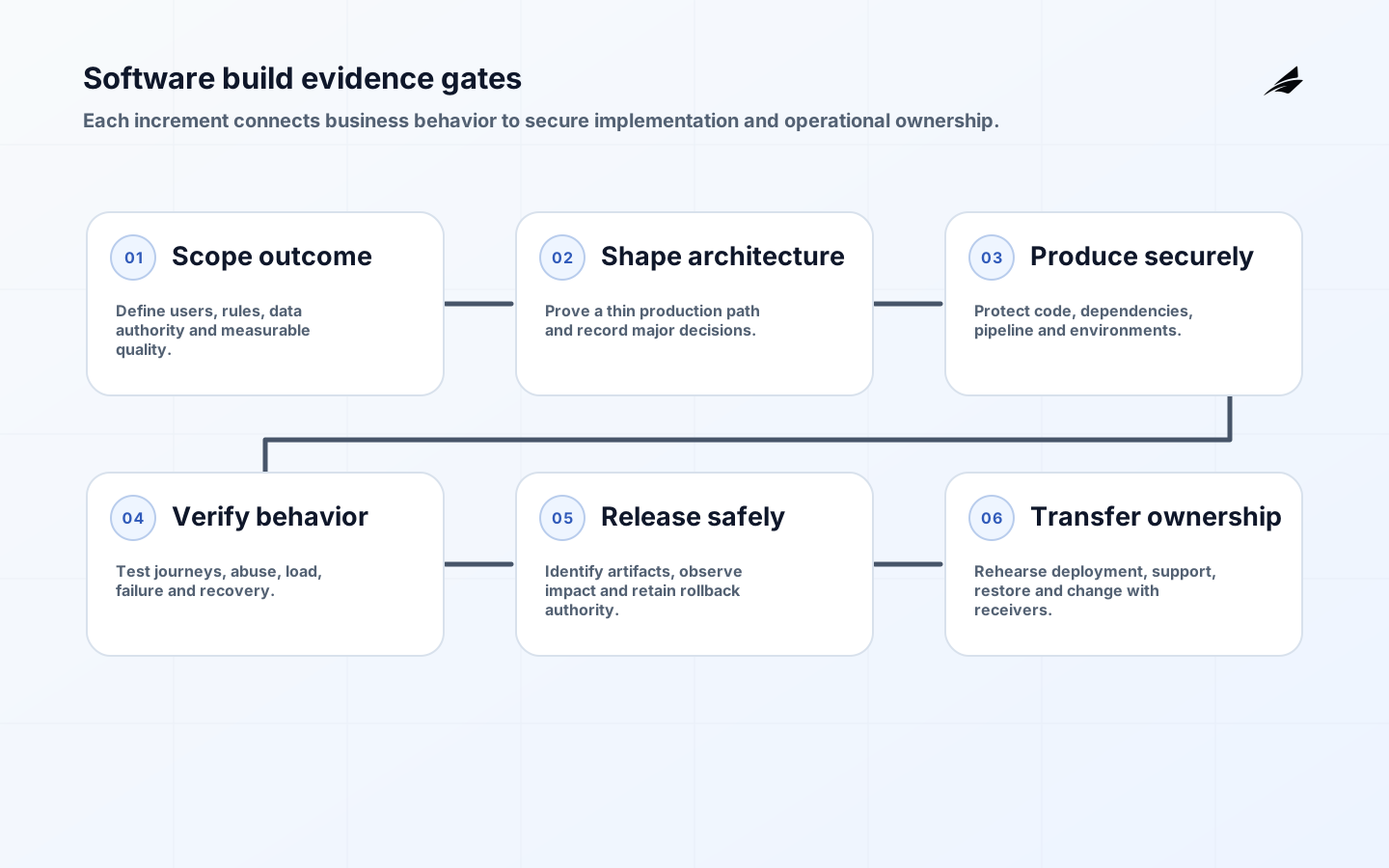
A software engineering services build succeeds when it creates a usable product and leaves the client able to operate, change and verify it. Code volume, sprint count and a polished demonstration are weak proxies. The build needs a controlled path from problem evidence through architecture, implementation, security, testing, release and handover. This checklist is for product owners and engineering leads who need explicit acceptance evidence without turning delivery into a document-production exercise.
Before implementation, align this checklist with the build scope and risk plan, the software build FAQ and the enterprise digital engineering checklist. Keep one accountable product owner on the client side; a supplier cannot resolve conflicting business priorities by technical judgment alone.
1. Turn the problem into a testable build scope
Describe the users, decisions and transactions the product must support. Map the current workflow, delays, exceptions and harmful failure modes. Then choose the smallest coherent release that can complete an outcome end to end. A list of screens is not a scope because it omits data authority, rules, integrations, roles and operational behavior. State exclusions and assumptions, especially around data migration, third-party access, compliance review, content ownership and support.
Write acceptance examples in business language. For an approval workflow, include a routine approval, rejection, delegated limit, duplicate request, stale permission and system outage. Identify quality constraints using a model such as ISO/IEC 25010:2023, which includes characteristics beyond functionality. Select measurable priorities such as accessibility, reliability, performance efficiency, security, maintainability and compatibility. Not every characteristic needs the same depth, but unspoken quality expectations become late disputes.
| Scope object | Question to answer | Acceptance evidence |
|---|---|---|
| User outcome | What can a named user complete? | Observed end-to-end scenario |
| Business rule | Who may do what under which conditions? | Positive, negative and boundary tests |
| Data authority | Which system owns each field and state? | Approved mapping and reconciliation |
| Quality attribute | How well must the product behave? | Measured threshold under a stated workload |
| Operational boundary | Who supports, restores and changes it? | Runbook exercise and ownership sign-off |
2. Establish architecture and decision records
Choose architecture from the product boundary, expected change and operating constraints. Define modules, data model, integration contracts, identity flow, deployment topology and failure boundaries. Prefer the simplest design that meets known requirements and can evolve through clear interfaces. Record consequential decisions with context, options, choice and consequences. Decision records make later change easier because a team can challenge the original assumptions instead of treating the architecture as unexplained convention.
Build one walking skeleton early: a thin production-shaped path through interface, domain logic, persistence, authorization, telemetry and deployment. It exposes missing access, environment and integration decisions while change is inexpensive. Use representative data without copying uncontrolled production records. Define API errors, idempotency and timeouts before integration code spreads. For asynchronous work, document delivery guarantees, retry limits, dead-letter handling and reconciliation ownership.
3. Build security into the development system
NIST's Secure Software Development Framework groups practices around preparing the organization, protecting software, producing well-secured software and responding to vulnerabilities. Apply those ideas to the actual build: protect repositories and pipelines, require reviewed changes, manage dependencies, separate environments, scan artifacts and retain provenance. CISA's secure-by-design work emphasizes shifting avoidable security burden away from customers. Do not charge extra for essential controls such as secure defaults, supported authentication or vulnerability handling.
Create a threat model around assets, trust boundaries and abuse cases. Translate applicable risks into testable requirements, using OWASP ASVS as a structured source for web application verification rather than an indiscriminate checklist. Verify server-side authorization, input handling, session behavior, secrets, audit events and privacy constraints. Triage findings by exploitability and impact, assign owners and block release when the accepted threshold is exceeded. A scanner result without context or remediation ownership is not a security process.
4. Deliver vertical slices with reviewable evidence
Organize work into vertical slices that produce observable user value, not separate months for database, API and interface layers. Each slice should include tests, telemetry, documentation changes and deployment behavior. Demonstrate against acceptance examples with representative users. Keep a short decision log for changed assumptions and maintain a release forecast as evidence changes. Incremental delivery reduces exposure by making integration and usability problems visible before the full budget is committed.
Use code review to examine correctness, clarity, security and operability. Automate formatting and routine checks so reviewers can focus on behavior. Define branch, merge and artifact policies that fit the team, then make the pipeline the only normal route to controlled environments. DORA research connects strong software delivery performance with technical and organizational capabilities; use deployment frequency, change lead time, change failure rate, recovery time and reliability as diagnostic signals, not individual targets or performance scores.
5. Test behavior, quality and failure recovery
Build a layered test portfolio. Fast unit and component tests protect domain behavior; contract tests protect integration assumptions; focused end-to-end tests protect critical journeys. Add accessibility, performance, security, migration and recovery tests according to risk. Keep test data deterministic and cover permissions and exceptions. A high coverage percentage can coexist with weak behavioral assurance, so trace critical risks and acceptance examples to specific tests and observed results.
Test production-shaped failure: dependency timeout, duplicate event, partial migration, expired token, exhausted quota, unavailable region and rollback. Verify the user-facing response, operator signal and recovery action. Run performance tests with a stated workload model, data size, ramp pattern and threshold. Record environment differences that could invalidate results. Defects found after a requirement or dependency change should update the regression suite, not merely close a ticket.
| Gate | Minimum evidence | Release-blocking example |
|---|---|---|
| Behavior | Critical scenarios pass with representative roles | Incorrect approval or financial result |
| Security | Threat controls verified and findings triaged | Authorization bypass or exposed secret |
| Performance | Target workload meets latency and error thresholds | Sustained overload without protection |
| Recovery | Backup, rollback or reconciliation exercise succeeds | Unrecoverable state transition |
| Operations | Telemetry, alerts and runbooks work in rehearsal | No owner or signal for material failure |
6. Release with observability and rollback ownership
Prepare a release record containing artifact identity, included changes, database actions, configuration, approvals, test evidence, known limitations, monitoring plan and rollback or forward-fix decision. Prefer small, reversible changes. Use feature controls where they reduce exposure, but govern their ownership and removal. Database changes often need expand-and-contract sequencing because application rollback cannot undo destructive schema changes safely. Define who can stop a release and who makes the decision during an ambiguous signal.
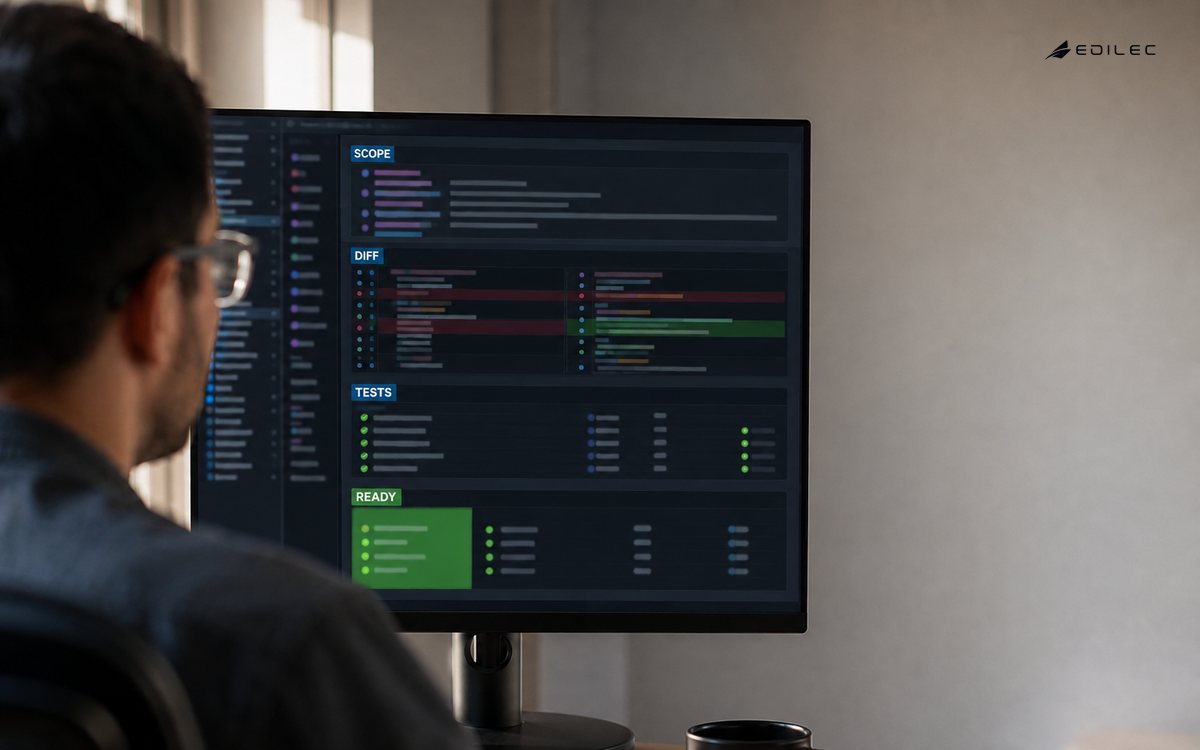
Observe the release through user outcomes, technical health, security events and business reconciliation. Set a defined observation window and compare against a baseline. A deployment is not accepted merely because containers remain running. Check transaction completion, error distribution, queue age, authorization denials, support contacts and data totals. If rollback occurs, preserve evidence and communicate impact before resetting the environment. Follow with a blameless review that creates owned improvements.
7. Complete handover and establish change ownership
Handover begins during discovery, not in the final week. Client engineers and operators need repository access, environment knowledge and decision context while the system is being shaped. Maintain concise architecture, data, integration, deployment, support and recovery documentation alongside changes. Rehearse a normal deployment, access change, incident diagnosis, restore and dependency update with the receiving team leading. Missing credentials, personal supplier accounts and undocumented manual steps must block final acceptance.
Agree the post-launch model: warranty defects, enhancement intake, vulnerability response, service levels, dependency maintenance, ownership of cloud spend and data retention. Transfer source, infrastructure definitions, pipeline configuration, artifact history, licenses and third-party contracts. Remove supplier access that is no longer required and time-bound the rest. Establish a backlog based on observed product outcomes rather than reopening every deferred idea. The product is ready when the accountable team can operate and change it safely.
Key takeaways
- Scope complete user outcomes, business rules, data authority and quality constraints.
- Use a production-shaped walking skeleton to expose architecture and access gaps early.
- Protect the software factory as carefully as the application and verify risk-based controls.
- Release small vertical slices with behavioral, failure and operational evidence.
- Make the receiving team lead rehearsals before final handover acceptance.
Frequently asked questions
Can a software engineering build use a fixed scope?
Yes, when the outcome, dependencies and acceptance rules are well understood. Keep an explicit change mechanism and contingency because discovery still occurs. For uncertain products, fix the investment window and decision cadence while allowing lower-value scope to change.
How much documentation is enough?
Enough for a competent receiving team to understand consequential decisions, deploy, support, recover and modify the system without relying on one person's memory. Verify usefulness through rehearsal. Generated pages that nobody can use do not satisfy that goal.
Who should approve production acceptance?
The accountable product owner should accept business behavior, while engineering, security and operations owners accept their risk boundaries. No single technical sign-off can substitute for business accountability, and a committee should not obscure who can accept residual risk.
Keep a concise acceptance ledger throughout delivery. For each material requirement, record the current evidence, reviewer, decision and any expiring exception. This prevents launch week from becoming a search across tickets and chat, and it gives the receiving team a truthful starting point for future change. The ledger should link to durable artifacts rather than duplicate them.
Conclusion
A strong software engineering services build creates a chain of evidence from problem to operation. Define testable outcomes, choose a proportionate architecture, secure the delivery system, deliver vertical slices, test failure, release reversibly and rehearse ownership transfer. The result is not merely software that passed a demonstration; it is a product the client can trust, run and improve.