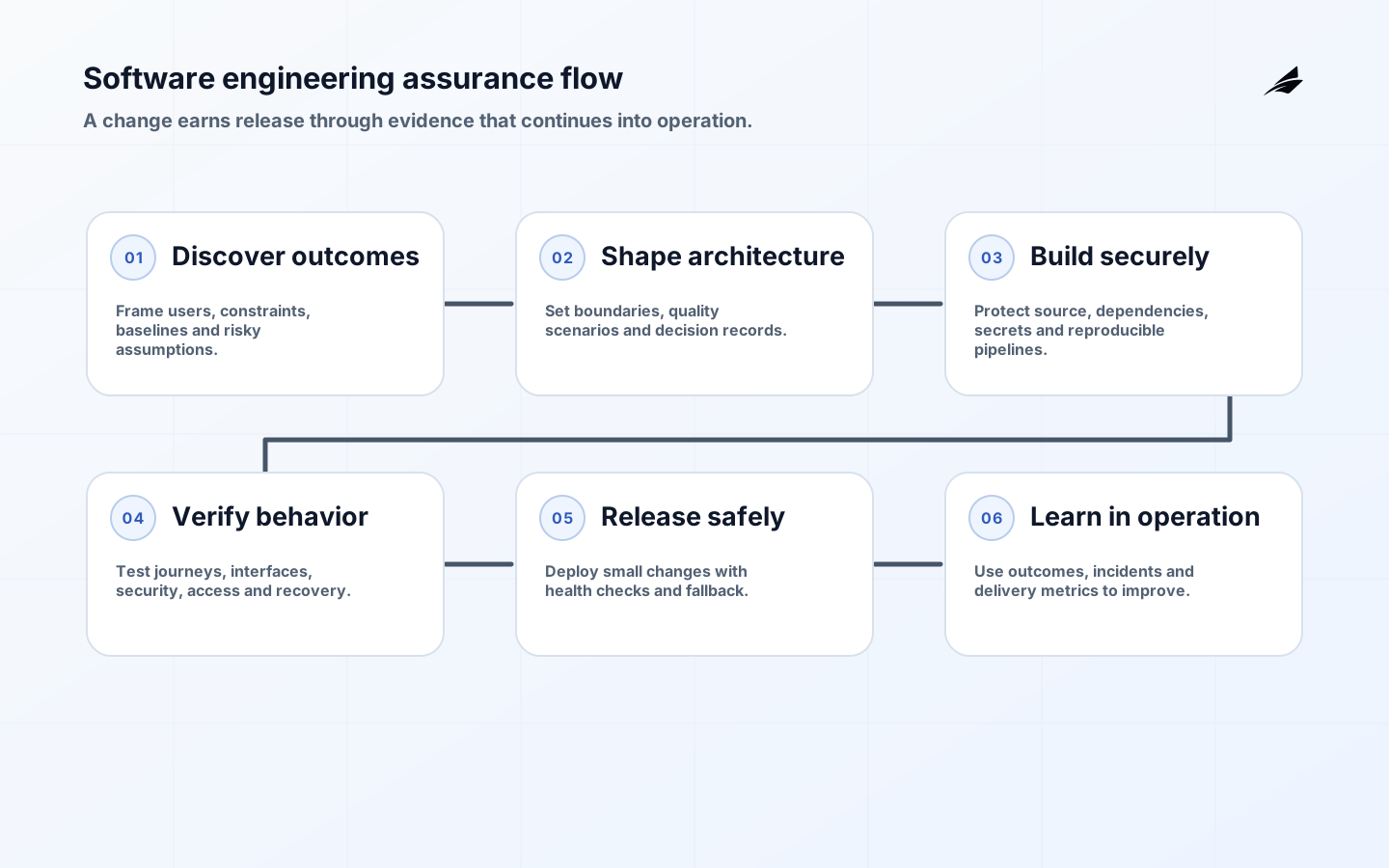
Software engineering services help an organization discover, build, modernize or operate software with an accountable delivery team. The service may cover product design, architecture, application development, integration, testing, cloud delivery, security and reliability. Value does not come from purchasing developer hours alone. It comes from turning uncertain needs into small, observable changes while protecting users, data and the customer’s ability to own the resulting system.
This FAQ complements the software engineering services delivery plan, the implementation checklist and the digital engineering lifecycle FAQ. Use it to compare proposals, define acceptance and establish a working relationship that survives changing requirements.
What do software engineering services include?
A well-scoped service can include problem discovery, user research, product management, interaction design, architecture, development, data migration, integration, quality engineering, security, platform automation, observability, release, support and modernization. Not every project needs every discipline full time. The provider should explain which outcomes it owns, which specialists are available, which customer decisions are dependencies, and which activities are excluded. Generic promises of end-to-end delivery are not a substitute for a responsibility map.
Distinguish product scope from team scope. Product scope describes users, workflows, systems, data, quality attributes and target outcomes. Team scope names roles, capacity, cadence and decision rights. A team can be stable while the product backlog changes. Conversely, a fixed feature list can fail if nobody owns architecture, security, release and operation. Define both, then set a change mechanism that protects budget and evidence without pretending all details are knowable at contract signature.
| Service model | Best fit | Main control |
|---|---|---|
| Outcome-based project | Bounded release with clear acceptance and limited uncertainty | Milestones tied to working evidence and explicit assumptions |
| Dedicated product team | Evolving roadmap that needs stable cross-functional capacity | Outcome review, backlog governance and transparent throughput |
| Staff augmentation | Customer already owns product, architecture and delivery management | Role clarity, code review and integration into customer controls |
| Managed application | Established system needs support plus planned change | Service objectives, incident/change controls and technical debt policy |
| Discovery engagement | Problem, feasibility or architecture is not yet understood | Time-boxed decisions, prototypes and a go/no-go recommendation |
What should happen before implementation?
Identify users, business outcome, present workflow, constraints, risks and baseline. Map systems, data, permissions and operational ownership. Write a small number of testable hypotheses and choose the thinnest end-to-end slice that can validate them. Discovery should reduce a decision, not produce an ornamental document set. Useful outputs include a prioritized journey, context diagram, quality-attribute scenarios, delivery risks, release approach, rough cost range and evidence needed for the next funding decision.
Validate difficult assumptions early: third-party API limits, legacy data quality, identity boundaries, peak load, regulatory records, offline behavior or a novel model. A prototype can test feasibility, but label throwaway code and data. Do not quietly turn an insecure demonstration into production. Link the approved direction to the digital engineering implementation checklist when the work crosses multiple enterprise systems and operating teams.
How should delivery be organized?

Use a cross-functional team able to take a change from decision to operation. Keep work in small vertical slices that include user behavior, data, integration, tests, security and telemetry. Maintain one prioritized backlog with acceptance examples and risk notes. Integrate frequently, review working software with users, and release through automated, reproducible pipelines. Feature completion without deployability creates hidden inventory; deployment without user validation creates fast waste.
Architecture should guide change through documented decisions and boundaries, not create a separate approval theater. Record quality attributes such as availability, latency, privacy, accessibility, maintainability and recovery with measurable scenarios. Prefer established platform capabilities and simple interfaces. Isolate volatile dependencies and preserve migration paths for consequential choices. Review architecture against actual production evidence, because diagrams age quickly when ownership and deployment behavior are not connected.
- Name product, engineering, architecture, security and operations decision owners on both customer and provider sides.
- Define done to include review, automated tests, security checks, documentation, observability and deployability.
- Protect main branches, require attributable review and keep production changes traceable to approved work.
- Use representative lower environments while controlling sensitive data and environment-specific secrets.
- Release small changes with feature controls, health checks, rollback or forward-fix criteria and clear support ownership.
- Reserve capacity for defects, dependency updates, reliability and technical debt rather than allowing roadmap work to consume every cycle.
How is secure software development assured?
Security belongs in requirements, design, implementation, verification, release and vulnerability response. NIST’s Secure Software Development Framework groups practices around preparing the organization, protecting software, producing well-secured releases and responding to vulnerabilities. Map relevant SSDF practices to the delivery workflow and evidence. A provider should show how developer access, source, build systems, dependencies, secrets, tests, artifacts and vulnerability reports are controlled.
Protect the supply chain as well as application code. SLSA v1.2 is an approved software supply chain specification with source and build tracks, increasing assurance levels and provenance formats. Select a target based on risk rather than claiming a level casually. Generate a component inventory, pin and review dependencies, scan continuously, sign important releases, preserve provenance and define vulnerability disclosure and remediation. The OpenSSF secure development guide provides a practical baseline for these controls.
What does a credible quality strategy look like?
Test behavior at the cheapest reliable layer: focused unit and component checks, contract tests at service boundaries, integration checks for real infrastructure, and a small set of critical end-to-end journeys. Include negative, authorization, concurrency, performance, recovery, upgrade and migration scenarios. Control test data and eliminate flaky tests by fixing root causes, not retrying indefinitely. Preserve failure diagnostics. Manual exploratory testing remains valuable for novel behavior and usability even when regression is automated.
Accessibility is a product requirement, not a final scan. W3C recommends WCAG 2.2 for current applicability and defines testable success criteria across full pages and responsive variations. Set the required conformance target with legal and product owners, use semantic components, test keyboard and assistive-technology journeys, and include people with relevant disabilities in research. Automated tools find only part of the problem; human evaluation is still needed.
Who owns reliability after release?
Assign a service owner, on-call or support route, severity model, service objectives, escalation, incident authority and recovery responsibilities before launch. Instrument user journeys and critical dependencies with logs, metrics and traces. Dashboards should show user impact, not only infrastructure utilization. DORA’s observability guidance emphasizes customer-experienced state and the ability to debug unknown problems. Developers need production evidence and a controlled path to investigate it.
Rehearse restore, dependency failure and rollback. Record incidents as timelines of observations, decisions and actions, then improve code, tests, alerts and runbooks. A managed service contract should separate acknowledgement, diagnosis, mitigation and restoration and identify pause conditions caused by customer dependencies. Availability guarantees are meaningful only when scope, measurement source, exclusions and remedies are explicit. Ensure logs, cases and runbooks remain accessible if the provider relationship ends.
| Measure | Useful definition | Avoid |
|---|---|---|
| Outcome adoption | Target users completing the intended workflow successfully | Counting registered accounts as value |
| Change lead time | Commit to production for the measured service | Combining unrelated applications |
| Deployment frequency | Successful production deployments in context | Demanding one universal target |
| Change fail rate | Deployments requiring immediate intervention | Hiding hotfixes outside the denominator |
| Recovery time | Time to recover from a failed deployment | Using ticket closure as restoration |
| Escaped defect impact | User or business harm from production defects | Raw defect count without severity or exposure |
How should delivery performance be measured?
Measure product outcomes and delivery health together. DORA’s current software delivery metrics use a five-metric model: change lead time, deployment frequency, failed deployment recovery time, change fail rate and deployment rework rate. Apply them to one application or service in context and trend over time. They are diagnostic outcomes, not individual targets. Pair them with user success, reliability, security, accessibility and cost.
Use evidence to find constraints. If lead time is high, inspect review queues, environment wait, test duration and batch size. If rework rises, examine requirement clarity, change size and production learning. Never use story points to compare teams or infer business value. Publish definitions and data quality. A provider dashboard should allow the customer to inspect underlying changes and incidents rather than presenting an unexplained productivity score.
How should price, ownership and exit be handled?
Cost depends on uncertainty, team composition, integrations, migration, quality attributes, compliance, release cadence and support. Compare proposals using the same scenarios and customer dependencies. Time-and-materials can fit evolving work if governance is strong; fixed price fits bounded outputs with stable acceptance; a dedicated team fits a changing roadmap. Whichever model is used, expose rates or unit assumptions, one-time setup, cloud and license costs, support, travel, taxes and change treatment.
The customer should have timely access to source, issues, designs, infrastructure definitions, pipelines, test assets, artifacts, credentials under customer control, component inventories and operating evidence. Define intellectual-property rights and open-source obligations. Test a handover before the final month. Exit should revoke provider identities, rotate secrets, transfer open incidents and risks, export records in usable formats and verify deletion. A healthy provider relationship earns continuity through performance, not technical captivity.
Key takeaways
- Scope product outcomes and team responsibilities separately, with explicit customer decisions and exclusions.
- Deliver small end-to-end changes through one team that can build, release and learn from production.
- Integrate secure development, supply chain controls, accessibility and recovery into the definition of done.
- Use product outcomes and contextual delivery metrics to improve the system, never to rank individuals.
- Preserve customer ownership of code, evidence, environments and operational knowledge throughout the engagement.
Frequently asked questions
Is a dedicated team better than a fixed-price project?
Neither is universally better. A dedicated team suits an evolving roadmap and rewards learning, while fixed price can suit a bounded migration or release with stable acceptance. Risk allocation on paper does not remove uncertainty. Choose the model that matches how often scope decisions will change and how actively the customer can govern them.
Should the customer own the source repository?
Usually yes for custom software. Customer-controlled repositories and cloud accounts improve continuity, evidence and access governance. The provider can work through least-privilege roles. If a provider platform or pre-existing component is licensed instead, document that boundary, source access, escrow or continuity options, data portability and what happens at termination.
Can AI coding tools reduce the quoted team size?
They can accelerate some tasks, but output still requires requirements, design, review, testing, security and operational ownership. Ask how tools are approved, what data they receive, how generated code is reviewed and how provenance or licensing risk is handled. Price the accountable outcome and demonstrated throughput, not an assumed universal productivity percentage.
Conclusion
Good software engineering services create a delivery capability as well as a product. They clarify outcomes, make architecture and risk visible, automate repeatable assurance, release in small increments and learn from real use. Contracts should support that work with transparent responsibilities, evidence and customer ownership. When those conditions are present, an external team can extend engineering capacity without weakening long-term control of the system.