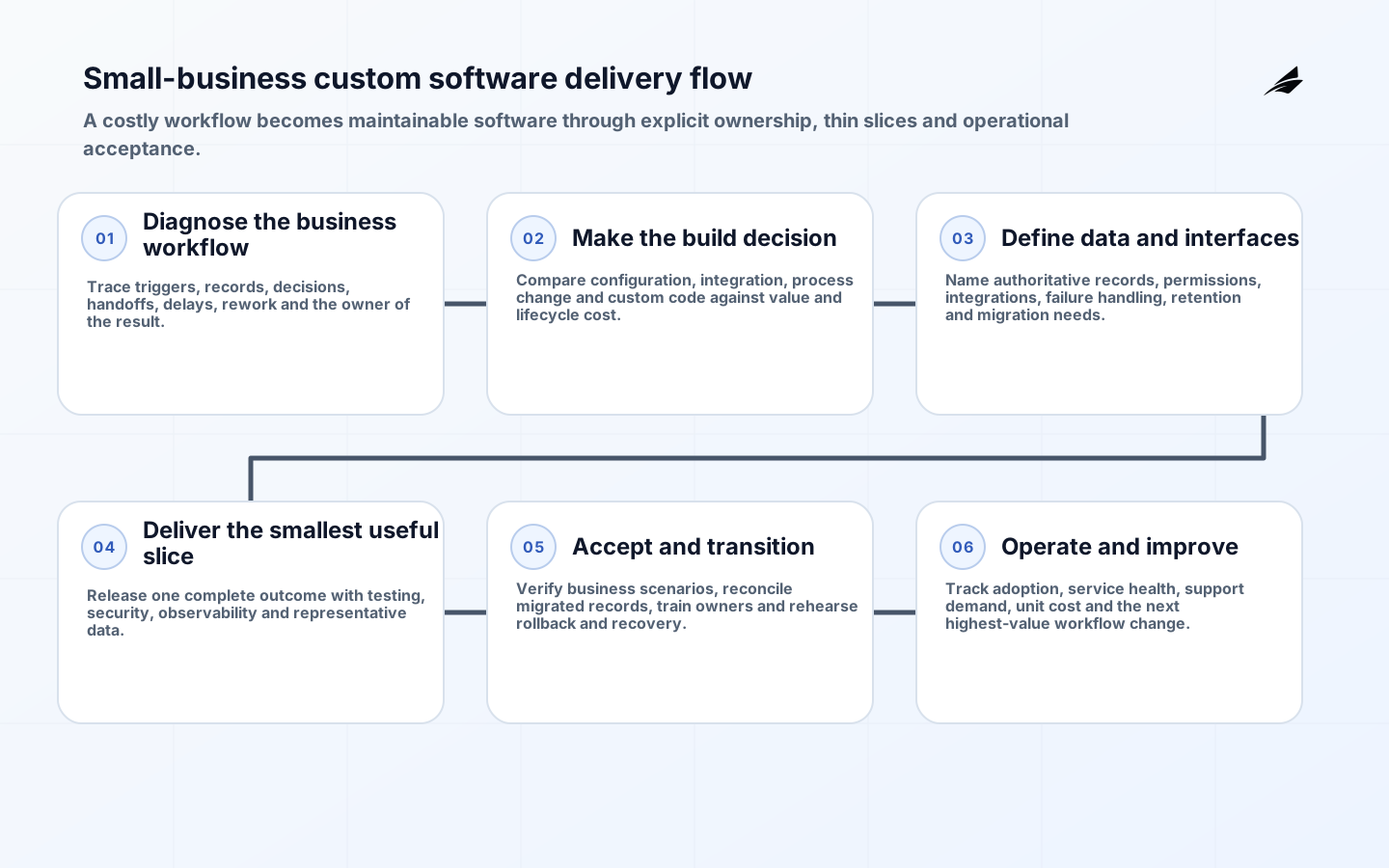
Custom software development services for small business are justified when an important workflow cannot be supported well by configuration, integration or a suitable product. Custom code creates flexibility, but it also creates an asset the business must fund, secure, operate and eventually replace. The implementation checklist therefore starts with the workflow and ownership, not a feature wishlist. It helps a small team turn informal decisions, spreadsheets and handoffs into software without locking critical knowledge inside one vendor or developer.
Use the companion small-business custom software FAQ for procurement questions and the broader custom software implementation checklist for engineering controls. A growing company can compare the startup delivery plan. Complete each gate with evidence and an owner; do not treat every line as mandatory bureaucracy for a low-risk tool.
Confirm that custom software is the right option
Describe the current workflow, users, records, decisions, volume, exceptions, handling time and failure cost. Identify what is genuinely distinctive. Compare process improvement, existing software, low-code configuration, integration and custom development. Include switching and operating cost, not only initial price. A custom customer portal may be justified by a unique service model; rebuilding ordinary accounting because staff dislike one screen usually is not.
Set a measurable outcome and stop condition. Examples include reducing duplicate data entry, cutting approval delay, giving customers accurate status or eliminating reconciliation errors. Name the business owner who can decide policy and accept the workflow. If nobody owns definitions, access or exceptions, software will encode disagreement rather than solve it.
| Decision | Evidence | Do not proceed when |
|---|---|---|
| Workflow value | Baseline time, error, delay or customer impact | The problem is rare or has no accountable owner |
| Product fit | Documented comparison with existing tools | A configurable product meets the need at lower lifecycle cost |
| Integration feasibility | API, export, identity and data-right review | A critical system cannot provide supported access |
| Operating capacity | Named support, security and budget owners | The business cannot fund maintenance and continuity |
| Exit path | Data export and repository ownership | Records or source would remain trapped with the supplier |
Turn daily work into acceptance requirements

Observe representative staff and customer journeys. Write scenarios with trigger, role, authoritative record, decision, completed state and exception. Prioritize the smallest end-to-end slice that creates value. Include nonfunctional needs: security, privacy, accessibility, performance, availability, backup, retention and audit. Define what good looks like in examples a business owner can review, not only technical tickets.
Control scope by outcomes and explicit exclusions. A first release might accept requests, route approval, update one record and show status; advanced reporting and broad automation can wait. Identify seasonal peaks, mobile conditions and external dependencies. Record decisions in plain language. Requirements should evolve with evidence, but changes must show their effect on budget, schedule and risk.
Select a supplier while preserving business ownership
Interview the people who will perform the work. Ask for examples of discovery, architecture, testing, deployment, incidents and handover. Verify company identity, references, subcontracting and access location. The contract should cover intellectual property, confidentiality, data processing, security, accessibility, repository and cloud ownership, warranty, support, vulnerability response, termination and data return. Avoid paying entirely in advance for a long speculative scope.
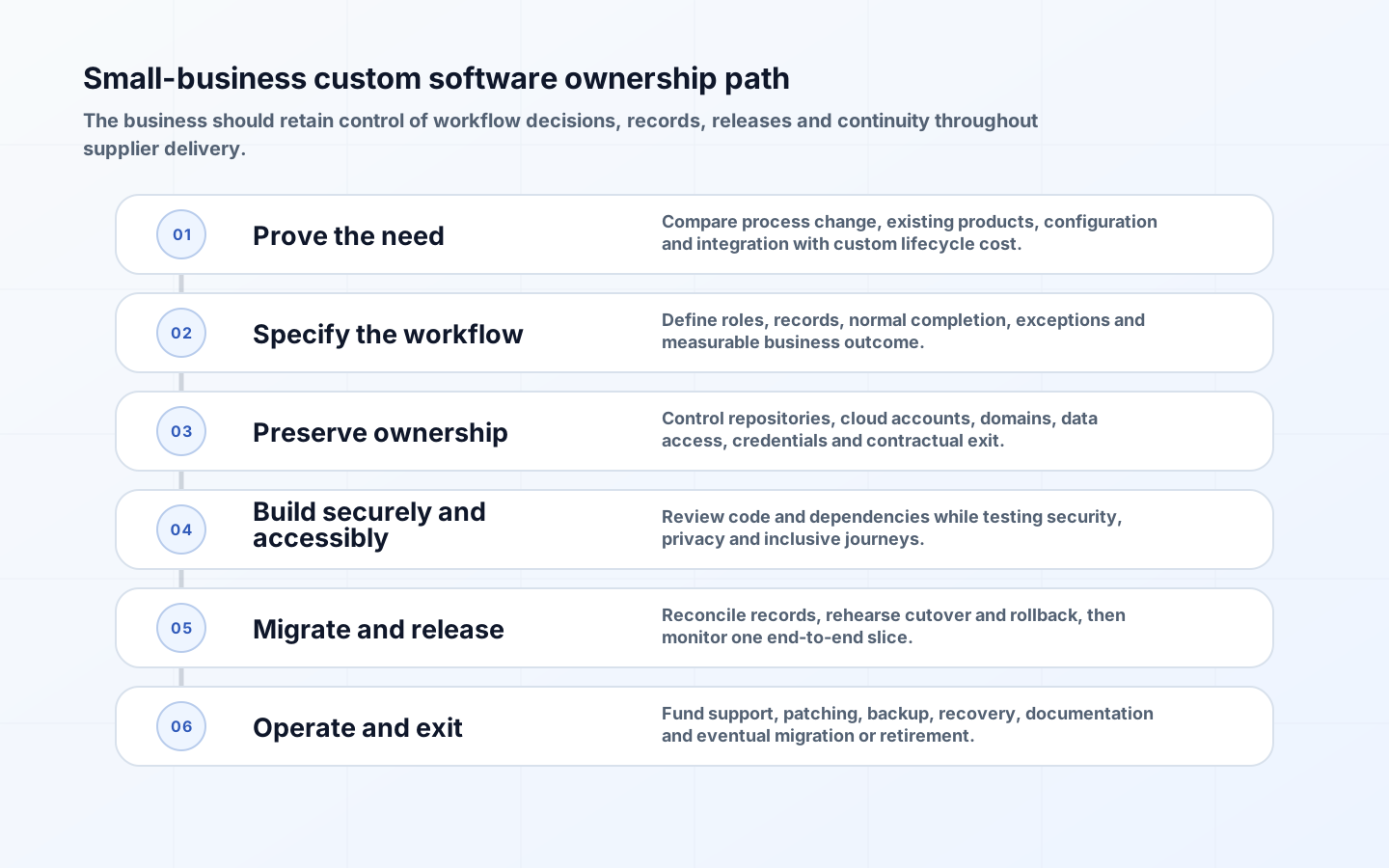
Keep source code, issue history, designs, infrastructure definitions and credentials in business-controlled accounts where feasible. Use role-based access and remove it promptly when people leave. Require documentation as part of accepted increments. At least one internal owner should understand the architecture and release process. Vendor expertise is valuable; vendor captivity is not an operating strategy.
Build security and accessibility into delivery
Use NIST SSDF practices appropriate to the system: protect source and build environments, review changes, manage dependencies, test security requirements and respond to vulnerabilities. OWASP ASVS can provide a verifiable baseline for web application controls. Threat-model the actual workflow, including account takeover, excessive access, unsafe file upload, injection, lost devices and administrator misuse. Encrypt sensitive data, minimize collection and test backup restoration.
Apply WCAG 2.2 principles from design through testing. Ensure keyboard access, visible focus, labels, understandable errors, adequate contrast, responsive layouts and alternatives for meaningful media. Include staff with real devices and constraints in acceptance. Security and accessibility defects are expensive when discovered after workflows and components have hardened.
| Delivery gate | Required evidence | Owner |
|---|---|---|
| Architecture | Data, identity, integration and recovery boundaries | Technical lead and business owner |
| Secure build | Reviewed source, dependency record and security tests | Supplier engineering lead |
| Usability and access | Representative journey and accessibility results | Product owner and users |
| Migration | Reconciled records, cutoff and rollback rehearsal | Data owner |
| Production | Approved artifact, monitoring and recovery runbook | Service owner |
Migrate and release without losing business records
Inventory source records, owners, duplicates, retention and legal constraints. Define mappings and reconciliation totals. Rehearse migration with production-like volume and preserve rejected records for review. Decide whether old and new systems run in parallel, whether writes are frozen, and who authorizes cutover. A rollback plan must explain what happens to changes created after cutover, not merely how to redeploy code.
Release progressively when possible. Monitor errors, latency, workflow completion and customer contacts. Give users a visible support route and keep manual continuity for critical work. Verify backups by restoring a representative dataset and completing a journey. Record the production version and configuration so incidents can be reproduced. Do not declare completion until staff can operate the new process during ordinary failures.
Fund maintenance, support and eventual exit
Assign ownership for hosting, monitoring, account administration, updates, certificates, backups, incidents and vendor contact. Budget recurring infrastructure, licenses, support and improvement. Review service health and unresolved defects monthly. Patch supported dependencies and retire unused integrations. Keep a prioritized backlog based on business outcomes rather than collecting every request.
Test continuity if the supplier is unavailable. Confirm access to source, environments, domains, data export, documentation and credentials. Maintain a second qualified contact for critical systems. Define retirement triggers and export formats from the beginning. Software is an operational asset; responsible ownership includes the ability to migrate away when cost, risk or business direction changes.
Plan for business adoption explicitly. Identify who changes procedure, who receives training and how old spreadsheets or duplicate entry will be retired. Run a controlled period where exceptions are captured and resolved, not simply worked around. Measure whether staff use the supported path and whether customers receive a consistent result. A technically successful application can fail commercially when informal work remains faster or when managers continue asking for reports from the old source.
Protect business continuity during supplier transition. Maintain current architecture, data dictionary, deployment instructions, dependency inventory and recovery contacts. Schedule a periodic restore and release performed with internal participation. Confirm domain, certificate, payment and messaging accounts are not tied to a former employee. If source escrow is appropriate, remember that code alone is insufficient without data access, configuration, build tooling and operational knowledge.
Use a quarterly value review after stabilization. Compare the original baseline with workflow completion, errors, handling time, customer outcomes, support demand and operating cost. Retire features that add maintenance without measurable use. Fund improvements that remove recurring manual exceptions or risk. This review helps a small business avoid treating every historical request as permanent product scope and keeps the software aligned with current operations.
Document financial controls when software affects quotations, invoices, payroll, inventory or payments. Define calculation ownership, approval limits, effective dates, duplicate protection and reconciliation with the accounting record. Separate administrator capability from ordinary transaction roles. Test refunds, cancellations, partial failure and period close. Small businesses often discover these controls late because one trusted employee previously handled exceptions informally; implementation should make the authority visible without making routine work unusable.
Review regulatory and contractual obligations with qualified advisers for the actual industry and location. The development supplier can implement agreed controls but should not invent retention, consent, tax or professional-practice policy. Record the source and owner of each material rule and the date it was reviewed. When requirements change, assess data, workflow, customer communication and historical records together rather than patching one screen. Keep legal interpretation separate from technical evidence so reviewers can see which control implements which approved requirement. Reconfirm obligations before entering a new market or customer segment. Preserve approvals with the release record. Review insurance, incident-notification and data-breach duties with the same care, then assign a tested contact route. Review it annually and after incidents.
Key takeaways
- Build only when the workflow value exceeds product and lifecycle alternatives.
- Translate real journeys and exceptions into testable acceptance.
- Keep repositories, data access and critical accounts under business control.
- Include security, accessibility, migration and recovery in the first plan.
- Budget support, maintenance and exit as part of the product—not as surprises after launch.
Frequently asked questions
| Question | Answer |
|---|---|
| How much should a small business build first? | One complete workflow slice that proves value and operating assumptions; postpone features that do not change the first outcome. |
| Should the cheapest quote win? | No. Compare total scope, evidence, communication, rework, ownership, support and exit cost. |
| Who owns the source code? | The contract should state ownership and third-party licenses; the business should retain practical repository and build access. |
| Is cloud hosting maintenance-free? | No. Managed services reduce some tasks, but access, configuration, cost, backup, monitoring and application security remain owned work. |
| When is handover complete? | When internal owners can build, release, diagnose, restore and obtain support using current documentation and controlled credentials. |
Conclusion
Custom software development services for small business can turn a painful, distinctive workflow into a durable advantage when scope and ownership are disciplined. Prove the need, deliver one end-to-end slice, protect data and users, rehearse migration and recovery, and keep an exit path. The best implementation fits daily work and remains understandable long after the initial project team leaves.