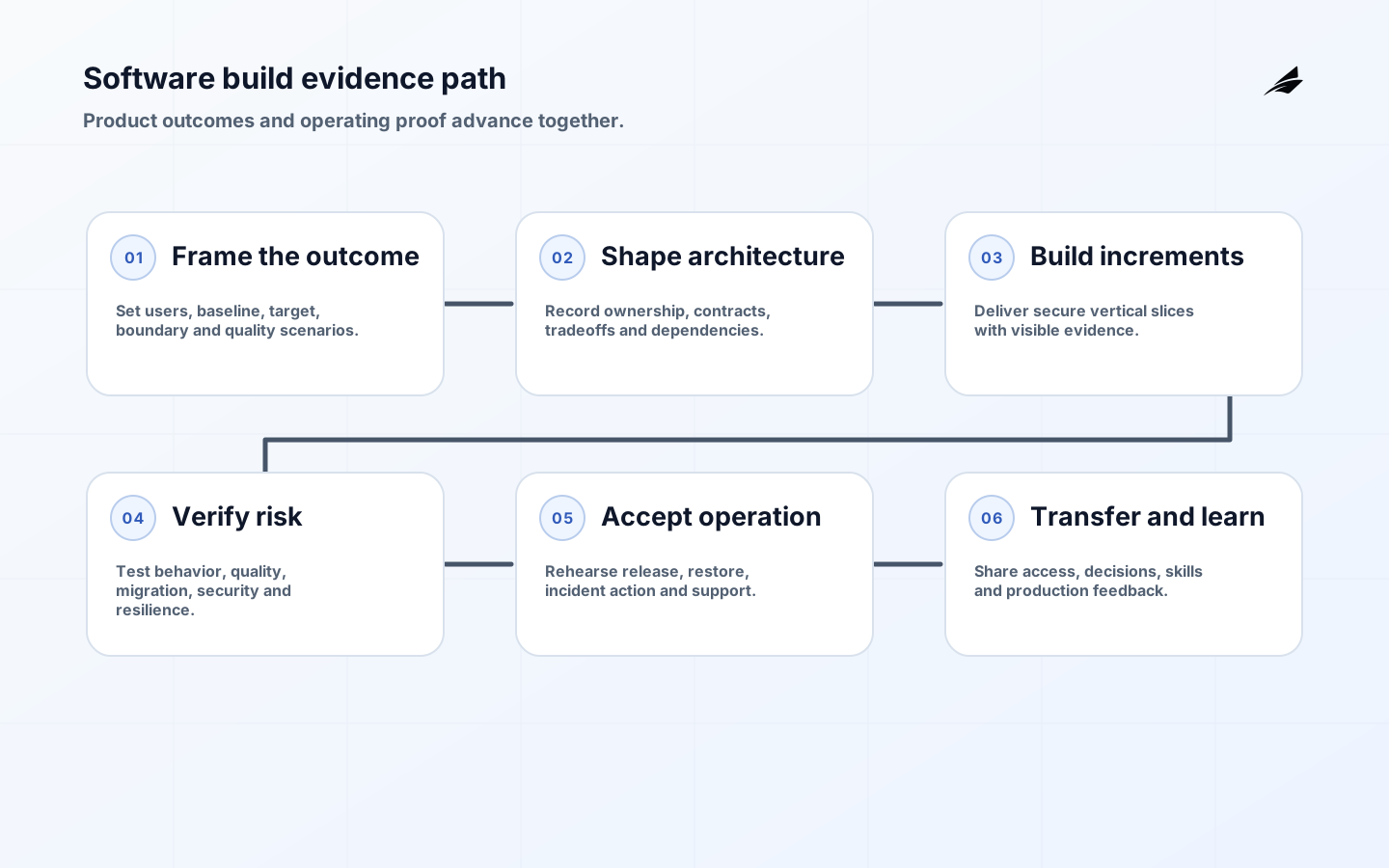
A software engineering services build should convert a product or operational goal into software that the customer can change, run and recover. The engagement includes discovery, architecture, implementation, verification, release, documentation, support and knowledge transfer. It is not complete when a provider demonstrates features in its own environment. This delivery plan explains how to scope outcomes, price uncertainty, control engineering risk and accept an operable service.
Use the software engineering build checklist, build services FAQ and broader software engineering services plan. The customer should own product decisions and acceptance; the provider may supply capacity and specialist judgment. Clear decision rights prevent an agile backlog from becoming an unbounded contract.
Define scope as outcomes, users and quality scenarios
Start with users, jobs, current baseline and measurable change. Describe which journeys and business rules are in scope, the systems and data they touch, and the cases explicitly deferred. Add quality scenarios for availability, performance, security, privacy, accessibility, resilience, supportability and change. “The system must be scalable” cannot be accepted; a peak profile with latency, error and recovery objectives can.
Create a dependency map and decision log. Record owner, contract, environment, volume limit, test route and fallback for every material external service. Identify authoritative records and correction paths. Resolve whether the provider can change adjacent systems, when customer reviewers are available, and who supplies test data. Unowned dependencies are a common source of schedule claims that neither party can validate.
| Scope layer | What to specify | Acceptance evidence |
|---|---|---|
| Outcome | Population, baseline, target, measurement period and owner | Measured pilot or production result |
| Functional boundary | Journeys, rules, states, exceptions and exclusions | Scenario demonstrations and automated checks |
| Quality | Load, recovery, security, accessibility and operability scenarios | Reproducible test and exercise records |
| Dependencies | Interfaces, owners, limits, failure modes and test access | Contract tests and fallback behavior |
| Handover | Repositories, environments, rights, documentation and skills | Customer team performs release and recovery |
Choose architecture through explicit tradeoffs
Design the smallest architecture that satisfies known quality scenarios and permits likely change. Define service and module boundaries around business ownership, not vendor fashion. Record significant decisions, alternatives, consequences and review triggers. Prefer standard protocols and portable data formats where they reduce exit risk. A modular monolith may be safer than distributed services for a small team; a managed service may justify lock-in when its operational advantage is explicit.
Run a thin end-to-end increment through interface, business logic, data, observability and deployment before scaling parallel work. This exposes missing access, environment and integration assumptions while change is inexpensive. Maintain versioned interface schemas and consumer expectations. Decide compatibility and deprecation rules before several clients depend on them. Architecture governance should unblock teams with principles and evidence, not turn every implementation choice into a committee.
Build secure increments with customer-visible evidence

Organize delivery around small vertical slices that a product owner can evaluate. Each increment should include code, tests, telemetry, migration effects, documentation and security work necessary for its risk. Demonstrate working behavior in a customer-accessible environment and update the forecast using actual throughput and discovered complexity. Keep acceptance criteria stable inside a short iteration while allowing the backlog to evolve through governed tradeoffs.
Apply the NIST Secure Software Development Framework to prepare people and environments, protect software, produce well-secured releases and respond to vulnerabilities. The provider should use attributable identities, protected branches, peer review, dependency controls, managed secrets and reproducible pipelines. OWASP SAMM helps teams assess and improve assurance activities proportionately instead of claiming one tool makes development secure.
- Keep repositories, issue history, pipeline results and architecture decisions accessible to the customer from the start.
- Define completion to include review, tests, security, documentation, telemetry and accepted product behavior.
- Generate a software bill of materials and monitor dependencies according to product risk and support status.
- Protect build identities and artifacts; use SLSA concepts to reason about provenance and tampering resistance.
- Use production-like, privacy-safe test data and explicitly approve any use of sensitive records.
- Track defects to root causes and improve requirements, design or pipeline controls rather than only patching instances.
Estimate cost and choose a commercial model
Cost is driven by uncertainty, integration, data migration, quality requirements, platform constraints, team composition and handover obligations. Discovery reduces uncertainty but cannot remove it. Build a range from team cost and plausible duration, then include cloud environments, licenses, specialist security and accessibility review, migration, training and contingency. Compare total cost to operate and change, not only provider development fees.
Use fixed price for understood, bounded deliverables with objective acceptance; use capacity or time-and-materials where priorities and learning will change. A capped discovery followed by rolling forecasts often provides useful control. Tie payments to evidence and accepted increments rather than lines of code. Keep change control lightweight but explicit: record the decision, outcome impact, cost or schedule effect, alternatives and approver.
| Risk | Early signal | Commercial or delivery control |
|---|---|---|
| Unclear product fit | Stakeholders cannot prioritize journeys or define success | Short discovery and prototype with a stop decision |
| Integration uncertainty | No representative environment or contract owner | Paid technical spike before the full estimate |
| Quality debt | Features pass demos but fail load, security or recovery | Quality evidence included in completion and payment |
| Provider dependence | Customer lacks repository, deployment or architecture access | Continuous access and staged paired handover |
| Schedule pressure | Scope grows while the forecast date remains fixed | Tradeoff register and confidence-based forecast |
| Operational gap | No service owner, alerts or recovery rehearsal | Operational acceptance gate before traffic expansion |
Prove release and operational readiness
Use layered verification: static and component checks for fast feedback, contract and integration tests for boundaries, selected end-to-end journeys, exploratory testing, accessibility review, security analysis and realistic performance and resilience tests. Test migrations forward and backward where rollback is possible; otherwise rehearse roll-forward correction. Acceptance records should identify artifact, environment, dataset, result, exception, owner and date.
Treat deployment as a secured engineering process. The OWASP SAMM secure build practice emphasizes repeatable builds and dependency awareness, while secure deployment addresses automation, verification and secrets. Rehearse release, rollback, restore, incident coordination and provider unavailability. A customer operator should execute the runbook while provider engineers observe and correct documentation.
Operate, learn and complete handover
Define service indicators from user journeys and critical dependencies. Instrument latency, errors, saturation, queue age, business reconciliation and security events with runbooks and owners. Review production feedback with product outcomes, support contacts and incidents to reorder work. Do not use deployment frequency as a target detached from safety or value; the delivery system exists to make useful change routine and recoverable.
Handover is progressive capability transfer. Pair customer engineers during architecture, coding, release and incident work; rotate ownership; maintain decisions and operating records; and test provider access revocation. Final acceptance should confirm intellectual-property rights, third-party licenses, credentials, accounts, artifacts, data exports, known debt, supplier contacts and vulnerability response. Retain support only where responsibilities and exit remain clear.
Key takeaways
Practical example: a customer commissions a claims intake service with an uncertain legacy interface. The parties fund a short discovery and technical spike before committing to the full forecast. The first vertical slice accepts one claim type, validates it, writes the authoritative record, emits telemetry and deploys through the intended pipeline. Acceptance includes a contract test against a representative legacy environment, an accessible error journey and restoration from backup. The provider exposes repository and pipeline access from day one, while customer engineers execute the second release. When an integration limitation appears, the tradeoff register shows the cost of an adapter, scope reduction and schedule change so the product owner can choose explicitly.
- Scope outcomes, representative journeys, quality scenarios and dependencies in testable terms.
- Use thin end-to-end increments to expose architecture and environment assumptions early.
- Protect source, dependencies, pipelines and artifacts as part of the delivered product.
- Price uncertainty openly and connect payment to accepted evidence rather than activity volume.
- Rehearse release, migration, recovery and incident response before production expansion.
- Transfer access, decisions and operating skill continuously so the customer can sustain change.
Frequently asked questions
How long does a software engineering services build take?
Duration depends on outcome, uncertainty, integrations, quality and decision speed. A small production slice may take weeks; a regulated multi-system service may require many months. Ask for a discovery range, milestone evidence and forecast confidence. A precise distant date without resolved dependencies is presentation, not planning.
What team roles are needed?
A typical team needs product authority, domain expertise, engineering, quality, design and operational capability, with security, privacy, data and accessibility specialists according to risk. Roles may be combined on a small product, but accountability cannot be omitted. The customer must supply timely product and record decisions.
Who should own the source code?
The contract should state ownership, licenses and access for source, infrastructure code, tests, documentation and generated artifacts. Customers usually need continuous repository access and durable rights to operate and modify commissioned software. Review third-party and open-source obligations separately with qualified counsel.
Conclusion
At each commercial milestone, review a compact evidence pack: accepted journeys, quality results, architecture decisions, dependency changes, forecast range, spend, defects, risks and handover progress. The product owner decides whether to continue, change priority or stop; finance can see remaining exposure; engineers can see what must be true for release. Include work removed from scope as clearly as work completed. This cadence protects both parties: the customer is not surprised by accumulated uncertainty, and the provider is not expected to absorb every new discovery inside an obsolete estimate.
A successful software engineering services build is an evidence-producing operating capability. Define the outcome, make architecture decisions visible, deliver secure vertical slices, price uncertainty honestly, prove production readiness and transfer capability throughout. That produces software the customer can trust and a delivery system it can continue to use.