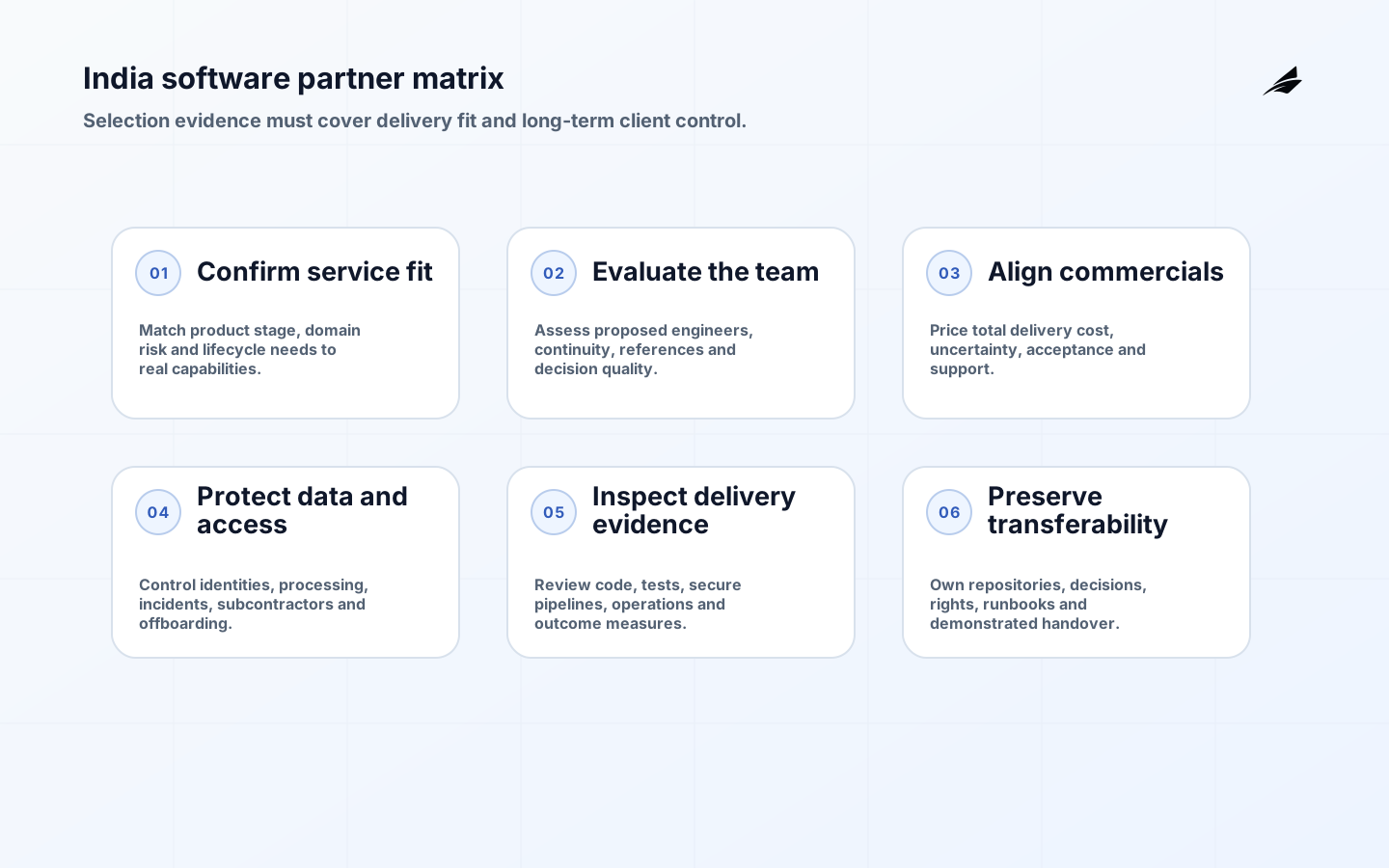
Choosing a custom software development company in India is a delivery and operating decision, not simply a rate comparison. Buyers need evidence that a team can understand the domain, build securely, communicate across locations, protect data and transfer a maintainable product. This FAQ explains common services, commercial models, due diligence and practical controls for organizations comparing Indian development partners or extending an existing global engineering model.
For a structured procurement, use Edilec's India software partner delivery plan, vendor implementation checklist and broader custom software services FAQ. The right answer varies by product risk, internal capability and desired ownership after launch.
What services should a custom development company provide?
Common services include product discovery, user research, experience design, architecture, web and mobile engineering, integration, data migration, quality engineering, cloud delivery, security testing, site reliability and application support. Some partners also provide fractional product or technology leadership. Ask which capabilities are performed by the proposed team, which are shared specialist pools and which are subcontracted. A long capability list does not prove that those people will be available to your engagement.
Define deliverables around working outcomes: validated workflow, production increment, migrated dataset, service objective or resolved support backlog. Specify documentation, automated tests, accessibility, observability and deployment assets as part of done. Clarify who owns product decisions, architecture, release approval and operations. A partner can supply leadership, but the client should retain accountable authority over business priorities, data use, risk acceptance and access to production.
| Service area | Evidence to inspect | Contract boundary |
|---|---|---|
| Discovery | Research notes, prototypes and decision records | Who approves scope and assumptions |
| Engineering | Representative code, review and test practices | Repository, branch and quality ownership |
| Cloud delivery | Infrastructure code, pipeline and recovery example | Environment and privileged-access responsibility |
| Support | Coverage, severity model and incident example | Response, resolution and escalation terms |
How do buyers evaluate an India software partner?
Evaluate the exact team through a paid discovery or small production-shaped exercise. Meet delivery leadership and likely engineers, review a technical decision together and observe how they challenge ambiguity. Check references for similar risk and lifecycle stage, not only the same industry. Verify employee and contractor mix, attrition, hiring lead time, office and remote controls, business continuity, insurance, financial stability and any dependencies on a single founder or client.
Request evidence rather than badges alone: secure-development policy, recent test artifacts, incident procedure, access review, vulnerability handling, backup restore result and example handover. CISA's Secure by Demand guide helps buyers ask manufacturers how security is built into products. Adapt its procurement posture to custom work by placing secure defaults, vulnerability support and transparency into acceptance criteria.
How are Indian software services priced?
Time and materials works when priorities will evolve and the buyer can govern a backlog. Fixed price works for bounded deliverables with stable interfaces and acceptance tests. A dedicated team reserves capacity and supports continuity; managed delivery gives the supplier more responsibility for planning and outcomes. Hybrid models can fix discovery or milestones while retaining flexible implementation. Compare what is included in each rate: leadership, quality, cloud, security, tools, leave, support and taxes.
Build a total-cost model rather than multiplying hourly rates. Include buyer product ownership, onboarding, travel, overlapping work hours, environments, third-party services, security reviews, rework, transition and ongoing maintenance. Low bids may assume junior staffing, sparse testing or change requests for foreseeable work. Ask vendors to estimate from explicit assumptions and ranges. Use a paid discovery to narrow uncertainty before fixing a large commitment, and reserve payment for operational handover.
| Commercial model | Best fit | Buyer control |
|---|---|---|
| Time and materials | Evolving product with active prioritization | Backlog, capacity and spend review |
| Fixed price | Stable, testable scope | Assumptions, acceptance and change control |
| Dedicated team | Long-lived roadmap and knowledge continuity | Role mix, performance and replacement terms |
| Managed service | Defined operational outcomes | Service levels, exclusions and exit assistance |
How should security and data protection be handled?
Classify data and map where it will be accessed, stored, logged and backed up before granting the vendor access. Use client-controlled identity, individual accounts, least privilege, managed endpoints, approved repositories, secrets management and logged production access. Separate development data from live personal data and use synthetic or de-identified fixtures where practical. Define breach escalation, evidence preservation, subcontractor approval, secure deletion and offboarding in the agreement.
India's Digital Personal Data Protection Rules 2025 and the underlying Act require a current legal assessment for applicable processing. Buyers must also account for laws in user and client jurisdictions. Record controller or fiduciary and processor roles, permitted purpose, retention, rights support, transfer mechanisms and deletion evidence. Contract language should match the actual architecture and support workflow.
Understand applicable Indian cyber-incident obligations and operational coordination. CERT-In publishes its directions under Section 70B, including reporting and information-security requirements. Legal counsel should determine applicability; engineering teams should ensure clocks, logs, contacts and incident procedures can meet contractual and regulatory needs. Do not wait for an incident to discover that client and vendor teams use incompatible severity definitions or cannot export required evidence.
What quality and secure-development practices matter?
Require a version-controlled backlog, architecture decisions, peer review, automated tests, dependency management, protected build pipelines and reproducible release records. The NIST Secure Software Development Framework offers a common vocabulary for organizational preparation, software protection, secure production and vulnerability response. Map selected practices to the product's risk rather than demanding every control without context. Review actual repository and pipeline evidence during delivery.
For web applications, the OWASP Application Security Verification Standard can turn vague secure-coding promises into testable requirements. Choose a suitable verification level and identify requirements in acceptance criteria. Combine automated scanning with design review and targeted manual testing. Measure escaped defects, change failure, time to restore, vulnerability age and test reliability. Lines of code, hours billed and story points do not demonstrate product quality.
How should distributed delivery be governed?
Establish overlapping hours for decisions and incidents, while protecting focused work. Define channels for backlog questions, architecture decisions, urgent production issues and executive escalation. Keep decisions in shared systems rather than private messages. Use short demos with working software and production telemetry. A weekly status deck cannot substitute for accessible code, tests, risks and deployment evidence. Record language, accessibility and domain terminology expectations during onboarding.
Plan continuity at role level. Require a named delivery lead, backup contacts, documented onboarding and notice for key-person changes. Pair client and vendor engineers on critical components, rotate review responsibility and rehearse access removal. The contract should permit reasonable team review but avoid creating approval bottlenecks for every replacement. Monitor continuity, not nationality or location: a stable distributed team can outperform a frequently changing colocated one when ownership and communication are clear.
Example: run a paid partner evaluation
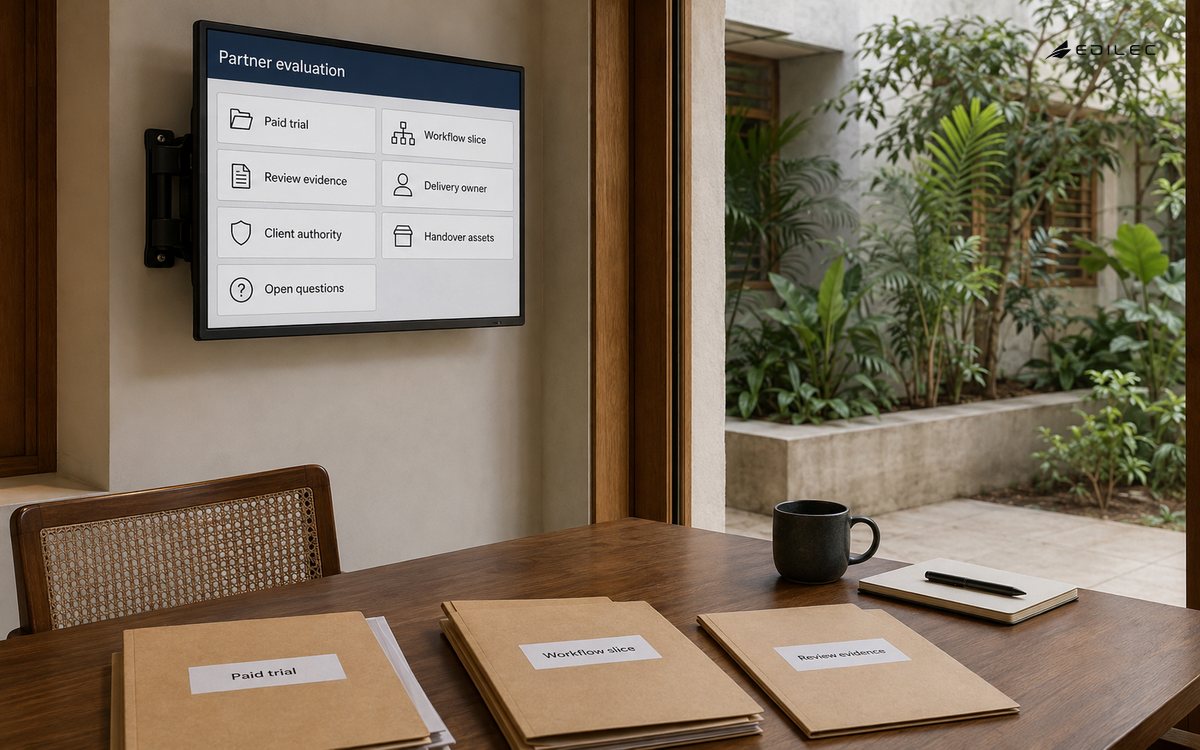
A buyer planning a claims portal can invite shortlisted partners to price a paid discovery that covers one claimant journey and one insurer integration. Supply the same problem brief, security constraints and anonymized examples. Require each team to map assumptions, prototype the workflow, propose an architecture, threat-model the boundary and build a thin deployable increment. The exercise should use the engineers expected to continue, not a separate presales studio.
Score evidence across domain learning, product judgment, code quality, testing, security, delivery transparency and collaboration. Introduce a controlled requirement change and an integration failure to observe decision-making. Review repository history, pipeline results, defects and documentation. Compare total proposed team composition and operating model, not only the polish of the demonstration. Pay for the agreed outputs and ensure intellectual-property terms allow the buyer to continue with any selected route.
Before award, negotiate access, data processing, incident response, key-person continuity, acceptance, warranty, support and transition. Establish client-owned repositories and identities on day one. Set a ninety-day checkpoint based on production evidence, team stability and forecast. This approach costs more than relying on proposals, but it reduces uncertainty on the very capabilities that determine whether a geographically distributed software partnership will remain effective after contract signature.
What should handover and exit include?
Keep source, infrastructure code, pipelines, issue history and core documentation in client-accessible systems from the start. Define intellectual-property assignment, third-party licenses, open-source obligations and rights to reusable supplier components. Maintain architecture diagrams, data models, runbooks, environment inventory, support contacts and known risks continuously. A final documentation sprint usually produces stale summaries because the operational knowledge was never captured at the decision point.
Set transition assistance, rates, duration and cooperation duties in the initial contract. Before exit, verify builds, deployments, backup restoration, credential rotation, monitoring, license transfer and data return or deletion. Have the receiving team perform key tasks while the supplier observes. Remove accounts and certificates after acceptance and review logs for unexpected access. A buyer should be able to change suppliers without rebuilding the product from incomplete artifacts.
India software partner takeaways
- Evaluate the proposed team through production-shaped work, not sales credentials alone.
- Compare total delivery and lifecycle cost, not hourly rates.
- Put data flows, incident duties and subcontractor controls into the operating design.
- Use recognized secure-development and verification practices as testable requirements.
- Keep repositories, decisions and operational evidence accessible to the client.
- Contract for demonstrated handover and orderly exit from the beginning.
Frequently asked questions
Should buyers choose a large or specialist company?
Large firms may offer capacity, geographic coverage and broad specialist pools. Smaller firms may provide senior attention and domain focus. Assess the exact team, governance and continuity model against the work. Company size does not guarantee access to specialists or prevent key-person risk.
What is a useful vendor trial?
Choose a four-to-eight-week bounded problem that exercises discovery, architecture, coding, tests, security, deployment and collaboration. Pay for the work and define ownership. Review decisions and artifacts, not just the demo. Avoid speculative free trials, which attract a sales team and create incentives unlike the real engagement.
Conclusion
A custom software development company in India can provide strong engineering depth and durable product capacity when the buyer governs outcomes, evidence and ownership. Select the real team, align the commercial model to uncertainty, protect data through architecture and contract, and make secure delivery and handover observable. Geography influences logistics and law; delivery quality still comes from clear responsibilities and disciplined engineering.