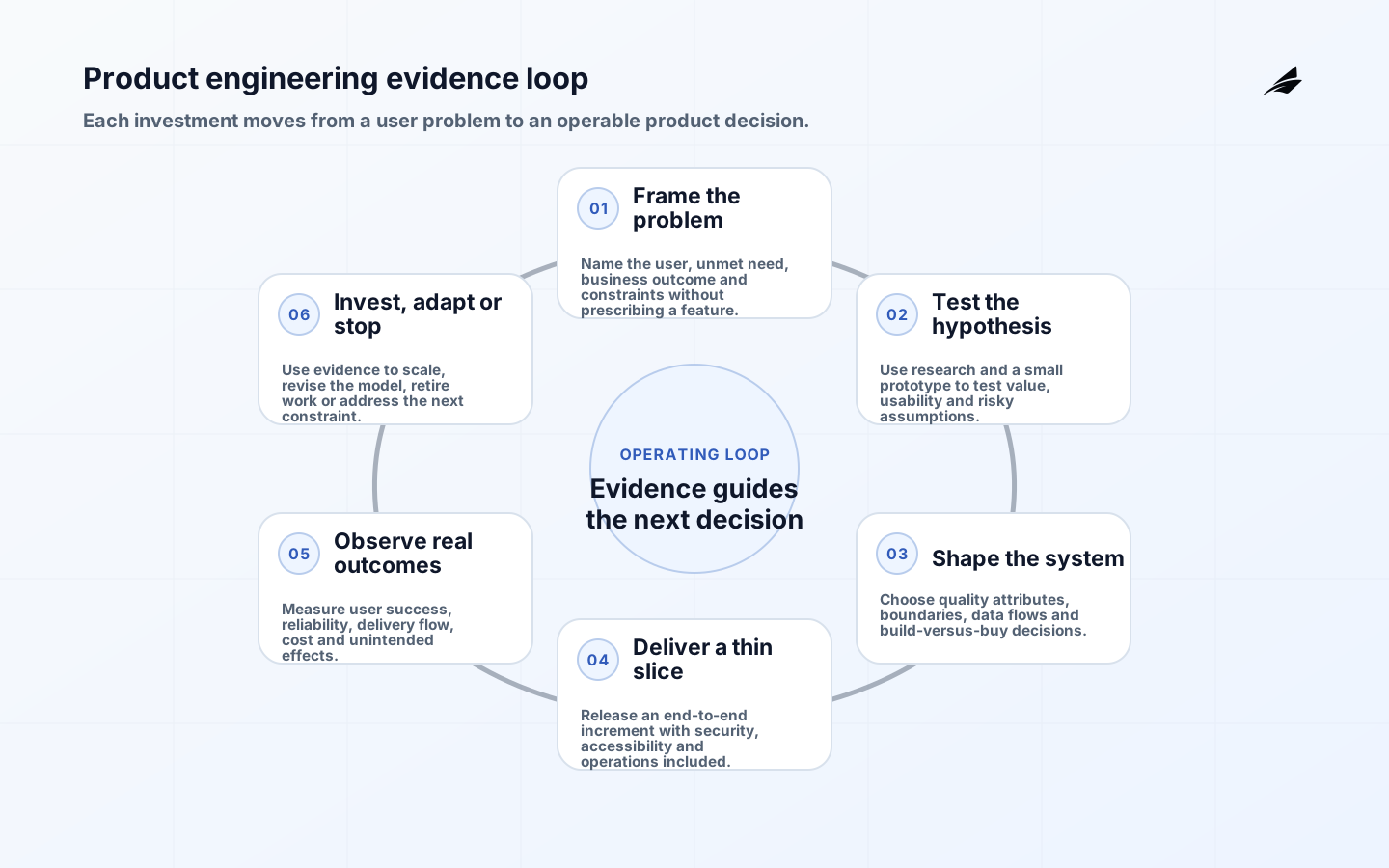
Product engineering and technology is the discipline of turning an uncertain customer problem into a useful, reliable and economically sustainable digital product. It joins product management, design, software engineering, data, security and operations around one outcome. That is different from treating technology as a queue of requested features: the team is accountable for whether people can complete the task, whether the system remains dependable, and whether the result justifies its continuing cost.
This FAQ answers the decisions leaders usually face before funding or reorganizing product work. It complements the practical product engineering guide and the product engineering implementation checklist. For a supplier-oriented view, compare the software engineering build delivery plan.
What does product engineering include?
A product engineering team owns the path from evidence to operation. It researches needs, tests propositions, designs journeys, chooses architecture, writes and verifies software, releases safely, watches production, supports users and improves the service. Hardware, firmware, data products and machine-learning components may also be in scope. The product boundary should follow a user outcome, not an organization chart; otherwise customers experience a broken journey while each internal component reports success.
The work begins with an outcome hypothesis: for a named user in a defined situation, a change should improve a measurable result. The team then identifies assumptions about desirability, feasibility, viability, safety and legality. Cheap evidence should address the riskiest assumption first. The UK Government Service Standard guidance recommends iterative, user-centred delivery because exposing work to real users early reduces the risk of delivering the wrong thing.
| Decision layer | Question to settle | Useful evidence |
|---|---|---|
| Product | Whose problem is worth solving now? | Observed needs, baseline journey and outcome hypothesis |
| Experience | Can intended users complete the whole task? | Prototype tests, accessibility findings and support demand |
| Technology | Can the system meet critical quality attributes? | Architecture options, spikes and measurable constraints |
| Economics | Will value exceed lifecycle cost and risk? | Demand, unit cost, opportunity cost and forecast ranges |
| Operations | Can the team run and change it responsibly? | Service levels, runbooks, ownership and recovery tests |
How should the product engineering operating model work?
Give a durable, multidisciplinary team responsibility for a product area and the authority to make routine decisions inside explicit guardrails. Product leadership sets outcomes and sequencing; design brings user evidence; engineering makes technical trade-offs; security and privacy define proportionate controls; operations exposes real service behaviour. Specialists can support several teams, but accountability cannot disappear into a central review queue. One product owner should reconcile customer value, commercial constraints and technical health.
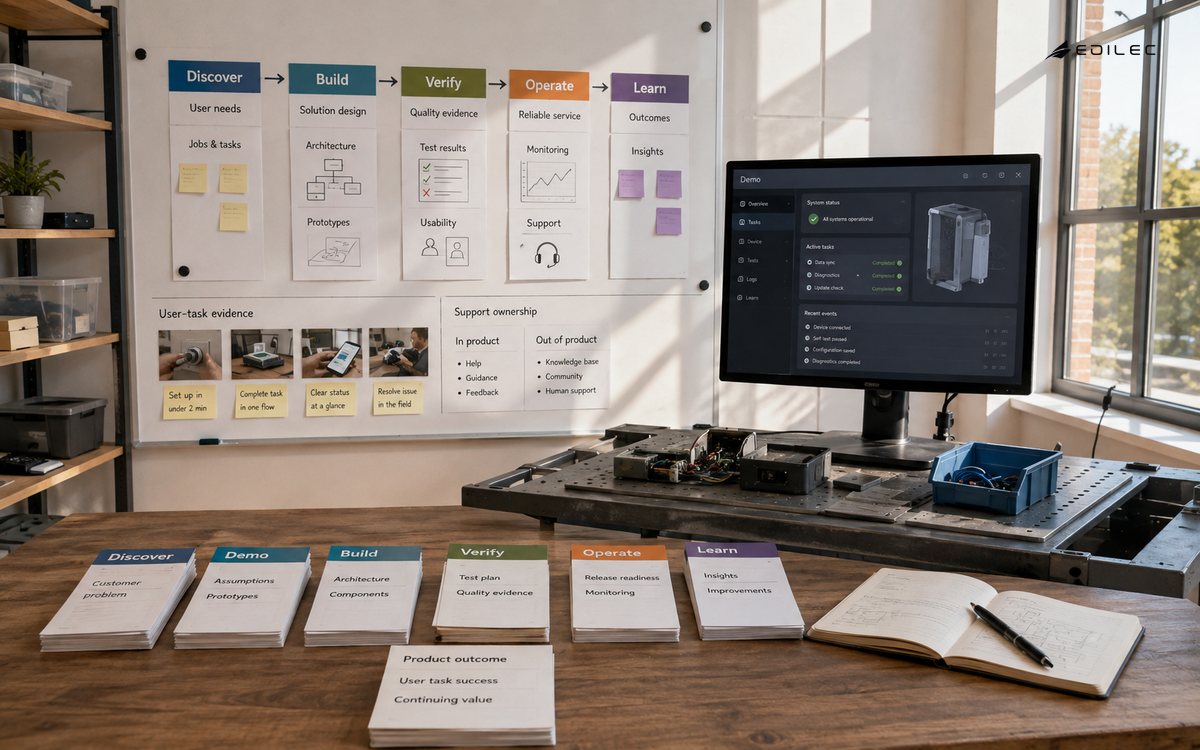
Funding should support a persistent capability rather than a temporary feature project. A project can finish while a product still has users, vulnerabilities, dependencies and support obligations. Use quarterly outcome and investment reviews, while allowing the team to release and learn more frequently. Keep a short decision record for consequential choices: context, options, evidence, decision, owner, review trigger and reversibility. This creates useful institutional memory without turning every choice into a committee meeting.
How much architecture should be decided up front?
Decide enough architecture to protect expensive-to-change qualities and enable the first end-to-end slice. Identify sensitive data, trust boundaries, availability needs, latency limits, integration contracts, regulatory constraints and recovery objectives. Explore uncertain choices with small technical experiments. Avoid pretending that a complete future architecture can be known before usage is understood; equally, do not call accidental coupling an agile choice. Architecture is a sequence of risk decisions, not a single diagram.
Turn quality into measurable acceptance conditions. The ISO/IEC 25010:2023 product quality model provides a vocabulary for specifying and evaluating qualities such as functional suitability, reliability, security, maintainability and interaction capability. Select the characteristics that matter in context. A checkout might prioritize correctness, availability and recoverability; an internal analysis tool might tolerate delay but require traceability and data quality.
| Quality concern | Example requirement | Evidence before wider release |
|---|---|---|
| Reliability | Core task succeeds during a dependency failure | Fault-injection result and recovery receipt |
| Performance | 95th-percentile response stays within the user budget | Representative load test and production trend |
| Accessibility | Key journey conforms to agreed WCAG 2.2 level | Automated checks plus expert and user testing |
| Security | Sensitive actions require verified identity and authorization | Threat model, control tests and audit event |
| Maintainability | A routine change can be made and rolled back safely | Deployment rehearsal, lead time and ownership |
For web products, use the current WCAG 2.2 Recommendation as a testable baseline, then include people with relevant access needs in research. Conformance does not prove that an end-to-end service is understandable or usable. Accessibility belongs in design, components, content, testing and procurement; postponing it creates both exclusion and expensive rework.
Where do security and quality assurance fit?
Security and quality are properties of the delivery system, not late approval phases. Apply the NIST Secure Software Development Framework: prepare the organization, protect software and build infrastructure, produce well-secured releases, and respond to vulnerabilities. Translate that into owned practices such as protected branches, isolated build identities, reviewed dependencies, secret scanning, provenance, risk-based verification and a supported disclosure process.
Use several feedback layers. Unit and component tests protect local behaviour; contract tests protect integrations; journey tests cover a few critical flows; exploratory and accessibility testing find issues scripted checks miss; production checks verify assumptions in the real environment. Every control should have a failure response. A scanner that generates an unread backlog is weaker than a smaller set of enforced checks with risk owners, remediation targets and documented exceptions.
How should product engineering performance be measured?
Use three linked views: customer outcomes, product health and delivery capability. Customer measures might include successful task completion, time to value, retention or avoidable contact. Health covers availability, latency, defects, security exposure, accessibility and cost. Delivery measures reveal whether the team can change the system safely. The current DORA software delivery metrics describe throughput with change lead time, deployment frequency and failed deployment recovery time, and instability with change fail rate and deployment rework rate.
Do not turn a measure into an individual target. Deployment frequency varies with product context, and raw output says little about benefit. Review trends for one service, segment outcomes by relevant user groups, and pair speed with quality. A useful monthly narrative explains what moved, why the team believes it moved, what remains uncertain and which decision follows. The aim is a learning system, not an attractive dashboard.
What should remain owned when a vendor helps build?
The organization must retain product direction, risk acceptance, access to users, data responsibility and the ability to operate or transition the service. Contracts should define repository and artifact access, intellectual-property rights, dependency disclosure, security evidence, environments, service objectives, incident duties, documentation, knowledge transfer and exit support. Acceptance should depend on working evidence, not the number of completed tickets.
A blended team works best when supplier and internal staff share one backlog, architecture record, delivery pipeline and definition of done. Name counterparts early and rehearse handover throughout delivery rather than in the final week. The digital engineering lifecycle FAQ expands on lifecycle evidence and supplier transition.
Maintain a product-risk register that includes product, technology and operating uncertainty in one view. For each risk, state the assumption, evidence, exposure, treatment, owner and next review trigger. Link substantial discovery work and technical enablers to those risks. This helps leaders understand why a prototype, migration rehearsal or reliability improvement deserves capacity even when it adds no visible feature. Close risks only with evidence; moving an item to a supplier or future quarter does not reduce its consequence.
Plan retirement while the product is healthy. Define how users will be notified and migrated, how records will be exported or retained, how integrations and identities will be revoked, and how legal or audit obligations will be met. Include decommissioning cost in portfolio decisions. Running two overlapping products indefinitely creates fragmented journeys, duplicated controls and hidden support demand, so replacement funding should include a measurable path to switch off the old capability.
Key takeaways
- Organize product engineering around a user outcome and a durable team, not a temporary list of features.
- Test the riskiest product, technology and operating assumptions with the cheapest credible evidence.
- Specify critical quality attributes as measurable conditions and include accessibility and security from the start.
- Measure customer outcomes, product health and delivery capability together.
- Keep product decisions, risk acceptance and transition capability inside the organization even when delivery is shared.
Frequently asked questions
Is an MVP the smallest set of features?
No. A useful minimum viable product is the smallest coherent way to test a material product hypothesis with real users. It still needs proportionate privacy, security, accessibility, support and measurement. A disconnected feature list can be small without producing valid learning or a usable service.
How much technical debt is acceptable?
Debt is acceptable when it is a conscious, observable trade-off with an owner and a trigger for repayment. Record the constraint it creates, likely interest, affected outcomes and remediation option. Unknown coupling, unsupported dependencies and missing recovery paths are operational risks, not merely engineering preferences.
When should a team rewrite a product?
Only when evidence shows incremental change cannot reach required outcomes at acceptable cost or risk. Compare replacement, strangler migration and focused remediation. Include data migration, feature parity, dual running, user disruption and the fact that a rewrite can recreate old assumptions in newer technology.
Conclusion
Product engineering and technology works when discovery, delivery and operation form one evidence loop. Clear outcomes prevent feature drift; measurable quality attributes guide architecture; secure incremental delivery makes learning affordable; production evidence directs the next investment. Start with one bounded user journey, prove the whole operating model on a thin slice, and expand only when outcomes and service health justify it.