A digital engineering services implementation checklist should convert enterprise investment into a production capability the organization can change and operate after the engagement. Deliverables such as target architectures, cloud accounts, pipelines, and code matter only when they shorten a real value stream while preserving security, accessibility, reliability, data integrity, and ownership. Begin with one measurable service outcome and the operating evidence required to accept it.
Use this checklist after agreeing the engagement boundary in the scope, cost, risk, and governance guide. The general digital engineering checklist provides a complementary baseline, while the enterprise lifecycle FAQ helps sponsors resolve sourcing, measures, and transition questions.
Set the outcome, baseline, and decision rights
Name the target user, current journey, business constraint, baseline performance, desired behavior, guardrails, and review date. Map the value stream from demand to production and from incident to learning, including queue time, approvals, rework, handoffs, and external dependencies. DORA’s value-stream guidance focuses on visualizing the flow of software delivery; the enterprise should use that evidence to select a bounded improvement rather than launching a technology-wide transformation with no acceptance signal.
Create a responsibility model for product priority, architecture, security risk, data, platform, release, service operation, supplier management, and budget. Give the cross-functional team authority within explicit guardrails and define escalation for decisions outside them. Record assumptions and exclusions. If architecture, security, procurement, or operations can veto late without participating early, the implementation will accumulate hidden waiting time and produce a handoff rather than a capability.
| Gate | Required evidence | Decision owner |
|---|---|---|
| Outcome | Baseline, target, guardrails, and stop rule | Product or service owner |
| Architecture | Context, decisions, risks, migration, and recovery | Accountable architect |
| Security and data | Threats, controls, retention, access, and test plan | Security and data owners |
| Production | Traceable artifact, tests, telemetry, runbook, rollback | Technical service owner |
| Transition | Access, knowledge, support, cost, and next release | Receiving organization |
Establish an evolvable architecture baseline
Document system context, business capabilities, trust boundaries, authoritative data, interfaces, failure behavior, quality attributes, deployment topology, and material decisions. Prefer the simplest modular design that meets current scale and isolation needs. Modernization strategy can vary by component: retire, retain, rehost, replatform, refactor, replace, or rebuild. Every choice needs a business rationale, dependency plan, data transition, compatibility period, and reversal or containment approach.
Create versioned interface contracts and ownership. Use timeouts, bounded retries, idempotency, backpressure, and durable state where distributed effects require them. Avoid a shared integration layer with no domain authority. Define how identity and authorization propagate, how schemas evolve, and how old and new systems reconcile during coexistence. Architecture acceptance includes a working thin slice through production controls, not only a review meeting.
Build a paved path around real team needs
Provide version-controlled environments, identity, network, secrets, artifact storage, build, test, deployment, policy, telemetry, and service templates through self-service workflows. Start from the selected product slice, then generalize repeated capability. A platform should reduce cognitive load and lead time while leaving an exception route for justified needs. Measure adoption, task success, waiting time, support burden, reliability, and satisfaction rather than counting provisioned tools.
Use infrastructure and policy as code with review, preview, drift detection, and recovery. Protect the delivery system because compromise can affect every product it serves. Separate workload and platform administration, use short-lived workload identity where possible, and preserve break-glass procedures. Version templates and communicate deprecation. A paved path becomes coercive if it cannot explain its constraints or safely support a product that genuinely differs.
| Capability | Implementation check | Outcome measure |
|---|---|---|
| Environment | A team creates an approved environment without hidden tickets | Elapsed provisioning time and failure rate |
| Delivery | Artifact is traceable from reviewed source to deployment | Lead time and failed-deployment recovery |
| Security | Controls run in normal workflow with owned exceptions | Remediation time and recurring weakness |
| Observability | Service emits correlated useful signals by default | Diagnosis time and actionable alert ratio |
| Developer experience | Documentation and workflows succeed in user testing | Task success and support demand |
Integrate secure, accessible delivery controls
NIST SSDF groups practice around preparing the organization, protecting software, producing well-secured releases, and responding to vulnerabilities. Translate that into repository protection, reviewed changes, dependency and secret handling, threat modeling, security tests, artifact provenance, environment protection, vulnerability intake, remediation, disclosure, and root-cause improvement. CISA secure-by-design principles reinforce that security outcomes should not be shifted onto customers through unsafe defaults or premium-only controls.
Make accessibility part of design, component, acceptance, and regression work. WCAG 2.2 provides testable web-content criteria, but enterprise workflows also need research with disabled users and assistive technology. Include keyboard operation, focus, labels, errors, authentication, reflow, contrast, time limits, and non-visual status. Security and accessibility can conflict when implemented late; design account recovery and step-up authentication to satisfy both.
Engineer reliability, observability, and data change
Define user-centered service indicators and objectives, then instrument logs, metrics, traces, synthetic journeys, business events, and audit evidence. OpenTelemetry supplies vendor-neutral signal concepts, but teams must still choose meaningful attributes and protect sensitive data. Alerts need an owner and action. Exercise dependency failure, capacity, rollback, backup restoration, and regional or control-plane loss according to impact. Feed error-budget and incident evidence into roadmap decisions.
For data modernization, name authoritative records, quality rules, lineage, access, retention, deletion, residency, reconciliation, and migration cutover. Profile source data before estimating transformation. Rehearse migrations at realistic scale, verify totals and relationships, preserve audit history, and define correction authority. Dual writes are not a migration plan without consistency and repair. Keep rollback compatible until the acceptance window closes, then retire obsolete paths and permissions.
Deliver through evidence-based implementation gates
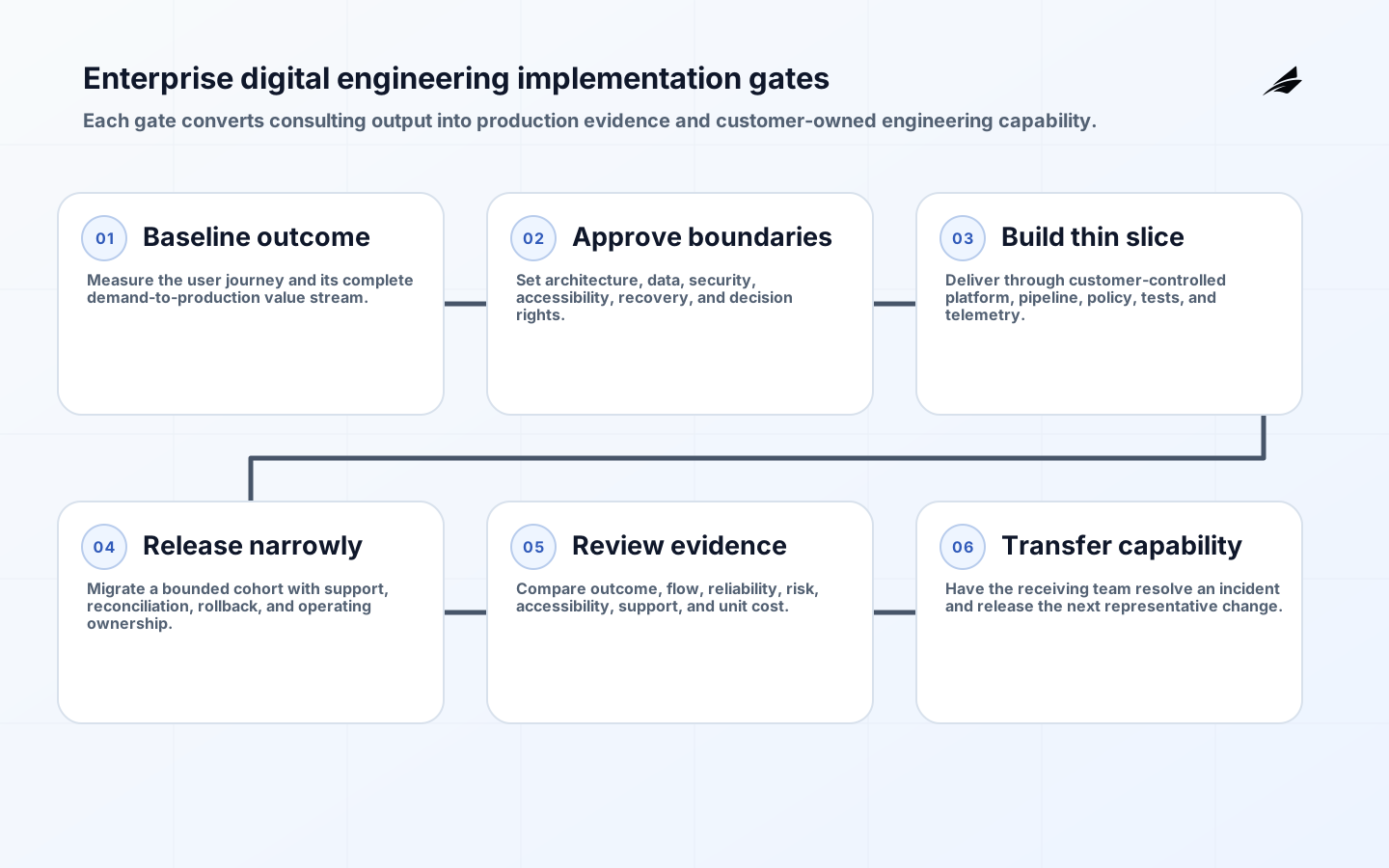
- Baseline one customer or employee journey and the delivery value stream that supports it.
- Approve decision rights, architecture boundaries, security, data, accessibility, and recovery acceptance.
- Build a thin production slice through the platform and normal delivery system.
- Release to a bounded cohort with telemetry, support, migration reconciliation, and rollback.
- Compare outcome, delivery, reliability, security, accessibility, and cost evidence with the baseline.
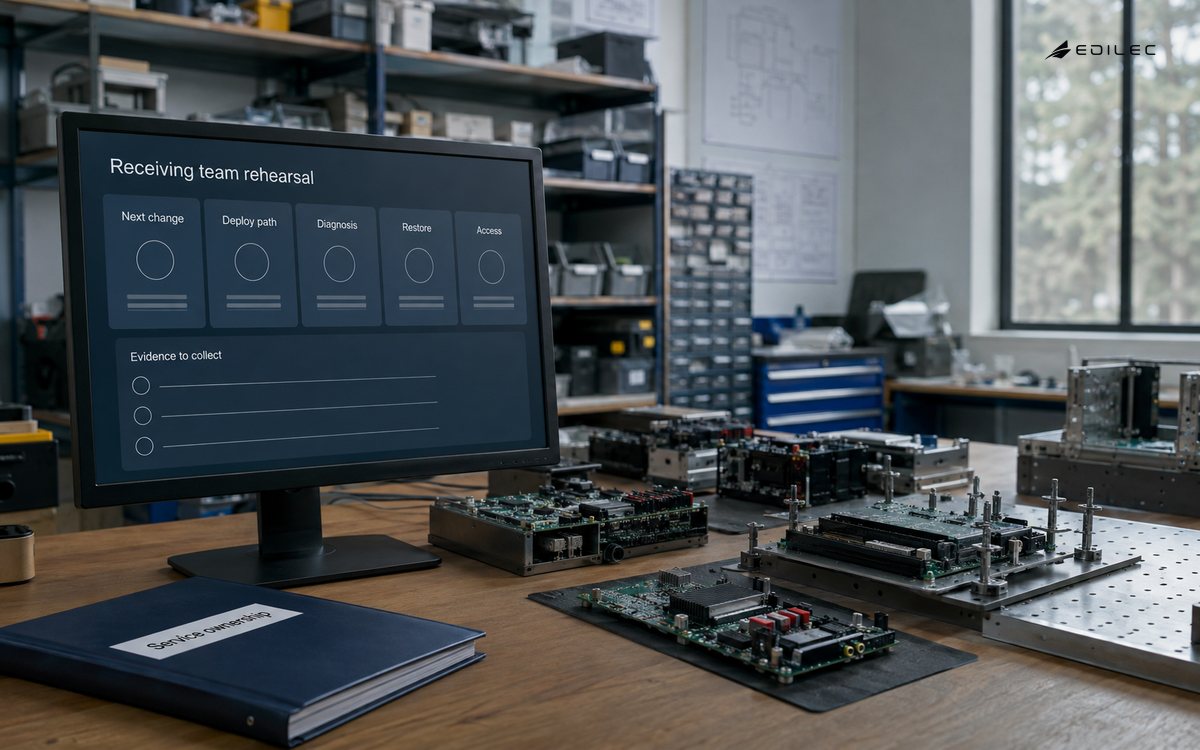
- Transfer ownership by having the receiving team operate an incident and deliver the next representative change.
Transfer ownership and govern improvement
Move source, history, infrastructure definitions, pipelines, artifacts, architecture decisions, data models, tests, threat models, inventories, dashboards, runbooks, licenses, credentials, supplier contacts, cost models, risks, and backlog into enterprise-controlled locations. Pair teams throughout delivery rather than scheduling knowledge transfer at the end. Verify access with real tasks and revoke partner privilege according to the approved support model.
Review outcomes and flow at a fixed cadence. DORA metrics should be interpreted as a system: throughput measures belong with stability and recovery, and local optimization can move queues elsewhere. Add user outcome, reliability, security, accessibility, platform adoption, support load, and unit cost. Fund the constraint revealed by evidence. Stop transformation activity that cannot connect to a service outcome or durable organizational capability.
Key takeaways
- Select one measurable service outcome and map its complete delivery value stream.
- Prove architecture and platform decisions through a thin production slice.
- Integrate security, accessibility, observability, reliability, and data controls into normal delivery.
- Measure flow with customer, stability, risk, cost, and support evidence.
- Complete transition only after the receiving team operates and changes the capability itself.
Frequently asked questions
How long should a digital engineering implementation take?
A first production slice should usually be measured in weeks or a few months, depending on criticality, procurement, data, and integration constraints. Enterprise-wide modernization is a portfolio of such slices, not one end date. Require useful evidence at each gate and replan from observed flow rather than accepting a long period with only foundational deliverables.
Should the platform be built before product teams use it?
Build the minimum platform capability with a real product team and generalize only what repeats. A speculative platform tends to optimize imagined workflows and delays outcome evidence. Protect foundational security and governance from the start, but validate interfaces, templates, support, and documentation through actual team tasks before broad rollout.
What prevents dependence on the engineering partner?
Customer-controlled repositories, cloud and delivery access, paired teams, versioned decisions, operable documentation, explicit licensing, transparent staffing, and progressive responsibility transfer. Tie acceptance to the enterprise team deploying and operating representative work. A contractual handover list helps, but demonstrated capability and revoked unnecessary partner access are stronger evidence.
Make quality gates risk-based and executable. A low-risk content change and a data migration should not wait for identical evidence, but both need a known path. Define which automated checks, human reviews, environment controls, approvals, and recovery plans apply by change class. Measure queue time and escape rate at each gate. Remove checks that add delay without detecting meaningful failure, and strengthen the controls associated with recurring production defects.
Include legacy retirement in the definition of done. After new capability is accepted, stop old writes, reconcile remaining records, preserve required history, remove integrations and scheduled jobs, revoke identities and secrets, end licenses and infrastructure, update support and monitoring, and verify that users no longer depend on shadow routes. Running both systems indefinitely preserves cost and risk while hiding whether modernization actually succeeded.
Conclusion
Enterprise digital engineering succeeds when it changes both a production service and the organization’s ability to improve it. Begin with an outcome and value stream, build the smallest complete architecture and platform path, and integrate secure, accessible, observable, reliable delivery. Release in bounded slices, measure the whole system, and transfer decisions and operation through real work. Revisit the baseline after transition so the enterprise can prove whether capability and customer outcomes continued to improve without partner dependency. That is the difference between acquiring engineering output and establishing engineering capability.