Custom Software Development for Startups: Practical FAQ requires more than selecting tools or assembling a feature list. The implementation must connect a defined business outcome to data, authority, failure behavior and permanent ownership. This guide explains the decisions a buyer, product leader and delivery team should settle before committing the full build. It uses current primary standards where they define a useful control, while keeping the architecture proportional to the actual workflow and consequence.
The practical goal is an operable service: people can complete the intended work, understand state and exceptions, and recover when a dependency or decision fails. Scope therefore includes discovery, design, integration, security, delivery, rollout and support. The sections below can be used for proposal review, architecture workshops and acceptance planning. Related reading includes Custom Software Development Services for Startups: Scope, Cost, Risks and Delivery Plan, Custom Software Development Services for Startups Implementation Checklist, Choosing a SaaS Product Development Company for a Startup.
When should a startup build custom software?
Build when software is necessary to test the business’s riskiest value assumption or creates a capability that available products cannot provide economically. Do not build simply because a workflow feels untidy. Compare configuration, integration, manual service and custom development against the next decision the company needs to make. A concierge process can reveal demand before automation; a narrow custom workflow can prove retention before a platform rewrite. Include switching cost, data portability and recurring license exposure in the buy-versus-build analysis, not only the first six months of engineering cost.
Write a decision memo with the current alternative, expected advantage, evidence needed and maximum acceptable investment before review. Revisit it when discovery changes assumptions. If the unique capability is a thin workflow over stable SaaS products, integration may be the product. If critical value depends on controlling data or algorithms, confirm rights and portability before choosing a managed vendor that could constrain later differentiation.
What should an MVP contain?
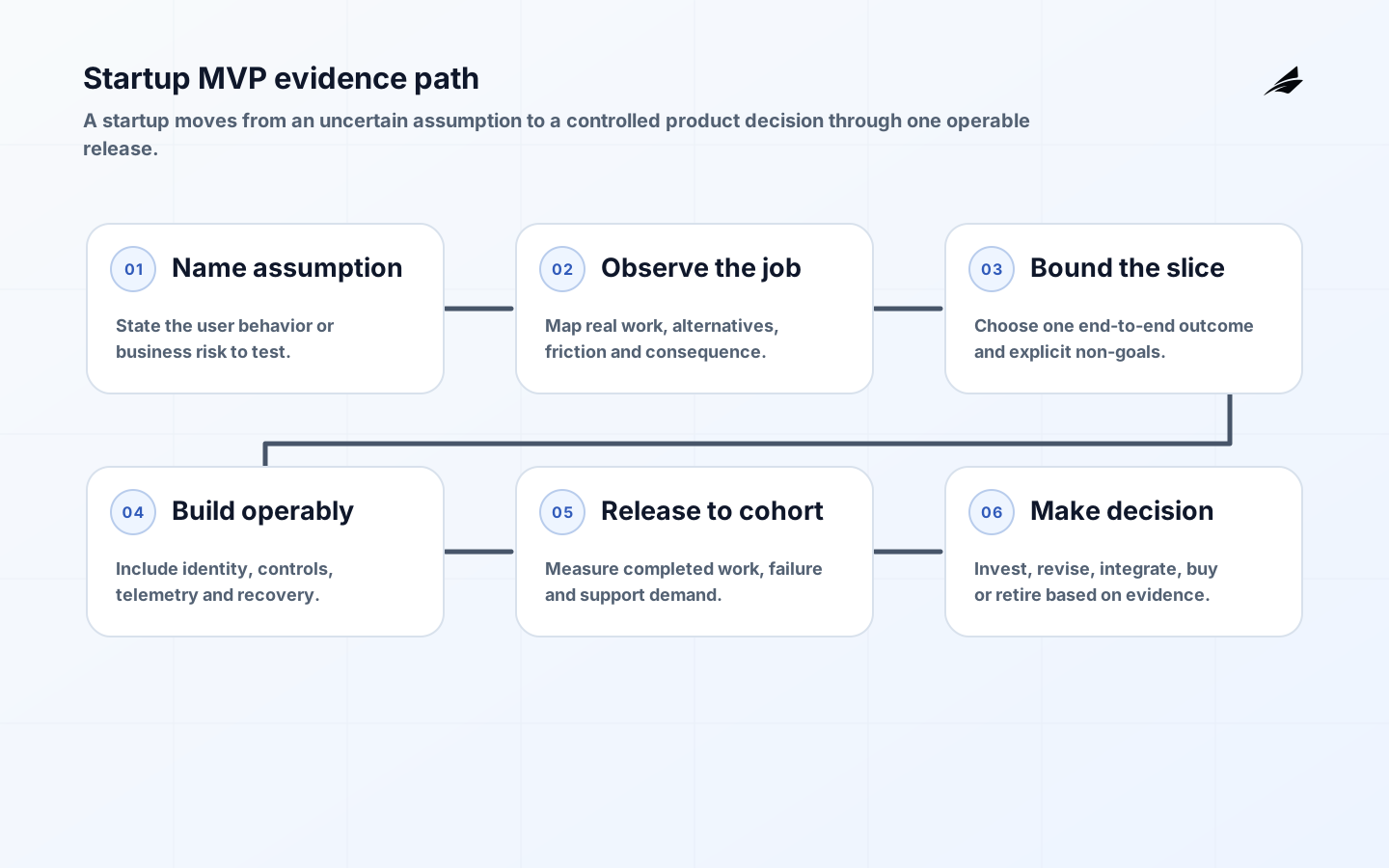
An MVP is the smallest operable product that can produce credible learning, not the fewest screens. Define the user, problem, behavior change and evidence threshold. Include identity, authorization, error handling, basic telemetry, support and data recovery appropriate to the consequence of failure. Exclude secondary personas, speculative configuration and scale mechanisms that have no current load evidence. Write explicit non-goals. A vertical slice that completes one real job is more informative than a broad prototype whose critical actions still require hidden manual repair.

Specify acceptance using real user data and edge cases. A founder walkthrough cannot replace representative users completing the job without coaching. Include an administrative path for support, corrections and account management. Decide how early customers are onboarded and offboarded. Keep manual operations visible in the service blueprint and measure their time; hidden founder effort can make an MVP appear economically viable when the product is not.
| Area | Decision | Evidence |
|---|---|---|
| Decision | Minimum evidence | Defer when |
| Build | The capability tests a material value or operational assumption | A configurable product can test the same assumption |
| MVP scope | One end-to-end job and measurable learning threshold | Critical workflow still depends on unowned manual repair |
| Architecture | Load, data and integration assumptions documented | A complex pattern has no current constraint |
| Launch | Recovery, support and rollback exercised | No one owns production after deployment |
How much architecture is enough?
Choose reversible decisions and managed capabilities while uncertainty is high. A modular application, relational database, background jobs and clear external interfaces often provide a strong starting point. The Twelve-Factor methodology offers useful operational practices such as explicit dependencies, environment-based configuration and separation of build, release and run. Avoid microservices until ownership, independent scaling or release constraints justify network boundaries. Record decisions, expected load, data sensitivity and triggers for revisiting them. Architecture should preserve change, not predict every future feature.
Set simple architecture fitness checks: can a developer run tests, can the team restore data, can one customer’s load be contained, and can a dependency be replaced? Establish schema migration and background-job patterns before rapid feature work creates inconsistency. Use infrastructure definitions and repeatable environments. Delay a generalized plugin system or event platform until at least two concrete uses prove a stable extension boundary.
Can security wait until product-market fit?
No, although controls should be proportionate. Authentication, authorization, secrets, dependency management, backups and secure deployment are cheaper to establish early than to reconstruct after customer data accumulates. Use the NIST SSDF to integrate security into the development process and OWASP ASVS to select verifiable application requirements. Classify data and delete what is unnecessary. Threat-model consequential actions and public interfaces. A startup does not need every enterprise control, but it does need to know who can access production, how changes are approved and how an incident will be contained.
Create a small asset and access inventory from the first production release. Use managed identity and secret services instead of shared credentials. Enable dependency updates, code review and protected production changes. Define responsible disclosure and a contact for customer security questions. For payments or health data, reduce scope through specialized providers and expert review. Security requirements should be recorded in acceptance, not remembered by one engineer.
What drives startup software cost?
Cost comes from uncertainty, integrations, data, quality expectations and operating responsibility more than feature count. A payment flow with three screens may require more assurance than a large internal content interface. Separate discovery, product design, implementation, external services, testing, launch and support. Estimate ranges against assumptions, then prove the riskiest dependency early. Keep cloud, vendor and transaction costs visible. The cheapest proposal can be expensive if it leaves no tests, deployment automation, documentation or team capable of changing the product after launch.
Maintain a monthly runway view that separates product development from keep-the-service-running cost. Model growth in database, storage, email, observability, support and third-party API usage. Set budget alerts with an owner and response. Do not optimize speculative scale while ignoring vendor minimums or manual operations. Re-estimate after the first cohort because real support and data behavior often changes the architecture and staffing assumptions.
| Area | Question | Control |
|---|---|---|
| Commercial question | What to request | Why it matters |
| Scope | Assumptions, non-goals and acceptance examples | Prevents implied features and disputes |
| Team | Named people, availability and decision rights | Reveals actual capability and handoffs |
| Quality | Automated tests, review and release evidence | Makes later change safer |
| Ownership | Repository, accounts, IP and dependency terms | Protects continuity |
| Support | Hours, response path and exit plan | Avoids an abandoned first release |
How should a development partner be selected?
Give candidates one real product scenario and ask how they would reduce uncertainty, shape a release and operate it. Examine shipped work, but also request architecture decisions, test strategy, incident learning and ownership practices. Meet the people who will do the work. Clarify product responsibility, communication cadence, security access, intellectual property, open-source policy, subcontracting and exit. A partner should challenge an oversized scope and explain tradeoffs in business language. Promises of a complete platform on a fixed date without assumptions are a risk signal.
Run a paid discovery or small vertical slice before a long commitment when the relationship is untested. Evaluate whether the team documents assumptions, surfaces bad news and leaves code reviewable. Require work in startup-controlled repositories with reproducible environments. Define how unavailable personnel are replaced and how subcontractors are approved. References should match the product stage and consequence, not merely the same programming language.
What makes the first release ready?
Release readiness includes more than feature acceptance. Verify representative user journeys, accessibility, authorization boundaries, backups and restoration, monitoring, support ownership, rollback and customer communication. Roll out to a small cohort and observe complete tasks rather than registrations alone. DORA’s delivery measures can help improve the release system, while product measures show whether the release changes behavior. Keep a decision log for incidents and feedback. The first release should make the next product decision clearer and leave a controlled path to repair or retire what was built.
Prepare a support inbox, incident contact, status message process and data-correction path before inviting users. Establish analytics events with definitions and privacy review. Watch users complete the full workflow and compare telemetry with interviews. A successful cohort may still reveal that operations are too expensive. Use the release to decide whether to deepen the product, automate a bottleneck, change segment or stop, and document that decision.
Key takeaways
- Build only when custom software is the best way to test a material assumption.
- Define an MVP as an operable vertical slice with explicit non-goals.
- Choose reversible architecture and establish security foundations early.
- Select a partner for learning, ownership and production capability, not promises alone.
Frequently asked questions
How long does a startup MVP take?
A bounded vertical slice may take several focused weeks; a regulated or integration-heavy product can take months. The honest schedule follows discovery evidence, dependencies and acceptance rather than a universal MVP duration.
Is fixed-price development suitable?
It can suit a narrow, well-understood release. For uncertain product discovery, fund a bounded discovery or use a capacity model with frequent outcome reviews. Fixed price does not remove uncertainty; it determines who prices its risk.
Who should own the code and cloud accounts?
The startup should control source repositories, deployment accounts, domains, data and critical vendor relationships. Contracts should assign intellectual property and require disclosure of third-party components and restrictions.
Conclusion
Custom software development for startups should increase learning without creating an uncontrolled technology burden. A strong engagement narrows the value assumption, ships an operable slice, uses proportionate security and architecture, and keeps ownership with the company. The result is not merely an MVP launch; it is reliable evidence for the next investment, product or market decision. Revisit the original build decision as the company learns; continued custom investment should remain evidence-based.