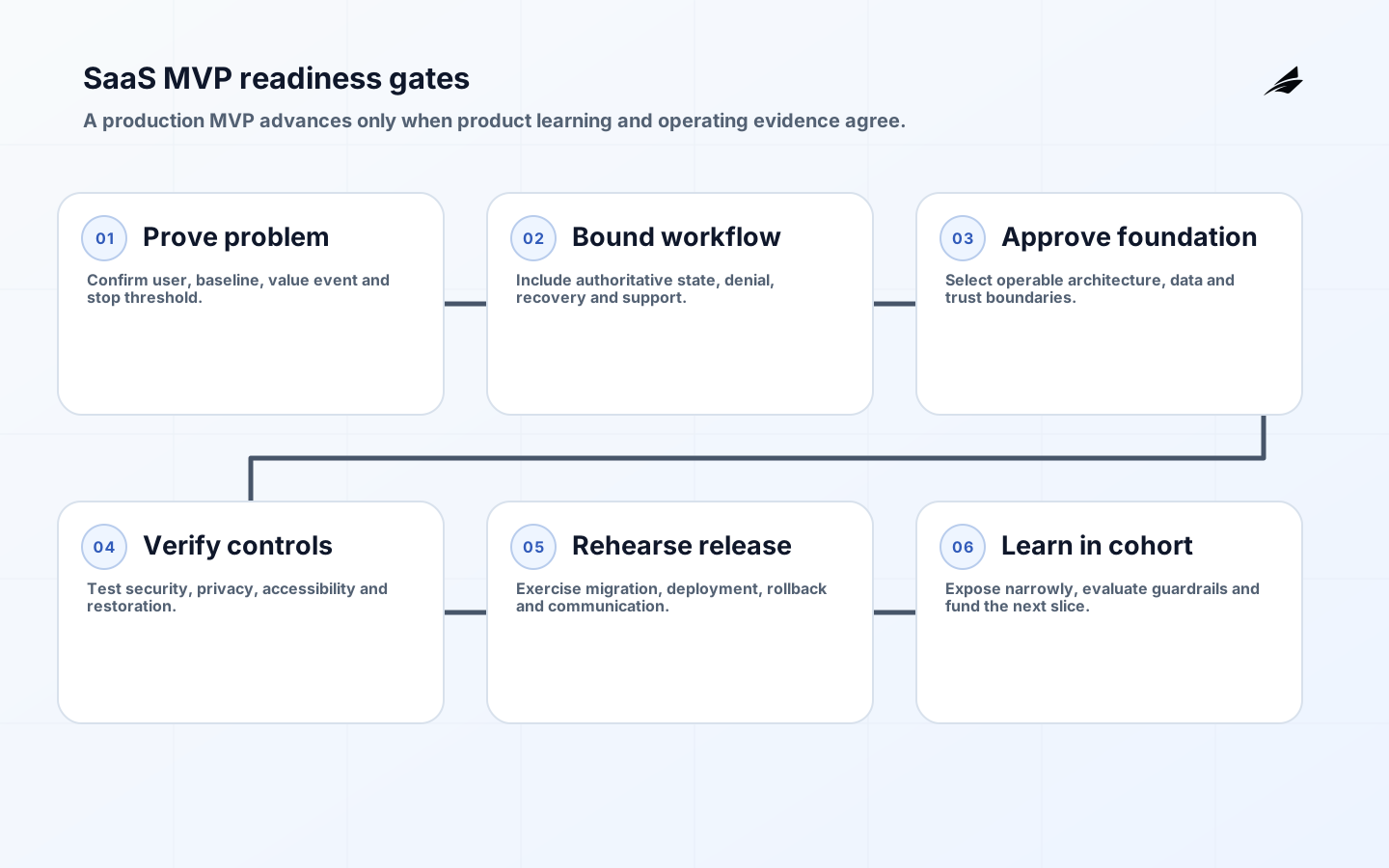
A SaaS MVP development readiness checklist should prove that the team can release one valuable workflow safely, observe what happens and support customers when the happy path fails. “Minimum” describes the smallest coherent test of a product thesis; it does not excuse missing authorization, unreliable data, inaccessible forms or a deployment no one can recover.
Use this checklist at discovery exit, before engineering starts, and again before launch. Attach an owner and evidence link to every gate. The companion SaaS MVP scope and delivery plan explains program choices, the MVP implementation FAQ answers common buyer questions, and the support-team SaaS MVP guide covers a specific operational context.
Gate 1: Confirm the problem and evidence threshold
Name the target user, present task, material friction and behavior the product should change. Support the claim with observed work, interviews, service data or a credible baseline. Write the next investment decision in advance: continue, change direction or stop. Completion is not “users liked the demo.” It is evidence that a defined cohort completed the intended job within agreed quality guardrails.
Select one primary value measure and a few diagnostics. Establish exclusions so the MVP does not become an unbounded collection of stakeholder wishes. Record assumptions separately from facts and rank them by consequence and uncertainty. High-risk assumptions need an earlier, cheaper test than full production construction.
| Readiness gate | Minimum evidence | Reject or revisit when |
|---|---|---|
| Problem | Named user, observed workflow and baseline | The audience or pain changes by stakeholder |
| Outcome | Observable value event and decision threshold | Success is only feature completion |
| Scope | One end-to-end path plus explicit exclusions | Core value depends on deferred features |
| Risk | Data classes, abuse cases and legal questions | Sensitive use has no accountable reviewer |
| Operations | Owner, support path and service expectation | Launch depends on developer availability |
| Investment | Funded next review and stop condition | No one can act on the result |
Gate 2: Approve one complete workflow
Map trigger, eligibility, identity, input, validation, decision, state change, notification, recovery and completion. Include empty, loading, duplicate, denied, partial-success and cancelled states. Identify the authoritative record for every consequential state and who may correct it. A clickable prototype can validate comprehension; it cannot demonstrate transaction integrity, permissions or third-party failure.
Turn the map into acceptance examples using real domain language. Specify what is intentionally manual during the first release and provide a controlled operator interface rather than direct database edits. Mark later capabilities in a separate backlog. Scope changes require a trade-off against the outcome, date, cost or risk instead of silent accumulation.
Gate 3: Select an operable architecture
Choose the simplest structure the current team can test and run. A modular application with one primary data store is often a sound starting point; independent services need a concrete reason such as isolation, scaling, deployment or ownership. Document module boundaries, request path, asynchronous work, external dependencies and failure behavior. Managed services still need limits, configuration, recovery and cost ownership.
Keep configuration outside source and make processes disposable where practical, drawing on Twelve-Factor App principles without treating them as a complete architecture. Add timeouts, bounded retries and idempotency where repetition can create duplicate business effects. Define backup and restoration against business records, including the recovery point and time the product actually needs.
Gate 4: Build verifiable security and privacy controls
Classify data, draw trust boundaries and define human and workload identities. Require server-side authorization for every protected operation, least privilege, secret management, encryption in transit, dependency review and auditable administration. NIST’s Secure Software Development Framework groups work around preparing the organization, protecting software, producing well-secured releases and responding to vulnerabilities; translate those outcomes into backlog and acceptance evidence.
Use the current OWASP ASVS to select application control requirements appropriate to the risk. Write abuse cases for invitation, recovery, exports, billing, tenant switching and privileged actions. Record collection purpose, retention, deletion and processor flows for personal data. Qualified counsel should confirm jurisdiction-specific obligations rather than letting engineers infer them from a generic checklist.
| Control area | Implementation evidence | Release test |
|---|---|---|
| Identity | Supported login, recovery and session design | Stolen or expired session cannot act |
| Authorization | Operation-resource-role matrix | Cross-tenant and direct-object tests deny |
| Data | Classification, retention and deletion map | Deletion reaches primary and derived stores |
| Software supply chain | Locked dependencies, review and artifact provenance | Known critical issue blocks release |
| Auditability | Actor, action, object, tenant and outcome events | Privileged changes can be reconstructed |
| Recovery | Backups, restore procedure and owner | Representative data restore is verified |
Gate 5: Verify usability and accessibility
Test the workflow with representative users and realistic data, including first-time and assistive-technology use. Adopt WCAG 2.2 as a technical reference: keyboard access, visible focus, labels, error identification, contrast, target size and accessible authentication are especially relevant to compact SaaS flows. Automated scans help but do not replace keyboard, screen-reader and human task testing.
Use plain domain language and explain irreversible actions before commitment. Preserve entered data after recoverable errors. Provide status and next action for delayed work. The support view should expose safe search, event history and bounded correction actions. If staff need to inspect raw logs or ask an engineer to explain normal state, operational UX is not ready.
Gate 6: Prove the release path
Automate build, tests and deployment from versioned configuration. Protect the main branch, require review for consequential changes and create an immutable artifact traceable to source. Separate deployment from feature exposure when a bounded rollout is needed. Rehearse database changes with forward and backward compatibility where rollback remains possible.
Test rules at unit level, service and data boundaries with integration tests, external contracts with stubs and provider sandboxes, and the revenue or safety critical path end to end. Include security and accessibility checks. Use DORA guidance to consider delivery speed together with failed-change and recovery performance, not as a race to maximize deployment count.
Gate 7: Accept production ownership
Define service owner, incident contact, product decision maker, security contact and supplier escalation. Instrument successful value completion, rejected actions, latency, errors, queue age, dependency failures and data reconciliation. Every alert needs a condition, severity, owner and runbook. Page only when timely human action can improve the outcome.
Rehearse one unavailable dependency, one suspected account compromise and one restore. Verify support can locate an account, explain state and escalate without excessive data access. Publish customer contact and status-update authority. Record service objectives and support hours that match the commercial promise; an MVP does not need global operations unless it sells global availability.
Gate 8: Release to a bounded cohort
Choose eligible accounts, exposure controls, observation window, stop thresholds and communication. Verify migrations, configuration, secrets, synthetic smoke tests, dashboards, alerts, runbooks and support staffing immediately before exposure. The launch decision belongs to a named person using recorded evidence, not to whoever happens to run the deployment.
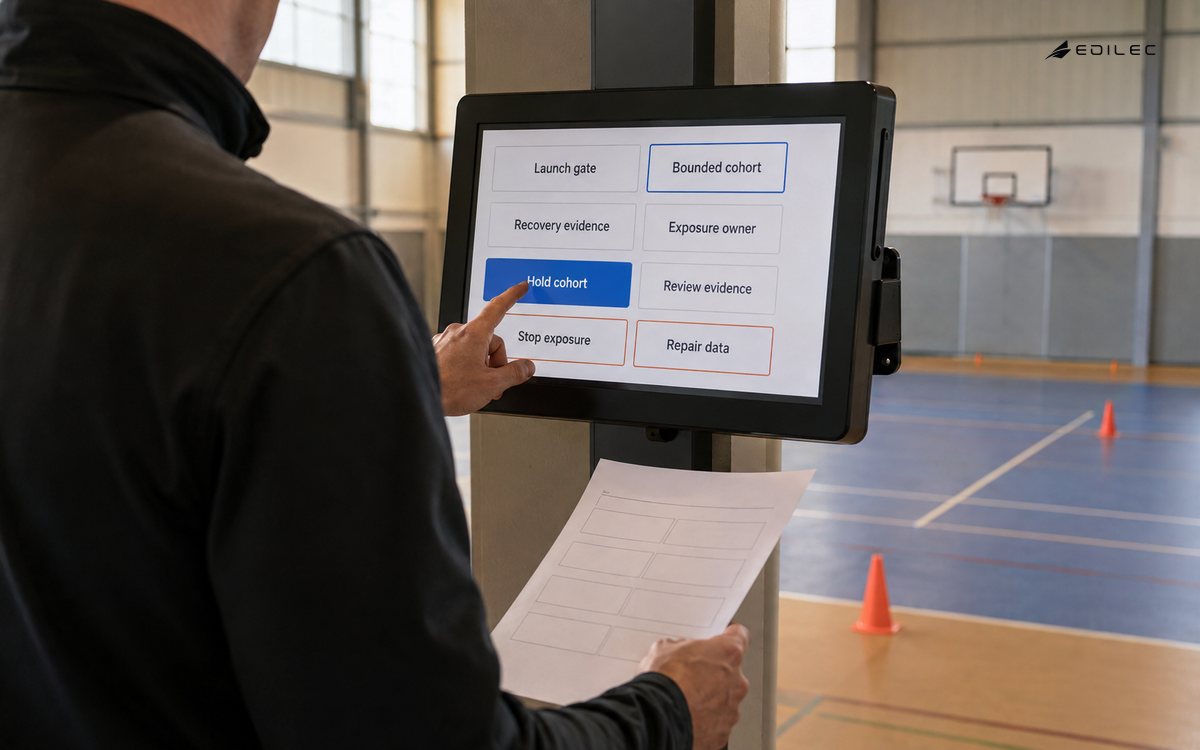
During the cohort, review customer outcomes and operational guardrails daily. Triage defects separately from product-learning observations. Close the cohort with a decision memo: evidence, caveats, incidents, support burden, cost and next funded slice. Stabilize reliability and data quality before widening access. Record customers who were excluded and why, because cohort boundaries affect how confidently the result can support broader release.
Prepare a cohort rollback sheet before launch. It should distinguish stopping new exposure, disabling a feature, reverting application code and repairing data. Name who can choose each action, which signals trigger review, how customers are informed and how writes made under the new behavior are reconciled. A feature flag can stop traffic but cannot undo emails, payments, exports or changed records. Run the decision sheet during the release rehearsal and verify that the required people, credentials and dashboards are available under time pressure. Include the support script and audit record for each response so recovery remains consistent across engineering and customer operations.
- Approve problem evidence, outcome threshold and stop rule.
- Freeze a coherent workflow, explicit exclusions and manual operations.
- Review architecture, trust boundaries and authoritative data.
- Complete security, privacy, accessibility and recovery acceptance.
- Rehearse deployment, migration, monitoring, support and communication.
- Expose a bounded cohort, evaluate evidence and fund the next decision.
Key takeaways
- An MVP is the smallest complete learning system, not the smallest codebase.
- Scope one valuable workflow and include denial, recovery and support paths.
- Treat security, privacy and accessibility as design inputs with testable evidence.
- Prove deployment, restoration, monitoring and ownership before customer exposure.
- Launch narrowly and make the next investment decision from production evidence.
Frequently asked questions
Should we calculate a readiness score?
A score can summarize progress but must not average away a critical failure. Use mandatory gates for authorization, data integrity, recovery and legal obligations, then report remaining risks individually with owners. A product that scores 90 percent can still be unfit to launch.
Who signs off the checklist?
Evidence should be owned by the relevant product, engineering, security, data and operations leads. One accountable launch authority accepts the combined residual risk and cohort bounds. A vendor may provide evidence but should not accept the customer’s business risk.
When should readiness be reassessed?
At major scope or architecture changes, before each exposure increase, after a serious incident, and when regulation or critical suppliers change. Keep the checklist tied to versioned evidence so the team can identify which assumptions a new release invalidates.
Conclusion
A production-ready MVP earns the right to learn from real use. Verify the problem, deliver one whole workflow, make controls observable and rehearse how the team will release and recover. With bounded exposure and a clear decision threshold, speed and responsibility reinforce each other.