Product engineering services for enterprise teams must create a product that can evolve inside real organizational constraints: identity, data ownership, procurement, security, accessibility, integrations, release controls and long-term operations. A delivery can meet its feature scope and still fail if business ownership is unclear, platform teams cannot support it or the receiving organization cannot release a change. This checklist makes production evidence and capability transfer part of the implementation, not an end-of-contract ceremony.
Use the checklist when commissioning a new internal or customer-facing product, modernizing a departmental application or adding an external product team. Read the related enterprise product engineering FAQ for commercial questions and the product engineering delivery plan for scope framing. Assign an owner and acceptance artifact to every gate.
Establish product outcomes and decision rights
Name the product owner with authority over priority and acceptance, the service owner accountable in production, and owners for security, data, architecture and adoption. Define how these roles make decisions with the external engineering team. A steering group is not a substitute for one accountable decision maker. Set escalation times for blocked access, unresolved risk and cross-system dependency because enterprise delays often arise outside the delivery team's direct control.
Write two or three measurable outcomes linked to user behavior or operating performance, plus guardrails for reliability, risk and support burden. Baseline the current process. Map one end-to-end journey including exceptions, approvals and administrative correction. Maintain an explicit exclusion list and assumption log. A feature enters delivery only when its user, outcome, data, acceptance behavior and operational owner are sufficiently clear.
| Decision right | Accountable role | Evidence |
|---|---|---|
| Outcome and backlog priority | Product owner | Outcome brief and ordered backlog |
| Production fitness | Service owner | Operational readiness and support acceptance |
| Data use and quality | Data owner | Classification, contract, retention and quality rules |
| Security risk | Security owner | Threat model, test findings and risk decisions |
| Architecture exception | Design authority | Time-bounded decision record and remediation owner |
Convert discovery into executable architecture
Document the context, system boundaries, critical journeys, trust boundaries, integrations, data flows and failure modes. Identify systems of record and teams that own them. Architecture decisions should record options, constraints, consequence and review trigger. Prefer established enterprise platform capabilities for identity, messaging, secrets, observability and deployment when they meet the need; exceptions create a support obligation and should be deliberate.
Choose the simplest modular shape compatible with team boundaries, scale and isolation requirements. A modular monolith can be more supportable than premature microservices, while a queue may be necessary for slow enterprise workflows. Apply relevant Twelve-Factor principles for configuration, backing services, disposability and environment consistency, but supplement them with explicit data recovery, tenancy, audit and supplier-exit requirements.
Contract data and integrations before UI completion
For each integration define business owner, source of truth, API or event contract, identity, rate limits, idempotency, timeout, retry, reconciliation and change notice. Use realistic nonproduction data under approved controls. Build a simulator or contract test when access to a shared dependency is slow or unstable. Failed integration work must be visible to operators through a queue or case, not buried in logs.
Classify data by sensitivity and purpose. Minimize collection, define field ownership, validation, retention, export and deletion, and identify legal or policy obligations with qualified specialists. Preserve audit events for consequential changes with actor, time, target, prior state and outcome. Include migration rehearsal, reconciliation and a tested rollback or forward-fix strategy. A database backup does not prove that business state can be restored correctly.
| Production gate | Acceptance evidence | Failure rehearsal |
|---|---|---|
| Identity and authorization | Role matrix and server-side permission tests | Removed user and cross-organization access |
| Data integrity | Migration reconciliation and restore result | Interrupted migration and replay |
| Integration | Contract tests and exception queue | Timeout, duplicate and rejected message |
| Release | Traceable artifact, smoke test and rollback rule | Failed canary with writes in progress |
| Operations | Objectives, dashboard, alerts and runbook | Dependency outage and escalation |
Embed security and accessibility in delivery
NIST's Secure Software Development Framework groups practices around preparing the organization, protecting software, producing well-secured software and responding to vulnerabilities. Translate that into repository protection, reviewed changes, secret management, dependency inventory, artifact integrity, vulnerability triage and a response owner. Use the OWASP ASVS to select verifiable application controls based on risk, then retain test evidence and risk decisions.
Adopt WCAG 2.2 as the web accessibility baseline where applicable. Include keyboard operation, focus, labels, error recovery, status messages, contrast, zoom and assistive-technology testing in acceptance. Design loading, empty, denied, partial and interrupted states. Enterprise products are used under time pressure and through varied devices; accessibility and resilient interaction reduce errors for the whole workforce, not only a compliance audience.
Create a repeatable delivery and release system
Version code, infrastructure, configuration schema and database changes. Protect the main branch, require review and automate build, tests, security checks and deployment. Promote immutable artifacts across environments and trace each release to source and approvals. Separate deployment from feature exposure for risky capabilities. Define rollback criteria before launch, including treatment of data written under the new version. Avoid manual production changes that cannot be reproduced.
Use tests at the appropriate boundaries: unit tests for rules, contract tests for integrations, integration tests for state transitions and a focused set of end-to-end tests for critical journeys. DORA's software delivery guides provide measures for continuous improvement; interpret speed with stability and recovery rather than chasing deployment frequency alone. Review queue time, change failure and recovery evidence to improve the system of work.
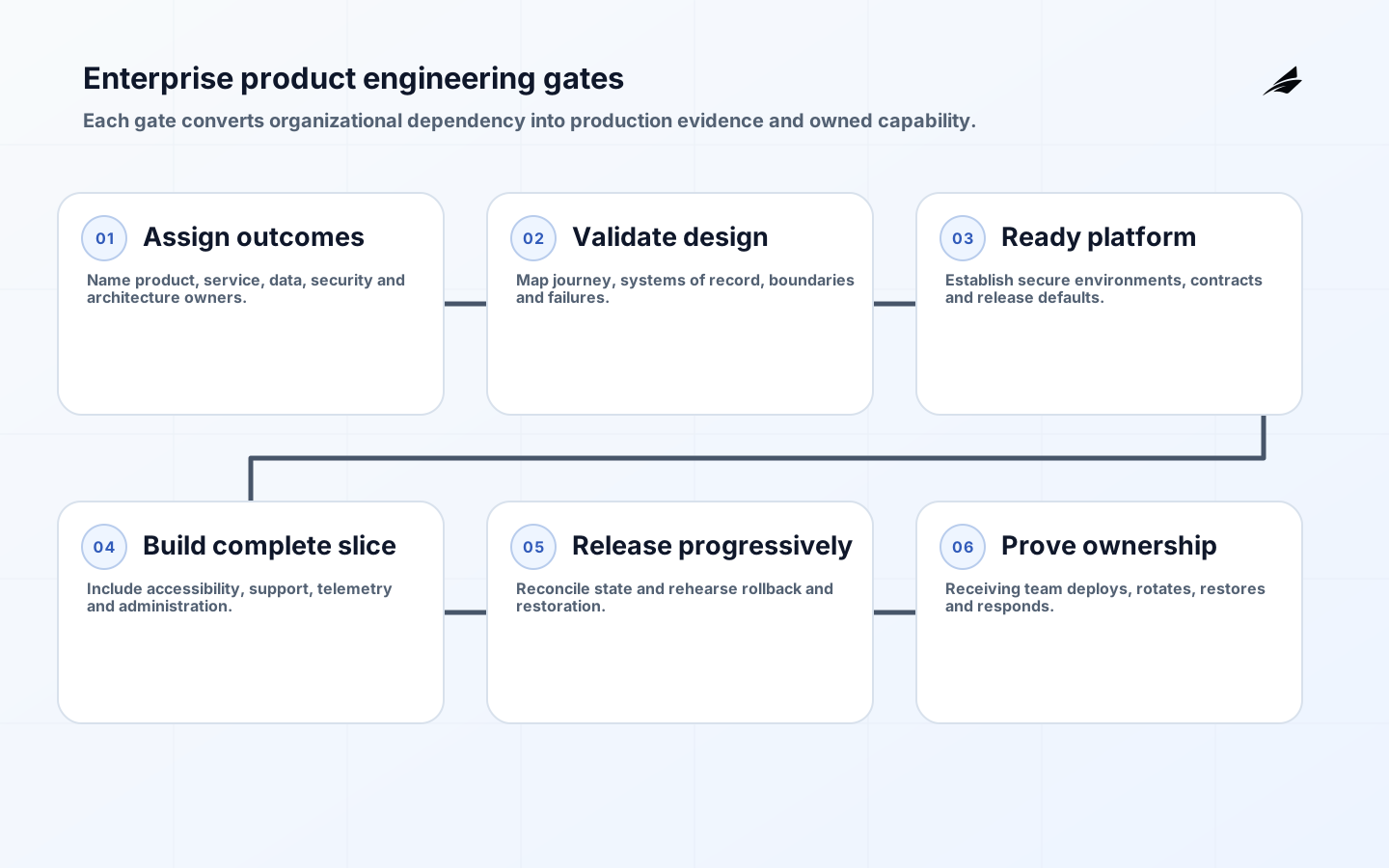
Move through six enterprise implementation gates
- Approve outcomes, owners, decision rights, constraints and current baseline.
- Validate the end-to-end journey, architecture, data flows and system ownership.
- Establish secure environments, contracts, pipelines and operational defaults.
- Build a complete production slice with support and administrative controls.
- Release progressively with telemetry, reconciliation and rehearsed recovery.
- Transfer ownership through demonstrated operation and an agreed improvement backlog.

Prove operational ownership and handover
Handover should include source history, architecture decisions, infrastructure definitions, build and deployment paths, data model, API contracts, dependency inventory, test evidence, credentials under enterprise control, licenses, runbooks, known risks and support responsibilities. Keep these artifacts current throughout delivery. The receiving team should deploy a representative change, restore data, rotate a secret and respond to a simulated alert before accepting ownership.
Agree service objectives, escalation, on-call coverage, vulnerability response, dependency updates, capacity review and cost ownership. Monitor user outcome, correctness, latency, integration backlog and support demand. Schedule a post-launch review after enough real use to compare with baseline. Feed observations into a funded backlog with product ownership; otherwise the application becomes a finished project while its dependencies and user needs continue changing.
Use evidence-based governance throughout delivery
Run governance around decisions, risks and evidence rather than presentation volume. A weekly product review should inspect outcome learning, accepted work, blocked dependencies and scope decisions. A technical review should address consequential architecture or security choices, not approve every implementation detail. Maintain a visible decision and risk log with owner, due date and effect. Close risks only with evidence or documented acceptance by the authorized role.
Commercial controls should support the same transparency. Define acceptance windows, intellectual-property terms, subcontractor access, service levels, exit assistance and ownership of cloud accounts and tooling. Tie milestones to usable increments and retained evidence instead of percentage-complete estimates. The companion software product engineering checklist can help align supplier deliverables with the enterprise's internal software lifecycle.
Plan adoption as product work, not corporate communication. Recruit representative users into discovery and acceptance, identify policy or role changes, update training and remove the old path only after exceptions are covered. Instrument completion and bypasses by workflow stage. Give managers a way to distinguish a usability problem from missing authority or bad source data. During rollout, keep an adoption decision log and fund fixes that remove repeated manual work. A technically stable service can still fail if teams retain parallel spreadsheets and messages because the new operating model was never agreed.
Name the date and evidence for retiring each replaced process. Parallel operation can support reconciliation during rollout, but indefinite duplication fragments records and ownership. Archive required history, revoke obsolete access and confirm that support no longer directs users to the old path.
Key takeaways
- Assign product, service, data, security and architecture decision rights explicitly.
- Turn discovery into owned contracts, failure behavior and acceptance evidence.
- Embed secure development, accessibility and operations in each product slice.
- Automate a traceable release path and rehearse recovery before broad rollout.
- Accept handover only after the receiving team demonstrates core operating tasks.
Frequently asked questions
Should an external product squad work independently?
It should have delivery autonomy within clear product, security, architecture and platform guardrails. Independence from every enterprise team is neither realistic nor desirable when identity, data and operations are shared. Name dependency owners and decision times so collaboration does not become diffuse approval.
How much architecture documentation is enough?
Keep a current context and container view, data and trust boundaries, critical sequence or state diagrams, integration contracts and consequential decision records. Documentation is sufficient when a new engineer or operator can explain ownership, failure behavior, security boundaries and release impact without relying on private memory.
What should determine implementation acceptance?
Acceptance should combine user behavior, automated and manual test evidence, security and accessibility checks, data reconciliation, release traceability, operational readiness and known-risk decisions. A demonstration is useful but cannot prove authorization, recovery, observability or maintainability under real conditions.
Conclusion
Enterprise product engineering succeeds when outcome ownership, platform constraints and production evidence are designed into the work. Establish decision rights, build one complete operational slice, automate the release path and make the receiving team prove it can change and recover the service. That turns a supplier engagement into a maintainable product capability rather than a code handoff.