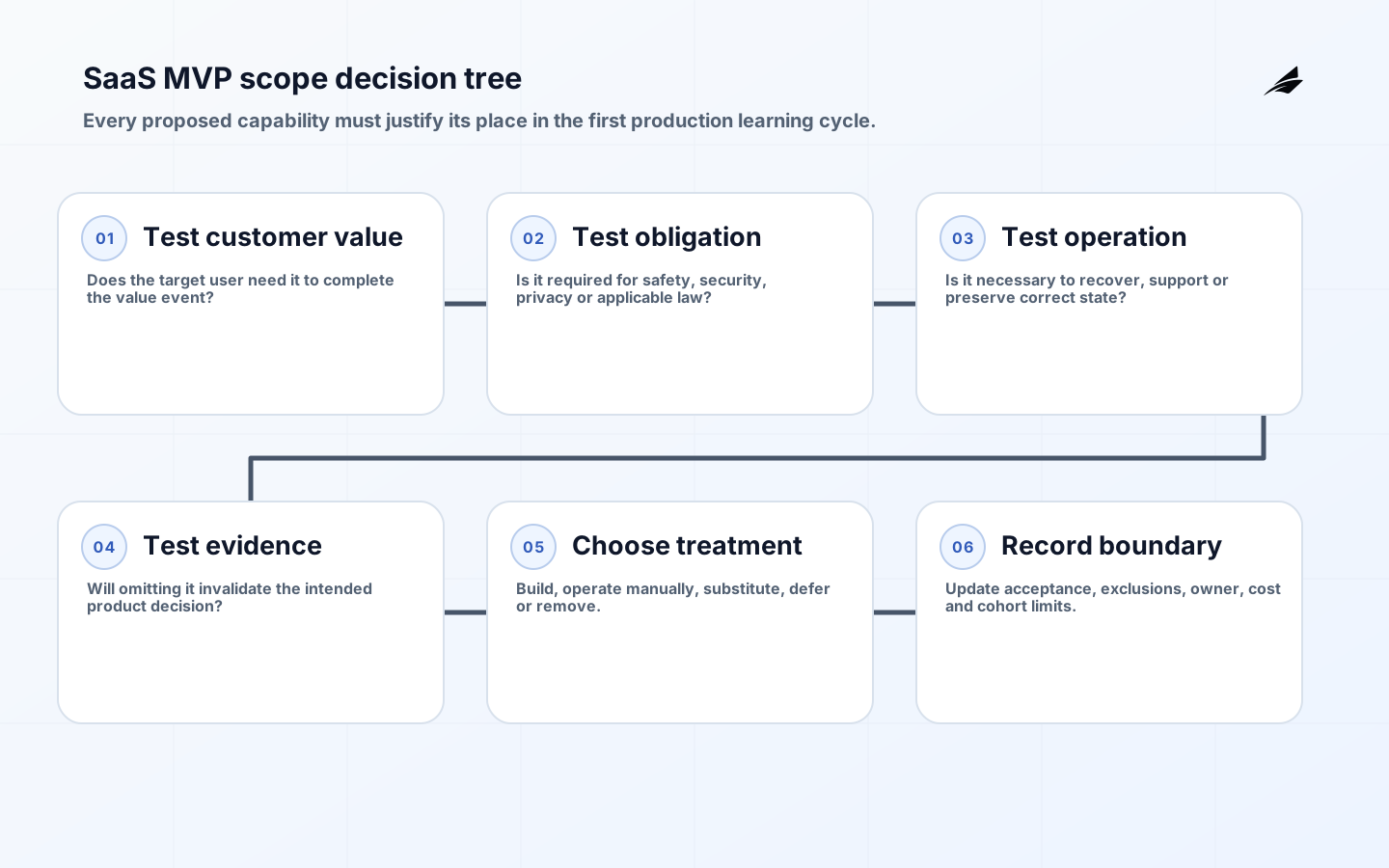
A SaaS MVP development implementation plan is a sequence for reducing business and technical uncertainty, not a promise to build a compressed version of the final platform. Founders and delivery leads need concrete answers about what belongs in the first release, what can wait, how risk changes the plan and what evidence justifies expansion.
The answers below assume a customer-facing production service, not a disposable prototype. For detailed gates, use the SaaS MVP readiness checklist. The scope, cost and risk guide supports commercial planning, while the implementation readiness guide provides another operational review.
What should a SaaS MVP include?
Include one end-to-end outcome for a defined user and account type: eligibility, sign-in, input, validation, core state change, confirmation, recovery and support visibility. Add essential tenant authorization, data protection, telemetry, backups and accessible interaction. Defer alternate personas, advanced reporting, broad customization and convenience integrations unless the hypothesis depends on them.
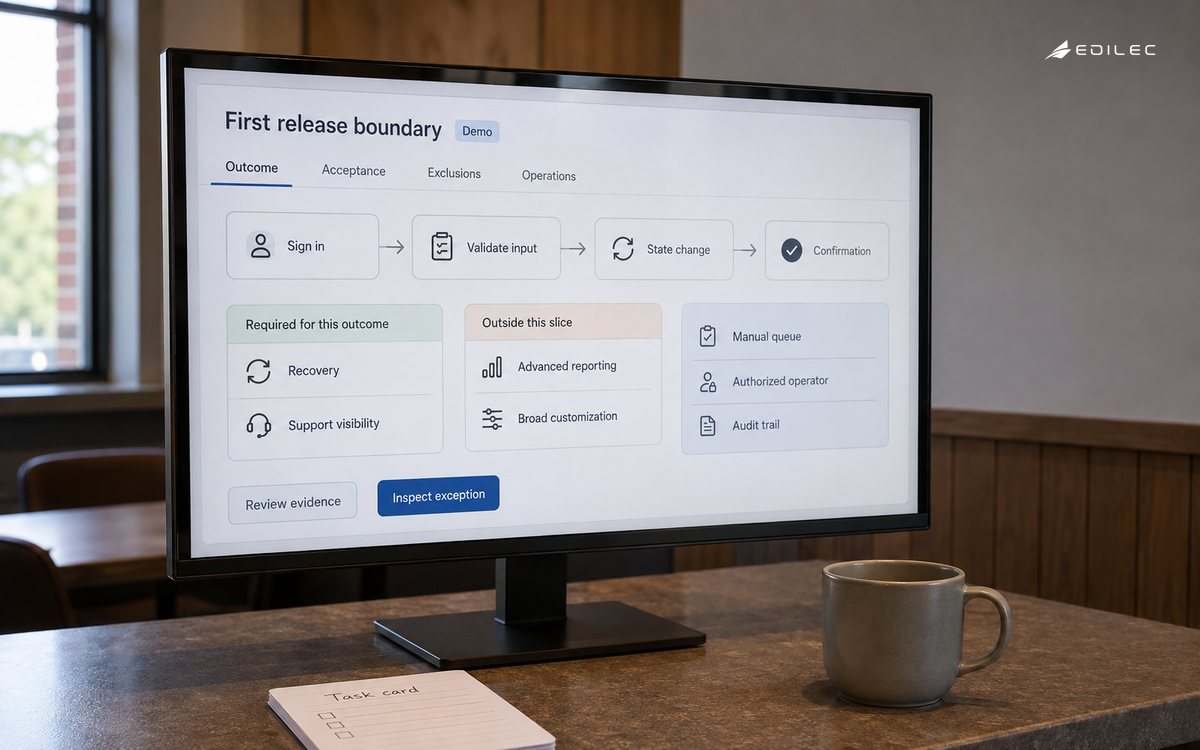
Write exclusions beside acceptance criteria. If removing a capability makes the value event impossible or the result unsafe, it is not optional. If it only increases reach, automation or polish, it may fit a later slice. A manual step is acceptable when volume is bounded and the operator has a controlled queue, clear authority and an audit trail.
| Scope item | Usually first release | Usually later | Decision test |
|---|---|---|---|
| Core workflow | One coherent path and recovery | Additional variants and bulk tools | Does the hypothesis require it? |
| Identity | Supported login, recovery and roles | Enterprise federation variants | Can access be revoked and explained? |
| Administration | Safe support lookup and bounded correction | Rich self-service configuration | Can normal exceptions be resolved? |
| Integrations | Only outcome-critical contracts | Convenience and broad ecosystem | What happens if it is unavailable? |
| Analytics | Value, failure and guardrail signals | Large dashboard catalog | Will a metric change a decision? |
| Operations | Deploy, monitor, restore and respond | Advanced optimization | Can the current team own it? |
How long should implementation take?
Estimate from evidence, dependencies and acceptance work rather than a universal week count. Discovery ends when the workflow, data, risks and decision threshold are clear. Implementation includes experience design, engineering, controls, integration, data work, testing, release rehearsal and bounded launch. Third-party approvals, weak source data and unclear ownership often dominate elapsed time.
Plan in vertical slices that produce demonstrable behavior. Timebox investigation, but do not timebox away unresolved safety or legal questions. Publish a range with assumptions, then reforecast after the first production-shaped slice. A fixed date can remain, but scope and cohort size must change transparently when evidence changes.
Which architecture is appropriate?
Default to a well-structured application with explicit modules and a small number of managed dependencies. Add separate services only for demonstrated isolation, scaling, team or deployment needs. Document boundaries so later extraction is possible, but do not prepay the coordination cost of a hypothetical organization. The Twelve-Factor App remains useful for configuration and process discipline, though it does not decide domain design or resilience.
Architecture acceptance should answer how requests fail, where authoritative state lives, how repeated work is deduplicated, how schema changes roll out, how data restores and what the team monitors. A technology diagram without these behaviors does not establish readiness.
Do we need multi-tenancy from day one?
If separate customer organizations will use the product, design tenant context and isolation before storing their data. That does not force one database or a complex shared platform. It requires a deliberate isolation model, server-resolved tenant scope, authorization tests, tenant-aware jobs and caches, and safe administration. Retrofitting tenant boundaries after broad data access is expensive and dangerous.
Choose shared or isolated infrastructure from sensitivity, scale, noisy-neighbor risk, residency and operational capability. Keep the business-level tenant identifier explicit even in dedicated deployments so exports, audit events, support tools and future consolidation remain coherent.
How much security is enough for an MVP?
Enough to manage the actual data, actors and abuse paths. Baseline controls include individual identities, secure recovery, server-side authorization, least privilege, secret handling, transport protection, dependency management, security events, backups and a vulnerability response owner. Apply NIST’s SSDF to the delivery process and choose risk-appropriate verification requirements from OWASP ASVS.
A penetration test may add assurance for exposed or high-risk functionality, but it cannot replace architecture review and normal automated checks. Classify findings by exploitability and business effect, fix release blockers and record accepted residual risk. Never call customer data “test data” to avoid production controls.
Does accessibility belong in the first release?
Yes. Accessibility affects whether people can complete the value path and is costly to retrofit into component and interaction patterns. Use the current WCAG overview to set an appropriate target, then test keyboard operation, focus, labels, errors, contrast, reflow and authentication with human review. Confirm applicable legal duties with counsel.
Accessible design also improves operational quality. Explicit labels, predictable status, preserved input and clear errors help every user and make automated acceptance more reliable. Include support and administrative surfaces, not only the public workflow.
What determines SaaS MVP cost?
Cost follows workflow breadth, role and tenant complexity, data sensitivity, integrations, migration, assurance, experience quality and service expectations. Include discovery, design, delivery, cloud services, testing, compliance work, support, monitoring and handover. A lower build estimate that omits operating ownership is not a lower total cost.
| Cost driver | Low-complexity condition | Higher-complexity condition | Planning evidence |
|---|---|---|---|
| Workflow | Single actor and short state path | Many roles, approvals and exceptions | State and responsibility map |
| Data | New, limited and low sensitivity | Legacy migration or regulated records | Classification and mapping sample |
| Integration | Asynchronous, tolerant dependency | Real-time payment or core-system chain | Contract and failure rehearsal |
| Assurance | Standard web controls | High-impact decisions or formal evidence | Control and test matrix |
| Availability | Business-hours pilot | Contracted continuous service | Service objectives and support model |
| Change | One product configuration | Many jurisdictions or customer variants | Variation inventory and governance |
Which roles are essential?
Name one product decision owner, technical owner and experience owner. Add engineering skills for the chosen stack, security and privacy review, quality automation, data or integration expertise and an operations owner. A person can cover several roles in a small team, but the decisions cannot be ownerless. Include customer support before launch so correction and communication paths are designed.
When using an external partner, retain product, architecture, data and risk authority internally. Require source, infrastructure definitions, tests, decisions, runbooks and credentials under customer control. Make knowledge transfer executable: the receiving team should deploy a change, inspect an incident and restore representative data.
What testing is necessary before launch?
Test domain rules, permissions, tenant boundaries, data transitions, external contracts and the complete value path. Include duplicate submissions, expired sessions, dependency timeouts, partial failure, migration errors, inaccessible interactions and restore. Reconcile critical state independently. A passing UI journey can conceal double processing or an unauthorized API.
Automate repeatable checks and preserve focused human review for usability, accessibility, abuse and operational judgment. Test from an immutable release candidate in a production-like environment. Rehearse deployment and recovery with the people who will perform them.
How should the MVP launch?
Expose a defined cohort behind a controllable release mechanism. Set eligibility, observation period, support contact, data-health checks, success threshold and stop conditions. Verify dashboards and alerts with synthetic activity before inviting customers. Keep product changes small during the evidence window unless customer safety or service restoration requires action.
Review value completion, failure, support burden, reliability, security and cloud cost. Delivery performance is also part of the learning system; the DORA guides provide measures for delivery and recovery. Decide whether to stabilize, expand, revise or stop, and write the evidence behind that choice.
Preserve the definitions, cohort query, release version and known data gaps with the decision. Without that record, a later event-schema or eligibility change can make the original result impossible to reproduce. The implementation plan should budget this evidence work as part of product management, not leave it as an analyst’s optional cleanup.
- Define the target user, value event and investment decision.
- Scope one complete workflow with explicit operational and security boundaries.
- Select a simple architecture and contract critical dependencies.
- Build controls, accessibility, telemetry and support into the production slice.
- Rehearse release and recovery, then expose a bounded cohort.
- Compare evidence with thresholds and fund only the justified next step.
Key takeaways
- Scope the MVP around a decision and one complete customer outcome.
- Design tenant isolation, security and accessibility according to real exposure.
- Estimate the whole delivery and operating system, not coding alone.
- Use production-shaped tests and rehearsals before customer access.
- Expand only after bounded use produces trustworthy evidence.
Frequently asked follow-up questions
Can a no-code platform support the MVP?
Yes, if it meets workflow, authorization, data ownership, integration, accessibility, audit, export, recovery and scale requirements. Test limits and exit behavior with a realistic slice. Speed of screen assembly is only one part of production readiness.
Which metric should we use?
Choose the proportion of eligible users or accounts completing the verified value event within a meaningful time. Pair it with diagnostics and guardrails for errors, support, unsafe behavior and retention. Registration and page views rarely prove customer value.
What if the hypothesis changes during development?
Return to the decision and determine whether the current slice still produces useful evidence. Change scope deliberately, preserve what was learned and reapprove cost, date and risk. Continuing a now-irrelevant build to protect the original plan wastes the experiment.
Conclusion
A strong SaaS MVP development implementation plan makes trade-offs visible. It gives a small team a complete outcome to build, a defensible control baseline, a repeatable release path and a threshold for what happens next. The right first release is not the one with the most features; it is the one that produces trustworthy learning without borrowing unacceptable risk.