Use this checklist to control an enterprise SaaS MVP from sponsorship through pilot handover. It assumes the release will handle real users or data. Tailor each item to risk and document why an item is not applicable; do not silently omit security, privacy, reliability or operational work simply because the feature set is small.
Gate 0: decision and ownership
- Name the executive sponsor, product owner, technical owner, security owner and operational owner.
- State the business problem, target users and one investment decision the MVP must inform.
- Define expand, revise and stop criteria before build begins.
- Identify who can approve scope, architecture, risk exceptions and production release.
- Create a decision log and require expiry dates for temporary exceptions.
- Confirm budget covers discovery, build, environments, security review, pilot support and handover.
The gate passes when owners can explain what will be learned and who will act on the result. A launch date, feature list or vendor contract is not a substitute. Record assumptions that materially affect estimates, such as identity-provider access, source-system API readiness and availability of representative users.
Gate 1: workflow and data discovery
Walk through real examples from intake to completion. Include rejected, corrected and abandoned cases. Mark manual handoffs and unofficial spreadsheets. Determine which system owns every important field and what happens when systems disagree. Classify personal, confidential, regulated and customer-controlled data with the relevant privacy or legal owner.
| Checklist area | Required artifact | Acceptance question |
|---|---|---|
| Workflow | Journey and exception map | Can a user complete meaningful work end to end? |
| Roles | Role and action matrix | Are read, write, approve, export and administer rights explicit? |
| Data | Field ownership and lifecycle map | Are source, retention, deletion and export rules known? |
| Integration | Contract and failure map | Are retries, reconciliation and manual recovery owned? |
| Evidence | Measurement plan | Will the pilot answer the investment question? |
| Scope | Now, later and excluded list | Are deferrals tied to reasons and triggers? |
- Collect representative records with sensitive data removed or controlled.
- Define the completion event and top workflow failure states.
- Document data residency, retention, deletion, backup and portability requirements.
- Confirm accessibility and language requirements for pilot users.
- Identify procurement, legal, security and compliance review lead times.
- Write acceptance criteria in observable terms rather than interface preferences.
Gate 2: tenant and architecture design
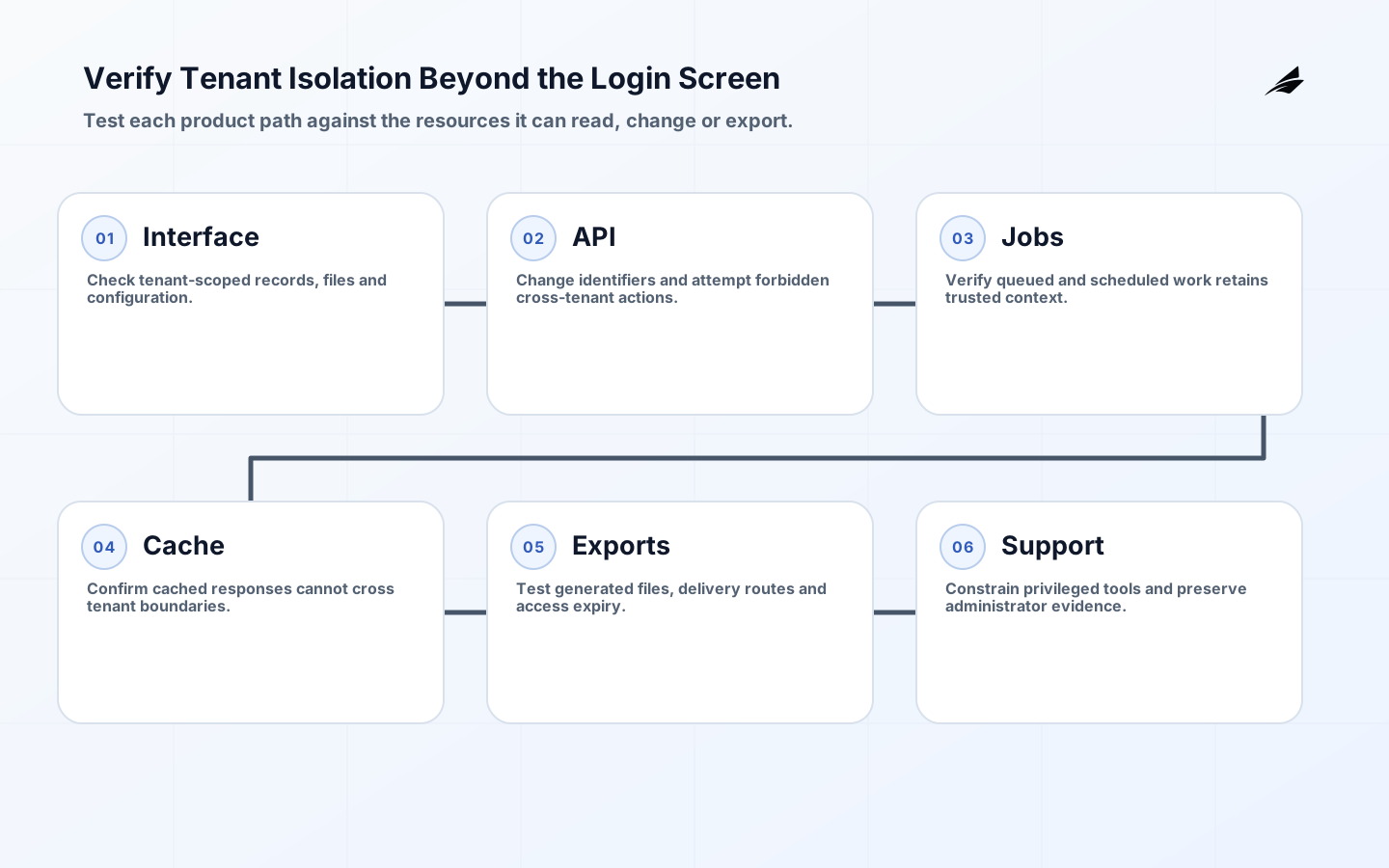
Define tenant, user and service identities separately. Decide whether users can belong to several tenants and how they switch context. Select pooled, siloed or bridge deployment patterns per component based on isolation, scale, compliance, cost and manageability. Authentication confirms identity; tenant isolation must also constrain data, cache, files, messages, jobs, exports, logs and administrative tooling.

- Carry trusted tenant context from identity through authorization and every downstream operation.
- Enforce isolation in shared components rather than relying on each developer to remember filters.
- Define keys, partitioning, encryption, secrets and key-rotation ownership.
- Design idempotency and bounded retries for externally visible actions.
- Separate product configuration from customer-specific code forks.
- Document capacity limits, noisy-neighbor controls and the next scaling trigger.
Gate 3: secure delivery foundation
Map relevant NIST SSDF and OWASP ASVS practices into the backlog and definition of done. Protect source repositories, branches, build credentials, deployment identities and artifacts. Pin or constrain dependencies, scan them, and define how vulnerabilities will be triaged. Threat-model identity, tenant boundaries, administrator functions, APIs, uploads and integrations before their shape becomes expensive to change.
| Control | Before pilot | Evidence |
|---|---|---|
| Identity | Federation or approved authentication, MFA policy and recovery | Role-based access tests |
| Application | Input handling, authorization and secure session behavior | Relevant ASVS verification |
| Delivery | Reviewed changes and protected automated pipeline | Build and deployment records |
| Secrets | Managed storage, rotation and no repository secrets | Secret scan and access review |
| Logging | Security and business events with correlation | Sample incident trace |
| Recovery | Backups, restore steps and rollback | Completed rehearsal |
Gate 4: build and integration
Deliver thin vertical slices that include interface, business rule, persistence, audit event and operating signal. Demonstrate them with realistic roles. Build an operator view for failed integrations instead of leaving failures only in logs. Mask or synthesize test data, separate environments and control production access. Keep infrastructure and tenant provisioning repeatable.
- Add unit, contract, integration, accessibility and isolation tests in proportion to risk.
- Test timeouts, duplicate messages, partial failure and dependency unavailability.
- Make errors useful to users without exposing internals or sensitive data.
- Record auditable state transitions and administrative changes.
- Instrument tenant-aware latency, error, saturation and workflow completion.
- Review scope after each slice and protect the explicit later list.
Gate 5: launch readiness
Run a production-readiness review with product, engineering, security, operations and business owners. Confirm service-level indicators around user journeys, alert thresholds, escalation, status communication and pilot support hours. Restore data in a production-like environment. Rehearse deployment and rollback. Verify that logs are accessible to responders and retained according to policy.
- Close or explicitly accept high-impact defects and security findings.
- Verify tenant provisioning, deprovisioning, user lifecycle and access review.
- Reconcile migrated data and retain evidence of approval.
- Publish user, administrator and support guidance.
- Confirm incident contacts, legal escalation and customer communication authority.
- Set pilot guardrails, stopping conditions and rollback decision owner.
Gate 6: pilot rollout
Launch to a bounded cohort with representative users, administrators and support staff. Prefer staged enablement or feature controls that allow exposure to increase without redeployment. Observe the first workflows closely, but avoid coaching every action; excessive help can conceal usability problems. Record reasons for abandonment and off-system work, not only successful completions.
| Pilot signal | Interpretation question | Possible response |
|---|---|---|
| Low activation | Is access, relevance or onboarding failing? | Fix the barrier before adding features |
| High completion time | Where does work wait or leave the product? | Improve the constrained step |
| Repeated exceptions | Is policy missing or the scope wrong? | Model the exception or narrow the promise |
| Support concentration | Which role or tenant is struggling? | Improve design, guidance or permissions |
| Reliability breach | Is load, dependency or code responsible? | Contain, recover and revise the objective |
| Security anomaly | Could tenant or data boundaries be affected? | Stop exposure and follow response process |
Gate 7: evidence review and handover
Compare pilot evidence with the pre-agreed decision criteria. Review adoption, workflow outcomes, exceptions, support burden, reliability, security findings, administrator effort and qualitative feedback. Separate a product problem from a rollout problem. Document what was learned, unresolved risks and the cost of the next increment before requesting expansion.
- Choose expand, revise or stop and record the evidence behind the decision.
- Transfer runbooks, dashboards, access routines, known limits and architecture decisions.
- Assign owners and dates to vulnerabilities, defects and temporary controls.
- Remove pilot data and access that should not persist.
- Prioritize the next backlog by outcome and risk, not stakeholder volume.
- Review delivery throughput and instability trends without ranking individuals.
Checklist risks
A checklist can create false confidence when teams mark items complete without evidence, apply every control identically, or ignore interactions between controls. Use it as a review aid, not a substitute for architecture and threat analysis. The companion practical enterprise SaaS MVP guide explains the decisions behind these gates, while the enterprise MVP FAQ addresses stakeholder questions.
Control changes and exceptions during implementation
Every material change should identify the new evidence, affected acceptance criteria, architecture and data implications, delivery effect and decision owner. A role added for one pilot group may alter authorization tests and administrator guidance. A new export may change privacy, retention and incident exposure. A second integration may introduce a different consistency model. Treating these as small interface requests allows risk and operating work to arrive invisibly.
Use a lightweight decision record for scope and architecture changes. State the context, options, decision, consequences and review date. Link the record to backlog work and updated tests. The goal is not bureaucracy; it is preserving why the product behaves as it does after the people in the meeting have moved on. Review accumulated decisions before each launch gate because several reasonable exceptions can combine into an unreasonable operating burden.
Temporary controls need the same discipline. If pilot provisioning is manual, define who performs it, the approval evidence, validation check, maximum cohort and trigger for automation. If a dependency cannot support the preferred authentication method, document the compensating access and monitoring controls. Close, replace or explicitly accept each temporary measure before broad rollout; otherwise the pilot process quietly becomes the production design.
Maintain a release evidence index so reviewers can find the current threat model, permission matrix, test results, migration reconciliation, restore rehearsal and accepted exceptions without searching several tools. Evidence should identify environment, version, date and reviewer. Protect it according to sensitivity and retention needs. This index makes the final launch review faster while exposing stale proof that no longer matches the release candidate.
After launch, run a short implementation review. Compare planned and actual assumptions, identify controls that created unnecessary friction, and capture incidents or near misses. Turn lessons into checklist changes with an owner. A checklist should evolve from evidence while remaining stable enough that teams understand what each gate expects.
Archive superseded evidence according to policy while keeping the decision trail. Reviewers should be able to distinguish the current release packet from historical tests and understand which findings remain open across versions. Before each cohort expansion, confirm that evidence still matches deployed configuration, integrated service versions and the current data classification.
- Classify changes by effect on value, data, security, reliability and operations.
- Update acceptance criteria and test evidence with the change.
- Give every temporary control an owner, limit and expiry trigger.
- Review the combined burden of exceptions at release gates.
- Prevent customer-specific decisions from bypassing product governance.
Key takeaways
- Require evidence and an owner for every completed gate.
- Define tenant isolation across synchronous, asynchronous and administrative paths.
- Make security, recovery and support part of the MVP rather than a later phase.
- Pilot with explicit stop conditions and representative users.
- Base expansion on product, operational and risk evidence together.
Frequently asked questions
Must every checklist item be completed?
Every item should be considered. Marking one not applicable requires a reason and owner. The depth of evidence should match the data, users, criticality and obligations of the pilot.
Who owns the checklist?
The product owner should coordinate it, while named specialists own their evidence. No single role can approve business value, tenant architecture, security risk and production readiness alone.
What happens when scope changes?
Assess the effect on the investment question, architecture, risk, test plan and pilot. Record the decision. A seemingly small export or role can materially change data exposure and support requirements.
Is passing the checklist enough to launch?
No. The accountable release authority must review evidence and residual risk. The checklist improves visibility; it does not replace professional judgment or required approvals.
Conclusion
A useful MVP checklist turns assumptions into visible gates and production claims into evidence. It keeps a narrow release honest about tenant boundaries, secure delivery, recovery and support. Used throughout the work, it helps the team learn quickly without treating enterprise risk as unfinished paperwork.