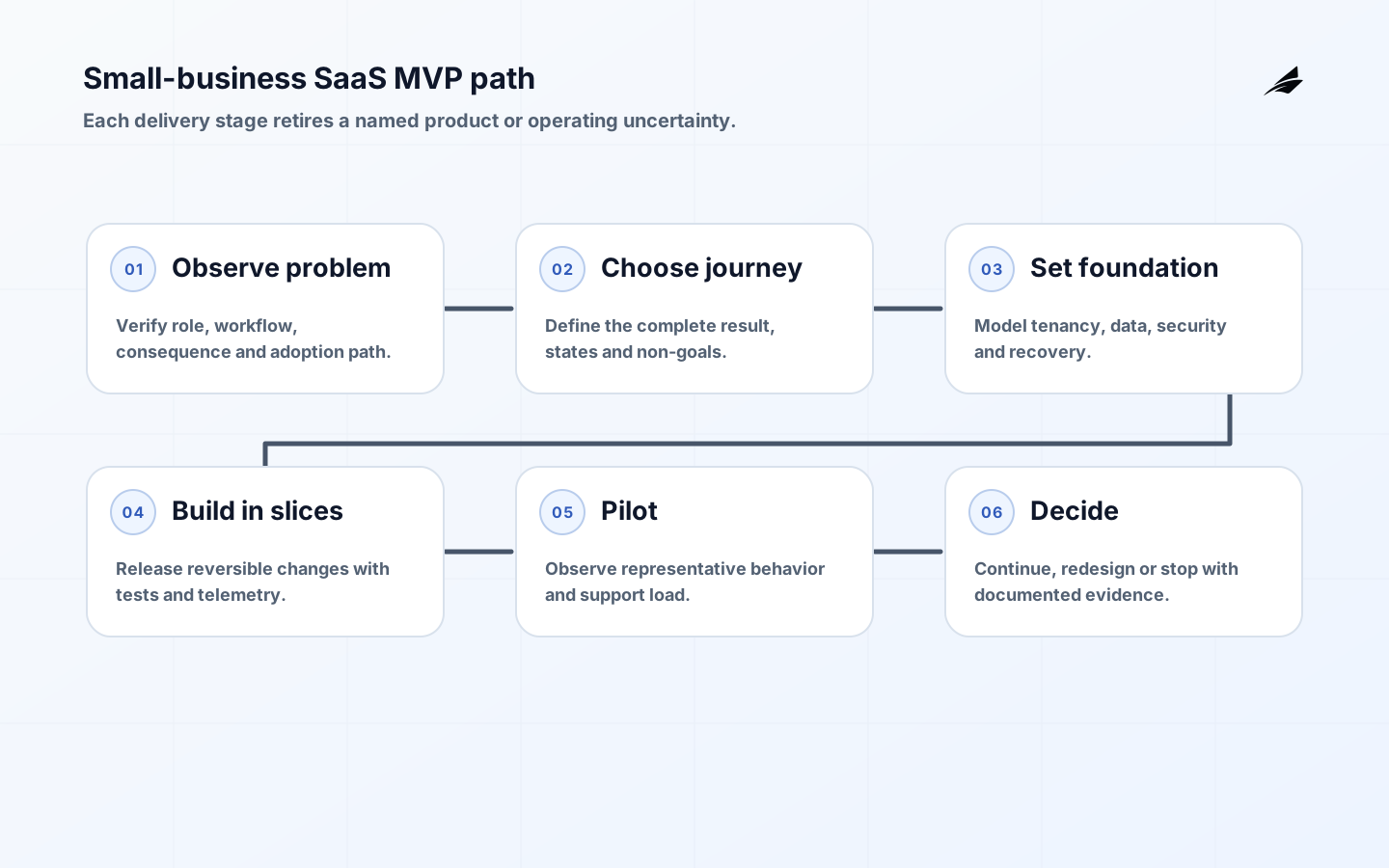
Building a SaaS MVP for a small business is an exercise in reducing uncertainty, not racing to publish the largest possible feature list. The work should answer whether a specific group will adopt and pay for a better way to complete a recurring job, while leaving a product the team can support. The constraint is useful: limited time and money force decisions about the customer, workflow, data and operating model that larger programs often postpone.
This guide uses staged evidence rather than a single launch date. Each stage has a decision, artifact and stop condition. Small-batch delivery shortens feedback cycles; secure development, accessibility and observability are built into the selected workflow. The result can be modest in breadth but credible in behavior. That is a better foundation for growth than a visually complete application whose permissions, billing and recovery remain improvised.
1. Verify the problem before designing the product
Interview people who perform the work, observe the current process and collect examples of delays, re-entry, errors and workarounds. Ask what triggers the job, what information is trusted, who approves the result and what happens when it fails. Separate the user from the buyer and administrator. A technician may use the product, an operations manager may own the outcome, and a business owner may approve spending. The MVP must satisfy the adoption path as well as the interface.
Write a one-page problem brief with the target role, context, current alternative, consequence, frequency and evidence. Avoid claims such as businesses need automation. Prefer a falsifiable statement: independent clinics lose appointment follow-up because staff reconcile three unconnected lists; a shared exception queue should reduce unresolved cases without increasing call time. Define the evidence and decision threshold now, before attachment to a solution turns every response into apparent validation.
2. Select one complete customer journey
Map the journey from invitation or purchase to first value, repeated use, help and departure. Choose one path that produces the promised result. Include the unglamorous transitions: empty state, invalid data, permission denial, correction, cancellation and export. A small-business inventory MVP might import a product list, record a count, flag a discrepancy and assign resolution. Forecasting, supplier portals and custom analytics can wait. The selected journey cannot stop at displaying a discrepancy if the customer value is resolving it.
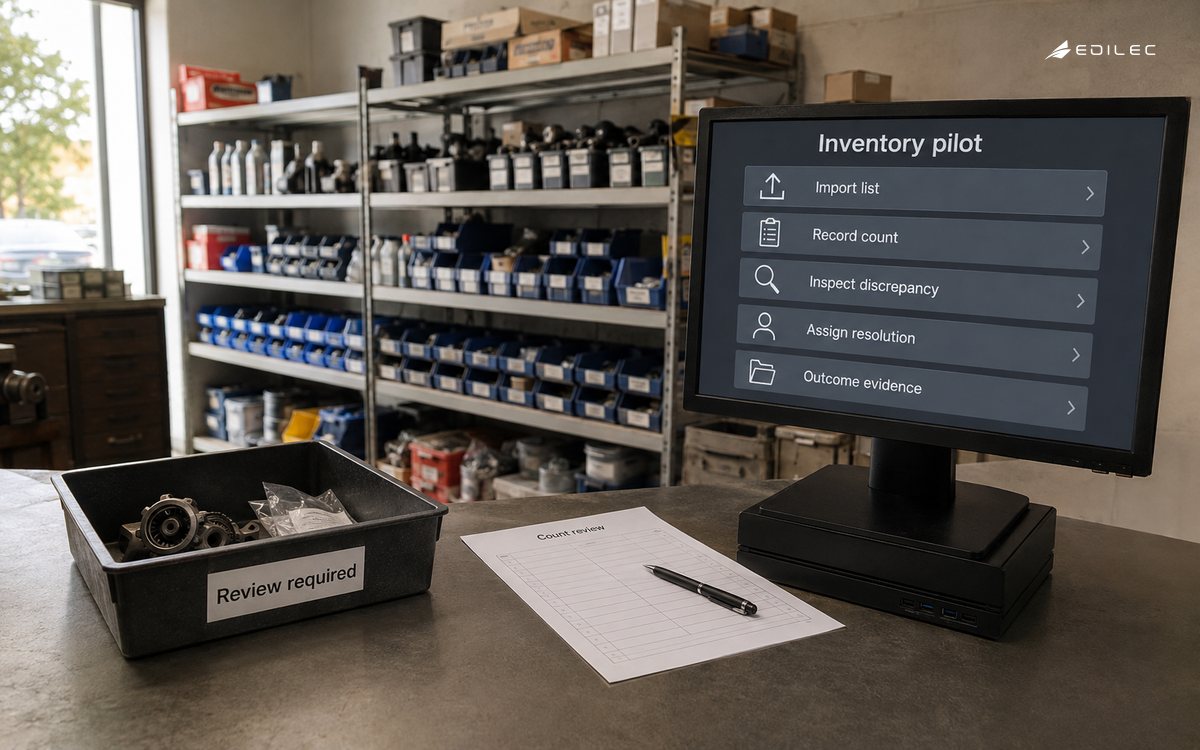
Create a non-goal list and an assumption register. Mark which needs are handled manually during the experiment and cap that labor. Manual onboarding may be sensible; manual repair of tenant permissions is not. Rank assumptions by consequence and uncertainty, then place the riskiest in early slices. This prevents the team from polishing familiar screens while identity, data import or customer willingness to change remains untested.
| Stage | Decision | Required artifact |
|---|---|---|
| Problem | Is the pain specific and consequential? | Observed workflow and hypothesis |
| Journey | What is the smallest complete result? | State map and non-goals |
| Foundation | Which controls make the slice trustworthy? | Tenant, data and threat model |
| Build | Can changes be released and reversed safely? | Tested delivery pipeline |
| Pilot | Does real behavior support the hypothesis? | Evidence review and support log |
| Expand | Is the product operable and economical? | Readiness and unit-cost decision |
3. Define tenancy, roles and authoritative data
Model organizations, memberships, roles and resources explicitly. Derive tenant scope from the authenticated session and enforce it in server-side queries, jobs, storage paths and caches. Do not rely on a hidden field in the browser. Start with a few roles tied to real responsibilities, such as owner, operator and viewer. Every privileged action needs a reason to exist. Automated tests should attempt access across tenants and after membership removal.
Identify authoritative records and lifecycle states before designing dashboards. Define creation, update, correction, archive, retention, export and deletion. Use stable identifiers and record consequential transitions. Data imported from a spreadsheet or partner should be validated, previewed and reconciled. If a result is derived, preserve its inputs and rule version so support can explain it. A source-of-truth claim is earned through ownership and correction behavior, not visual prominence.
4. Establish a proportionate technical foundation
Prefer a supported, understandable stack. A modular application, managed relational database, object storage and managed identity can serve many early products. Keep environments and configuration reproducible, secrets outside code and changes reviewed. Add automated tests around authorization and the core workflow before broad component coverage. Build database migrations that can be rehearsed. Back up the authoritative data and perform a restore into an isolated environment.
Document a small number of architecture decisions: tenancy, data store, identity, external services, deployment, recovery and likely scale constraint. Record why each was chosen and when to revisit it. Avoid microservices introduced only for future scale; they add network failure, deployment and observability work. Also avoid locking product rules inside low-code tools or vendor workflows without export and change control. Reversibility is more useful than theoretical flexibility.
5. Deliver the workflow in small, releasable slices
Create a walking skeleton that reaches production-like infrastructure with sign-in, tenant context, one record and telemetry. Add state transitions in small increments behind feature flags or cohort controls. Keep the main branch releasable, review changes and use a staging environment only for tests that need it. DORA's small-batch guidance is valuable because shorter changes reduce review and recovery difficulty and connect feedback to a manageable set of decisions.
Define done to include tests, authorization, accessible interaction, telemetry, support notes and migration behavior. Review keyboard navigation, focus order, labels, errors, contrast and target size against current WCAG guidance. Accessibility is easier to maintain when components and patterns are corrected early. Test with representative devices and browsers rather than assuming a component library guarantees the complete experience.
6. Add commercial state without corrupting product state
Decide whether the experiment needs self-serve payment. For a few design partners, contracts and manual invoices may reveal willingness to pay with less implementation. When subscriptions are needed, keep the provider as the authority for payment events and the application as the authority for product access. Verify event signatures, store event identifiers and process idempotently. Reconcile periodically because webhooks can be delayed, duplicated or missed during an outage.
Map plans to explicit entitlements rather than scattering plan-name checks through code. Define trial expiry, payment failure, upgrade, downgrade, cancellation and reactivation. Preserve customer access to export and support where appropriate. Keep initial pricing simple enough to explain and test. Measure the cost driver behind the plan, not only revenue. A popular customer can still be uneconomic if intensive imports, storage or support are invisible.
7. Make the product diagnosable before the pilot
Instrument the core journey with structured events and service telemetry. OpenTelemetry provides vendor-neutral concepts for traces, metrics and logs, but the team must choose useful attributes and protect sensitive data. Correlate request, background job and external dependency. Measure workflow completion, error, queue delay, notification and entitlement reconciliation. Use logs to explain a failure, not to collect every payload. Assign retention and access for operational data.
Create a support view that shows account, membership, plan, important state and recent errors without granting unrestricted database access. Write runbooks for sign-in failure, import rejection, delayed job, missing notification and payment mismatch. Test an alert and escalation. The founder may initially carry support, but the evidence and procedure should allow another person to help. This is a direct test of whether the product is becoming a business rather than a personal script.
| Pilot measure | Interpretation | Decision use |
|---|---|---|
| Time to first value | Friction before the core result | Simplify onboarding or targeting |
| Workflow completion | Whether users reach the promised outcome | Fix product path before adding breadth |
| Repeat use | Whether the problem recurs and value persists | Assess retention hypothesis |
| Support interventions | Hidden labor needed for success | Automate, document or narrow scope |
| Service failures | Reliability of the tested journey | Stabilize before cohort growth |
| Unit cost | Cost of serving one account or outcome | Adjust architecture, usage or pricing |
8. Run a bounded pilot and make a decision
Set participant criteria, duration, data rules, support hours and success measures. Onboard a small cohort whose work matches the hypothesis. Observe first use and schedule outcome reviews, but avoid custom-building each request. Record failures and workarounds in one backlog with customer consequence. Use controlled releases and a rollback plan. Protect participant data with the same seriousness expected after launch; a pilot label does not change the impact of exposure.
At the decision gate, compare behavior and outcomes with the threshold. Continue when evidence supports the problem and delivery model; redesign when value exists but the workflow or segment is wrong; stop when the problem is weak or economics are structurally poor. Document what was learned and retire unused data and infrastructure. If continuing, create the next hypothesis around retention, acquisition, broader workflow or scale rather than expanding from momentum alone.
Key takeaways
- Validate a specific recurring problem and adoption path before building.
- Choose one end-to-end journey and write non-goals.
- Make tenancy, data ownership, recovery and secure delivery part of the first slice.
- Use simple commercial rules and reconcile billing asynchronously.
- Expand through evidence gates that include operability and unit cost.
Frequently asked questions
How long does a SaaS MVP take?
A bounded product may take weeks to validate and several months to make operable, depending on integrations and risk. Estimate stages and uncertainties rather than promising a universal duration.
Should a small business build mobile apps first?
Only when the workflow needs device capabilities, offline use or frequent field interaction. A responsive web experience is often faster to test and maintain. Base the choice on observed context.
What should be handed over by a development partner?
Require repositories, build and deployment instructions, infrastructure definitions, environment inventory, data model, tests, credentials procedure, dashboards, runbooks, decision records, cost model and known risks.
Conclusion
A small-business SaaS MVP works when it turns a real workflow into a testable service and a clear investment decision. Scope narrowly, build the trust boundaries honestly, release in small batches and observe outcomes with representative users. The product may start simple, but its core should be explainable, secure, accessible and recoverable. That combination preserves both learning speed and the option to grow.