A SaaS product development readiness checklist should answer two different questions: whether the product deserves to be built and whether the service can be operated. Evidence of customer pain does not prove tenancy, billing, security, reliability, and support readiness; a polished architecture does not prove demand. The plan should connect both sides through one narrow customer workflow and explicit release gates. The primary planning lens is SaaS product development readiness checklist, with decisions expressed in language that product users and operating teams can verify.
Nearby planning resources include SaaS Product Development Implementation: Scope, Cost, Risks and Delivery Plan, SaaS Product Development Implementation FAQ, How to plan SaaS launch checklist before development starts, Subscription Access Control: A Practical Guide for Product Leaders. Those pages provide companion scope and checklist views; this article develops the technical and operating evidence for the topic here.
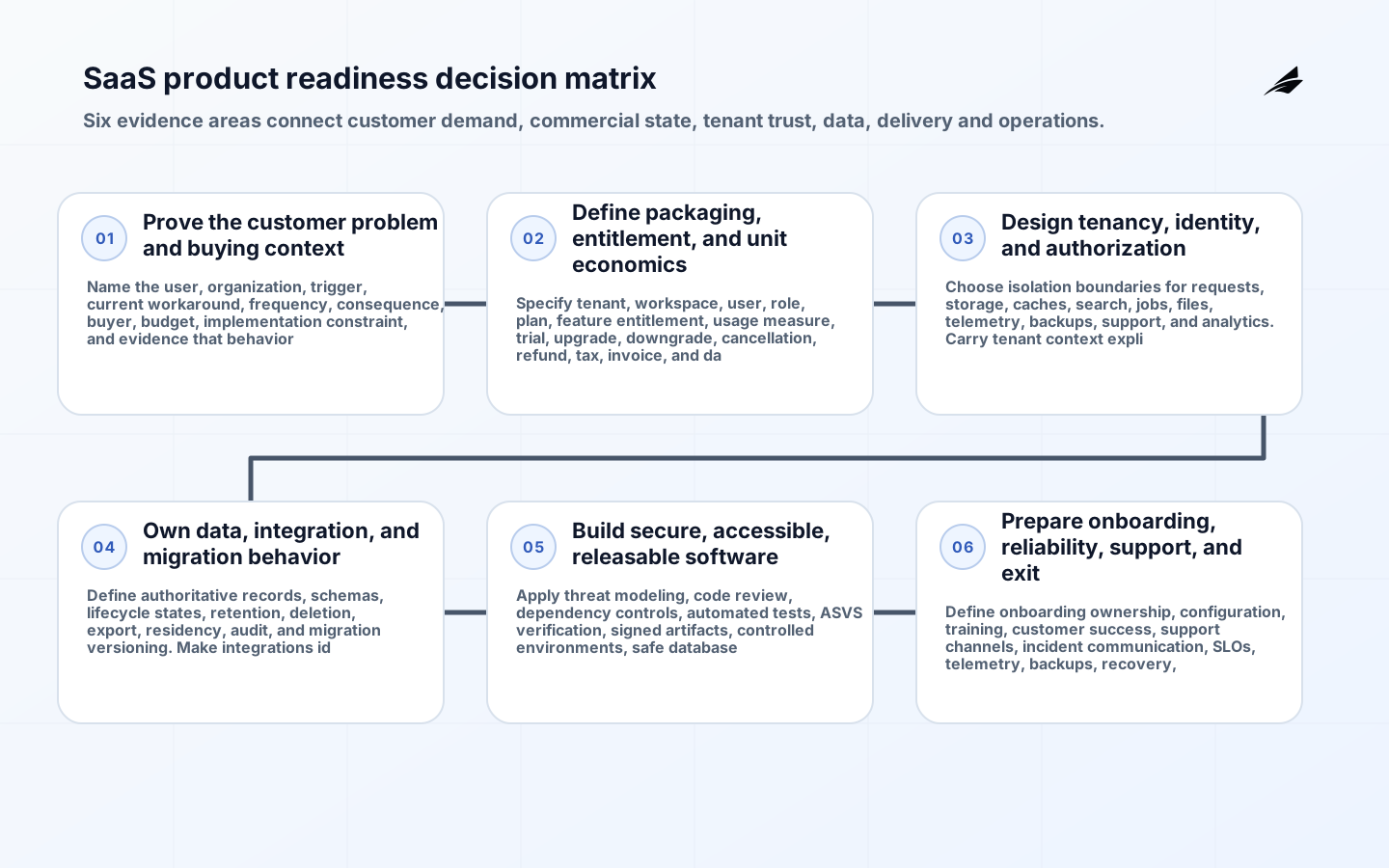
Prove the customer problem and buying context
Name the user, organization, trigger, current workaround, frequency, consequence, buyer, budget, implementation constraint, and evidence that behavior will change.
Use interviews, observed workflows, prototypes, and paid or committed pilots rather than broad survey enthusiasm. Define the narrow promise the first release must keep. A feature list assembled from several customer segments can satisfy none of them and make onboarding impossible to standardize.
Define packaging, entitlement, and unit economics
Specify tenant, workspace, user, role, plan, feature entitlement, usage measure, trial, upgrade, downgrade, cancellation, refund, tax, invoice, and data-export behavior.
Model revenue and cost by the same units. Include infrastructure, third-party APIs, support, onboarding, payment fees, observability, storage, backups, and bad debt. Billing added after product logic often creates access gaps, unreconciled usage, and customers receiving features outside their contract.
| Decision area | Required decision | Acceptance evidence |
|---|---|---|
| Prove the customer problem and buying context | Name the user, organization, trigger, current workaround, frequency, consequence, buyer, budget, implementation constraint, and evidence that behavior will change. | Use interviews, observed workflows, prototypes, and paid or committed pilots rather than broad survey enthusiasm. Define the narrow promise the first release must keep. |
| Define packaging, entitlement, and unit economics | Specify tenant, workspace, user, role, plan, feature entitlement, usage measure, trial, upgrade, downgrade, cancellation, refund, tax, invoice, and data-export behavior. | Model revenue and cost by the same units. Include infrastructure, third-party APIs, support, onboarding, payment fees, observability, storage, backups, and bad debt. |
| Design tenancy, identity, and authorization | Choose isolation boundaries for requests, storage, caches, search, jobs, files, telemetry, backups, support, and analytics. Carry tenant context explicitly and test denial paths. | Use secure OAuth practices, strong authentication, least privilege, organization roles, delegated administration, invitation controls, session revocation, and auditable privileged support. |
Design tenancy, identity, and authorization
Choose isolation boundaries for requests, storage, caches, search, jobs, files, telemetry, backups, support, and analytics. Carry tenant context explicitly and test denial paths.
Use secure OAuth practices, strong authentication, least privilege, organization roles, delegated administration, invitation controls, session revocation, and auditable privileged support. Cross-tenant leaks often originate in background work, object storage, exports, or support tools rather than normal API requests.
Own data, integration, and migration behavior
Define authoritative records, schemas, lifecycle states, retention, deletion, export, residency, audit, and migration versioning. Make integrations idempotent and observable.
Plan import validation, duplicate handling, partial failure, reconciliation, webhook signing, API versioning, rate limits, and customer credential rotation. A successful demo with clean sample data says little about importing inconsistent customer history or recovering a partially applied integration event.
| Control area | Failure to prevent | Production proof |
|---|---|---|
| Own data, integration, and migration behavior | A successful demo with clean sample data says little about importing inconsistent customer history or recovering a partially applied integration event. | Plan import validation, duplicate handling, partial failure, reconciliation, webhook signing, API versioning, rate limits, and customer credential rotation. |
| Build secure, accessible, releasable software | Speed gained by skipping migration, accessibility, and security checks returns as customer-blocking defects and expensive retrofits. | Use WCAG 2.2 as an accessibility reference and test keyboard, focus, labels, errors, contrast, responsive layouts, and assistive technology in critical journeys. |
| Prepare onboarding, reliability, support, and exit | A launch staffed by the founding engineers can appear healthy until the first weekend incident, large import, billing dispute, or customer departure. | Rehearse tenant creation, failed payment, import error, provider outage, regional failure, restore, security report, account closure, data export, and deletion. Assign 24-hour ownership where promised. |
Build secure, accessible, releasable software
Apply threat modeling, code review, dependency controls, automated tests, ASVS verification, signed artifacts, controlled environments, safe database migrations, feature flags, rollback, and emergency change.
Use WCAG 2.2 as an accessibility reference and test keyboard, focus, labels, errors, contrast, responsive layouts, and assistive technology in critical journeys. Speed gained by skipping migration, accessibility, and security checks returns as customer-blocking defects and expensive retrofits.
Prepare onboarding, reliability, support, and exit
Define onboarding ownership, configuration, training, customer success, support channels, incident communication, SLOs, telemetry, backups, recovery, status, and vendor dependencies.
Rehearse tenant creation, failed payment, import error, provider outage, regional failure, restore, security report, account closure, data export, and deletion. Assign 24-hour ownership where promised. A launch staffed by the founding engineers can appear healthy until the first weekend incident, large import, billing dispute, or customer departure.
SaaS go-live evidence by accountable owner
Product should present customer evidence, scope, success measures, and pilot commitments. Engineering should present architecture decisions, tenant-isolation tests, migration and rollback results, dependency inventory, and release controls. Security and privacy should present threat, access, retention, and incident evidence. Finance should reconcile packaging, usage, billing, and unit economics. Operations should demonstrate SLOs, telemetry, backup, restore, support, and customer communication.
Run a full customer lifecycle rehearsal: create a tenant, invite roles, import imperfect data, activate a plan, exceed an entitlement, receive a webhook twice, rotate credentials, degrade a dependency, open a support case, restore data, change ownership, export records, cancel, and delete. Readiness depends on coherent state and evidence across those transitions, not on a successful happy-path signup.
Taken together, the decision for SaaS product development readiness checklist must connect prove the customer problem and buying context, define packaging, entitlement, and unit economics, design tenancy, identity, and authorization, own data, integration, and migration behavior, build secure, accessible, releasable software, prepare onboarding, reliability, support, and exit. The release review should show which owner accepts each decision, where its source evidence is stored, which threshold blocks production, and how a failed dependency or incorrect result is contained. It should also explain how changes to data, policy, integrations, identities, customer scope, or software versions trigger renewed testing. That linkage matters because controls assessed independently can still conflict in operation: a secure interface may carry stale data, a reliable service may enforce the wrong authority, and a useful workflow may become uneconomic when review or support demand rises. Record these dependencies as maintained product artifacts, not one-time project notes, so later operators can distinguish an approved constraint from an accidental behavior.
The control chain starts with prove the customer problem and buying context: Name the user, organization, trigger, current workaround, frequency, consequence, buyer, budget, implementation constraint, and evidence that behavior will change. Evidence must explicitly guard against A feature list assembled from several customer segments can satisfy none of them and make onboarding impossible to standardize. Next, define packaging, entitlement, and unit economics: Specify tenant, workspace, user, role, plan, feature entitlement, usage measure, trial, upgrade, downgrade, cancellation, refund, tax, invoice, and data-export behavior. Evidence must explicitly guard against Billing added after product logic often creates access gaps, unreconciled usage, and customers receiving features outside their contract. Next, design tenancy, identity, and authorization: Choose isolation boundaries for requests, storage, caches, search, jobs, files, telemetry, backups, support, and analytics. Carry tenant context explicitly and test denial paths. Evidence must explicitly guard against Cross-tenant leaks often originate in background work, object storage, exports, or support tools rather than normal API requests. Next, own data, integration, and migration behavior: Define authoritative records, schemas, lifecycle states, retention, deletion, export, residency, audit, and migration versioning. Make integrations idempotent and observable. Evidence must explicitly guard against A successful demo with clean sample data says little about importing inconsistent customer history or recovering a partially applied integration event. Next, build secure, accessible, releasable software: Apply threat modeling, code review, dependency controls, automated tests, ASVS verification, signed artifacts, controlled environments, safe database migrations, feature flags, rollback, and emergency change. Evidence must explicitly guard against Speed gained by skipping migration, accessibility, and security checks returns as customer-blocking defects and expensive retrofits. Next, prepare onboarding, reliability, support, and exit: Define onboarding ownership, configuration, training, customer success, support channels, incident communication, SLOs, telemetry, backups, recovery, status, and vendor dependencies. Evidence must explicitly guard against A launch staffed by the founding engineers can appear healthy until the first weekend incident, large import, billing dispute, or customer departure. Reading these checks as one chain prevents a local pass from hiding an end-to-end failure. The accountable owners should review the chain after any material incident or change and record whether the original assumptions, thresholds, and fallback remain valid.
Implementation takeaways
- Prove a narrow customer problem before broad product scope.
- Design packaging and entitlement with product state and cost.
- Test tenant isolation in every storage and background path.
- Treat migration, accessibility, security, and rollback as launch work.
- Rehearse the complete customer lifecycle, including exit.
Frequently asked questions
| Question | Answer |
|---|---|
| How many customers are needed before development? | There is no universal number. Seek repeated evidence of the same problem, a reachable buyer, realistic constraints, and commitment strong enough to test behavior. |
| Should an MVP be multi-tenant? | If the intended business is shared SaaS, tenancy and isolation decisions belong in the foundation even when the first pilot is small. |
| What should block launch? | Unproven isolation, unreconciled billing, unsafe migration, missing recovery, inaccessible critical journeys, or no owner for incidents and customer communication. |
| When is SaaS readiness complete? | It is reviewed continuously; launch approval is one gate, followed by evidence from real onboarding, reliability, support, retention, and unit economics. |
Conclusion
SaaS readiness is the alignment of product evidence and service responsibility. A team should know who needs the product, what they will pay for, how access and data are isolated, how change is released, and how customers are supported through failure and exit.
The strongest first launch is narrow but complete. It delivers one valuable workflow with honest packaging, secure tenancy, accessible interaction, observable operation, tested recovery, and a customer lifecycle the team can sustain. That foundation makes later growth cheaper and safer.