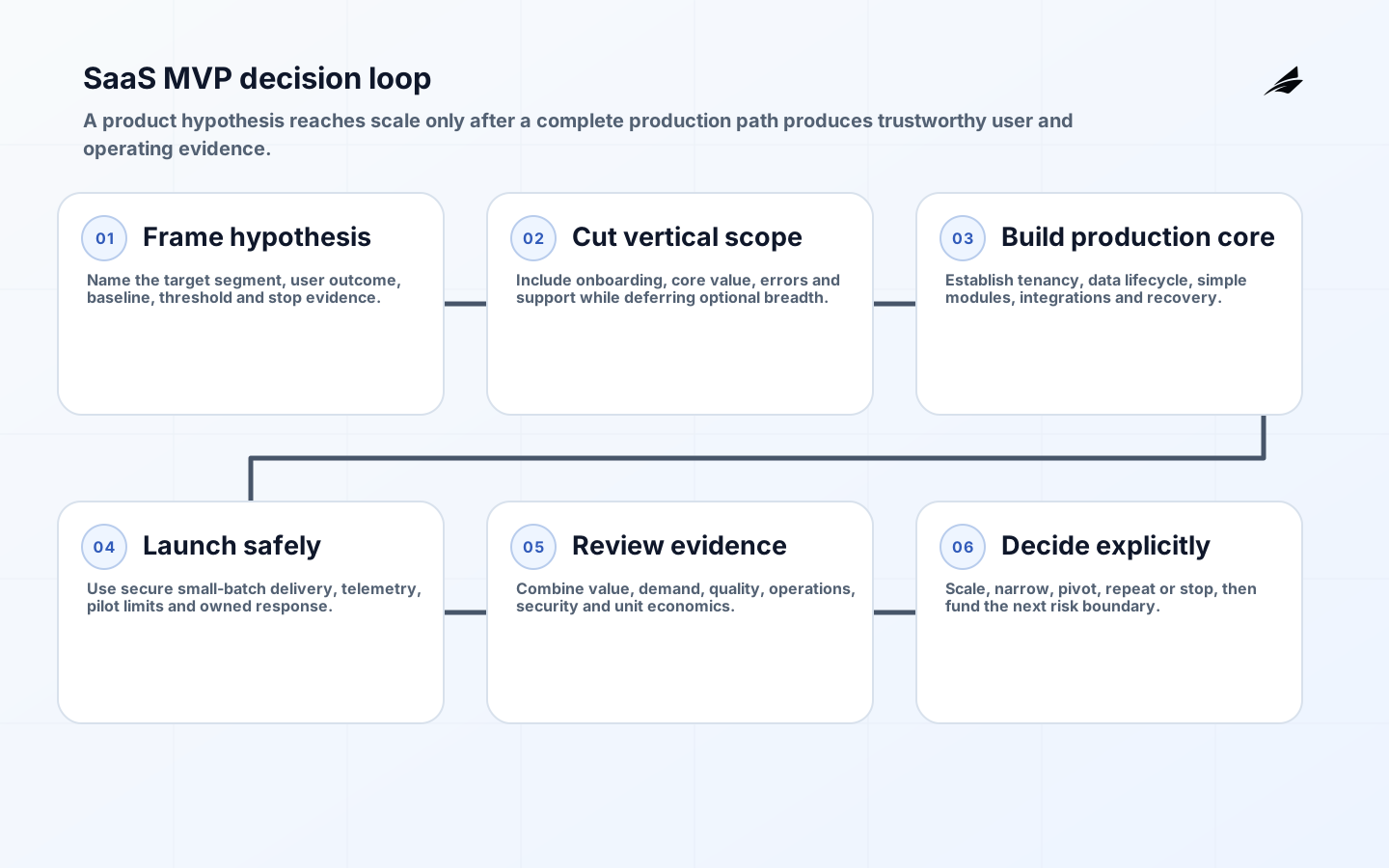
SaaS MVP development implementation is the work of turning a risky product hypothesis into a small, supportable production service. “Minimum” refers to the smallest complete path that can generate credible learning; “viable” means target users can obtain value and the team can operate the service without unsafe improvisation. An MVP is not every planned feature built cheaply, a design prototype exposed as production, or a permanent excuse for missing authorization, backup and support.
DORA's small-batch guidance describes an MVP as enough capability for validated learning about a product and business model. GOV.UK's agile guidance emphasizes user needs, iterative delivery, early feedback and continuous planning. This FAQ applies those ideas to a SaaS product that must also handle tenants, data, security, deployments and incidents. Use it with the SaaS MVP readiness checklist and the scope and risk guide.
What makes a SaaS MVP genuinely viable?
A viable MVP has a named target segment, frequent problem, complete user outcome, measurable success condition and explicit scope limit. It includes onboarding, core work, error handling, support and return use. The business can explain how participants are recruited, what commitment they make and which decision the pilot will support. The product can protect tenant data, recover important records, release a fix and show whether the core journey is healthy. Viability is evidence across desirability, feasibility and operability.
Write the hypothesis as a decision: “If independent clinics can configure a reminder workflow and reduce missed confirmations without extra coordinator time, we will invest in automated integrations.” Name the baseline, target, period and guardrails. Identify what would cause the team to narrow, change or stop. A vague goal such as “validate the market” invites selective interpretation. Measure behavior—completion, repeat use, paid commitment or saved work—alongside interviews. A user requesting features is not proof that the current outcome matters.
How should features be selected for the first release?
Map the job from trigger to outcome and select one vertical path for one segment. Score candidate work by whether it tests a critical assumption, enables the core outcome, controls unacceptable risk or supports operation. Defer broad configuration, secondary roles, edge integrations and sophisticated analytics unless the hypothesis requires them. Keep a visible exclusion list. Replace some automation with a documented concierge step when it is safe and the labor cost is measured.
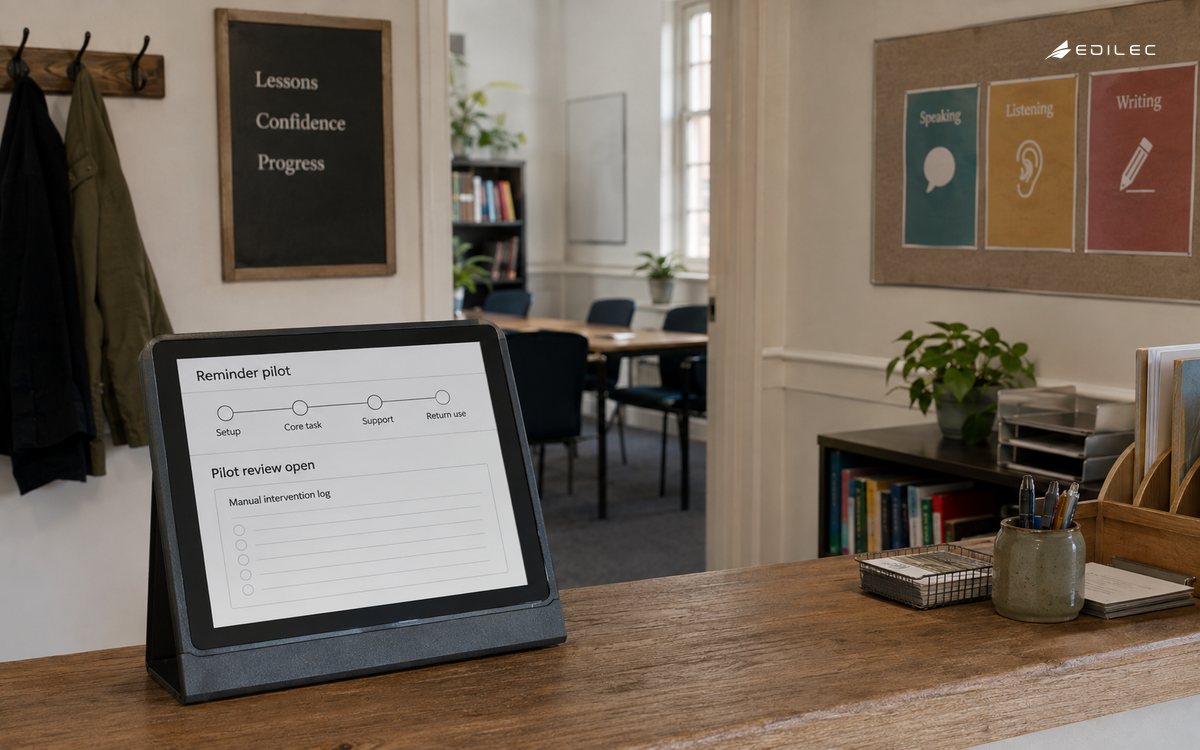
Break the path into small independently releasable slices. Each slice should have an example, permission rule, data result, telemetry and failure behavior. Prototype the most uncertain interaction, integration or technical constraint before committing the production architecture. Do not assume prototype code must survive; its job may be to answer a question. Production work begins when the team adds the tests, security, recovery and operational behavior required for real users and data.
| Candidate capability | MVP test | Likely decision |
|---|---|---|
| Core workflow | Does it produce the promised outcome? | Include end to end |
| Integration | Is it necessary to test adoption or feasibility? | Include one or use controlled import |
| Administration | Can the team operate accounts safely? | Include narrow internal tooling |
| Analytics | Does it measure the hypothesis or detect harm? | Include essential events only |
| Customization | Is it common to the target segment? | Use bounded settings or defer |
What architecture is appropriate for an MVP?
Choose the simplest architecture the team can operate and change. A modular monolith, managed relational database, object storage, queue for necessary asynchronous work and managed identity are often sufficient. Use infrastructure as code, distinct environments, automated backups and a repeatable deployment pipeline. Keep domain modules and third-party adapters explicit so growth does not require immediate rewriting. Record consequential decisions and triggers for revisiting them, such as workload isolation, regional data or team ownership.
Design tenancy deliberately. Put tenant context in trusted identity and apply it to requests, database queries, background jobs, caches, storage keys, exports and logs. Test valid users attempting to cross boundaries. Decide whether users can join multiple organizations and how context is selected. Use stable identifiers and data lifecycle states. Avoid premature microservices: they add network failure, distributed authorization, observability and data consistency. Split only when a measured boundary justifies those operating costs.
Which security controls cannot wait until after MVP?
Identity, server-side authorization, tenant isolation, secret management, encrypted transport, production access control, dependency management, audit of consequential administration, backup recovery and vulnerability response belong in the first production release. Minimize collected data and define retention and deletion. Use multifactor authentication for administrators and time-bound support access. Threat-model account takeover, cross-tenant access, injection, abusive automation, leaked credentials, dependency compromise and destructive mistakes.
NIST SSDF groups secure development into preparing the organization, protecting software, producing well-secured releases and responding to vulnerabilities. Integrate those practices into source, build and delivery. Use OWASP ASVS 5.0 to select verifiable application requirements appropriate to the risk. Automated scanners help but do not replace design and authorization tests. Publish a security contact and incident route. If customers require regulated or highly sensitive use, narrow the pilot until the necessary controls and expert review exist.
How should integrations and customer data be handled?
Integrate only systems necessary to the hypothesis or a credible operating path. Define which system owns each field, authentication, scopes, rate limits, idempotency, retries, error taxonomy, reconciliation and support ownership. Treat external calls as uncertain: a timeout does not prove failure. Verify webhook signatures and process repeated events safely. Put provider-specific mappings behind an adapter. A controlled CSV import may be the right first choice if it tests value without committing to an unstable API.
Use realistic synthetic or consented pilot data. Do not copy production datasets casually into development. Document data purpose, region, access, retention, export and deletion, and reflect customer commitments in system behavior. Keep migrations versioned and backward compatible. Test backup restoration and data reconciliation. When a manual correction occurs, record actor, reason and prior value. Hidden founder edits destroy the very evidence the MVP is supposed to generate.
What should the MVP measure?
Measure the hypothesis funnel from eligible user to completed outcome and repeat use. Segment by target cohort and record time to value, completion, retention, failure and support intervention. Add a small set of guardrails for incorrect outcomes, privacy or security exceptions, customer waiting and operator labor. Define every event and denominator. Compare with baseline and interviews. Avoid changing metric definitions mid-pilot without annotating the result.
Measure service health as well. OpenTelemetry describes metrics, traces and logs as complementary signals. Instrument the core path and dependencies, queue age, error classes, deployment and background completion. Establish practical service objectives and alerts with owners. Observe the load generator and third parties during tests. Early traffic may be small, so one severe failure can be hidden by monthly averages; review individual customer-impacting events as well as rates.
| Evidence area | Question | Graduation signal |
|---|---|---|
| Value | Do target users complete and repeat the job? | Outcome meets the predefined threshold |
| Demand | Will users commit time, data or money? | Credible pilot or purchase behavior |
| Quality | Are results correct and recoverable? | Guardrails hold and restore passes |
| Operations | Can the team support the service? | Owned incidents and bounded manual work |
| Economics | Can delivery and support scale plausibly? | Visible unit-cost path without hidden labor |
How should delivery and launch work?
Keep work in version control, review small changes, build immutable artifacts and promote through controlled environments. Automate unit, integration, authorization, schema and core journey tests. Use feature flags to separate deployment from exposure, with owner and removal date. Release first to the team, then a small pilot cohort. Define stop conditions for error, data correctness, security and support load. Roll forward when a data mutation cannot safely roll back.
Google SRE's launch guidance treats launches as shared work across development and operations. For an MVP, name owners for capacity, dependency, support, security, recovery and communication. Rehearse one representative failure and confirm dashboards and runbooks. Tell pilot users the boundaries and response route. Do not call an unmonitored public deployment a beta strategy. A bounded pilot provides better evidence because participant, data, volume and support conditions are known.
How much should an MVP cost and who must be involved?
Cost follows uncertainty and consequence more than screen count. Estimate discovery and research, product and interaction design, engineering, integration, data preparation, security, cloud, testing, pilot support and post-launch operation. Separate fixed setup from usage-based services and vendor fees. Include contingency for poorly documented APIs and data. A cheap build that requires continuous founder repair or an immediate rewrite is not necessarily economical. Compare cost with the decision value of the hypothesis.
At minimum assign a product decision owner, technical owner and service owner. Ensure access to user research, design, engineering, testing, security and relevant domain or legal expertise. One person can cover several roles, but no decision should be orphaned. If using a development partner, retain customer learning, priorities, accounts and production authority inside the startup. Require transferable source, infrastructure, documentation and credentials, plus a clear support and exit arrangement.
When is the MVP ready to scale—or stop?
- Compare outcome and guardrail results with thresholds set before the pilot.
- Review interviews, support contacts and manual interventions for the target segment.
- Confirm tenant security, data recovery, delivery and incident ownership remain dependable.
- Model unit cost and capacity under the next realistic cohort, not hypothetical mass scale.
- List assumptions retired, assumptions still open and new risks created.
- Choose to scale, narrow, pivot, repeat the test or stop, with a written reason.
- Fund reliability and control debt before it becomes the next cohort's failure.
Scaling does not require proof of every future market, but it requires evidence that the defined segment receives repeatable value and that the current operating model will not collapse under the next step. Scale in cohorts, integrations or regions, not all dimensions together. Stopping is a legitimate outcome when demand, feasibility or economics fail; it preserves capital and attention. Preserve learning, data decisions and reusable platform work without forcing a weak product to survive.
Key takeaways
- Define the MVP as a complete learning path for one target segment.
- Keep architecture simple while designing tenancy, recovery and secure delivery properly.
- Use only necessary integrations and make ownership and retry behavior explicit.
- Combine product outcome, guardrail, operational and economic evidence.
- Make an explicit scale, narrow, pivot, repeat or stop decision after the pilot.
Frequently asked questions
Is an MVP the same as a prototype?
No. A prototype answers a focused design or feasibility question and may use disposable code. A production MVP serves real users and therefore needs appropriate security, data handling, reliability, support and recovery.
How many customers should join the pilot?
Use enough well-matched participants to observe the behavior and variation relevant to the hypothesis while the team can still support them closely. Quality of segment fit and repeated use matter more than a universal number.
Should the MVP include billing?
Include it when willingness to pay or self-service purchase is part of the hypothesis. Otherwise a controlled invoice can test commercial commitment without adding a full subscription system. Still define entitlements, cancellation and access state.
Conclusion
A SaaS MVP is successful when it creates trustworthy evidence for a consequential product decision. It gives a narrow group a complete outcome, protects their data, survives ordinary failure, shows how it is used and exposes the real cost of support. Build in small vertical slices, launch within explicit boundaries and let the evidence—not the amount of code already written—determine what happens next.