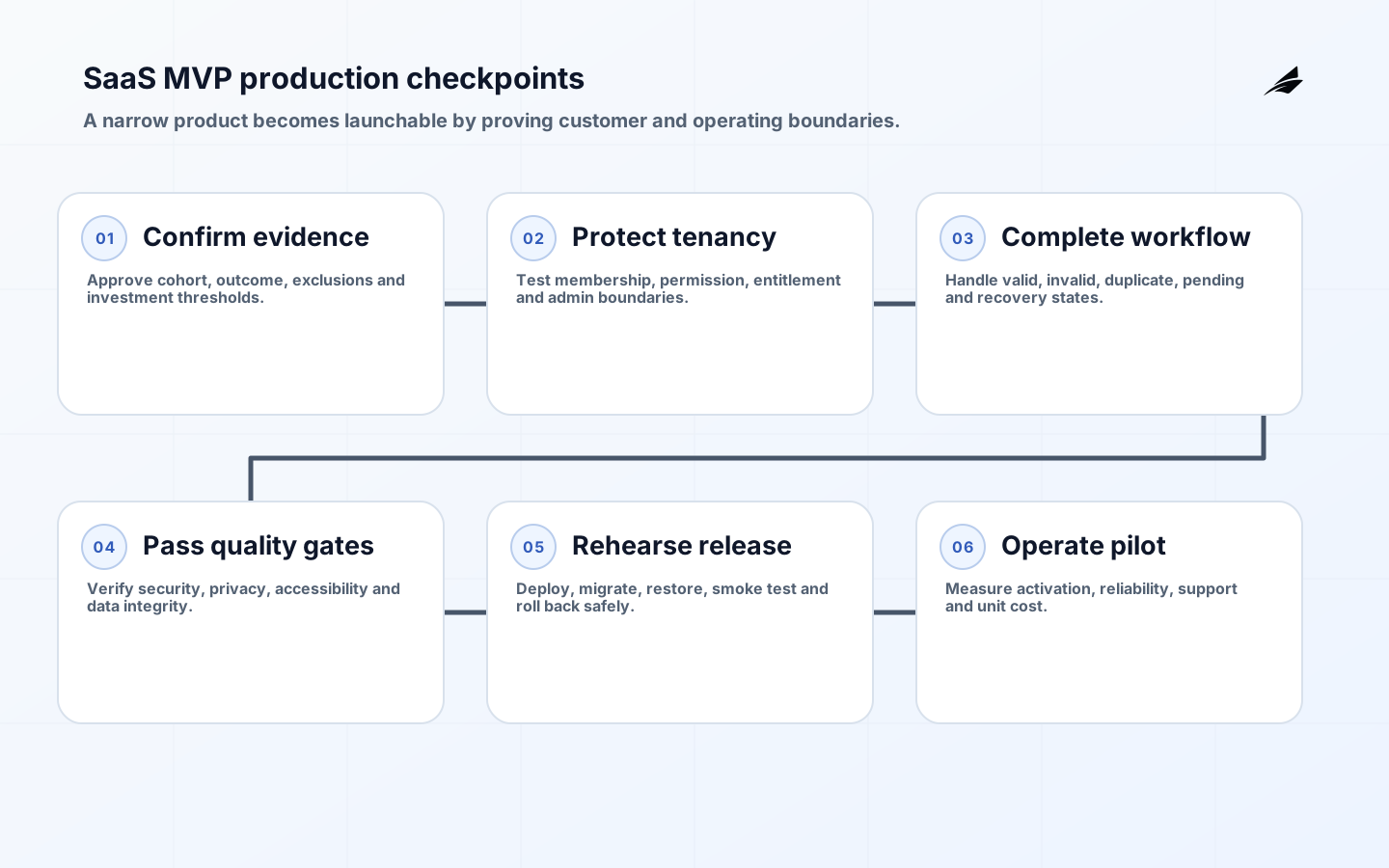
SaaS MVP development for SaaS companies succeeds when a narrow product can be sold, activated, secured, supported and measured without pretending that temporary gaps are production behavior. This implementation checklist is for the point after the product hypothesis is clear and before a customer depends on the service. It treats the MVP as a complete operating slice: one segment, one primary workflow and limited configuration, supported by real tenant isolation, identity, billing or entitlement, telemetry, recovery and accountable ownership.
Start with the practical SaaS MVP business guide and use the SaaS MVP product-learning FAQ to settle scope questions. Support-led products can compare the support-team delivery plan and its implementation checklist. Give every checklist item an owner and evidence link; “discussed” is not an acceptance state.
Confirm product evidence and exclusions
- Name the target role, triggering problem, completed outcome and present baseline.
- Define activation and repeated-value events from domain behavior, not page views.
- Recruit a representative pilot cohort with consent and support expectations.
- Write explicit exclusions for roles, regions, integrations, plans and migration.
- Set success, guardrail and stop thresholds before launch data is visible.
Walk five real examples through the proposed journey, including invalid input, cancellation and support intervention. The release should answer a defined investment question. If the hypothesis concerns repeated team collaboration, a single-user demo is not sufficient evidence. Keep roadmap ideas outside release acceptance unless they are necessary for the chosen outcome or control. Record assumptions about customer data, provider access, traffic and review turnaround so a change is recognized as a planning change rather than silently absorbed.
Implement tenant, identity and entitlement boundaries
Choose the tenant concept: organization, workspace, account or another business boundary. Put tenant identity in authoritative server context, scope every query and object, and test cross-tenant access negatively. Define membership invitation, role change, removal and account closure. Avoid a universal administrator role. Emergency access needs stronger authentication, time limit, reason and audit. If users can belong to multiple tenants, make the active context unmistakable and prevent cached data or browser history from crossing boundaries.
Keep plans, permissions and feature exposure separate
A plan describes the commercial package, an entitlement records what the customer may use, a permission records what the current actor may do, and a feature flag controls release exposure. Model them separately. Verify server-side authorization even when the interface hides an action. Define what happens after failed payment, downgrade, trial expiry and cancellation. Preserve customer data according to the contract and policy rather than immediately deleting or indefinitely retaining it.
| Boundary | Acceptance evidence | Failure test |
|---|---|---|
| Tenant isolation | Scoped data and authorization tests | Guess another tenant's identifier |
| Membership | Invite, accept, remove and recovery history | Removed member reuses session |
| Entitlement | Plan-to-capability matrix and provider sync | Webhook is duplicated or delayed |
| Feature exposure | Owner, expiry and cohort audit | Flag service is unavailable |
| Administration | Bounded operations and access review | Operator attempts prohibited action |
Complete the core workflow and recovery paths
Define domain states and legal transitions instead of deriving status from interface steps. Validate at the server, use stable identifiers and make repeated commands idempotent where effects could duplicate. For external calls, set timeouts, bounded retries and a pending state when outcome is unknown. Build a support timeline and safe correction actions with the customer path. Test empty, loading, denied, partial-success, duplicate and retry states. A workflow is complete only when operators can explain and recover it without editing the database.
Set security, accessibility and data gates
Use NIST SSDF to assign secure-development work and OWASP ASVS 5.0.0 to select verifiable requirements. Threat-model tenant boundaries, invitations, recovery, billing, exports, integrations and admin actions. Keep secrets out of code, use least-privilege workload identity and scan dependencies and artifacts. Classify data, define purpose, retention, deletion and export, and use protected synthetic data in non-production. Document vulnerability intake and incident ownership before the pilot.
Adopt WCAG 2.2 as the accessibility reference. Test keyboard completion, visible focus, labels, contrast, zoom, error identification and status announcements. Do not make the support path less accessible than the customer path. Include browser and device combinations used by the cohort. Accessibility defects can invalidate product evidence by blocking part of the intended market, while clear errors and predictable focus also reduce support demand for everyone.
| Production gate | Evidence | Owner question |
|---|---|---|
| Security | Threat model, ASVS tests and dependency review | Can protected actions be bypassed? |
| Privacy | Data map, purpose, retention and deletion test | Can obligations be executed? |
| Accessibility | Keyboard, screen-reader and zoom results | Can target users complete the journey? |
| Integrity | Migration, idempotency and reconciliation tests | Can authoritative state be explained? |
| Recovery | Restore, rollback and provider-failure rehearsal | Can the team recover within target? |
Create a repeatable release path
Protect the main branch, require review, build immutable artifacts and deploy from versioned configuration. Keep environments sufficiently aligned to expose configuration errors. Rehearse database migration with representative volume, backward compatibility and recovery. Separate deployment from feature exposure for risky changes. Define smoke tests, stop thresholds and rollback or forward-repair criteria. A rollback plan must address writes created after the new version begins, not only the application binary.
- Deploy the release candidate to a production-like environment from the normal pipeline.
- Run identity, tenant, entitlement, core journey, accessibility and security smoke tests.
- Restore a backup and verify business records, attachments and configuration.
- Simulate one provider timeout, one duplicate event and one support correction.
- Release to a small cohort with named monitoring and communication owners.
- Review evidence and stabilize defects before increasing cohort or product scope.
Prepare observability, support and ownership
Instrument activation, workflow completion, errors, tail latency, queue age, provider failures and manual correction without logging secrets or unnecessary personal content. Give every alert a condition, severity, owner and runbook. Page only for actionable urgency. Define service owner, product decision maker, security contact, support escalation, provider contacts and customer communication authority. Establish backup verification, dependency update and access-review cadence. A small team can have lightweight operations, but it cannot have ambiguous responsibility.
Use DORA’s five delivery metrics to improve one service over time: change lead time, deployment frequency, failed-deployment recovery time, change failure rate and deployment rework rate. Pair them with product and reliability evidence. Do not compare unlike teams or turn one metric into a quota. Track unit economics early: infrastructure, provider and support cost per active tenant or completed outcome. Cost anomalies often reveal unbounded queries, retry loops or misuse before the invoice alone explains them.
Run the pilot as a controlled experiment
Onboard the cohort in waves so one defect cannot affect every participant. Record eligibility, consent, expected support and the product version each tenant sees. Hold structured check-ins around completed work rather than asking only whether users like the interface. Compare telemetry with interviews and support evidence; a user may report satisfaction while staff quietly complete the hard steps. Define who can pause enrollment, disable a feature or communicate an incident. Do not change onboarding, pricing and workflow simultaneously if the team needs to learn which factor changed behavior.
Close the pilot with a written evidence review. Show adoption and repeated completion, failure and correction rates, reliability, security findings, accessibility barriers, support effort, provider cost and customer commitments. Separate proposition findings from implementation defects. Resolve high-consequence operational gaps before expanding sales. Archive abandoned test data and revoke temporary access. The decision can be continue, change segment, redesign workflow, narrow scope or stop; a pilot is valuable when it makes any of those choices more informed.
Key takeaways
- Launch one narrow but complete production workflow.
- Prove tenant, membership, permission and entitlement boundaries independently.
- Include support, accessibility, security and recovery in MVP acceptance.
- Release through a repeatable pipeline and bounded cohort.
- Let product, reliability and cost evidence decide the next scope increase.
Frequently asked questions
Must the first MVP be multi-tenant?
Not always. A dedicated deployment may be valid for an enterprise pilot, but tenancy still needs an explicit future model and cost analysis. If multiple customers share infrastructure, isolation is mandatory from the first shared release. Retrofitting tenant identity after data and queries assume one customer is expensive and risky.
Does an MVP need automated billing?
It needs a trustworthy commercial and entitlement process. Early invoices may be manual if volume is low, but plan, access, renewal, cancellation and payment status still need ownership and reconciliation. Do not let an ad hoc spreadsheet become the invisible authority for product access without controls and audit.
How do we know the MVP is ready to launch?
All release gates have evidence, critical risks have owners, the team can deploy and restore, representative users can complete the journey, support can investigate and correct bounded failures, and monitoring covers customer outcomes. Remaining limitations are explicit and compatible with the pilot agreement. Readiness is demonstrated behavior, not confidence in a meeting.
Conclusion
A production SaaS MVP is small in market and feature scope, not careless in trust. Establish the tenant and commercial boundaries, complete one workflow, automate a recoverable release and operate a measured pilot. This checklist protects the quality of product learning: when customers adopt or reject the service, the team can distinguish the proposition from avoidable failures in access, reliability, accessibility or support.