A support MVP pilot with measurable gates
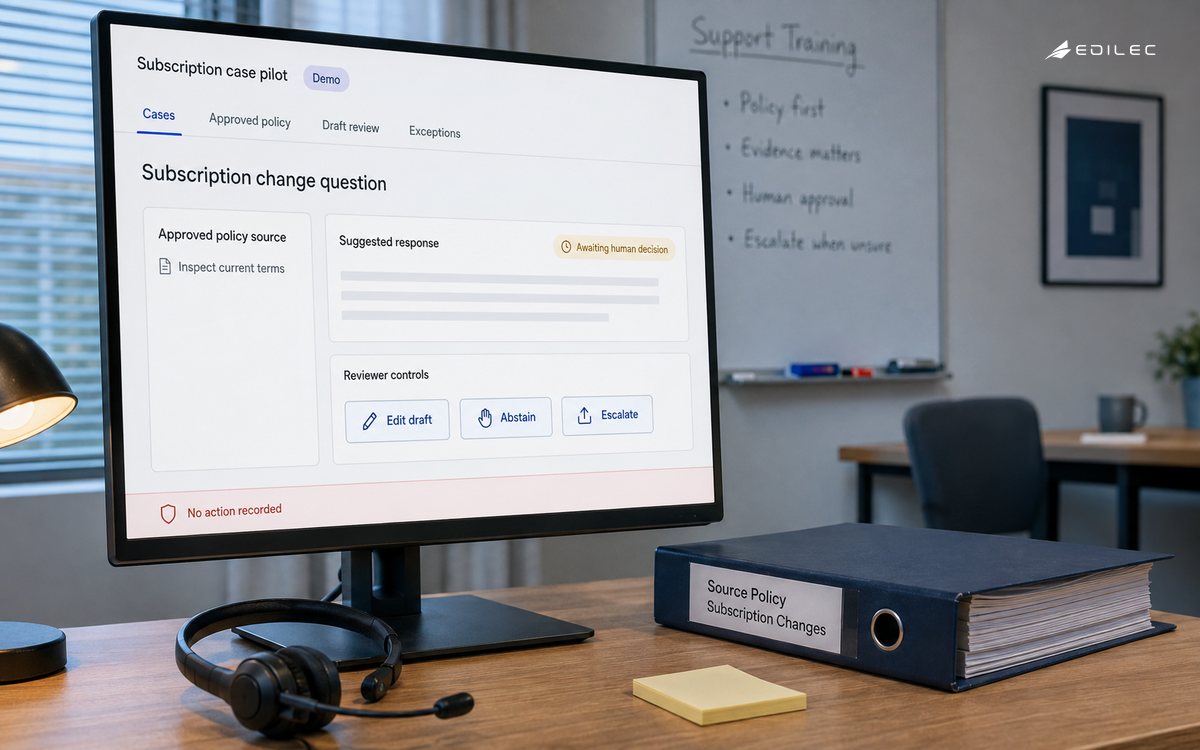
Imagine a support team handling subscription-change questions across email and a portal. The first SaaS MVP does not attempt every channel or an autonomous answer. It authenticates agents, imports one case family, shows the approved policy source, suggests a response with evidence, records the final action, and escalates uncertainty. Baseline handling time, transfer rate, reopen rate, customer effort, agent effort, and quality-review score. Include policy exceptions, missing account data, long conversations, and cases where the answer must be withheld. Human approval remains required. Track accepted suggestions, edits, abstentions, correction work, knowledge gaps, latency, integration errors, cost per case, and incident response. AWS product-development guidance supports the staged MVP framing; NIST SSDF, OWASP ASVS, and WCAG 2.2 provide security and accessibility checks for the first usable slice. Keep the existing workflow available so agents are not trapped when context is missing. Before adding another tenant, inspect tenant isolation, retention, deletion, accessibility, audit, support coverage, and source ownership. Scale only if quality and released capacity remain positive after hosting, review, training, knowledge maintenance, and support work are counted.
| Decision | Evidence to collect | Stop or change when |
|---|---|---|
| Scope | Representative workflow, owner, and measurable baseline | The boundary or outcome remains ambiguous |
| Safety | Negative, failure, recovery, and permission scenarios | A critical state has no tested response |
| Operations | Telemetry, runbook, capacity, and escalation | No named owner can respond |
| Release | Cohort, rollback, comparison, and acceptance record | The result cannot be compared with baseline |
The pilot should produce a decision, not just enthusiasm. Compare representative agents and cases with a baseline or control period. Record bypasses because they reveal missing context, weak source trust, or workflow interruption. Give each suggested answer an approved source, owner, review date, and abstention condition. Integrations need retry and reconciliation because a case can be created while a notification fails or a customer record changes between lookup and action. Cost the complete service: hosting, search or model use, evaluation, human review, content care, incident response, and training. Before scale, test deletion, export, tenant isolation, keyboard access, error recovery, and support escalation. Expand, narrow, redesign, or stop from evidence.
Which pilot evidence changes the plan?
Review the evidence with the people who own the outcome, the data, and the service. For saas mvp development for support teams: scope, cost, risks and delivery plan, the next decision should be based on observed behavior, not the number of features delivered.
SaaS MVP development for support teams should begin with a service problem that can be measured, not a long list of features. Support leaders may want a unified inbox, knowledge suggestions, routing, analytics, automation, and AI at once; a first release becomes credible only when it helps a defined team complete a defined case family with less effort and no unacceptable quality loss. AWS guidance on product strategy and MVP work is a useful reminder to connect prioritization to measurable business value. The plan below treats scope, cost, risk, delivery, and pilot evidence as one decision.
Choose one support outcome
Choose a workflow such as triaging a billing question, finding an approved answer, escalating a technical case, or measuring reopen drivers. Baseline resolution time, transfer rate, reopen rate, customer effort, agent effort, and quality review. Name the user roles, systems of record, policy constraints, and cases that must be excluded from the pilot. A narrow outcome creates a testable promise and exposes the integration and data work before the roadmap expands.
| Candidate capability | Include when | Defer when |
|---|---|---|
| Case intake | It removes a measured duplicate entry | It requires every channel on day one |
| Knowledge search | Content is governed and reviewed | Answers lack ownership or freshness |
| Routing | Rules and queues are observable | Escalation policy is unresolved |
| AI assistance | Human review and abstention are designed | Quality baseline is absent |
Write the smallest complete workflow
A useful MVP includes the path from authenticated agent action to persisted case state, integration response, audit evidence, error handling, and support ownership. Do not call a collection of screens an MVP if it cannot complete the target workflow. Define tenant boundaries, roles, retention, attachments, search behavior, notifications, and export only as far as the pilot needs them. Keep an explicit out-of-scope list: broad omnichannel coverage, complex workforce planning, custom reporting, autonomous replies, and deep workflow configuration are common sources of early drift.
Choose architecture that protects the pilot
Prefer a boring, observable path with clear interfaces to the ticketing, identity, knowledge, and analytics systems the pilot depends on. Keep authoritative records in the right system and avoid copying sensitive data without a retention reason. Use tenant-aware authorization, audit events, encryption, secrets management, dependency timeouts, and idempotent writes. NIST SSDF and OWASP ASVS provide useful security framing; WCAG 2.2 should shape keyboard, focus, labels, contrast, and error behavior from the first usable slice.
| Driver | Cost grows with | Control |
|---|---|---|
| Integrations | Number, variance, and weak APIs | Start with one system and contract tests |
| Data | Sensitive fields, retention, search index | Minimize, classify, and audit |
| Workflow | Rules, approvals, and exceptions | Pilot one case family |
| Operations | SLA, support hours, and uptime | Set ownership and service boundaries |
Build a transparent cost model
Separate one-time build from recurring service cost. Count product and engineering time, design and research, integration maintenance, hosting, observability, support, security review, content governance, user training, and change work. For AI or search features, include model or index usage, evaluation, human review, corrections, and knowledge upkeep. Make assumptions visible: active agents, cases per day, retention, attachment size, peak concurrency, and pilot duration. A range is more useful than false precision when the biggest variable is unresolved workflow complexity.
Pilot the case family in decision gates
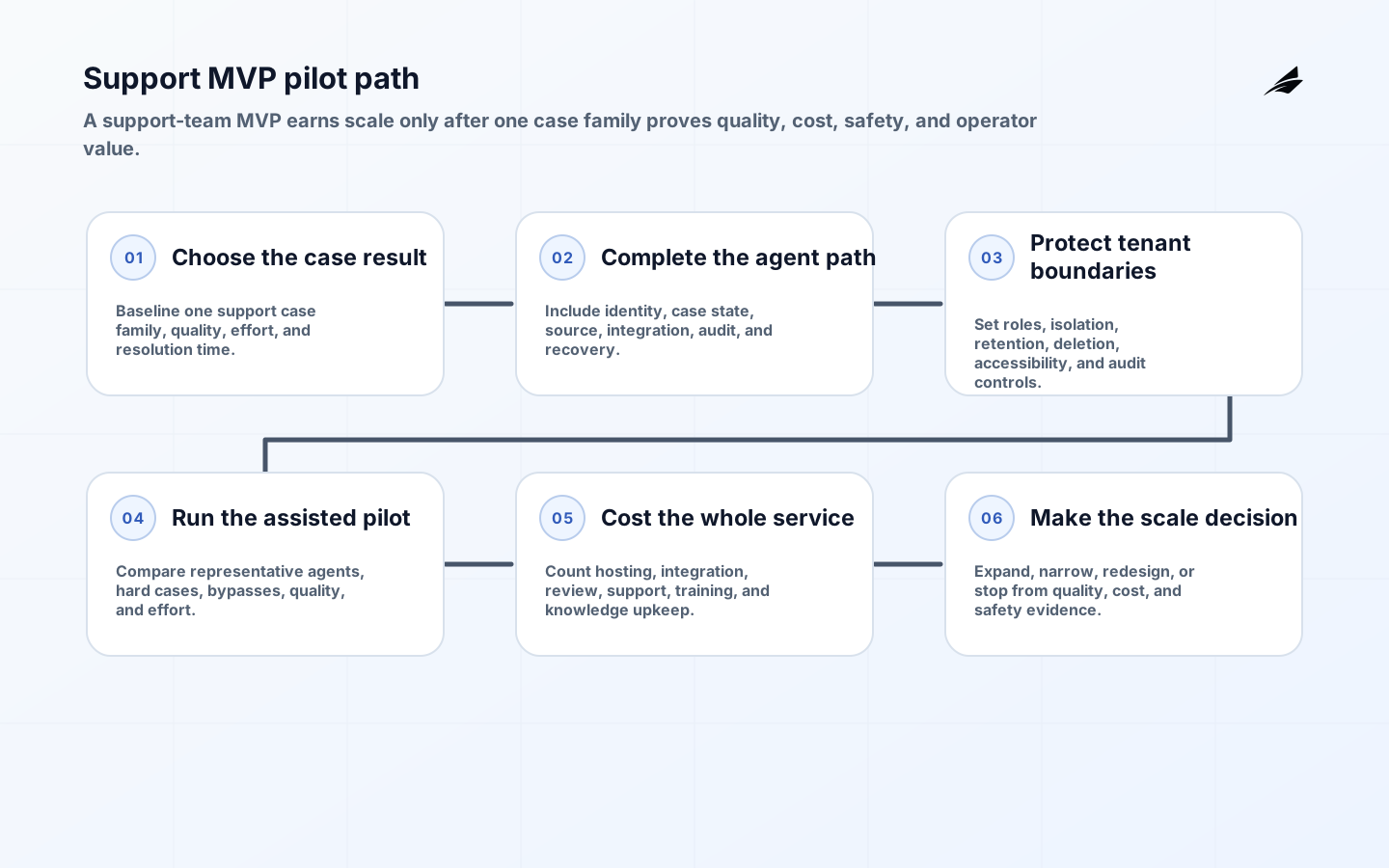
Stage one maps the workflow and baseline. Stage two proves identity, case state, one integration, and audit. Stage three adds the narrow agent experience and failure path. Stage four runs a shadow or assisted pilot with representative cases. Stage five compares outcomes, cost, correction work, and operator feedback. Each stage needs an acceptance decision and a named owner. Do not scale because a demo is popular; scale when the measured outcome remains useful after real support work, review, and incident handling are counted.
Design the pilot as a learning instrument
Select agents and cases that reflect the intended audience, including difficult and low-volume examples. Keep a comparison group or baseline period where feasible. Record resolution, transfer, reopen, customer effort, agent effort, correction, abstention, and escalation. Collect qualitative evidence about trust, workflow interruption, and missing context. Protect customers with human review for consequential responses, clear rollback, and a route to the existing process. The pilot should produce a decision: continue, narrow, redesign, or stop.
Decide what must change before scale
Before expanding tenants or channels, review access isolation, retention, auditability, incident response, accessibility, integration limits, support coverage, cost attribution, and recovery. Test deletion and export obligations where relevant. Confirm that knowledge has owners and review dates. If an AI feature is considered, define allowed sources, citations or evidence, abstention, prompt and output handling, evaluation, and human authority before using it in a customer-facing action. Scale is a new risk boundary, not merely more traffic.
- Choose one measurable support outcome and case family.
- Build a complete workflow, including errors, audit, and ownership.
- Make tenant, identity, data, and retention boundaries explicit.
- Cost hosting, integrations, review, knowledge care, and support work.
- Pilot with representative agents and compare customer and operator outcomes.
- Expand only after reliability, quality, security, accessibility, and economics are evidenced.
Key takeaways
A support SaaS MVP is a focused operating experiment. Narrow the outcome, complete one workflow, protect data and authority, expose cost assumptions, and run a disciplined pilot. The strongest MVP is not the one with the most features; it is the one that makes a trustworthy scale decision possible.
A support MVP pilot example
A focused pilot might help agents handle subscription-change questions. It authenticates the agent, imports one case family, shows an approved policy source, suggests a response, records the final action, and escalates uncertainty. Baseline handling time, transfer, reopen, customer effort, and quality. Include policy exceptions, missing account data, and difficult cases. Human approval remains required. Measure suggestion acceptance, edits, abstentions, correction work, latency, integration errors, cost per case, and knowledge gaps. Before expanding tenancy, test isolation, retention, deletion, accessibility, audit, support coverage, and source ownership. Scale only if quality and released capacity remain positive after review and maintenance work are counted.
Support-pilot decision signals
A focused support pilot might help agents handle subscription-change questions. It authenticates the agent, imports one case family, shows an approved policy source, suggests a response, records the action, and escalates uncertainty. Baseline handling time, transfer, reopen, customer effort, and quality. Include policy exceptions, missing account data, long conversations, and withheld answers. Human approval remains required. Track suggestion acceptance, edits, abstentions, correction work, knowledge gaps, latency, integration errors, cost per case, and incident response. Keep the existing workflow available. Before a second tenant is admitted, verify its isolation, retention, deletion, accessibility, audit, support coverage, and source ownership. Scale only when quality and released capacity remain positive after review and maintenance work.
Can a prototype prove a support MVP?
A prototype can validate vocabulary, workflow sequence, and willingness to use the service. It cannot prove tenant isolation, retention, audit, accessibility, integration retries, support ownership, recovery, or unit economics. Use it to choose a case family, then build the smallest complete path with authenticated agents, authoritative sources, visible uncertainty, human review, and a comparison baseline. Record cases where agents reject or bypass the tool. Before a broader pilot, price review, knowledge maintenance, support coverage, and incidents alongside hosting and integration.
Frequently asked questions
Can a no-code prototype be the MVP?
It can validate vocabulary, workflow, and demand, but it is not production-ready until identity, tenant isolation, data handling, audit, integration behavior, accessibility, support, and recovery are addressed.
How many features should the first release have?
Enough to complete one measurable case family safely. A short, coherent workflow is more informative than a broad menu that cannot prove resolution quality or operating cost.
Will the MVP need to be rewritten?
Some parts will evolve, but a bounded architecture, clear interfaces, observable behavior, and explicit data ownership reduce the chance that learning requires discarding the whole service.
Conclusion
SaaS MVP development for support teams works when the first release is treated as a measurable service, not a feature catalogue. Scope one outcome, protect the workflow, account for the full cost, pilot with real cases, and let evidence decide what deserves the next investment.