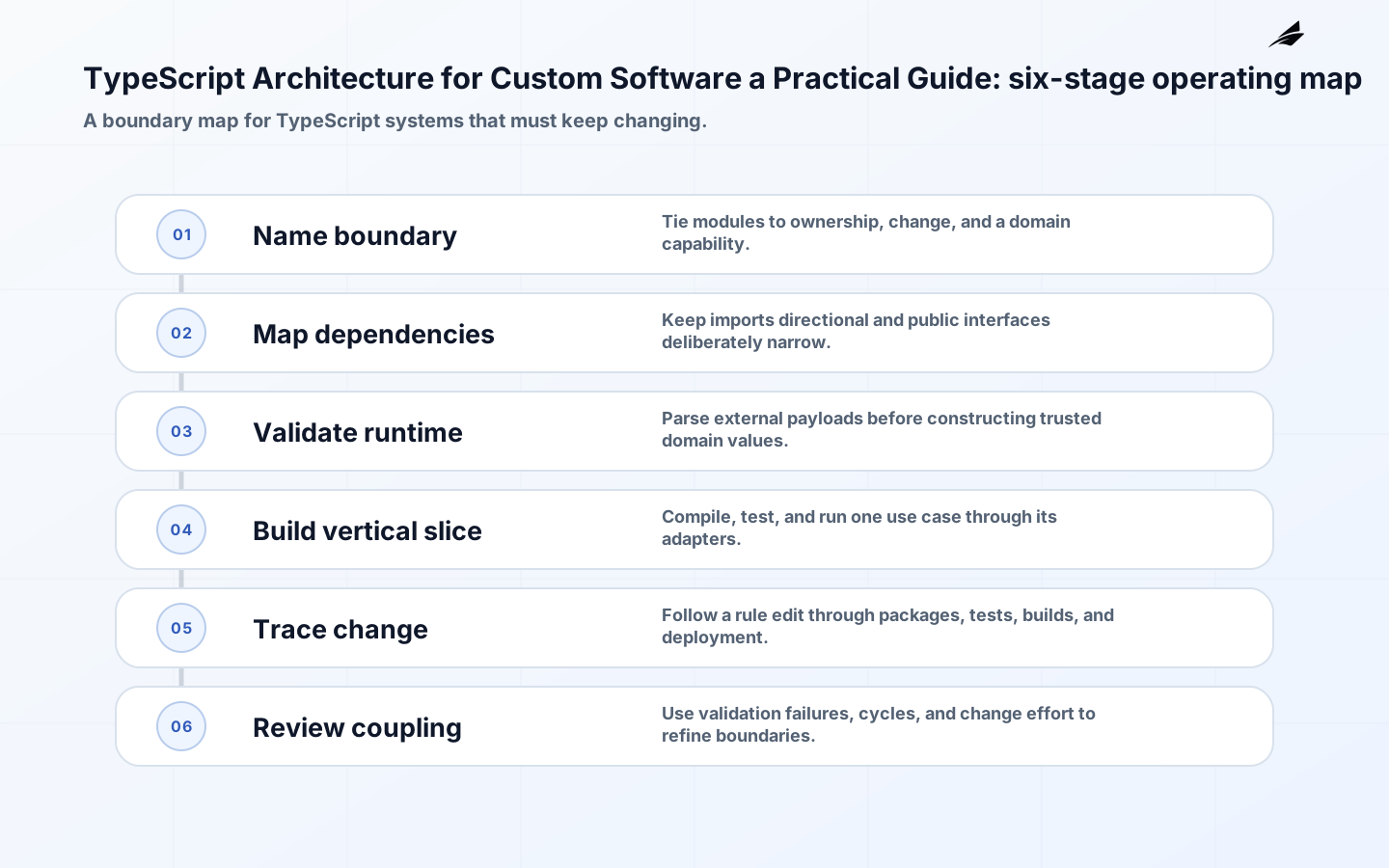
TypeScript architecture earns its keep when types make a changing business system easier to reason about at its boundaries. It is not achieved by maximizing advanced syntax or by treating every JavaScript value as a perfectly known object. The useful goal is a codebase where a new engineer can see which modules own a rule, what crosses process boundaries, and where runtime validation still has to happen. This practical guide frames TypeScript architecture as a production decision: make the boundary visible, choose controls that fit the risk, and keep enough evidence to revise the approach when real use contradicts the plan.
Set the TypeScript architecture boundary
Separate domain concepts from delivery mechanics. A type representing an approved order or an access policy can live near the use case that owns it; an HTTP request, database row, queue message, and browser form are boundary representations with their own failure modes. TypeScript narrows uncertainty inside the program, but it cannot prove what arrived over the network. The TypeScript Handbook makes that distinction practical: model useful invariants in types, then validate untrusted input before it becomes a domain value.
| Situation | Decision to make | Evidence to keep |
|---|---|---|
| External payload | A partner sends versioned JSON | Parse and validate before constructing domain values |
| Shared library | Several apps need one business rule | Publish a narrow API, not persistence structures |
| Large repository | Build times obscure affected packages | Use project references after defining dependency direction |
| Database evolution | A row shape changes during migration | Translate row data inside the persistence adapter |
Make the critical TypeScript architecture decisions explicit
Choose module boundaries around change and ownership, not around every noun in a data model. Keep public module APIs small and stable, make dependencies point inward toward business rules, and avoid a shared types folder that becomes an unowned dumping ground. TypeScript modules guidance explains the import and export mechanics; pair that language feature with an explicit rule about which package may depend on which. Project references can then help larger repositories divide builds without pretending they define the architecture.
- Which user or business outcome is TypeScript architecture expected to improve, and how will the team recognize success?
- For custom software architecture, which system, module, or role owns each material decision and its authoritative data?
- For custom software architecture, what does a normal outcome, a delayed outcome, and an exception look like to a user?
- For custom software architecture, which action must be idempotent, auditable, or subject to a higher level of review?
- For custom software architecture, what change can be released independently without weakening an existing customer path?
- For custom software architecture, which metric and real support example will be reviewed after the release?
Deliver a small, testable TypeScript architecture slice
Begin with one vertical use case and publish the contract it needs: input parser, command or query, domain result, persistence port, and external adapter. Compile strict settings in continuous integration, add a runtime schema at API and queue boundaries, and use fixtures that include malformed versions of real messages. Node’s TypeScript documentation clarifies runtime support and limits; use that boundary knowledge when choosing the build and execution path. Migrate callers in small steps so that a type change reveals its impact instead of forcing an all-at-once refactor.
| Failure pattern | Why it harms the workflow | Control to introduce |
|---|---|---|
| Type assertion as validation | Malformed input reaches domain logic | Use parsers and explicit error outcomes |
| Global types folder | Ownership dissolves across packages | Keep types with their capability or contract |
| Circular dependencies | Changes create surprising runtime order | Enforce directional imports |
| Compile-only confidence | Production rejects are invisible | Monitor validation failures by source |
Operate TypeScript architecture as a living capability
Architecture remains legible when build and release signals are attached to boundaries. Track type-check failures, circular dependency findings, bundle or cold-start impact where relevant, and runtime validation rejects by source. The project references documentation is useful for understanding incremental builds; use it after the ownership map is clear, not as a substitute for it.
Review TypeScript architecture risks before customer work
A recurring failure is mistaking a TypeScript assertion for validation. as can silence the compiler without changing the value at runtime, which gives untrusted payloads a respectable-looking type and lets bad data travel farther. OWASP input-validation guidance reinforces the need to validate at a trust boundary. Another failure is exporting internal persistence shapes to the UI, so a storage change becomes an application-wide event. Both problems disappear more readily when translations happen at deliberately chosen edges.
- Exercise a production-shaped request across valid, rejected, delayed, and conflicting outcomes.
- For custom software architecture, verify that the actor, relevant policy or version, and result are discoverable after the fact.
- For custom software architecture, test the most likely retry, timeout, stale-data, or concurrent-change behavior.
- For custom software architecture, confirm that monitoring names the affected capability rather than only the infrastructure component.
- Give support a customer-safe explanation and a named escalation route for the exception.
- Document the rollback or correction path before traffic is expanded.
Measure whether TypeScript architecture reduces friction
Measure the time and number of packages affected by a representative rule change, the rate of runtime validation failures, build duration, and how often dependency cycles appear. Review pull requests for boundary leaks: imports that reach around an application service, shared types that expose storage details, or adapters that contain business decisions.
Prepare a production rollout for TypeScript architecture
Before reorganizing a TypeScript repository, take one anticipated change and follow it through imports, tests, build output, runtime validation, and deployment. The result reveals whether the current pain is an overbroad public API, an unvalidated boundary, circular dependencies, or simply a missing owner for a shared rule. Draw the target dependency direction in a short architecture record and make it testable with tooling where possible. A diagram is less important than a rule engineers can apply during review.
A good acceptance exercise uses a deliberately awkward message or request: an older payload version, an extra field, a missing discriminant, or a value with a valid JavaScript type but invalid business meaning. The system should reject or translate it at the boundary, return a helpful typed failure, and keep invalid data from reaching persistence. Then change a domain rule and observe whether its callers are obvious. This proves the architecture is reducing uncertainty rather than only adding type annotations.
Keep generated clients, database types, and third-party SDKs behind adapters when their shape is not the business model. Their types remain useful, but exporting them across the application gives external change too much reach. The maintenance benefit is concrete: version upgrades and schema migrations become localized adapter work with a visible contract test, not an emergency search across every feature.
Finally, make architecture review part of ordinary feature delivery. A short request for a new cross-package import, a new shared type, or an exception to the dependency rule is more valuable than a large periodic audit because it captures the reason while the trade-off is fresh. The record should state the owner, boundary affected, and removal condition. Over time, those small decisions reveal whether the architecture still matches how the team actually delivers software.
Shape TypeScript architecture around change
Custom software earns an architecture by surviving the next requested change. List the decisions likely to move—workflow rules, external providers, storage, authorization, and presentation—and place each behind a boundary that can be tested without the rest of the system. This is not an argument for layers everywhere. It is a way to make expensive change visible before a framework choice hardens into a contract.

Keep domain rules independent of transport details. A use case should not need to know whether it was called by HTTP, a queue consumer, or a command-line repair tool. At the same time, do not create abstract interfaces for every function before a second implementation exists. Start with a concrete boundary and extract only where substitution, testing, or ownership justifies the indirection.
Use project references or package boundaries when the repository has a real dependency graph. Make imports directional, expose only intended public modules, and fail the build when a lower-level package reaches into an application feature. A boundary that is only documented but not enforced will erode during the first deadline. Tooling should make the safe path the easiest path.
Runtime validation deserves a first-class place in the design. Parse external payloads at the edge, return a typed result or a structured error, and retain enough context to diagnose the rejected input without logging secrets. This separates “the provider sent an unexpected shape” from “our business rule rejected a valid request,” which improves both support and test coverage.
Architecture review should end with a change rehearsal. Pick a realistic request such as adding a new payment method, changing a permission, or replacing an API client. Trace the files, tests, migration, telemetry, and rollback that would move. If the path crosses many unrelated modules, the architecture is giving you evidence about coupling and where the next boundary should be.
| Change | Boundary to inspect | Evidence of readiness |
|---|---|---|
| New provider | Adapter and contract | Provider-neutral use-case test |
| New permission | Policy and record access | Allow/deny matrix with audit event |
| Storage change | Repository and migration | Dual-read or rollback rehearsal |
| New workflow step | Domain state transition | Invalid transition and retry tests |
Key takeaways for engineering teams
- TypeScript Architecture should be owned as a business and operational decision, not an isolated framework task.
- Define authority, failure behavior, and acceptance evidence before expanding the implementation.
- For custom software architecture, release one meaningful path with observability and recovery instead of several unconnected features.
- For custom software architecture, use standards and official documentation to guide contracts, security controls, and maintenance choices.
- For custom software architecture, review production evidence regularly and retire assumptions that real use has disproved.
For a related decision, compare this approach with TypeScript Architecture: Explained from First Principles, Event-driven Systems: Security Review, API Versioning: Mistakes and Fixes. For custom software architecture, each adjacent article treats a different boundary; use the links to test whether the same ownership, evidence, and recovery expectations hold in the surrounding system.
TypeScript Architecture for Custom Software: a Practical Guide FAQ
What is the first decision for typescript architecture for custom software: a practical guide?
For typescript architecture for custom software: boundaries that survive change, begin by naming the user or operational outcome, the accountable owner, and the evidence that will show whether the outcome is safe. For custom software architecture, that boundary determines the smallest useful first implementation and gives the team a shared test for scope.
How should a team handle failure in typescript architecture for custom software: a practical guide?
In typescript architecture for custom software: boundaries that survive change, classify each failure by its next safe action: correct, retry, reconcile, escalate, or stop. For custom software architecture, preserve state and a correlation record so a person does not guess whether the first attempt took effect, especially when the boundary can create an external side effect.
When is the implementation ready to expand?
Expand typescript architecture for custom software: boundaries that survive change after a representative path works with realistic data, known exceptions, observable ownership, and a rehearsed recovery. For custom software architecture, a larger rollout should add confidence, not conceal unresolved ambiguity in a wider queue.
Conclusion: operate typescript architecture for custom software: a practical guide with evidence
The durable version of typescript architecture for custom software: a practical guide is not the one with the most components. For custom software architecture, it is the one whose promise is explicit, whose boundaries are understandable, whose failure states preserve a safe next action, and whose evidence reaches the people responsible for the result. For custom software architecture, start with one complete path, measure what users and operators actually experience, and let observed risk decide where the next investment belongs.