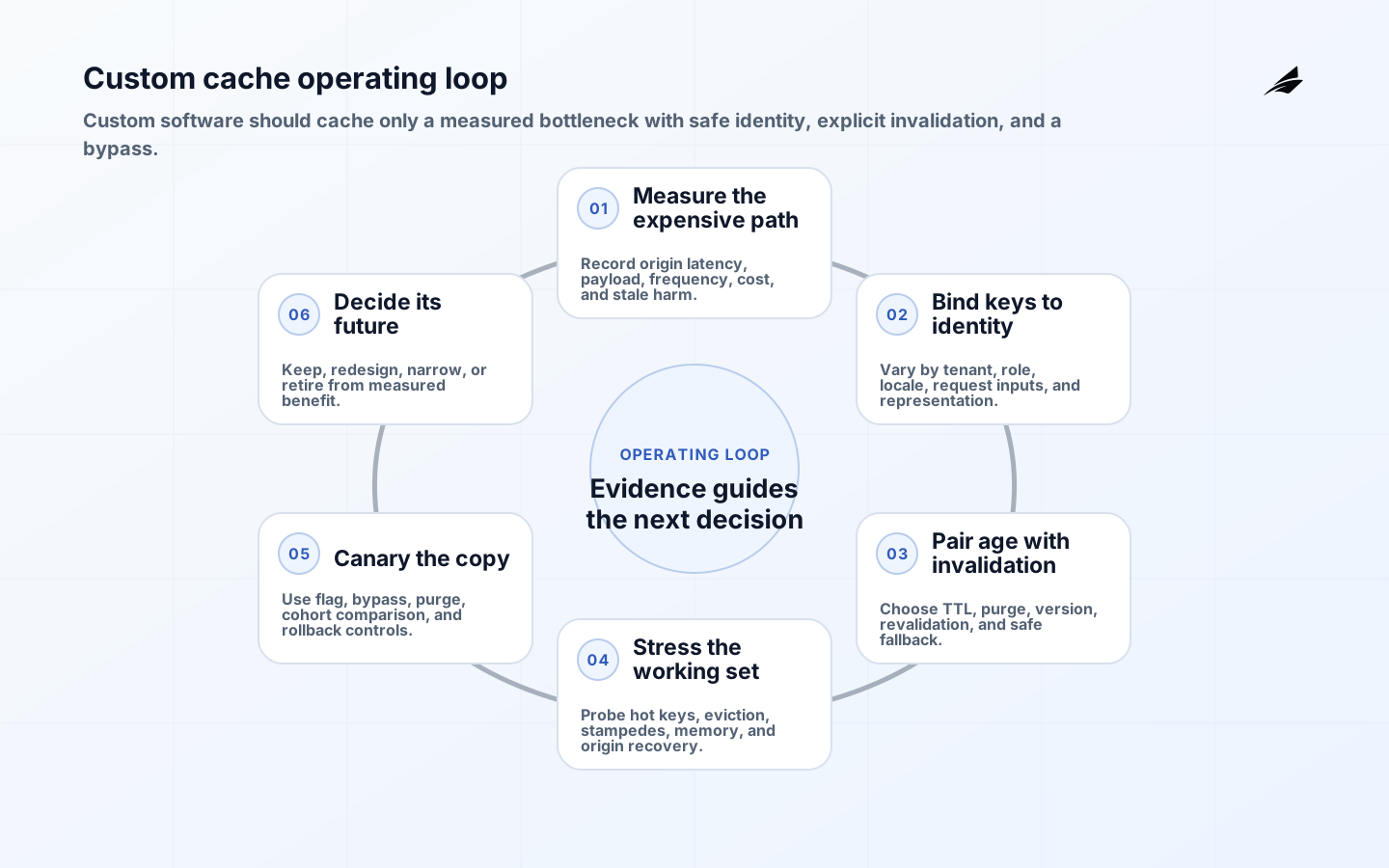
A caching strategy for custom software should begin with a promise a user can understand: which response may be reused, how fresh it must be, and what the application does when the source is unavailable. The cache is a copy, not an authority. That distinction shapes key design, authorization, invalidation, timeouts, monitoring, and the fallback path. RFC 9111, MDN Cache-Control, and Redis eviction guidance give the implementation team precise vocabulary for reuse, freshness, and memory pressure.
Set the custom software caching boundary
Name the bottleneck before adding a cache. Is the origin slow because of a repeated join, an oversized payload, a remote dependency, or an inefficient client request? Measure baseline latency, tail behavior, request volume, origin cost, and the consequence of a stale response. A cache that improves a dashboard while adding an unsafe copy of permissions is a net failure. The OWASP Web Security Testing Guide testing section is a useful prompt for checking authorization and session assumptions around cached responses. Write a short decision record with the data class, owner, freshness tolerance, cache layer, bypass route, and success metric.

| Decision | Example | Proof |
|---|---|---|
| Reusable value | Public product description | Repeated reads are identical for the cohort |
| Freshness window | Minutes for a report | Users accept the stated delay |
| Scope | Tenant and locale | No cross-tenant response is possible |
| Fallback | Serve stale or query origin | Degraded path is tested |
Design keys from the authorization model
A cache key must contain every input that changes the response, including tenant, user, role, locale, currency, feature configuration, and representation version where applicable. Do not use a generic URL as a shared key when authorization is applied after retrieval. Avoid raw secrets or personal data in keys and logs. Canonicalize inputs so equivalent requests do not fragment capacity, but preserve meaningful distinctions. Test a matrix of identities and roles, not only a happy-path user, and make the key construction a reviewed piece of application code.
Choose invalidation with revalidation
Fixed TTL is simple to reason about; explicit invalidation can reduce stale time but depends on reliable event delivery; revalidation lets an origin confirm a representation at lower transfer cost. Choose based on the business fact. Test an event that is delayed, duplicated, dropped, or delivered out of order. Define whether negative results may be cached, whether stale data is acceptable during an outage, and whether an operator can purge or bypass safely. MDN’s Cache-Control reference helps translate these choices for HTTP responses.
| Pattern | Benefit | Failure to rehearse |
|---|---|---|
| Versioned key | Simple release invalidation | Old versions consume capacity |
| Event purge | Fresh after a business change | Missed or unordered events |
| ETag revalidation | Smaller origin response | Origin remains on the path |
| Stale-if-error | Better outage availability | Old data may influence a decision |
Plan capacity, eviction, and stampedes
Estimate item size, cardinality, churn, hot-key concentration, and working set before choosing memory. A cache full of rare, large responses can evict the values that actually protect the origin. Redis documents eviction policies that favor all keys, volatile keys, least-recently-used entries, or other patterns; select one from observed workload rather than folklore. Add expiry jitter, request coalescing, admission control, and bounded origin timeouts when many callers can miss together. A restart, failover, or cold deploy should be a tested capacity event.
Measure origin relief and stale risk
Track hits and misses by data class, age served, origin fallback latency, eviction, memory pressure, hot keys, invalidation success, stale responses, and customer outcomes. Keep enough correlation to explain a single request without logging sensitive values. Compare cache-on and cache-bypass cohorts. A high hit ratio can conceal poor tail latency, unsafe sharing, or a stale result; a lower ratio can be acceptable if the origin is healthy and correctness is more important. Review dashboards with the owner who receives the incident, not only with the developer who wrote the key.
Release caching as a correctness change
Use a feature flag, a bypass switch, progressive traffic, and a rollback plan. Validate cold start, warm start, dependency timeout, cache restart, invalidation, permission changes, and a record created immediately after a miss. Document the expected metrics and an abort threshold. When a migration changes the response shape, version the cache or clear it deliberately. Include cache behavior in runbooks and restore exercises. The safest cache is one the on-call person can disable without editing code during an incident.
- Tie reuse to a stated freshness and authorization contract.
- Test key scope with multiple tenants, roles, locales, and feature states.
- Rehearse missed invalidation, stale responses, cold starts, and hot keys.
- Choose eviction from measured working-set behavior and capacity limits.
- Keep bypass, purge, observability, and rollback in the production design.
- Retire a cache when its operational cost exceeds its measured benefit.
Key takeaways for custom software
Caching is safe reuse bounded by a correctness contract. Establish the bottleneck, scope the key, choose freshness and invalidation together, budget capacity, instrument age and fallback, and release gradually. Custom software gains from a cache only when the team can explain both a hit and a miss.
A rollout example for custom software
Start with one read path and a bypass flag. Record baseline origin latency, partner limits, item size, and customer correction. Add a tenant-scoped key, expiry jitter, request coalescing, and a metric for age served. Exercise a cold start, hot key, dependency timeout, restart, purge, permission change, and malformed response. Compare cache-on and bypass cohorts. Promote only when the service stays inside its latency and freshness contract and the on-call owner can explain recovery. If the cache reduces origin work but creates unacceptable complexity, narrow it to a safer data class. A deliberate decision to remove the cache is better than keeping a layer nobody can operate.
Custom-cache decision signals
The first rollout should be deliberately boring. Capture origin latency, errors, request volume, payload size, partner limits, and correction baseline. Enable one representation for one tenant cohort, with a bypass flag. Verify key isolation with two tenants and two roles. Test warm and cold reads, simultaneous misses, expiry, purge, dependency timeout, restart, malformed origin data, and permission change. Watch age served, origin fallback, eviction, memory, hot keys, and user outcomes. Set an abort threshold before traffic increases. Compare cache-on and bypass cohorts. If latency improves but correction rises, stop and investigate freshness. If hit ratio is low but the origin is healthy, do not enlarge the cache just to improve the number. Expand only when useful, bounded, observable, reversible, and owned.
A safe custom-cache operating routine
For a custom cache, document key dimensions, representation version, expiry policy, purge command, bypass switch, capacity limit, alert thresholds, and the on-call owner before launch. During an incident, distinguish wrong data, missing data, slow origin, cache unavailability, and unsafe sharing because each condition needs a different response. After recovery, compare cached and authoritative samples and document whether the contract held. Review memory, network, invalidation maintenance, and support contacts in the cost model. Test a cold deployment and a partner outage before expanding traffic. The cache should be easy to disable without editing application code, and the person on call should know whether a stale response is allowed for the action a customer is taking.
Caching strategy FAQ
Is a short TTL enough to make a cache safe?
No. A short TTL cannot repair an authorization error, an incomplete key, a missed invalidation, or a stampede. It only bounds one part of the stale window.
How should a team choose an eviction policy?
Measure item size, access frequency, churn, and the cost of misses, then test candidate policies under realistic memory pressure. Keep the policy and its operating assumptions documented.
What production controls are essential?
A safe first release needs a bypass or feature flag, purge or versioning, freshness and hit metrics, origin timeouts, alerts for memory and eviction, and a named owner for false or stale results.
A custom software cache example
A field-service application reads equipment profiles from a slow partner API. The team first records the partner’s rate limit, response size, error behavior, and profile change frequency. It chooses a tenant- and equipment-scoped key with a versioned representation, a fifteen-minute TTL, and explicit purge when a technician edits the profile. A timeout returns the last known profile only for display; a work-order submission rechecks the authoritative service. The application coalesces simultaneous misses and adds jitter so thousands of keys do not expire together. Metrics show age served, origin fallback, partner errors, evictions, and work-order correction. A feature flag enables the cache for one region, with a bypass that support can activate. A security review confirms that technician permissions are in the key and that logs contain no profile secrets. The result is not simply faster screens: it is a bounded improvement with a clear answer to what happens when the copy is old, missing, or wrong.
Make the first release observable
Log a request correlation id, cache decision, representation version, age bucket, and fallback reason without logging sensitive values. Alert on origin saturation, stale age beyond contract, purge failures, memory pressure, and repeated hot keys. Load-test a cold deployment and a partner outage. Compare cache-on and bypass cohorts for customer completion and correction, not only latency. If the cache improves a benchmark but increases operational uncertainty, narrow the data class or remove the layer. That is a successful engineering decision, too.
Conclusion
A practical caching strategy makes each copy accountable. Define what may be reused, protect identity boundaries, choose a testable freshness model, and operate the cache with the same care as the origin. That is how custom software gets faster without becoming harder to trust.
A custom software cache should have a runbook that explains bad keys, stale entries, origin overload, memory pressure, invalidation failure, bypass, purge, and recovery. Review it with support and on-call staff, then exercise a cold deployment and partner outage. The cache is useful only while its measured origin relief and customer latency benefit exceed maintenance and incident cost.