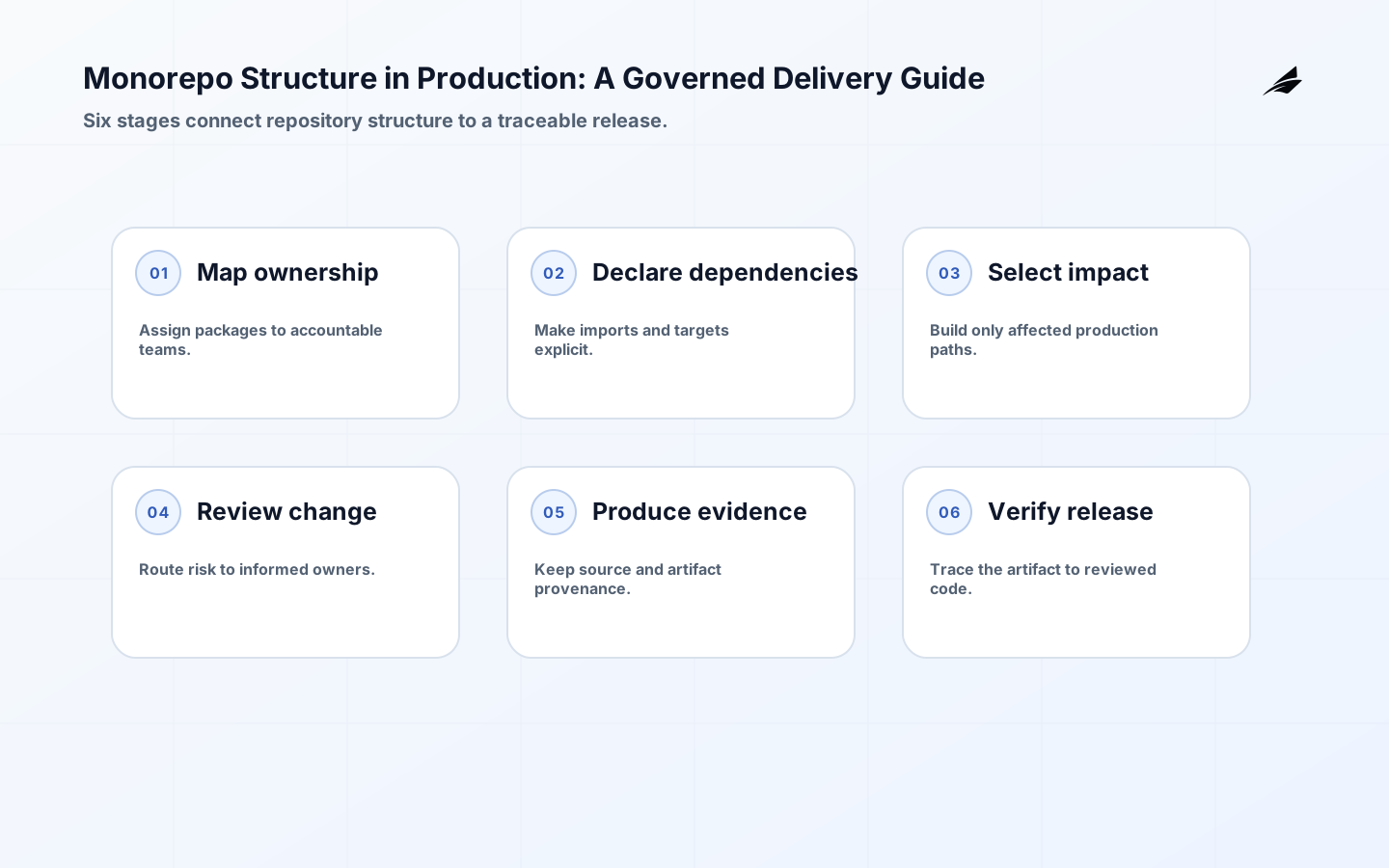
Monorepo structure changes meaning when the repository becomes the place where multiple products, libraries, build pipelines, and production responsibilities meet. A single source tree can make coordinated refactors easier and shared code more visible, but it does not create a safe production boundary by itself. The question is not whether the repository is large. It is whether engineers can answer who owns a behavior, what may depend on it, what must be built and tested when it changes, and how a released artifact can be traced back to reviewed source.
A practical monorepo treats folders and packages as contracts. The npm workspace feature can link local packages through a top-level configuration, while Bazel describes how explicit targets, visibility, and strict dependencies affect build speed and maintainability. Those tools are implementation choices; the operating model comes from ownership, dependency direction, release evidence, and recovery. The monorepo cost and scaling guide offers a useful sizing lens, and the monorepo structure guide for IT managers connects the repository to team accountability.
Map package ownership to durable responsibilities
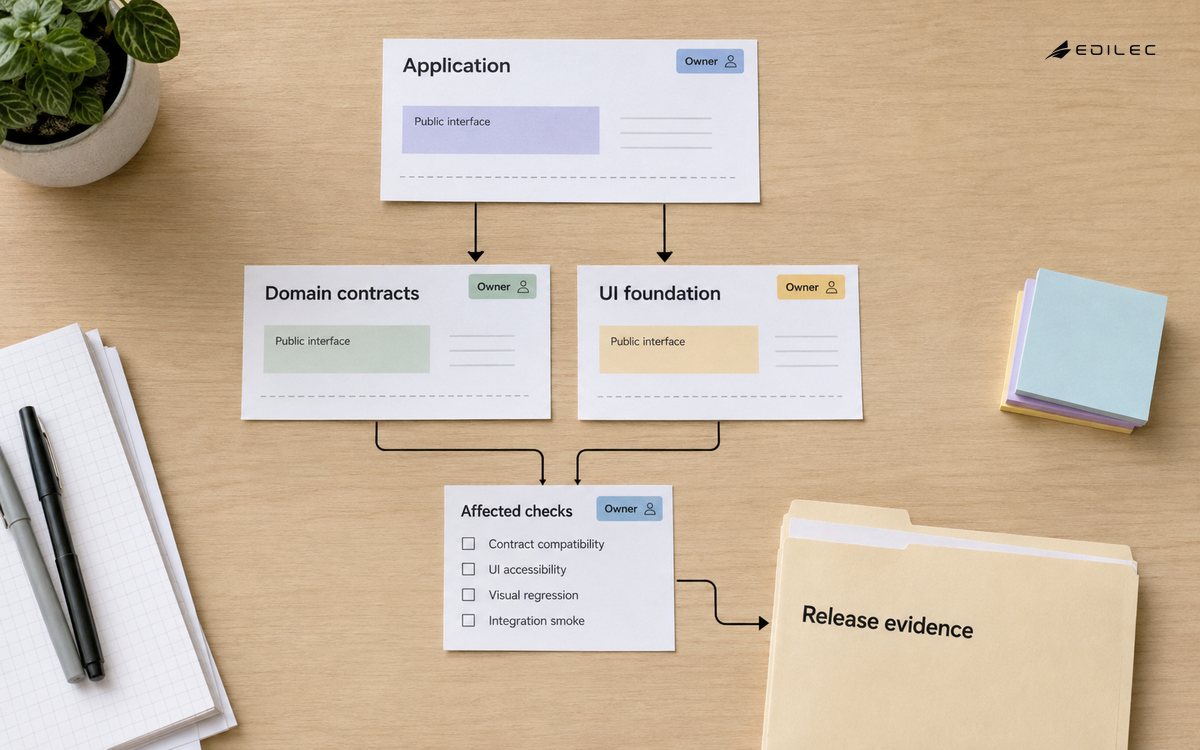
Start with the business and runtime boundaries that the repository supports: web applications, APIs, background workers, shared libraries, infrastructure, data migrations, and developer tooling. Each package should have a purpose, a maintainer, a public or private interface, a change policy, and an escalation path. Do not assign ownership only by current reporting line; teams reorganize, but a production capability still needs an accountable destination. GitHub’s CODEOWNERS feature can route review requests, but it does not replace a service owner who handles incidents, compatibility questions, and deprecation.
Make ownership visible at the path where a change begins. A shared identity library may have a central owner, while an application’s tenant rules remain private to the application team. A package that is imported widely is not automatically a platform. Promote it to a shared contract only when consumers, support, release cadence, and security responsibilities are understood. If a directory has no owner or its owner cannot explain the supported interface, its apparent reuse is a production risk rather than an architectural achievement.
| Repository unit | Owner must decide | Evidence to keep |
|---|---|---|
| Application | Which user journey and runtime does it serve? | Service record, SLO, on-call route |
| Shared library | Which interface is stable and who supports consumers? | API policy, changelog, deprecation plan |
| Build rule | Which inputs and tests determine an artifact? | Target definition and impact map |
| Migration | Which data change is safe to apply and reverse? | Versioned migration and recovery runbook |
| Tooling | Which developer or release workflow depends on it? | Owner, compatibility window, and fallback |
Make dependency direction enforceable
A directory layout is not a boundary if any package can import any other package or reach another application’s private implementation. Define layers or domains that reflect how the system should change. For example, a customer-facing application may depend on domain contracts and shared UI foundations, while a shared foundation must not import the application’s route handlers. Write allowed edges and forbidden edges in a form the build or lint system can check. A boundary that exists only in a diagram will erode under the first deadline.
Bazel explains why implicit transitive dependencies become expensive: a target can appear to work because another target pulls in a library, then break when that incidental dependency is removed. Strict dependency declarations make the consumer’s contract visible and let maintainers remove unused edges with more confidence. Inside a workspace managed by npm, the same principle means each package declares the packages it imports, rather than relying on root-level resolution or path aliases that the runtime will not reproduce after publication. Prefer the resolution model that production will actually use.
- Declare direct package dependencies where imports occur.
- Keep application internals private unless a supported contract exists.
- Use visibility or lint rules to prevent forbidden cross-domain edges.
- Avoid path aliases that bypass package exports and runtime resolution.
- Review dependency additions for ownership, security, and release impact.
- Remove unused edges so the graph stays an explanation of reality.
Build and test by declared impact
Production scale makes “run everything” an unreliable default. A useful build graph lets the system identify which targets, tests, generated files, and deployables can be affected by a change. Fine-grained targets can improve caching and selective verification, but only if the dependency graph is accurate. Start with a small set of important applications and libraries, compare full and impacted runs, and record false negatives as release blockers. A fast build that skips a dependent integration test is not an improvement; it is a confidence gap hidden by a green check.
Define impact at more than the source-file level. A schema change may affect generated clients, data migrations, background jobs, and dashboards even when their files are not imported directly. A change to a package export may affect consumers that load it through a runtime path. Add contract tests or explicit release metadata for those relationships. The test strategy guide is a useful companion because it separates unit confidence from integration and acceptance evidence. The monorepo should make the right tests easier to select, not make teams guess which green result is enough.
| Change type | Likely impact | Minimum verification |
|---|---|---|
| Private implementation | Owning package and local consumers. | Package tests and owner review. |
| Public export | All declared consumers and generated docs. | Compatibility checks and consumer tests. |
| Shared dependency | Multiple applications and build environments. | Impacted builds, security scan, release note. |
| Schema or migration | Readers, writers, jobs, and restore paths. | Migration rehearsal and compatibility tests. |
| Build configuration | Artifact contents and provenance. | Clean build, attestation, and deployment check. |
Route review to the people who can judge the risk
Code ownership should follow the risk of a change, not merely the location of a file. A package owner can review local correctness, but a change to authentication, database migrations, release tooling, or a shared API may need a second perspective. GitHub’s guidance notes that code owners can be requested automatically and that required approval can be enforced through branch protection. Use that mechanism for clear responsibility, and add explicit review rules for changes whose effect crosses a package boundary or production control plane.
Keep review sizes small enough to reason about the contract. A large repository often encourages a sweeping refactor that changes a dependency graph, build rule, and runtime behavior in one pull request. Split the work into boundary definition, consumer migration, enforcement, and cleanup when possible. Each step should state what remains compatible and what evidence is required before the next step. Reviewers should be able to see the affected applications, owner acknowledgements, generated artifacts, and rollback path without reconstructing the impact from a folder diff.
Preserve source, dependency, and artifact evidence
A monorepo can simplify source visibility while making release provenance more important. The same commit may build several applications, or a package may be published separately from an internal service. SLSA provenance models a build platform, external parameters, resolved dependencies, and produced subjects so consumers can compare an artifact with their expectations. Translate that into practical records: repository and commit, workflow or builder identity, dependency lockfile, build configuration, artifact digest, and deployment reference. Keep the record with the release so an incident can answer what was built and from which inputs.
Control dependencies as deliberately as internal imports. Bazel’s guidance describes the risk of automatically drifting external versions and the value of manually recorded versions, hashes, mirrors, or vendored sources at the appropriate scale. The npm workspace tooling improves local package linking, but it does not remove the need for lockfiles, provenance, script review, and registry policy. Decide whether the repository builds from the public registry, a mirror, or an approved cache, and test a clean build without an engineer’s personal machine state. Reproducibility is a production property, not just a build preference.
Adopt controls in an order the teams can sustain
Do not begin with a perfect graph for every package. Start with the applications and shared packages that cause the most release confusion or build cost. Create ownership records, declare direct dependencies, add impacted test selection, and measure the result. Then expand to migration paths, artifact provenance, and policy checks. A control that is technically correct but too noisy will be disabled or bypassed, so pair each rule with a repair path and a clear owner. The Node API decisions guide is useful for a related boundary: a runtime contract is only real when the release process can preserve it.
Use a compatibility window when changing package boundaries. Add the new export or package before migrating consumers, keep the old path with a deprecation notice, and remove it after usage evidence reaches zero or the agreed threshold. If a build rule changes, run it in reporting mode before enforcement and fix false positives with explicit dependencies rather than broad exclusions. If ownership changes, update the CODEOWNERS path and the operational record together. This makes the repository’s structure evolve with the organization without turning every reorganization into an outage risk.
Use a production readiness review for the repository graph
Before calling the monorepo ready for a new production team, walk one change from source file to deployed artifact. Identify the package owner, direct dependencies, generated outputs, test selection, reviewers, builder, artifact digest, and rollback procedure. Repeat the exercise with a shared package change, a dependency update, a migration, and a build failure. The exercise should expose where “the monorepo” is being used as a substitute for a missing service record or where a package’s public surface is larger than its owner realizes.
Keep a short set of signals: build duration and cache hit rate, impacted-test false negatives, dependency graph violations, owner response time, percentage of releases with provenance, and rollbacks caused by shared changes. Do not optimize one metric at the expense of the contract. A faster build that increases escaped regressions is a failed trade. Review the signals with application and platform owners and adjust target granularity, visibility, or process only when the evidence says the boundary needs to change.
- Every production package has a durable owner and escalation route.
- Direct dependency edges and visibility rules match runtime behavior.
- Impacted builds include generated, data, and integration effects.
- Shared changes receive reviewers who understand the affected risk.
- Releases retain source, dependency, builder, and artifact evidence.
- Deprecations and repository moves have a measurable cleanup condition.
The recommendations here are grounded in inspected primary guidance: Bazel Dependency Management, About Code Owners, npm Workspaces, SLSA Producing Artifacts Requirements, SLSA Provenance. These sources anchor dependency, ownership, workspace, and provenance decisions; this guide applies them to a monorepo that ships production artifacts.
Takeaways for monorepo structure in production
- Map packages to stable product and runtime responsibilities.
- Use explicit dependency and visibility rules to protect module boundaries.
- Select tests from a trustworthy impact graph and watch for false negatives.
- Route review to owners who can judge the affected production risk.
- Preserve source, dependency, builder, and artifact evidence for every release.
- Adopt controls gradually, with compatibility windows and measurable cleanup.
Questions teams ask as a monorepo reaches production
When is a monorepo too large?
Size alone is not the deciding factor. A monorepo becomes difficult when ownership, dependency direction, build impact, or release evidence cannot be made clear enough for the teams using it. Measure build and review friction, escaped changes, and graph ambiguity before deciding that another repository will solve the problem.
Should every folder become a package?
No. A package is useful when it has a coherent responsibility, an interface, an owner, and a meaningful change or release boundary. Creating packages for every folder can increase dependency bookkeeping without improving isolation. Start where ownership and reuse are real.
Do CODEOWNERS files create complete accountability?
They can route review and support required approvals, but they do not define runtime ownership, on-call responsibility, deprecation policy, or recovery. Pair code ownership with a service record, package contract, and escalation path.
Conclusion: make the repository explain the release
A production monorepo is trustworthy when its structure helps people predict the effect of a change. Give each unit an owner, enforce direct dependencies, verify declared impact, preserve review and provenance evidence, and roll out controls in sustainable steps. The result is a repository that supports coordination and shared change without making production responsibility ambiguous.