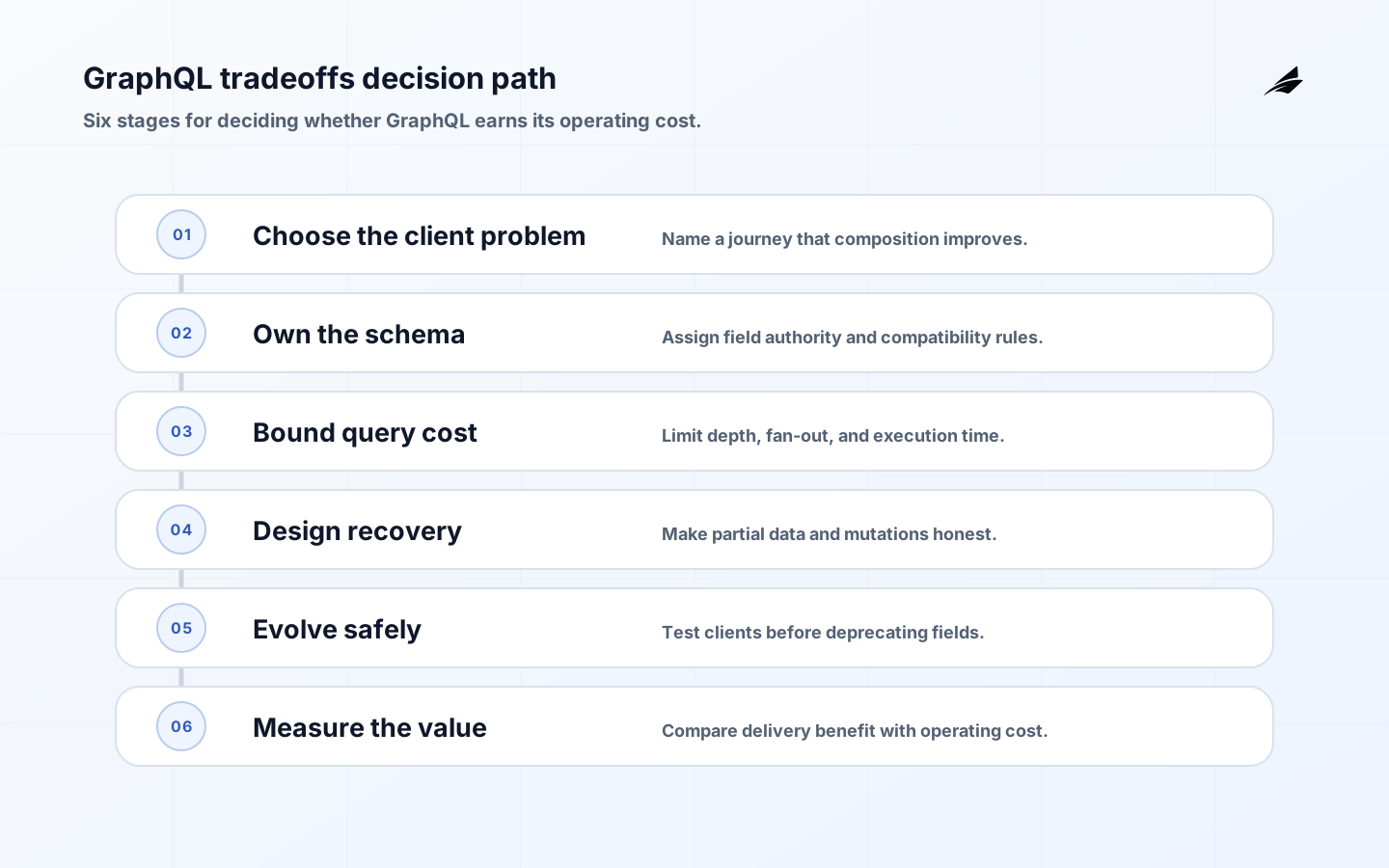
GraphQL tradeoffs become important when a custom product has several clients that need different slices of the same domain data. A mobile screen may need a compact response, an operations console may need a wide record view, and a partner workflow may need a carefully limited mutation. GraphQL can make those requests expressive and typed, but the flexibility moves work into the schema, resolver layer, authorization model, query planner, and operating dashboards. The right question is not whether GraphQL is modern or whether REST is old. It is whether one team can own the added freedom, control expensive operations, and explain partial results when the graph crosses several systems. This guide makes that decision concrete.
Choose the client problem before choosing GraphQL
Start with two or three real journeys and measure the shape of their data, not the number of endpoints. GraphQL is a strong candidate when clients need related records, the product has multiple presentation surfaces, and a typed contract can reduce coordination between client and server teams. A single back-office form with stable fields may be better served by a simple HTTP endpoint. A report that joins a dozen sources may need a dedicated read model rather than a resolver that performs the same expensive fan-out for every caller. The GraphQL specification defines the language and execution semantics, but it does not decide your ownership boundaries, cache policy, or business authorization. Those are local engineering decisions.

| Signal | GraphQL may fit | A different boundary may fit better |
|---|---|---|
| Client variety | Several clients need different field shapes from shared domain data. | One stable client consumes a narrow contract. |
| Composition | A typed graph makes related reads easier to coordinate. | A workflow needs a dedicated projection or report. |
| Change | Client and server teams can govern schema evolution together. | No team owns deprecation, compatibility, or resolver quality. |
| Cost | Query limits and telemetry can be operated continuously. | Unbounded fan-out would threaten latency or budget. |
Give the schema and resolvers accountable owners
A GraphQL schema is a client-facing product surface. Every type, field, argument, nullability choice, and mutation name creates an expectation that can outlive the team that introduced it. Assign a domain owner for each field or type, document the source of truth, and require examples for normal, denied, empty, and stale results. Keep resolver code thin enough to reveal where authorization and data access happen. If a resolver combines customer, billing, and support data, make those boundaries visible rather than hiding them behind one convenient field. The decision should be discoverable to product, support, and platform teams, not only to the author of the first schema file.
Treat nullability and errors as behavior, not decoration
Nullability determines what clients must be prepared to handle. A nullable field may represent absence, denied access, an unavailable dependency, or a resolver error unless the contract makes the distinction clear. Use structured error categories and stable business identifiers where a client needs to recover. For mutations, return enough state to tell the difference between accepted, rejected, pending, and completed work. The GraphQL over HTTP specification describes how requests and responses are carried over HTTP, including the possibility of partial data with errors. That transport behavior should inform the client experience; a response with some data is not automatically a successful business transaction.
Make query cost and authorization visible at execution
GraphQL lets a caller choose a response shape, so a server needs a way to bound the work that shape can trigger. Set limits for document size, depth, breadth, pagination, resolver time, and the number of records fetched from a dependent system. Use batching or a data-loader pattern to prevent repeated child lookups, but measure the resulting calls rather than assuming batching solved the N+1 problem. GraphQL performance guidance covers common techniques such as caching, pagination, and batching; the correct threshold still depends on your workload. Make expensive fields explicit, and give an owner the authority to reject or redesign a query whose cost is not justified by a user outcome.
Authorization belongs at the field, object, or mutation boundary where the relevant policy is known. A user may be allowed to see an order but not its margin, or to update a draft but not approve a published record. Do not treat schema visibility or a client-supplied operation name as authorization. The OWASP GraphQL Cheat Sheet highlights input validation, access control, excessive query cost, and error exposure as separate concerns. Keep them separate in code and in tests so a new field does not accidentally inherit a broader permission than intended.
| Risk | Control | Evidence to review |
|---|---|---|
| Deep or broad query | Depth, breadth, pagination, and timeout limits. | Rejected operation count and worst-case traces. |
| Resolver fan-out | Batching, bounded joins, and dedicated read models. | Downstream calls per operation and latency. |
| Field overexposure | Field-level authorization and safe error messages. | Denied-field tests and authorization events. |
| Untrusted operation | Validation, rate limits, and registered operations where appropriate. | Operation identity, caller, and policy decision. |
Design for partial results, dependency failure, and mutation ambiguity
A graph often crosses services that fail independently. A product page may have current catalog data but a delayed inventory count; a support screen may load a customer but not the latest payment status. Decide which fields can be stale or absent, how the client communicates that state, and when the operation should fail as a whole. For reads, returning useful partial data can be better than hiding the entire screen, provided the missing field is clearly labeled. For mutations, avoid returning a friendly success message when the durable outcome is unknown. Store a stable request or business identifier, reconcile against the authoritative record, and expose a pending state if work continues asynchronously.
- Classify each field as required, optional, stale-tolerant, or dependent on a consequential authority.
- Return stable error categories that let a client correct input, retry safely, or ask for review.
- Use idempotency keys or business identifiers for mutations that may be retried after a network failure.
- Trace the operation through gateway, resolver, downstream calls, and durable outcome so support can explain a partial response.
Evolve the graph without making clients guess
Schema evolution is a coordination practice. Add fields before removing old ones, publish deprecation reasons that tell a client what to use instead, and measure actual field and operation use before setting a removal date. Keep schema checks in continuous integration and run representative client operations against a compatibility environment. A changed nullability guarantee, enum value, authorization rule, or error category can break a consumer even when the schema still validates. Treat those changes as product decisions with an owner and migration notes. For a new graph, start with a single client and a few high-value operations rather than exposing every database table. The GraphQL Security Resources provide useful first-party pointers as the surface grows.
Separate the schema contract from implementation details such as table names, internal service identifiers, or provider-specific error text. A client should depend on stable domain meaning, while resolvers may change their data source behind the boundary. This is one reason to link the graph to REST API Contracts for Custom Software, Node.js APIs for Custom Software, and What Changes When React State Design Moves into Production when the surrounding architecture has several HTTP services and clients. GraphQL can compose those systems, but it should not make their ownership less clear.
Measure the operating cost as part of the product case
The economic case for GraphQL includes client delivery speed, network efficiency, schema review time, resolver maintenance, query planning, and incident response. Track the measures that reveal both value and cost: operation latency by client, resolver latency, downstream calls per operation, cache hit rate, rejected complex queries, error rate by field, and time to deprecate a field. Pair those signals with a user outcome such as fewer screen-specific endpoints, faster completion of an operations task, or lower mobile payload size. If the graph reduces client coordination but creates an unowned gateway bottleneck, the tradeoff is not favorable. Review the evidence with product and operations, not only with the platform team.
GraphQL tradeoffs takeaways
- Choose GraphQL for a real client-composition problem and compare it with a simpler read model or HTTP contract.
- Give every type, field, resolver, mutation, and deprecation an accountable owner and source of truth.
- Bound query size, depth, fan-out, pagination, and execution time before broad exposure.
- Treat authorization, partial data, mutation status, and error categories as first-class contract behavior.
- Measure client value and operating cost together, then expand only when the graph remains understandable and supportable.
GraphQL tradeoffs FAQ
Should a custom product replace REST with GraphQL?
Usually not as a blanket migration. Start with the journeys that suffer from over-fetching, under-fetching, or coordination across several client surfaces. Keep stable, simple commands and integration contracts where they are easier to govern. A GraphQL gateway can sit beside existing services and expose a focused graph while the underlying systems retain their own contracts and ownership.
Is a typed GraphQL schema automatically secure?
No. Types improve validation and make the contract more explicit, but they do not choose who can read a field, how much work a query can trigger, or what a resolver reveals in an error. Add authentication, authorization, input validation, cost controls, safe errors, rate limits, and tests for denied and expensive operations.
How should clients handle partial GraphQL responses?
Define which fields can be absent or stale, show that state without implying a complete success, and give the user a useful recovery path. For a mutation, distinguish accepted, pending, failed, and completed outcomes with a durable identifier that support can reconcile. For a read, partial data can be useful when the missing information is clearly labeled and the user can continue safely.
Conclusion: make GraphQL freedom accountable
GraphQL earns its cost when the graph solves a real composition problem and the team is prepared to govern the freedom it gives callers. Start with a narrow client journey, assign schema and resolver owners, enforce query and authorization boundaries, and make partial results honest. Then measure whether the graph improves the user task enough to justify its operational surface. A typed API is valuable when it helps people change the product safely; it becomes a liability when its flexibility hides cost, authority, or recovery.