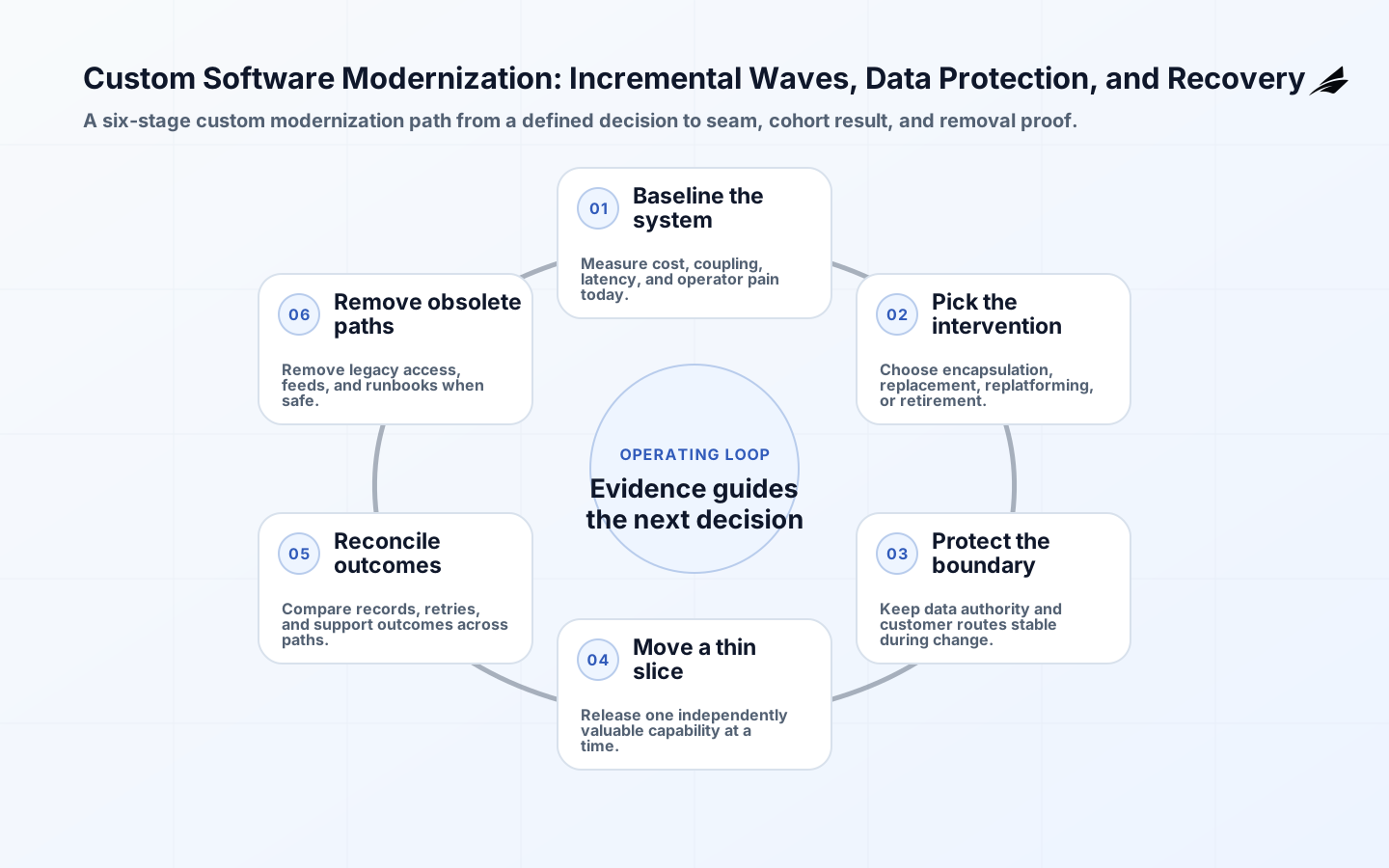
Software modernization is a change to a system's ability to deliver future value, not a cosmetic move to a newer stack. A useful modernization effort improves an outcome that matters: a risky service can be recovered faster, a customer journey can change without a release freeze, an operating cost can be understood, or an unsupported dependency can be retired. Starting with technology labels such as cloud, microservices, or containers reverses that logic. Those may be appropriate tools, but they do not supply a reason, an order of work, or a way to know whether the program helped. The work becomes credible when leaders can name the current constraint, the target capability, and the safeguards that keep the business running while change is underway.
Build the modernization case from the current system
Inventory the applications, integrations, data stores, operating dependencies, and business deadlines before selecting a pattern. The important question is not which component looks oldest; it is which dependency limits a valuable workflow or creates unacceptable exposure. Document who uses the capability, the authoritative data source, upstream and downstream callers, recovery expectations, and the cost of a failed cutover. AWS modernization guidance recommends assessing business, functional, technical, and financial significance together. That combined view avoids migrating a low-value system first simply because it is easy, while a high-value system continues to absorb operating risk. It also exposes dependencies that must move together or be protected by a compatibility layer.
| Assessment area | Question | Planning output |
|---|---|---|
| Business value | What outcome is constrained today? | Prioritized value stream and baseline |
| Technical risk | What fails, cannot be patched, or cannot scale? | Risk register and target controls |
| Dependencies | What contracts and data cross the boundary? | Migration sequence and owners |
| Operations | How will the new path be supported? | Runbook, telemetry, and rollback conditions |
Choose an intervention that fits the constraint
Modernization has several legitimate shapes. Rehosting may reduce infrastructure exposure quickly but leaves application behavior largely intact. Replatforming can simplify operation while preserving a stable domain model. Refactoring is appropriate when a capability needs different boundaries, deployment behavior, or data ownership. Replacing a system can make sense when the domain fit is gone, but it brings adoption and data migration risk. Retiring a capability is often the highest-return choice when evidence shows it is no longer needed. Do not make these labels the decision. Compare the expected benefit, reversibility, migration complexity, required skills, and the consequences of being wrong. One portfolio may use different approaches in different waves; uniformity is not the same as strategy.
- Which customer or operational outcome will be measurably better after this wave?
- What contract must remain stable while callers migrate?
- Which data requires reconciliation, dual-write avoidance, or a retention decision?
- What capability must be practiced before cutover, including rollback and support?
- What will stop the work if evidence shows the assumed benefit is not materializing?
Sequence modernization in independently valuable waves
A wave should deliver a usable improvement and leave the system easier to understand. Start with a bounded capability whose interfaces, users, and failure modes can be observed. Introduce adapters at unstable edges, move a small caller group, compare old and new behavior, and keep the rollback route until confidence is earned. For persistent data, decide which system is authoritative at every phase; unclear dual ownership causes more damage than a temporary delay. A wave plan also needs operational readiness: dashboards, alert routing, access controls, backup and restore evidence, and a support narrative that tells customers what changed. Database schema design in production is especially relevant when a modernization wave changes persistent data contracts.
| Wave stage | Deliverable | Exit evidence |
|---|---|---|
| Discover | Dependency and value map | Owners validate scope and assumptions |
| Prepare | Target contract and migration design | Security and recovery paths reviewed |
| Migrate | Limited production traffic | Behavior and performance compared |
| Stabilize | Operational handover | Support team can diagnose and recover |
| Retire | Removed legacy path | Usage, data, and costs reconciled |
Protect customers and operators during change
The modernization risk is rarely a compiler error alone. It is a missing permission, an untested batch job, a vendor callback that arrives late, or a support process that still points to the retired screen. Treat security, observability, and service continuity as work within every wave. Establish minimum checks for identity, secrets, dependency patching, data access, logging, and backup restoration. Make dashboards compare the user-facing outcome as well as component health; a green deployment does not prove that orders, notifications, or entitlements completed correctly. Run a cutover rehearsal that includes the awkward cases: partial migration, duplicate events, stale cache, failed rollback, and customer contact. The rehearsal produces operational knowledge before it becomes incident pressure.
Keep benefits and costs visible through the program
Modernization funding becomes fragile when the program measures activity instead of benefits. Establish a baseline before each wave: recovery effort, change lead time, infrastructure cost, support volume, conversion delay, or a risk with a concrete consequence. Record the expected mechanism of improvement. A platform move might reduce patching work; a contract boundary might allow teams to release independently; an automated reconciliation might remove a manual control. Measure the result after stabilization and revise the case when it differs from the forecast. Costs need the same honesty: dual running, training, data transfer, observability, vendor constraints, and temporary throughput reduction are real. Pausing a wave can be good governance when evidence says another constraint now deserves the investment. The business case should guide sequence, not lock the team into an early architecture assumption.
Run a modernization wave review
- Confirm that the intended business outcome still matters and that the current baseline is credible enough to judge the new path after real traffic arrives.
- Verify every dependency has an owner, including batch processes, operational reports, vendor callbacks, identity controls, and the customer communication route for a cutover issue.
- Review whether data authority is unambiguous during the transition and whether reconciliation can identify a missed, duplicated, or incorrectly transformed record quickly.
- Check that rollback is a practiced business operation with decisions about data created during the wave, not merely a deployment command that restores old code.
- Ask support and operations to demonstrate diagnosis of a representative failure using the new dashboards, access controls, runbook, and escalation contacts.
- Record the realized cost, benefit, and unexpected constraint so portfolio sequencing improves rather than repeating the same discovery work in each later wave.
A modernization steering review should leave with decisions, not only status. Name the next wave, the dependency that must be resolved first, the risk accepted for now, and the evidence needed to change course. Keep the record short enough that delivery teams can use it during a cutover. When tradeoffs are explicit, leaders can protect a valuable migration from scope drift without hiding a genuine operational concern.
Check the roadmap against authoritative guidance
AWS provides useful planning structure in its guide to continuous assessment, while the OpenAPI Specification helps teams make integration boundaries explicit and the OWASP Application Security Verification Standard makes security expectations testable. TypeScript's project references guidance is also useful when modernization changes build boundaries. Apply these references to the organization and constraints in front of you; they are prompts for disciplined decisions, not a reason to copy a vendor architecture wholesale.
Software modernization takeaways
- Begins with a constrained business or operational outcome.
- Maps dependencies and data authority before choosing a migration pattern.
- Delivers in waves that are observable, reversible, and independently useful.
- Includes security, recovery, support, and measurement in every wave.
- Retires old paths only after usage and reconciliation evidence are clear.
Software modernization FAQ — custom modernization
Is cloud migration the same as modernization? It can be part of modernization, but a move alone does not improve application boundaries or operating practices. When should a monolith be split? When a clear capability needs independent change or operation and the new boundary can be supported; not merely because microservices are fashionable. How long should a wave last? Long enough to deliver a measurable capability and establish operational evidence, short enough that assumptions can be corrected before they compound. Can legacy systems remain? Yes. A portfolio can retain stable systems when their risk and cost are acceptable and their interfaces are deliberately managed.
A custom software modernization decision example
Custom software modernization begins with an inventory that is useful for decisions. Map capabilities rather than only applications: who uses each path, which records it owns, what integrations it calls, what manual work surrounds it, and what failure costs. Separate symptoms such as slow releases from causes such as shared data ownership or missing tests. The resulting map should identify a first slice that is valuable enough to teach the team and bounded enough to roll back.
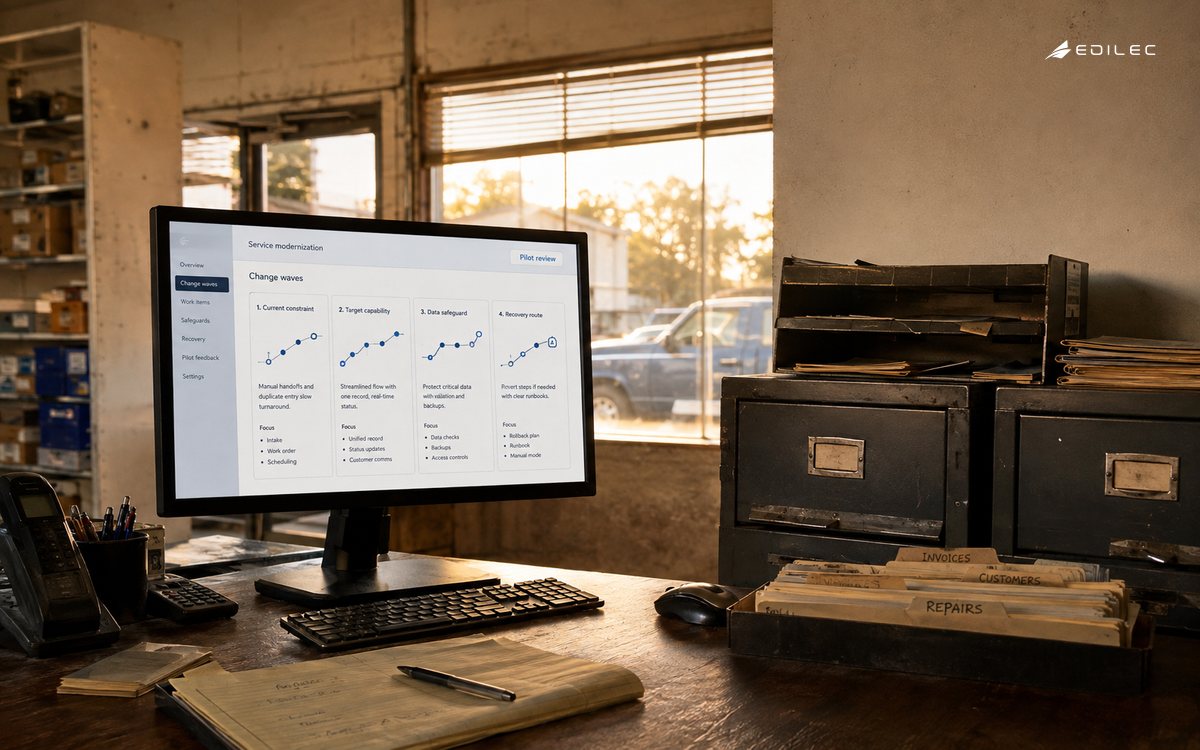
Make the custom-modernization decision inspectable
Choose a transition pattern that matches the seam. A strangler route is effective when requests can be intercepted and the old and new paths can coexist. A data-first migration may suit a reporting workload; a modular refactor may suit a stable monolith whose deployment boundary is the real problem. Do not promise a universal sequence. Define how records are reconciled, how writes become authoritative, how identifiers remain stable, and how a person corrects a mismatch.
Protect the operating envelope while the custom system is split. Keep service objectives, access controls, backups, runbooks, and audit evidence equivalent or stronger on the new path. Release one cohort or capability at a time, compare outcomes, and make the switch reversible. AWS and Microsoft guidance both emphasize incremental modernization and operational readiness; in practice that means the migration plan contains alerts, support training, restoration drills, and decommission criteria, not only engineering milestones.
Plan the end before starting the middle. A legacy route should have an owner, usage measurement, sunset date, and exception process. Remove dual writes, compatibility shims, credentials, scheduled jobs, and dashboards in a sequence that preserves evidence. Review cost and reliability after the new path has handled ordinary and adverse traffic. The modernization is successful when the organization has a simpler capability it can change and operate, not when it merely has two codebases.
Conclusion — custom modernization
Custom modernization becomes trustworthy when every wave protects a customer boundary, reconciles outcomes, and leaves a clear exit path. If your team needs help turning that plan into delivery, Edilec's legacy software modernization service covers assessment, phased change, validation, and retirement of the old path.