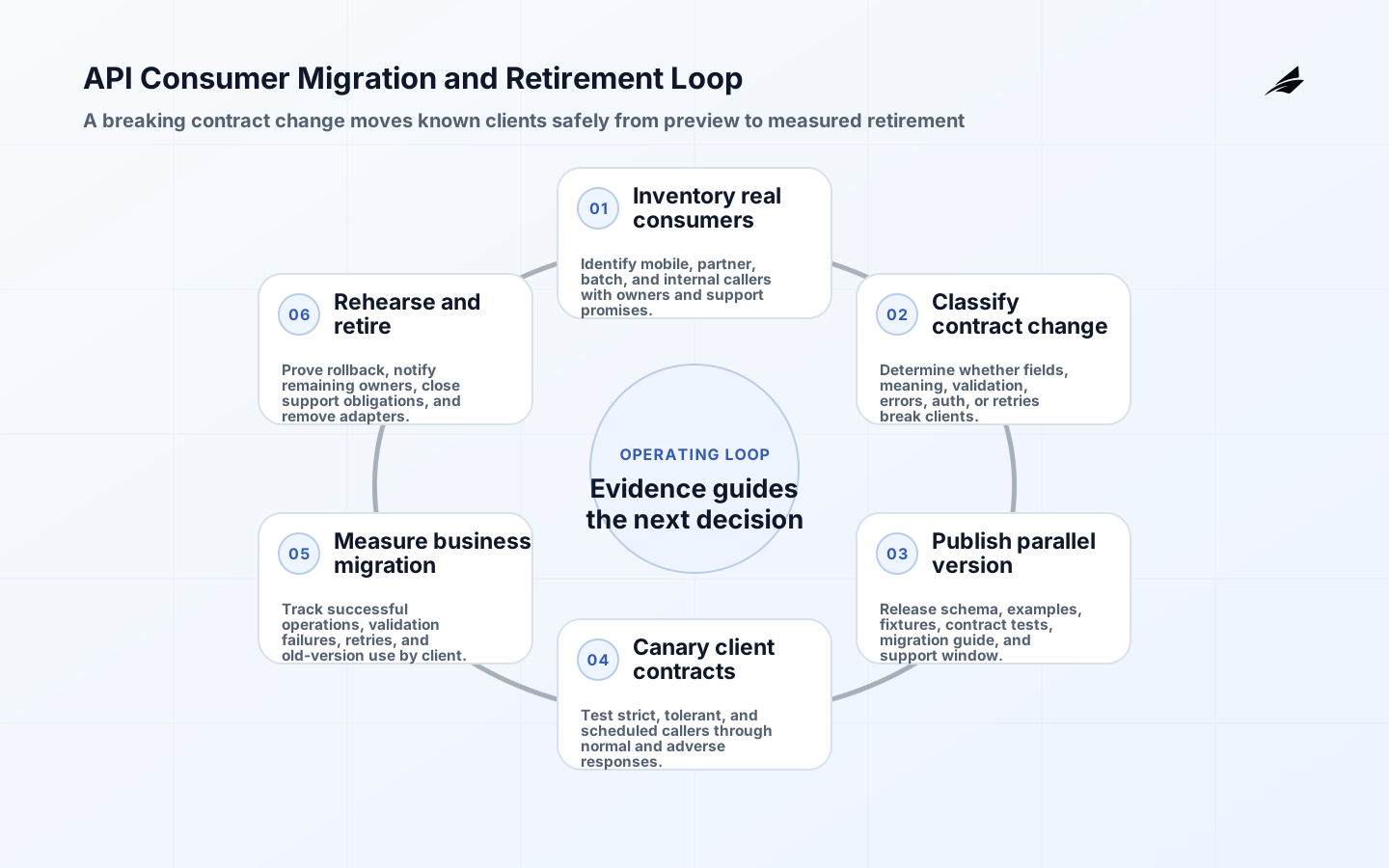
API versioning is not a routing convention; it is a promise about how long an integration can keep working. A mobile client, partner script, or warehouse job may upgrade weeks after a server release. If a response field changes type or a validation rule becomes stricter without a migration path, the supplier has shifted the cost of its release to every consumer. The better question is not whether an API has /v1 in its URL. It is whether a team can identify a breaking change, publish its replacement, observe consumer uptake, and remove the old behavior without guessing.
Make API versioning an explicit operating decision
HTTP gives methods and status codes stable semantics, while application representations evolve independently. That distinction matters when deciding whether an edit is compatible. Adding an optional response field is usually safe for tolerant clients; renaming or changing the meaning of a field is not. The OpenAPI Specification helps make those representations reviewable, but a schema alone cannot tell a team whether an existing client relied on an undocumented default. Compatibility must be a product and operational decision as well as a code review decision.
| Decision | Question to answer | Useful evidence |
|---|---|---|
| Breaking-change rule | What client assumption would fail? | A written compatibility classification |
| Contract source | Where do clients find the current behavior? | Versioned schema and examples |
| Migration proof | Who has moved to the replacement? | Observed client and endpoint usage |
| Retirement authority | Who can turn the old path off? | Approved date and rollback plan |
Define the API versioning contract and boundaries
Write the contract from the consumer's point of view. Define required request fields, response shape, paging, error categories, idempotency behavior, authentication scopes, and rate limits. Keep examples and machine-readable schemas in the same change set. For a payment endpoint, an idempotency key is not a convenience: retries after a timeout must not create a second charge. RFC 9110 explains the HTTP semantics behind safe and idempotent methods; application teams still need to document the business effect of each retry.
- Classify a proposed change as additive, behavior-changing, or breaking before implementation.
- Record known consumers, their contact path, and any contractual support commitment.
- Publish request, response, error, and authentication examples with the schema.
- Add contract tests for both the new behavior and the supported older behavior.
- Expose deprecation information in documentation and, where useful, response headers.
- Set a review date based on measured migration rather than an arbitrary calendar.
Build and roll out API versioning in a bounded slice
Start with an inventory of callers rather than a debate over versioning styles. Instrument a stable client identifier where appropriate, record the requested API version, and measure the endpoints and fields that actually matter to migration. Publish a new representation alongside the old one, provide a test environment with realistic error responses, and state a retirement date only after support and legal owners agree on it. The OWASP API Security Project is a useful reminder that old API surfaces remain part of the attack surface, so deprecated versions need the same authorization, logging, and patch discipline as current ones.
| Failure mode | Guardrail | Signal to monitor |
|---|---|---|
| Silent client dependency | A field was optional on paper but required in practice | Consumer telemetry and staged canary |
| Duplicate side effect | A timeout causes a second create request | Idempotency key and replay test |
| Stale surface | Deprecated endpoint misses a security fix | Shared patch and inventory policy |
| Unplanned shutdown | Unknown client still calls v1 | Traffic threshold and support notice |
Operate API versioning with evidence
A version should have an owner, a documented support window, and a dashboard that distinguishes traffic from successful business outcomes. Watch for old-version calls, schema validation failures, unusual 4xx changes, and clients that retry a non-idempotent operation. A support ticket saying 'the API broke' becomes actionable when the team can compare the old and new contract, request ID, client version, and release time.
Make API versioning tradeoffs explicit
URL, header, and media-type approaches can all work. Choose one that clients and gateways can route, cache, test, and document consistently. Do not use an API version to hide every additive change; reserve a new major contract for behavior that a reasonable existing client cannot safely interpret. Teams also designing backend boundaries can compare these decisions with the Node.js API guide.
A concrete example keeps the design grounded. A worked engineering example keeps the discussion honest. A logistics partner may deploy its order-import worker only once per quarter. When a provider changes delivery_window from a string to an object, the worker can still receive a 200 response while silently discarding the new value. A compatible transition would add a new field, publish examples for both shapes, and let the partner choose the replacement during its scheduled release. Use the example to identify the authoritative record, expected outcome, failure that changes it, and operator who must choose the next action. That turns an architectural claim into a reviewable slice of production behavior.
Test the old and new contracts against a representative client suite, including missing fields, unknown enum values, retry after a timeout, pagination, and authorization failures. Keep fixture payloads under version control so a change review shows exactly what a consumer is expected to parse. Keep evidence with the change: a reproducible command, expected telemetry, and a note about the failure being exercised. Checks should state the capability being protected, not merely mirror implementation details.
Product owns the support promise and retirement communication; the API owner owns contract decisions; security owns authentication review; and support owns escalation. Their names should appear in the deprecation record, because an email alias without decision authority does not resolve a blocked migration. Agree on a review cadence and escalation route before the first exception arrives. The aim is a timely decision by someone with the right context, not a large committee or a static policy nobody can apply.
Start with a documented preview, move a small set of opt-in callers, then make the replacement the documented default. A gateway adapter can reduce immediate disruption, but it needs rate, error, and latency telemetry plus a removal date. Rehearse returning the old behavior before the final cutoff. Publish entry and exit criteria for each step, including the condition that stops expansion. A narrow rollout gives a better learning loop because intended and observed behavior can be compared while scope remains correctable.
Measure migration by successful business operations on the new contract, not only requests containing a version header. Segment errors by client and endpoint, and treat a validation-failure spike as a contract-learning signal rather than an invitation to silently loosen rules. Ask what action each signal would justify. A metric without an owner, threshold, or practical response is not useful observability; a smaller trusted set is stronger during a release or incident.
Keep a compact changelog linking each version decision to its schema diff, test evidence, migration notice, and retirement outcome. This history helps maintainers distinguish intentional compatibility from accidental behavior clients have come to rely on. Include this in dependency review, planning, and incident follow-up so it does not depend on one person's memory. Clear notes should cover normal operation, known limits, emergency authority, and recovery evidence.
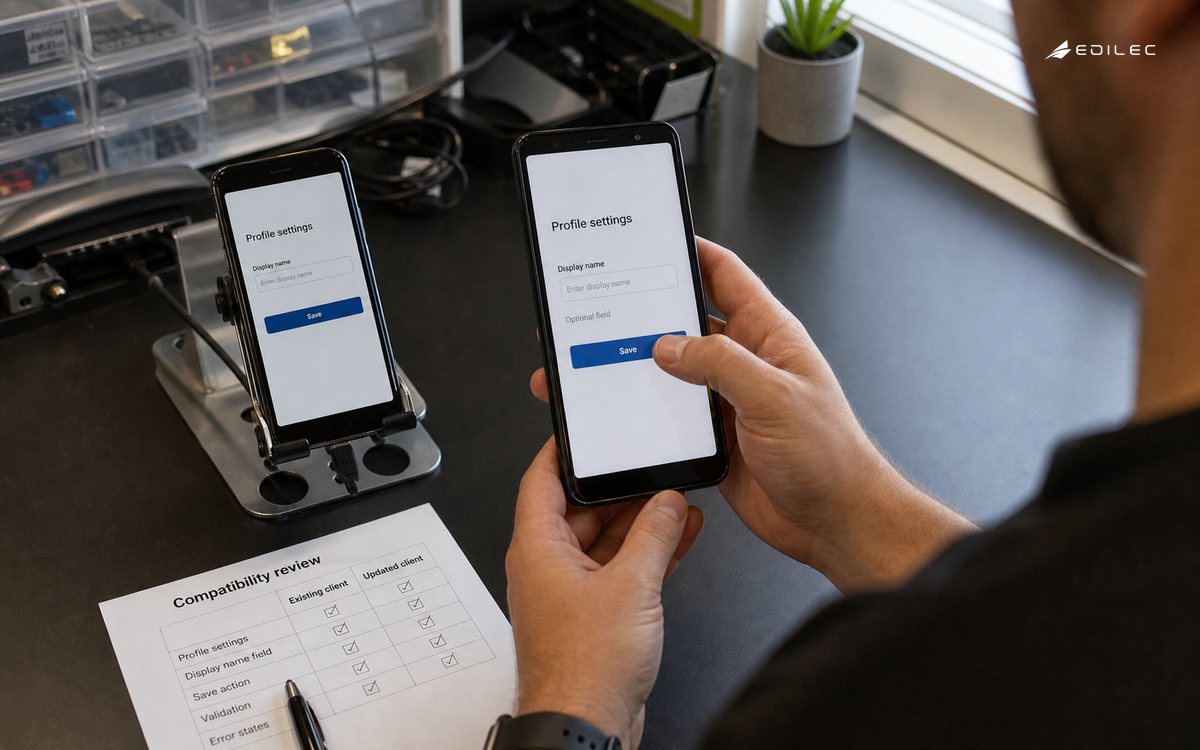
Before treating a plan as ready, turn it into a small review exercise. Use a sample client with a strict parser, a tolerant parser, and a scheduled batch job to expose compatibility assumptions that a schema linter cannot infer. The exercise should name an owner, expected evidence, and a concrete result that would cause the team to pause. It is intentionally more demanding than a demo: demonstrations often assume ideal data and a cooperative dependency, while real confidence comes from showing that the boundary responds predictably when assumptions fail. Store the result with the relevant change record so the next engineer can repeat the check rather than reconstruct its purpose from an old ticket.
Failure rehearsals are a practical way to protect operational knowledge. Ask an on-call engineer to find the active contract, identify a caller, and explain the action for a failed migration notice. The person running the rehearsal should use ordinary documentation and permitted tools, not private memory or administrator shortcuts. Note the time needed to detect the condition, make a decision, and verify recovery. Those observations often reveal a missing identifier, unclear authority, or unsafe default before an incident turns the same omission into customer harm. Feed the learning back into tests, runbooks, and the next release rather than treating the exercise as a one-time audit.
Change needs a decision record as well as code or configuration. Record version milestones beside the release calendar so marketing, support, and engineering do not make conflicting promises. Include the scope, assumption, approval authority, observable success condition, rollback or correction route, and date for reconsideration. This discipline keeps temporary controls from becoming invisible permanent architecture. It also gives product, operations, security, and engineering a common artifact for resolving tradeoffs, which is far more useful than asking each group to infer intent from dashboards, implementation details, or an incomplete support history.
Key API versioning takeaways
- Compatibility is defined by consumer behavior, not by the location of a version string.
- Schemas need human examples, contract tests, and an explicit owner.
- Deprecation without telemetry is only an announcement.
- Retries require business-level idempotency decisions.
- Old versions remain security and support obligations.
- Retirement should be rehearsed before the final shutdown.
API versioning FAQ
Do all API changes require a new version? No. Additive, optional information can remain in the current contract when clients can ignore it safely. How long should a deprecated version live? Long enough for the known client population and contractual commitments, with telemetry rather than hope guiding the date. Can a gateway translate v1 to v2 forever? It can ease a migration, but permanent translation creates another product to test and secure; give the adapter an owner and an end date.
Conclusion: make API versioning dependable
Good API versioning makes change boring for consumers. Treat contracts, migration tooling, observability, and retirement as one release capability, and a version label becomes the smallest part of a reliable compatibility policy.