Event-driven systems replace a direct request with a durable fact such as OrderPlaced or DeviceReadingReceived. That can reduce coupling, but it also separates cause from effect in time and often across trust boundaries. A service may publish once, a consumer may receive more than once, and a replay may happen days later. The engineering work is therefore not merely choosing a broker. It is deciding which producer may assert a fact, which consumers may act on it, how sensitive fields are minimized, and how an operator can explain a downstream result.
Make event-driven systems an explicit operating decision
An event is a contract with a different failure profile from an HTTP call. Delivery is commonly at least once, ordering may be limited to a key or partition, and consumer-side effects must tolerate duplicates. The CloudEvents specification provides interoperable metadata conventions, but it does not grant authority to the payload. Treat every event as input from another security domain, even when producer and consumer are owned by the same company.

| Decision | Question to answer | Useful evidence |
|---|---|---|
| Event authority | Which service may assert this fact? | Producer identity and domain owner |
| Payload scope | What data must travel? | Classified minimal schema |
| Delivery behavior | What happens on duplicate or delay? | Idempotent consumer test |
| Recovery path | Who handles poison messages? | Quarantine queue and service target |
Define the event-driven systems contract and boundaries
Give each event a stable name, schema version, producer identity, event ID, occurrence time, subject, classification, and retention expectation. Put an account ID in a message only when the consumer needs it; use a lookup with authorization for sensitive detail. A producer should sign or authenticate to the broker using a workload identity, and a consumer should have the narrowest permission to a topic or queue. NIST SP 800-204 is useful background for the security challenges created by microservices and their communications.
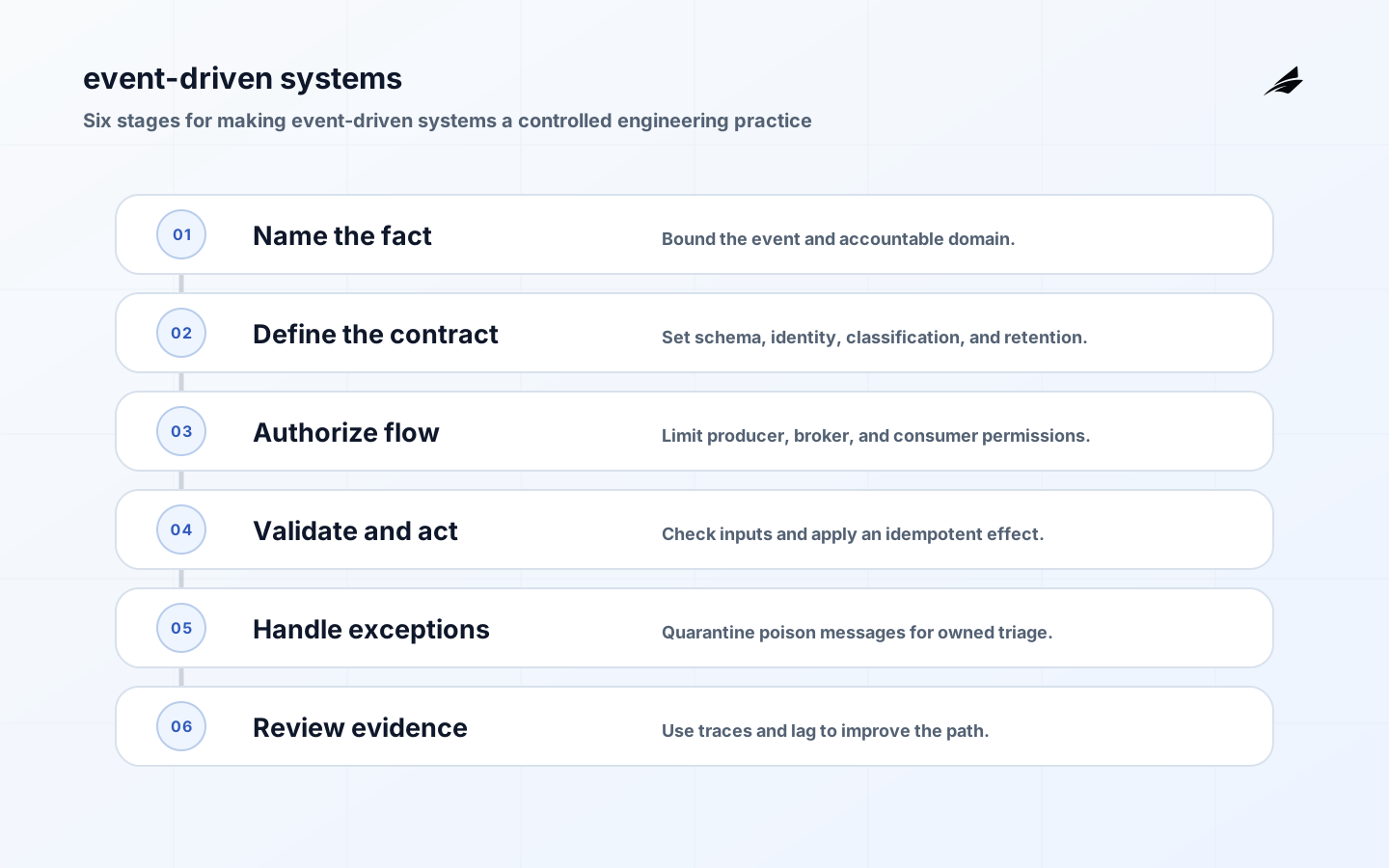
- Name the business fact and the bounded context that owns it.
- Define event ID, subject, schema, classification, and retention before publishing.
- Grant producer and consumer identities only the topic permissions they require.
- Make consumer effects idempotent and test a duplicated delivery.
- Route malformed or unauthorized messages to an owned quarantine path.
- Rehearse replay, key rotation, and consumer recovery with production-like data.
Build and roll out event-driven systems in a bounded slice
Design the consumer as an idempotent state transition. For example, an invoice service can store the event ID and invoice ID in the same transaction that creates an invoice record, rejecting a repeated event without recharging the customer. Validate payload shape, authorization context, and business invariants before effecting a change. Quarantine malformed or unauthorized messages with access controls instead of endlessly retrying them. The OWASP API Security guidance remains relevant because message consumers still expose application logic and sensitive data.
| Failure mode | Guardrail | Signal to monitor |
|---|---|---|
| Forged publish | Untrusted workload writes to a topic | Workload identity and topic ACL |
| Replay effect | Old message creates a second side effect | Event ledger and idempotency key |
| Sensitive leakage | Payload or dead letter contains excess data | Data minimization and redaction |
| Unbounded retry | Bad message blocks healthy processing | Retry limit and quarantine owner |
Operate event-driven systems with evidence
Correlation IDs should join the producer log, broker metadata, consumer processing record, and user-visible outcome. Monitor consumer lag, retry volume, dead-letter growth, authorization failures, and age of the oldest unprocessed message. Avoid putting tokens, passwords, or full customer records in logs or dead-letter queues; diagnostics need a redaction policy too.
Make event-driven systems tradeoffs explicit
A single global event bus is rarely a useful security boundary. Prefer domains with named owners, narrow subscriptions, and explicit cross-domain contracts. A request-response API may be the better choice when the caller needs immediate validation and a definitive answer. For teams examining integration behavior more broadly, the API versioning guide explains why contracts and retirement disciplines still matter.
A concrete example keeps the design grounded. Consider a fulfilment event that triggers stock reservation, customer notification, and a finance record. If a consumer crashes after reserving stock but before recording its offset, a redelivery is normal. The correct design makes each side effect detect the same event and reach the same durable result. Use the example to identify the authoritative record, expected outcome, failure that changes it, and operator who must choose the next action. That turns an architectural claim into a reviewable slice of production behavior.
Test duplicate delivery, out-of-order arrival, delayed replay, malformed schema, revoked producer identity, expired consumer permission, and unavailable downstream services. Fixtures should include classifications, because a happy-path payload cannot prove that logs and quarantine paths avoid sensitive retention. Keep evidence with the change: a reproducible command, expected telemetry, and a note about the failure being exercised. Checks should state the capability being protected, not merely mirror implementation details.
The producing domain owns event meaning and lifecycle, and the consuming domain owns the effect it performs. Platform teams may operate broker policy, but cannot decide whether a payment reversal is valid. Record these responsibilities in the event catalog beside schema and subscriptions. Agree on a review cadence and escalation route before the first exception arrives. The aim is a timely decision by someone with the right context, not a large committee or a static policy nobody can apply.
Release a consumer in observe-only mode where possible: validate and record what it would do before enabling the durable effect. Add one subscriber at a time, limit replay scope, and establish a freeze or rollback procedure for schema changes that alter business interpretation. Publish entry and exit criteria for each step, including the condition that stops expansion. A narrow rollout gives a better learning loop because intended and observed behavior can be compared while scope remains correctable.
Pair broker indicators with business evidence. Lag and retry count show pressure, while duplicate-effect rejection, quarantine age, and missing downstream outcomes show whether the workflow is safe. An empty dead-letter queue is not necessarily healthy if a consumer silently drops messages. Ask what action each signal would justify. A metric without an owner, threshold, or practical response is not useful observability; a smaller trusted set is stronger during a release or incident.
Review subscriptions and access policies when teams or data classifications change. Remove unused consumers, rotate credentials, and periodically replay an approved sample into isolation to prove that recovery documentation still matches the deployed system. Include this in dependency review, planning, and incident follow-up so it does not depend on one person's memory. Clear notes should cover normal operation, known limits, emergency authority, and recovery evidence.
Before treating a plan as ready, turn it into a small review exercise. Use a transaction boundary where possible to persist the effect and the processed-event marker together; where that is not possible, document the compensating action. The exercise should name an owner, expected evidence, and a concrete result that would cause the team to pause. It is intentionally more demanding than a demo: demonstrations often assume ideal data and a cooperative dependency, while real confidence comes from showing that the boundary responds predictably when assumptions fail. Store the result with the relevant change record so the next engineer can repeat the check rather than reconstruct its purpose from an old ticket.
Failure rehearsals are a practical way to protect operational knowledge. Ask an incident responder to trace one event from producer through broker to outcome, including a quarantined copy and an authorized replay. The person running the rehearsal should use ordinary documentation and permitted tools, not private memory or administrator shortcuts. Note the time needed to detect the condition, make a decision, and verify recovery. Those observations often reveal a missing identifier, unclear authority, or unsafe default before an incident turns the same omission into customer harm. Feed the learning back into tests, runbooks, and the next release rather than treating the exercise as a one-time audit.
Change needs a decision record as well as code or configuration. Record schema and access changes in the domain catalog so a subscriber can assess a new field or retention rule before it receives production traffic. Include the scope, assumption, approval authority, observable success condition, rollback or correction route, and date for reconsideration. This discipline keeps temporary controls from becoming invisible permanent architecture. It also gives product, operations, security, and engineering a common artifact for resolving tradeoffs, which is far more useful than asking each group to infer intent from dashboards, implementation details, or an incomplete support history.
Key event-driven systems takeaways
- A message is an input across a trust boundary, not an internal implementation detail.
- At-least-once delivery requires idempotent effects.
- Authorization belongs to producers, brokers, and consumers.
- Payload minimization reduces exposure and coupling.
- Dead-letter queues need ownership and redaction.
- Traceability must connect the event to an observable outcome.
Event-driven systems FAQ
Are events inherently more secure than APIs? No. They change where authorization and validation occur; they do not remove either responsibility. Should every event carry the full business record? Usually not. Carry the minimum useful context and retrieve protected detail under the consumer's identity. Do dead-letter queues solve failures? They preserve evidence, but a queue without triage ownership becomes a quiet accumulation of unprocessed work.
Conclusion: make event-driven systems dependable
Secure event-driven systems make messages attributable, minimal, replayable, and observable. Start with one bounded flow, prove its duplicate and failure behavior, then expand the event estate with the same care used for a public API.