Subscription Access Control: Define It Before You Build
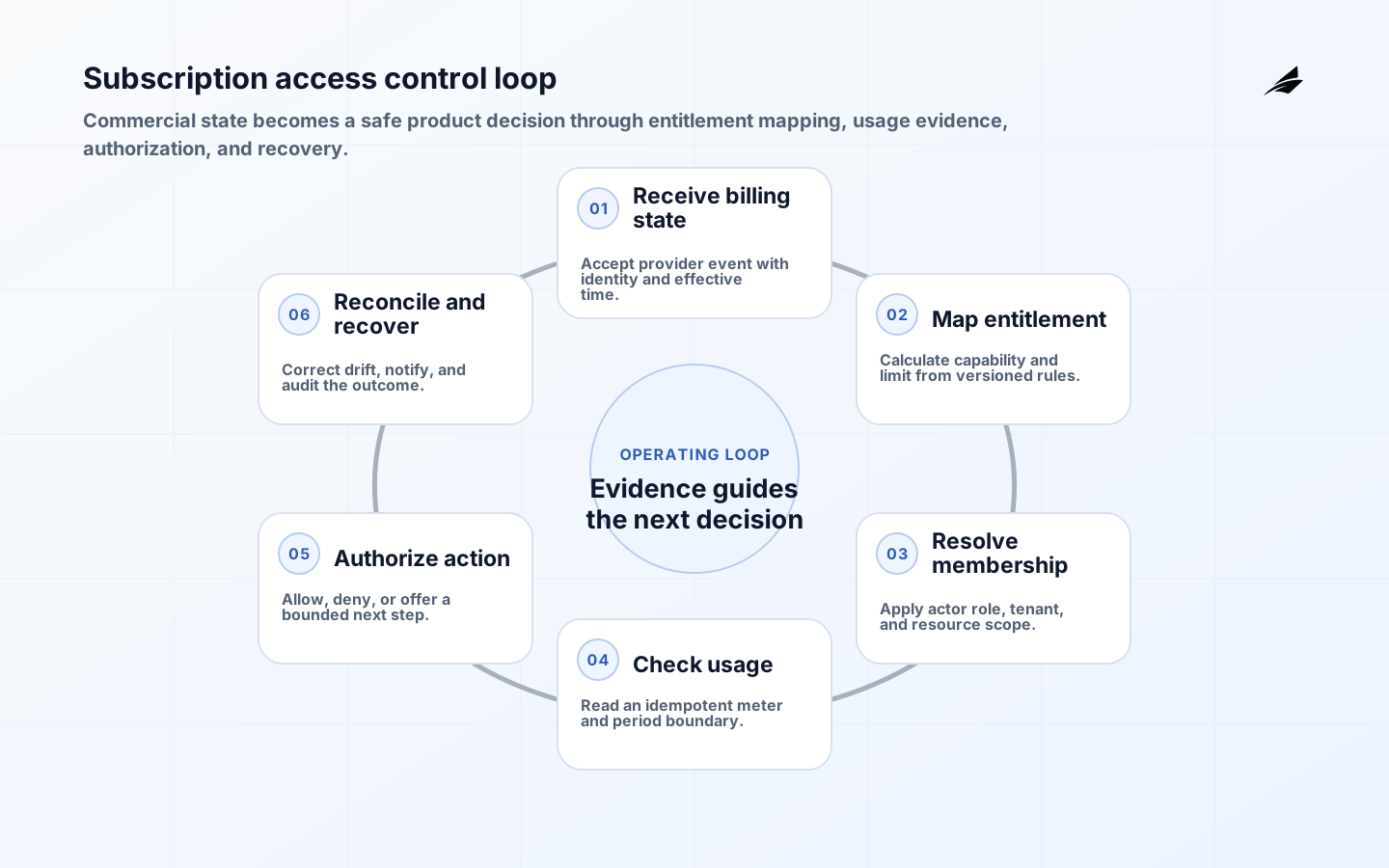
Subscription access control is the system that turns a commercial agreement into product behavior. It decides what a tenant may use, who may use it, when a limit applies, and what happens when payment, plan, usage, or entitlement data changes. Treating it as a handful of feature flags creates surprises: a cancelled subscription can retain access, a renewal can fail to unlock a feature, or a support agent can grant authority without a durable reason. Stripe Subscriptions API is a useful official reference for billing objects and API behavior, but the product still needs its own source of truth and reconciliation rules.
Define access in product language
Start with a table of capabilities rather than plan names. Name the action, resource, quantity, actor, state, and customer value. “Advanced reporting” may mean access to a report type, a monthly usage allowance, a retention period, or a response-time promise. Separate entitlement from authorization: an organization may have the capability in its plan, while a particular member still lacks permission to use it. The Stripe Entitlements reference helps connect a feature to an outcome; use that connection to avoid pricing logic that has no clear customer meaning.
Separate billing, entitlement, and membership
Billing records identify a commercial relationship. Entitlements express what the relationship currently includes. Membership and role express what a person may do within the tenant. Keep these models related but independent. A failed payment may change an entitlement state after a grace period; it should not erase membership history. A plan upgrade may add a capability without granting every member a sensitive action. A support override should be temporary, scoped, approved, and visible.
| Layer | Question | Evidence |
|---|---|---|
| Billing | What subscription, invoice, or usage state exists? | Provider object, event, effective time, and reconciliation. |
| Entitlement | Which capability or limit is active for the tenant? | Versioned rule, source, and effective period. |
| Membership | Which person or workload belongs to the tenant? | Role, scope, status, and membership history. |
| Authorization | May this actor perform this action now? | Policy decision, resource, and reason. |
| Usage | Has the tenant consumed a billable or capped unit? | Meter definition, event identity, and correction path. |
Choose a source of truth and reconcile it
Decide which system is authoritative for subscription status, plan definition, usage, entitlement calculation, and access decision. A payment provider may be authoritative for an invoice but not for internal product limits. Your application may calculate entitlements but should retain the input version and effective time. Webhooks can be delayed, duplicated, or delivered out of order, so process them idempotently and reconcile against provider state where appropriate. Store “pending,” “grace,” “restricted,” and “cancelled” states if they have different customer consequences. A binary active/inactive field is rarely enough.
- What event changes access, and when does that change become effective?
- What is the grace or recovery behavior for failed payment or delayed billing data?
- Which usage unit is measured, and how are late or corrected events handled?
- Can a plan change mid-period, and how are proration and entitlements interpreted?
- Which features are tenant-level, member-level, workspace-level, or resource-level?
- How can support grant or remove access without creating an untraceable exception?
Make runtime decisions explicit
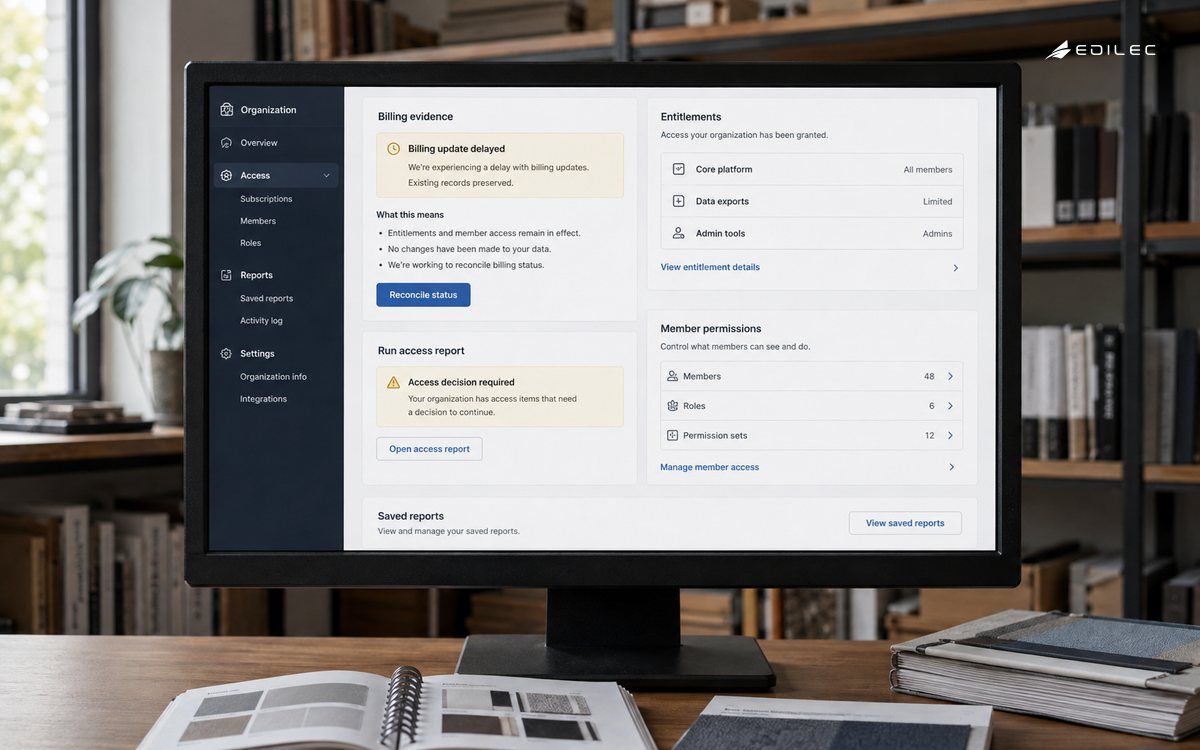
An access check should receive actor, tenant, capability, resource, current state, and policy version. It should return allow, deny, or a bounded alternative with a reason that is safe to show. The OAuth 2.0 authorization framework is a useful reference for delegated scope, but it does not replace product entitlement checks. Avoid calculating access only at login; plans and roles change while sessions remain open. Apply checks at the server or service boundary and make background jobs use the same decision model. AWS SaaS tenant-isolation guidance is useful context for tenant-aware SaaS operations; the important implementation choice is whether the team can explain and audit a decision after a customer disputes it.
| Scenario | Expected decision | Control |
|---|---|---|
| New subscription | Unlock defined capabilities after verified state. | Effective time and entitlement version. |
| Payment retry | Keep or restrict access according to a published grace rule. | State machine and customer notice. |
| Plan upgrade | Apply new capability and limits without changing member roles. | Reconciliation and rollout test. |
| Usage threshold | Warn, cap, or allow overage according to contract. | Idempotent meter and correction path. |
| Support override | Grant narrow, temporary access with approval. | Scope, expiry, reason, and audit event. |
Design usage and limits as contracts
A limit is only fair if the customer can understand the unit, period, source, and correction rule. Define whether a unit is created, processed, stored, delivered, or successfully completed. Use stable event identity and idempotency so retries do not double-count. Keep a ledger or evidence trail that can explain a current total without relying on a mutable counter alone. If a usage event arrives late or is corrected, state whether the correction changes the current period, a prior statement, or only a future calculation. Clear contracts reduce both billing disputes and access surprises.
Instrument access without exposing secrets
Record policy version, tenant, actor type, capability, resource class, decision, and reason category in a controlled audit or telemetry stream. OpenTelemetry Metrics Specification provides useful guidance for consistent context; do not put payment details, tokens, or sensitive customer content in traces. Measure denied access, stale entitlement cache, webhook lag, reconciliation mismatch, usage correction, and support overrides. An observability signal is useful when someone owns the response. A high denial rate may indicate a broken plan mapping, while a low denial rate may reveal an overbroad policy.
Roll out subscription controls gradually
Build a shadow decision first: calculate the new entitlement result while preserving current behavior, then compare outcomes by plan and tenant. Test new subscriptions, upgrades, downgrades, cancellation, failed payment, renewal, usage correction, membership removal, and provider outage. Use feature flags to release a capability to a small cohort, but ensure flags cannot bypass server-side authorization. Vercel deployment documentation is a useful deployment reference; release evidence should additionally show which tenants were exposed, what changed, and how the team would disable the path safely.
Example: a usage-capped analytics plan
Imagine a SaaS analytics plan that includes 100 report runs per month, five member seats, and 12 months of history. The tenant is entitled to the capabilities; an administrator may invite members; a viewer may run a report only if the capability and usage policy allow it. A report run receives an idempotency key when accepted, not when a button is clicked. At 80 runs the product warns; at 100 it follows the contract—cap, overage, or approval. A delayed billing event does not silently delete the tenant's data. The customer can see the meter, period, plan, and reason for any restriction.
Review failure and recovery paths
Common failures include provider events processed twice, entitlements cached beyond their effective period, plan changes that alter access mid-request, meters that count retries twice, and support overrides that never expire. Another is treating access restriction as data deletion, making recovery impossible when billing is corrected. Define containment and recovery: pause a risky capability, mark entitlement data stale, use a safe grace rule, reconcile the provider, and communicate the result. Preserve the before and after decision so support can explain what happened without editing production records by hand.
- Billing, entitlement, membership, authorization, and usage have separate models and owners.
- Provider webhooks are idempotent, ordered where needed, and reconciled against authoritative state.
- Every limit has a unit, period, effective time, and correction behavior.
- Runtime checks occur at the protected service boundary, not only in the user interface.
- Support overrides are scoped, approved, time-bound, and auditable.
- Outage, delayed event, failed payment, upgrade, downgrade, and rollback paths are tested.
Measure access accuracy and customer impact
Track entitlement freshness, provider event lag, reconciliation mismatches, incorrect allow or deny reports, support override count and age, usage correction rate, upgrade activation time, restriction recovery time, and feature adoption by entitled tenants. Pair those with conversion, failed workflow, support contact, and churn signals. A product can have technically healthy webhooks while customers wait hours for an upgrade; that is still an access-control problem. Use the measurements to improve the state model, cache strategy, messaging, or commercial contract rather than hiding the issue in manual exceptions.
Access-control principles for launch
- Define capabilities and limits in customer language before naming plan flags.
- Keep billing, entitlements, membership, authorization, and usage distinct.
- Choose sources of truth and reconciliation rules for delayed or duplicated events.
- Make runtime decisions current, scoped, explainable, and server-enforced.
- Give every meter a stable unit, idempotent event, and correction path.
- Measure access accuracy, activation time, disputes, and recovery—not just webhook health.
Subscription access control FAQ
Should the billing provider be the access-control source of truth?
Usually it is authoritative for payment objects and events, while the product owns capability mapping, membership, usage rules, and the final runtime decision. Define reconciliation between them.
Can access decisions be cached?
Yes, if the cache has a bounded lifetime, invalidation or refresh path, tenant and actor scope, and a safe response when entitlement data is stale. High-consequence actions may need a fresher check.
How should support overrides work?
Use a narrow capability, reason, approval, start and expiry time, and a visible audit event. Avoid permanent administrator access as a shortcut for a customer-specific exception.
Conclusion: make commercial state operationally precise
Subscription access control is a running negotiation between commercial state and a protected product action. Define which event changes entitlement, which actor may use it, how usage is counted, and what support can correct without rewriting history. The product support tooling guide, in-app guidance guide, and trial conversion guide add useful neighboring patterns. Customers judge the system by whether the right person can act, receive a clear reason, and recover when billing reality arrives late. Keep that answer testable in staging.