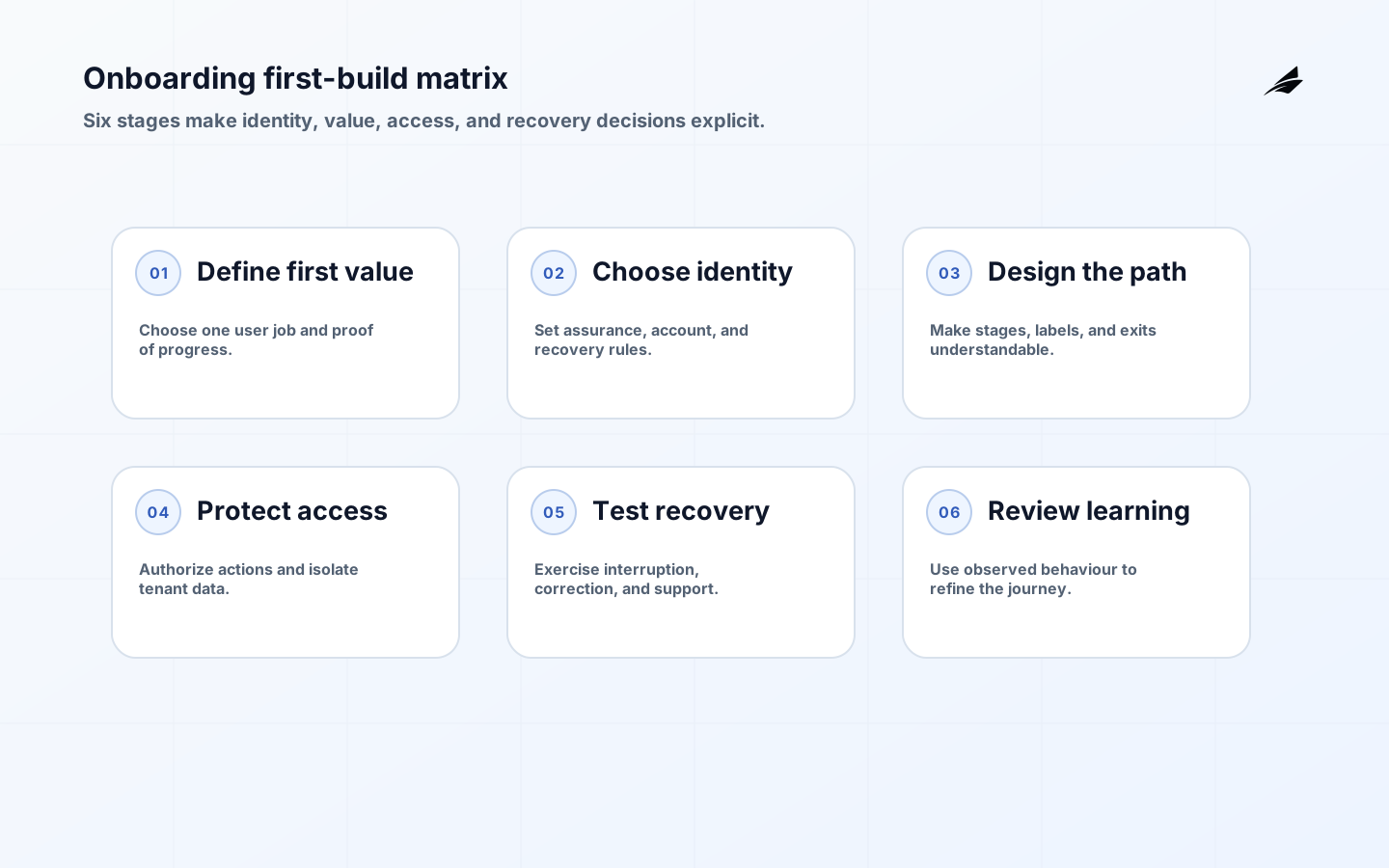
Onboarding flows are often designed as a short sequence of screens: create an account, answer a few questions, invite a teammate, and arrive at a dashboard. The important decisions happen before the first screen. What user job counts as first value? Does the service need identity proofing or only account creation? Who may create a workspace and invite others? Which data is required, and how will it be corrected? What happens when a user leaves halfway through or loses access? NIST’s digital identity guidance separates identity proofing, authentication, and federation, while WCAG 2.2 gives teams a framework for making the interaction perceivable, operable, understandable, and robust. Use those distinctions to choose a small, coherent first build instead of copying a generic wizard.
Choose the first valuable outcome
Describe the first value as a user task with a visible result. “Completed onboarding” is weak; “created the first monitored asset,” “shared a project with a teammate,” or “received a useful report” is testable. Ask what must be true before that result is safe: a verified email, a tenant boundary, an integration, a role, or a consent decision. Keep optional education and profile enrichment after the first value unless they are genuinely required. Research with prospective users and people who perform the surrounding work; the GOV.UK service manual’s user-research guidance is a useful prompt to observe the job rather than designing from internal assumptions. The first build should make the path to value short, but not by hiding a necessary trust or access decision.
| Decision | Narrow first-build choice | Why it matters |
|---|---|---|
| First value | One job with a persisted result | Creates a meaningful activation test |
| Required data | Minimum fields for that job | Reduces abandonment and privacy burden |
| Identity | Assurance tied to consequence | Avoids overbuilding or underprotecting access |
| Workspace | Explicit owner and tenant scope | Prevents accidental data sharing |
| Recovery | Resume, correct, or human route | Protects users who cannot finish in one session |
Choose identity and assurance deliberately
Account creation, authentication, identity proofing, and authorization are different decisions. A low-risk product may need an email or federated login to create a personal account; a service handling sensitive records may need stronger proofing, role assignment, or administrator approval. NIST SP 800-63-4 frames assurance as a risk decision across identity proofing, authentication, and federation and also calls out privacy and customer experience. Choose the least burdensome assurance that protects the actual consequence, then state what happens when a user cannot complete it. Avoid collecting identity evidence simply because a provider makes it available. Retain the minimum, explain purpose and retention, and provide a redress route for a mistaken or failed result.
Design the journey and language before the interface
Write the stages, required inputs, decisions, exits, and recovery paths in plain language. Every field needs a reason, a label, an example or format instruction when necessary, and a useful error. WCAG 2.2 is not a visual polish checklist; it asks whether people can operate the journey, understand what is happening, and use it with different technologies. Decide whether a step can be skipped, whether progress can be saved, and how the service handles back navigation. Use headings and status messages that describe purpose, not internal state names. A user should know whether they created an account, joined a workspace, or merely submitted a request awaiting review.
| Journey element | Decision to make | Acceptance example |
|---|---|---|
| Stage | What must be true before moving on? | Workspace exists and belongs to the user |
| Field | Why is it required and how is it described? | Visible label, format, and correction message |
| Progress | Can the user stop and resume? | Saved stage and clear return path |
| Error | What can the user do next? | Cause, correction, retry, or support option |
| Exit | What does leaving mean? | State is saved, cancelled, or explicitly abandoned |
Protect authorization and tenancy from the start
Decide who may create, join, administer, invite, and view a workspace. Enforce those decisions on the server at every state-changing request. Do not infer authorization from the route, a client-side flag, or the fact that a user passed an earlier step. OWASP’s authentication guidance is a useful reminder to keep authentication, session management, authorization, and recovery explicit. Carry tenant scope through records, queries, events, exports, and support tools. If an invitation can create access, define who may issue it, how it expires, what it grants, and what happens if the recipient already has an account. These choices are easier to test before the first build than after multiple customers share a data model.
Plan interruption and recovery
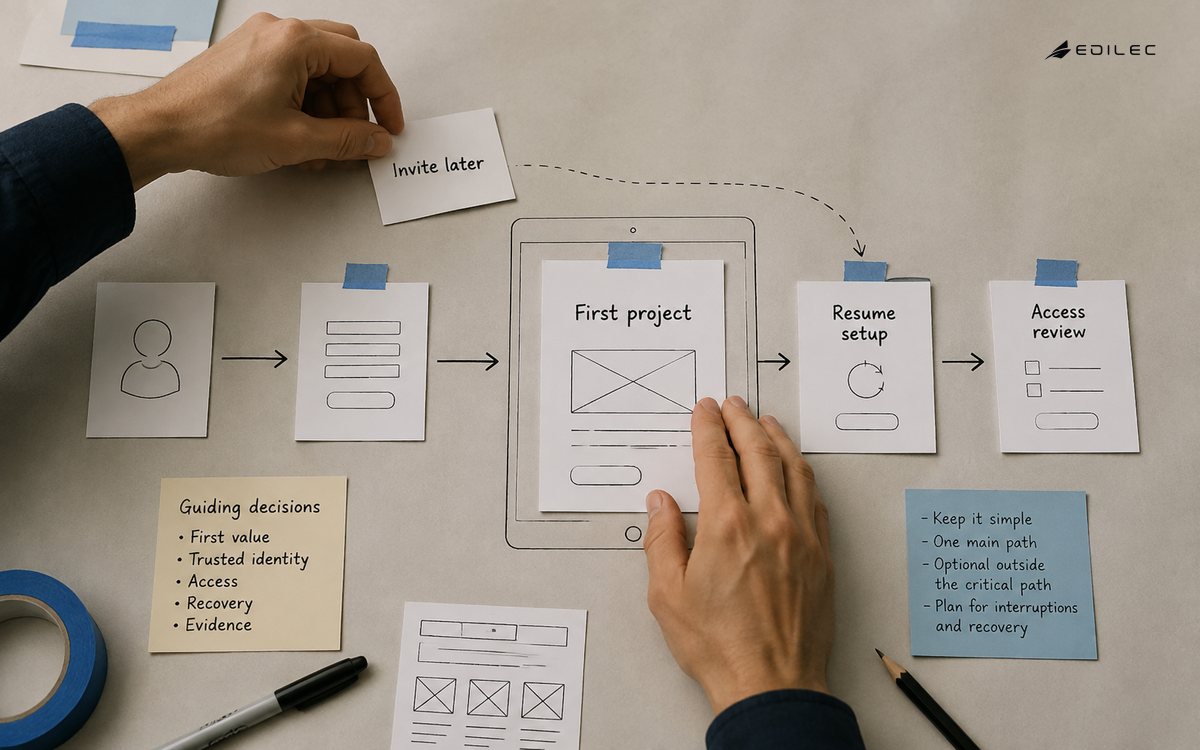
Assume the user closes the browser after a step, loses the network, changes identity provider, receives an expired invitation, or returns after the product’s rules have changed. Define a durable state machine with idempotent transitions, operation identity, expiration, and support visibility. A recovery path should not weaken the original access decision. Let a user retry a safe validation, resume a pending setup, or request a controlled review. If the system cannot determine whether a state-changing action completed, query the authority record before offering the action again. This is where the onboarding production guide becomes a useful next reading: it turns pre-build decisions into operational tests.
Define evidence and learning before implementation
Choose events that explain the journey without turning every field into analytics. Record stage entered, stage completed, outcome, reason, actor or tenant scope, client and flow version, and correlation ID. Separate product learning from security and support logs, and define access and retention for each. Set hypotheses such as “new teams can invite a collaborator after creating a first asset” and measure the result. Observe users completing the job, not only the funnel. If people finish the steps but do not return to the product value, the flow may be optimized for registration rather than activation. Review failed and abandoned paths with support and research participants before adding another step.
Test the smallest useful build
Test the chosen journey with realistic roles, identity states, devices, assistive technologies, interruptions, invalid data, duplicate requests, tenant-boundary attempts, and changed permissions. Use representative content rather than ideal examples. Ask a user to explain what they think will happen before they click. Verify the server rejects unauthorized transitions and that support can understand a blocked state. Test the first value itself: can the user locate it, complete it, and tell whether it succeeded? A diagram, prototype, or feature flag cannot answer every production question, but it can reveal ambiguous language and missing decisions before the data model becomes expensive to change.
A practical trial conversion sequence
- Name the user job, first value, required evidence, and accountable owner.
- Choose identity, authentication, authorization, privacy, and recovery requirements by consequence.
- Write stages, fields, progress, exits, errors, and support routes in plain language.
- Define tenant boundaries, state transitions, operation identities, and audit events.
- Test the journey with users, assistive technology, interruptions, and unauthorized attempts.
- Build only after the team can state what success, uncertainty, and recovery look like.
Turn pre-build choices into acceptance evidence
Add a recovery story to every design decision. If a user cannot verify an identity, what legitimate route exists? If an invitation is sent to the wrong address, who can revoke it? If a workspace is created but the first project fails, can the user resume without losing the useful context? If a role is reduced, which open requests are rechecked? These questions turn a polished prototype into a testable service contract. Include them in usability sessions and technical acceptance, then keep the resulting language in the product. The onboarding field guide for growing teams is helpful when the first build must support several roles without creating separate, incompatible state models. A good first release leaves fewer ambiguous states for support to explain.
Before implementation, ask a representative user to complete the first valuable job while the team observes language, interruptions, uncertainty, and recovery questions. Then ask an engineer to show the state transitions and a security owner to test a cross-tenant or stale-permission attempt. Compare what the user believes happened with what the authoritative records say happened. The gap is often the most important design finding. Use what changes when onboarding moves into production to translate these choices into retry, support, and evidence requirements before the data model hardens. Keep optional questions out of the critical path until the first job is trustworthy.
Write the first-build acceptance record in terms a future team can replay: target role, first value, identity assurance, required fields, stage rules, tenant boundary, access decisions, event names, interruption behaviour, and recovery owner. Include the reason behind each choice and the evidence that would allow a change. This prevents a later request for “more onboarding” from becoming an uncontrolled collection of prompts. It also gives research a sharper question: not whether users like the flow, but whether they can understand and complete the job with the right level of trust and support. Treat disagreement as a boundary to resolve, not as a reason to add a hidden default.
Key takeaways
Before shipping, turn the chosen first build into a reviewable contract. Name the user job, identity assurance, required inputs, durable stages, tenant boundary, allowed transitions, event evidence, and recovery owner. Have a representative user complete the task while the team records uncertainty and language. Have engineering replay interruption and duplicate requests, then have security attempt a stale-permission or cross-tenant action. Compare the user’s understanding with authoritative records and support’s ability to route the exception. Keep optional questions outside the critical path until the core result is trustworthy. Revisit the contract after a material change so “more onboarding” becomes a deliberate decision with evidence, scope, and an accountable owner that another team can understand and safely test.
If the first valuable job leads to a paid plan, record the product outcome separately from the trial entitlement. The trial conversion decisions guide helps teams decide which terms, access, and evidence belong in that handoff.
Use WCAG 2.2 for interaction requirements, NIST SP 800-63-4 for identity assurance and privacy, the OWASP Authentication Cheat Sheet for account and recovery controls, and the GOV.UK user research guidance for observing the real service job.
- First value is a user outcome, not a completed form.
- Choose identity assurance from consequence and privacy, not habit.
- Accessibility, language, state, and recovery belong in the architecture decision.
- Authorize every meaningful action on the server and carry tenant scope explicitly.
- Research the job and test the failure path before expanding the flow.
Frequently asked questions
Is email verification enough for onboarding?
It depends on the consequence. Email verification can establish control of an address, but it does not necessarily prove a person’s identity, organizational role, or authority over a resource. Match the assurance method to the risk and state its limitations.
Should we let users skip onboarding steps?
Let users skip steps that are optional for the first valuable job, while explaining what they will miss and how to return. Do not skip a control needed to protect access, privacy, safety, or the integrity of the outcome.
How much user research is enough before building?
Enough to observe the target job, its language, common interruptions, and the evidence users need to trust progress. A small set of representative sessions can expose more than a large internal workshop if the team watches the real task and tests its assumptions.
Conclusion
The first onboarding build should be a deliberate decision about value, identity, access, language, state, and recovery. Make those choices explicit, test them with real users, and preserve the evidence needed to improve them. The result is a smaller flow with stronger foundations and fewer production surprises.