Product Support Tooling for SaaS Product Engineering: a Practical Guide
Product support tooling is not a feature label; it is the operating decision about whether a support teammate can understand a customer problem and perform a narrowly authorised correction. For engineering teams, the practical standard is a support path that shortens diagnosis without turning support access into an unbounded production back door. Define the allowed evidence, action, owner, and recovery route before release.
Product support tooling: Define the product support tooling decision before implementation.
Write the decision in one sentence before selecting tools: whether a support teammate can understand a customer problem and perform a narrowly authorised correction. Then name the authoritative input as an evidence bundle that joins account identity, tenant scope, request trace, release version, and prior actions.
The difficult case is giving broad database access because the first diagnostic view is incomplete. Design that case deliberately.
| Decision element | Question to settle | Evidence to retain |
|---|---|---|
| Customer promise | What must product support tooling make dependable? | Affected user, expected outcome, and review date |
| Authority | Which record resolves a conflict? | An evidence bundle that joins account identity, tenant scope, request trace, release version, and prior actions |
| Boundary | Where must the rule be enforced? | Role-limited support tools and the backend operations they invoke |
| Recovery | How is a wrong result corrected? | A reversible correction recorded with actor, reason, customer scope, and follow-up owner |
Build evidence and controls into product support tooling
Use guidance as a design prompt, then make the choice testable in your own system. OWASP. ORG/cheatsheets/AuthorizationCheatSheet. HTML) explains a relevant control or operating model, while the OWASP Logging Cheat Sheet is useful for checking a boundary that must not rely on client-side convention.
Operational evidence must be usable under pressure. OpenTelemetry documentation provides a credible basis for treating implementation and verification as part of delivery rather than a later audit. The NIST Secure Software Development Framework is equally useful when the team needs to connect technical events to a real customer outcome.
| Failure mode | Control | Operator signal |
|---|---|---|
| Missing or stale input | Validate freshness and represent uncertainty explicitly | Age of authoritative record |
| Unauthorised operation | Enforce role-limited support tools and the backend operations they invoke at the protected action | Denied decision with actor and reason |
| Duplicate work | Use idempotency and a correlation identifier | One customer effect per request |
| Dependency loss | Choose timeout, fallback, and escalation behavior | Alert linked to customer impact |
Implement a thin, observable product support tooling slice
- State the product support tooling decision and its authority in the delivery brief.
- Assign named owners for product outcome, technical control, and recovery
- Exercise a normal path, a stale-input path, and a denied path with realistic data
- Expose a customer state that explains the next action rather than implying silent success
- Log the correlation identifier, version, and reason for each scoped correction
- Rehearse rollback or containment before expanding the audience
Measure the Product Support Tooling outcome, not activity
Operate Product Support Tooling as a customer commitment
For product support tooling, Roll out visibility before mutation. Give support staff a read-only case view that presents tenant scope, release version, and trace links, then collect the questions it fails to answer. Add one correction at a time, such as resending an invitation or revoking a stuck session, and bind it to a role, approval rule, and audit event. Do not ship a universal “fix account” control. Review the first corrections with support and engineering together; the pattern of repeated actions is usually a signal to improve the product path rather than broaden privileged access.
Review Product Support Tooling operating evidence
A weekly review of support actions should distinguish signal from convenience. Group corrections by action, role, tenant, and originating product version. An action that appears frequently may deserve a safer self-service recovery; one that appears rarely but carries broad scope may need an approval gate. This review is how a support tool remains a carefully bounded operating surface instead of accumulating powerful buttons that nobody can explain or safely revoke.
Key takeaways
- Product Support Tooling needs one explicit customer decision before it needs more workflow.
- Treat an evidence bundle that joins account identity, tenant scope, request trace, release version, and prior actions as inspectable evidence, not a private implementation detail.
- Enforce the rule at role-limited support tools and the backend operations they invoke, including non-UI paths.
- Make a reversible correction recorded with actor, reason, customer scope, and follow-up owner an owned product capability.
- Use outcome and operational signals together before extending the design
Frequently asked questions
What should be built first? Build the smallest path that makes whether a support teammate can understand a customer problem and perform a narrowly authorised correction observable and supportable. Support Tooling Who owns it? Product owns the promise, engineering owns the boundary, and operations or support owns recovery; named people should agree on the same evidence. Support Tooling When is it ready to expand? Expand only after normal, failure, and operator paths have been exercised with realistic data and the outcome can be explained without reconstructing context from memory.
The smallest useful improvement to product support tooling is often a sharper boundary, not another feature.
For product support tooling, test an unexpected load spike before treating the first release as complete. Make product support tooling corrections visible, scoped, and reversible during a practical guide.
A practical example for product support tooling is a customer-visible result remains pending.
Ownership is clearer when product support tooling separates the promise from the mechanism.
For Product Support Tooling, Taking notes and recording user research sessions defines scope; Signals support the control; Production Services Best Practices clarifies evidence.
After a correction, test how the workflow returns to a correct state and how the affected person is informed.
During normal handling, verify permissions, validation, and safe defaults before a state changes. After a correction, retain the source, version, decision, and resulting state so the outcome can be reconstructed.
When a request is denied, measure the customer or operator outcome, exception rate, and recovery effort. During normal handling, retain the source, version, decision, and resulting state so the outcome can be reconstructed.
After a correction, define what the workflow covers, its supported states, and its boundary. During normal handling, test how the workflow returns to a correct state and how the affected person is informed.
When a request is denied, retain the source, version, decision, and resulting state so the outcome can be reconstructed. During normal handling, name the accountable owner and the person who can pause or correct the workflow.
When a request is denied, name the accountable owner and the person who can pause or correct the workflow. During normal handling, measure the customer or operator outcome, exception rate, and recovery effort.
After a correction, name the accountable owner and the person who can pause or correct the workflow.
Test a delayed dependency before treating the first release as complete for product support tooling. Then verify that the documented control still leads to a recoverable state after the delay. After a correction, verify permissions, validation, and safe defaults before a state changes.
During normal handling, define what the workflow covers, its supported states, and its boundary. During normal handling, test how the workflow returns to a correct state and how the affected person is informed. After a permission change, verify permissions, validation, and safe defaults before a state changes.
During normal handling, verify permissions, validation, and safe defaults before a state changes. During normal handling, test how the workflow returns to a correct state and how the affected person is informed. After a permission change, retain the source, version, decision, and resulting state so the outcome can be reconstructed.
Compare a successful support resolution with a boundary case such as a denied export or missing audit record. When an event arrives late, define supported states, ownership, and the point at which the case leaves the workflow.
During normal handling, keep support evidence tied to the current customer state; for any unresolved case, record the next safe action and the owner who can take it.
Conclusion
Good product support tooling turns a difficult decision into ordinary, trustworthy work.
Use Edilec’s admin console guide, customer feedback loop guide and subscription access guide for adjacent decisions.
Product Support Tooling: production decisions that keep the workflow trustworthy
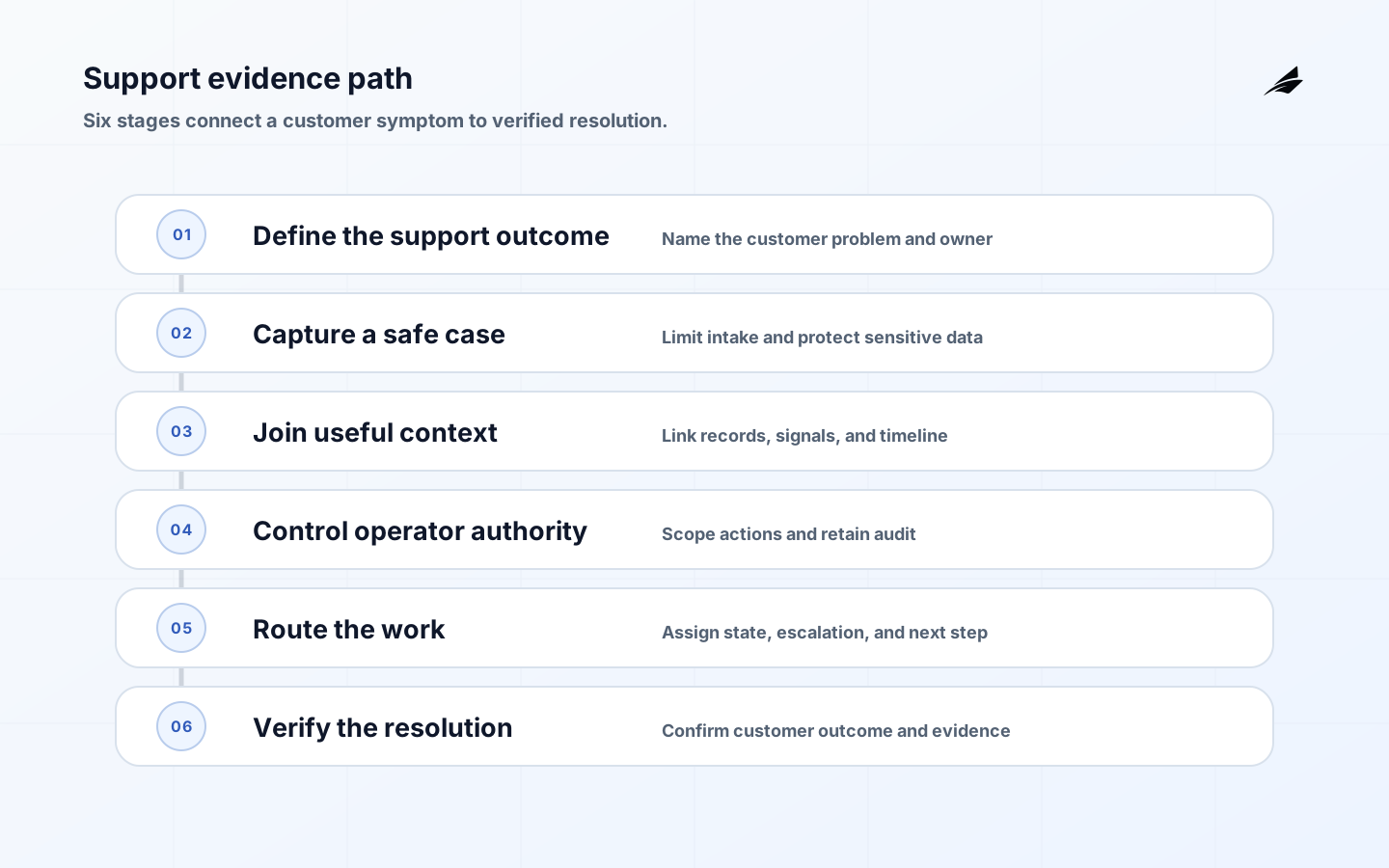
Start with the customer’s job: regain access, complete a transaction, understand a report, recover an integration, or report a risk. Define completion, response expectation, and escalation boundary. “Reduce ticket volume” is not enough because deflection can hide unresolved work.
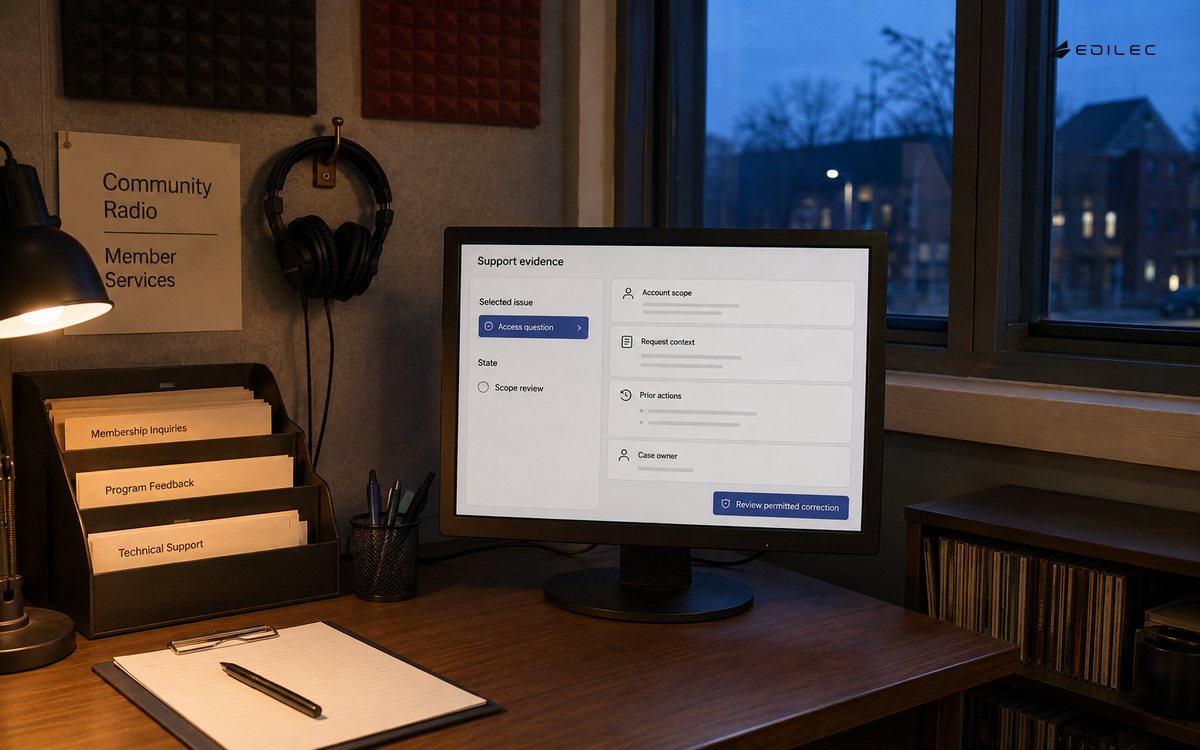
A useful case carries the customer goal, observed behavior, time, affected workspace or resource, expected result, request or event ID, and safe contact route. Ask for no secrets or unnecessary personal information. GitHub’s issue-form guidance shows how field descriptions and routing metadata improve contribution quality.
| Support layer | Purpose | Evidence to preserve |
|---|---|---|
| Intake | Capture problem and goal | Channel, time, role, symptoms |
| Context | Connect case to product state | Workspace, version, request ID |
| Diagnosis | Help test hypotheses | Trace, log, metric, reproduction |
| Action | Show ownership and next step | Assignee, state, severity |
| Resolution | Prove customer can proceed | Verified outcome and message |
Product Support Tooling: controls, evidence, and review
Separate view, diagnose, impersonate, change, export, and delete permissions. Enforce scope by organization, workspace, and role, require reason codes and time-bound elevation, and log who accessed what. NIST’s Privacy Framework treats privacy as risk management across collection, use, sharing, and retention.
Define verified resolution: successful retry, corrected record, confirmed login, delivered event, or accepted explanation. Track reopen rate, repeat contact, time to verified resolution, escalation age, and cases linked to a product or incident decision.
| Access type | Default scope | Review signal |
|---|---|---|
| View | Assigned customer or workspace | Access audit and role review |
| Diagnose | Masked diagnostics for the case | Reason and expiry |
| Impersonate | Time-bound with approval | Session record and customer notice |
| Change | Approved, reversible action | Before-and-after audit |
| Export | Restricted and justified | Download log and retention |
- Name the owner and the failure or exception state.
- Test normal, delayed, duplicate, unauthorized, and recovery paths
- Keep the source, decision, action, and validation evidence together
- Review the workflow on a cadence that matches customer and data risk
Frequently asked questions
Should product support tooling replace the ticketing system?
Not necessarily. Choose one canonical case record and connect other systems to it. The requirement is clear ownership, safe context, routing, and verified closure.
How much telemetry should support agents see?
Show the minimum context needed for the agent’s role, with masked identifiers and restricted escalation for deeper diagnostics.
Conclusion
Product support tooling succeeds when it makes the path from customer problem to verified resolution shorter, safer, and easier to
Evidence for “Product Support Tooling: Customer Evidence to Action” is grounded in Syntax for issue forms, Taking notes and recording user research sessions, NIST Glossary: Data Processing, Signals, Production Services Best Practices; each source informs a specific decision, test, or operating trade-off described in this guide.