What Changes When Pricing Gates Moves into Production
Pricing gates become production engineering when a customer’s subscription, trial, credit balance, usage, or contract changes whether an action is allowed. The gate is therefore an entitlement decision, not a cosmetic upgrade prompt. It needs to produce the same answer across the user interface, API, background job, and support tool, while remaining able to explain a grace period, a plan migration, or a disputed payment. The Stripe entitlements documentation is a helpful model for connecting product access to commercial state without making every application surface invent its own rules.
Set the pricing gates production boundary
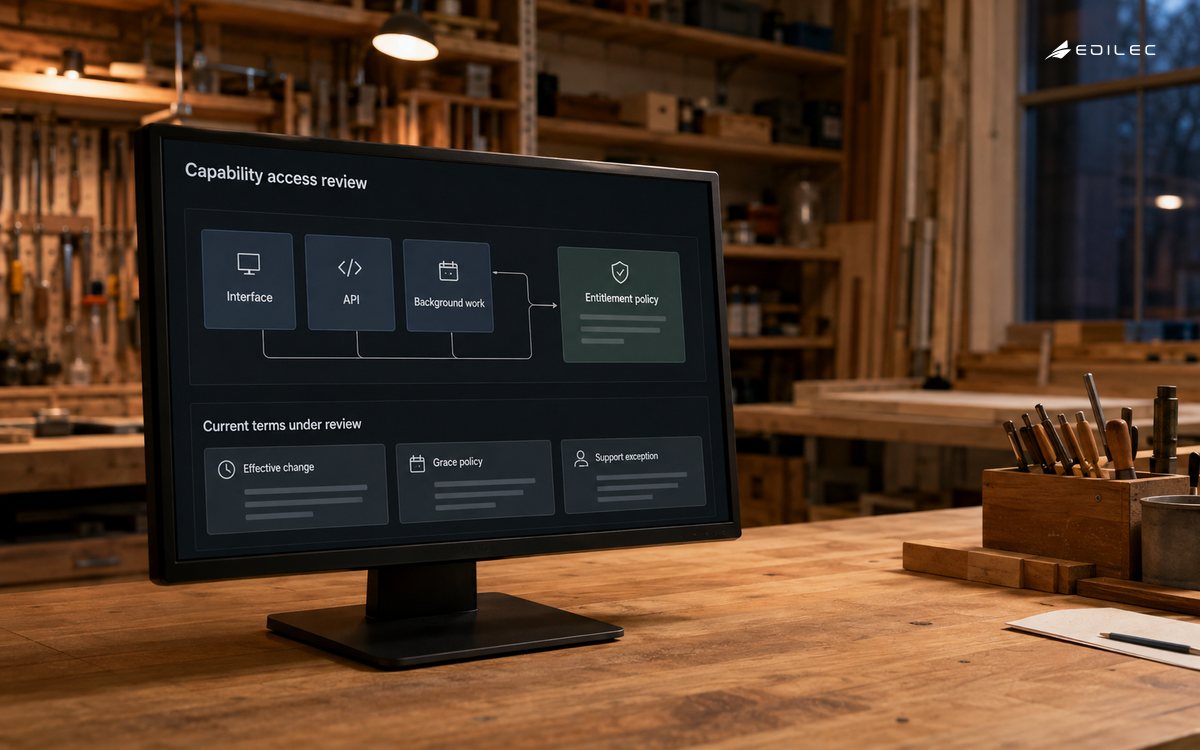
Describe each gated capability in terms of the account, resource, action, limit, and effective time. “Pro plan user” is too vague when one account has many members, a contract has an exception, or a usage limit is calculated asynchronously. Define whether a gate prevents creation, viewing, export, or continued use of an existing resource. Decide how trials, scheduled downgrades, unpaid invoices, promotional credits, and manual grants affect the result. A clear model lets product copy show the right next action without pretending that the interface is the authority.
| Decision | Question to answer | Evidence to retain |
|---|---|---|
| Scope | What account, role, resource, or period does this pricing gate govern? | Stable identifier, effective time, and accountable owner. |
| Authority | Which service provides the fact used by the pricing gate? | Source version, freshness, and reconciliation status. |
| Failure | What happens when the deciding fact is late or disputed | Safe state, user explanation, and escalation route. |
| Exception | Who can override the ordinary pricing gate result? | Purpose, approver, narrow scope, and expiry. |
Write an explicit pricing gates contract
Keep a versioned catalogue of offers and an entitlement resolver that consumes durable billing and usage facts. The resolver should return a decision, reason code, effective period, limit or remaining allowance when appropriate, and reference to the commercial rule version. Cache carefully: a small delay can be acceptable for a non-consequential view, but a server-side action must re-evaluate when stale data could grant or deny a costly capability. The Stripe usage-based billing guide demonstrates why meter ingestion and monitoring are prerequisites for believable usage-based gates.
- Name an accountable owner for the pricing gate decision and its data contract.
- Version the rule or state transition that changes the pricing gate outcome.
- Keep the user-facing explanation tied to a reason the system can reproduce
- Define an expiry and review point for every manual exception
Build controls around the pricing gates decision
Enforce pricing gates at the server action boundary. Client checks improve clarity but cannot protect an API, job, import, or direct integration. Test account switching, concurrent requests at a limit, delayed usage ingestion, plan migration, a cancelled payment, a restored subscription, and a support grant that expires. Restrict who can create exceptions and record purpose, scope, start, end, and approver. The OWASP authorization guidance applies because entitlement configuration and override paths are privileged authorization decisions in their own right.
| Failure mode | Preventive control | Operating signal |
|---|---|---|
| Stale or absent context | Derive scope from a trusted server-side fact. | Decision failures by reason and source. |
| Duplicated work | Use durable identifiers and idempotent processing. | Duplicate suppression and retry outcomes. |
| Unexplained change | Record version, actor, target, and correlation. | Audit completeness and investigation time. |
| Unsafe override | Use narrow, expiring, reviewable exceptions. | Override age and post-expiry activity. |
Implementation decisions for pricing gates
Model a gate as a decision over a capability, not as a page component. The same capability may be invoked from a web screen, mobile client, API, automation, or support workflow. Giving each entry point its own interpretation guarantees drift as plans and exceptions evolve.
Make downgrade behaviour deliberate. Customers can have existing objects above a new limit, queued work, shared resources, or contractual grace. Define what remains readable, what stops accepting new work, how exports behave, and which actions are available to regain compliance. A surprise destructive cleanup is rarely a credible pricing experience.
Review entitlement changes with commercial and support stakeholders before release. The technical change may be small, but the customer impact includes messaging, invoice timing, exception handling, and account-manager commitments. A shared scenario set prevents engineering from enforcing a rule that the business never intended to apply.
Release pricing gates with observable limits
Release a new gate with a cohort map, customer communication, and a reversal plan. First observe how many actions would be affected, then enforce for a bounded group once the data is trusted. Monitor denied-action rate, reason-code distribution, entitlement resolver errors, support contacts, conversion, over-limit usage, and mismatches between billed and enabled capabilities. OpenTelemetry can connect a denied action to the resolver, billing dependency, and customer-facing response so an apparent pricing problem is diagnosable.
Recover without obscuring the pricing gates history
When the commercial facts are unavailable or inconsistent, use a policy that protects both service integrity and customer trust. For a destructive or costly action, a conservative pause with an honest explanation may be right; for a previously enabled core workflow, a documented grace period may be safer. Do not silently make different decisions across channels. Reconcile temporary exceptions and delayed events, then contact affected customers when the outcome changed. Every incident should improve a reason code, data contract, or migration test.
- Keep a support-ready view of the facts behind an affected pricing gate.
- Stop or narrow automated effects before a disputed decision spreads
- Use a corrective action that references the original outcome rather than overwriting it
- For adjacent planning, Use the billing workflow guide to connect pricing decisions with invoice and payment-state handling.
Preflight review for pricing gates
A useful preflight review for pricing gates walks through offer versions, usage limits, grace periods, and manual grants. Review pricing gates in production evidence with product, engineering, and support for moves into production. Keep customer language aligned with the recorded state for pricing gates in production.
Use a scenario table built around a concurrent request arriving as an account reaches its allowance.
The minimum review evidence for this workflow is reason code, effective period, commercial version, and override expiry.
Plan now for a scheduled downgrade and delayed billing evidence.
Key takeaways
- Pricing gates must be owned as a production decision, not left as interface behavior.
- A versioned contract and evidence trail make changes explainable to customers and operators
- Release signals should measure both technical correctness and the user outcome the workflow serves
- Recovery is stronger when exceptions are narrow, attributable, and reconciled
Frequently asked questions
For pricing gates, What is the first production test for pricing gates? Exercise one normal path and one hostile or interrupted path with the same identifiers, then confirm that the result, audit evidence, and user explanation agree. Keep pricing gates in production observable, owned, and recoverable through the next review.
Who should own pricing gates? Product owns the customer decision and success measure; engineering owns the dependable implementation; operations, security, finance, or support own the specialised controls that apply to their part of the workflow. Keep pricing gates in production observable, owned, and recoverable through the next review.
When is a manual override acceptable for pricing gates? Only when its scope, purpose, approver, expiry, and reconciliation action are visible. Keep pricing gates in production observable, owned, and recoverable through the next review.
Trace a pricing gate from decision to entitlement
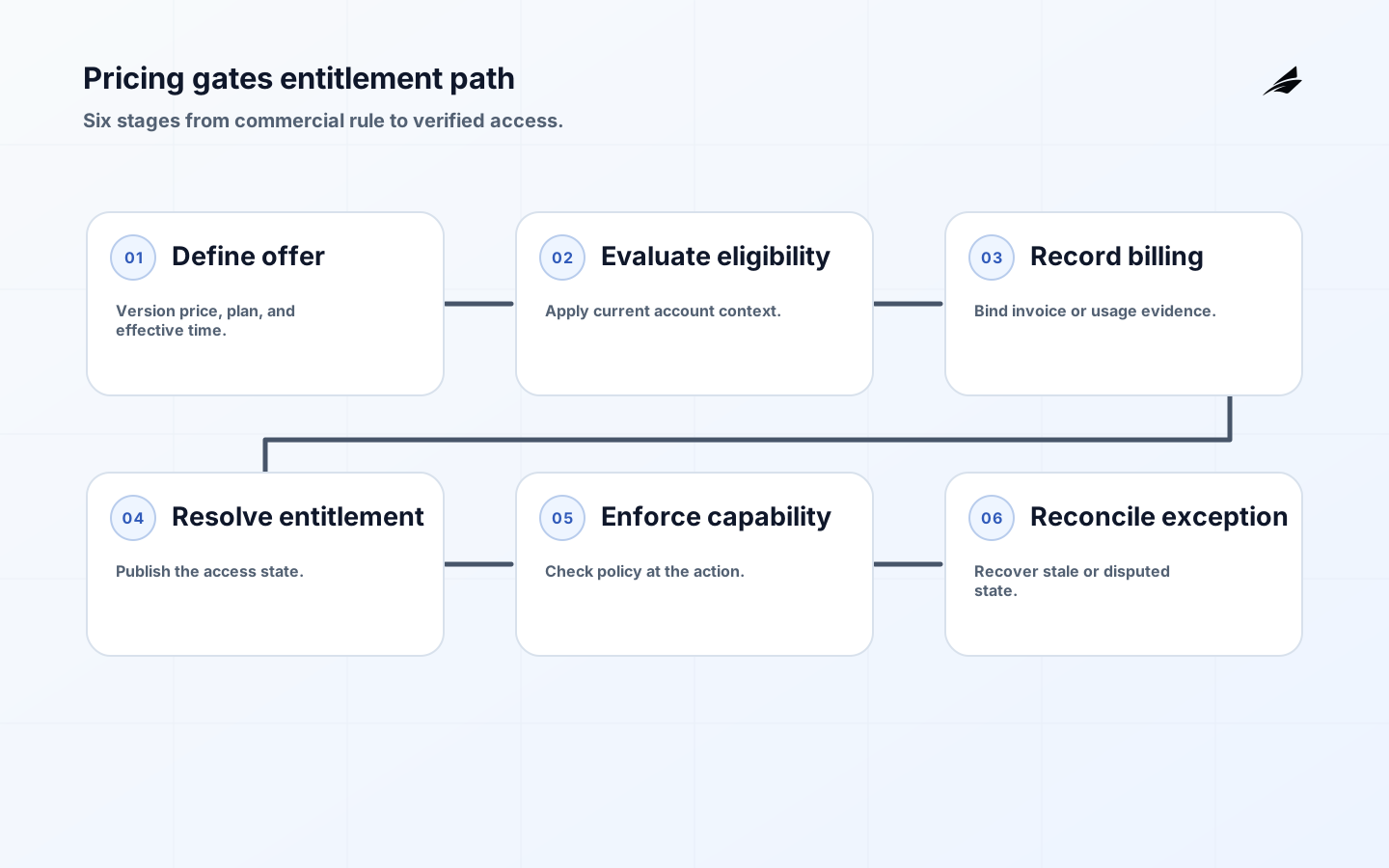
When pricing gates move into production, trace one plan decision end to end: catalog or contract input, evaluated eligibility, checkout or invoice state, entitlement update, application enforcement, and customer explanation. A plan label is not enough. The system must know which price and rule version applied, when it became effective, which usage or seat count was authoritative, and what happens if the payment or entitlement event is delayed.
Test a boundary matrix before widening exposure. Include a new customer, an upgrade, a downgrade, an overdue invoice, a canceled subscription, a usage event at the limit, and an administrator acting on behalf of a workspace. Compare the commercial record with the access result and the message shown to the user. Related controls appear in billing workflows, subscription access control, and usage reporting.
Is a pricing gate the same as authorization?
No. Pricing determines commercial eligibility; authorization still checks identity, role, tenant, resource, and current policy before a protected action.
How should a usage limit behave at the boundary?
Define inclusive or exclusive semantics, rounding, time window, and overage behavior before launch, then show the customer enough evidence to understand the result.
What should happen when entitlement data is stale?
Choose a documented fallback based on consequence, expose a pending or limited state where appropriate, and reconcile before allowing irreversible work.
The smallest useful improvement to pricing gates in production is often a sharper boundary, not another feature. Keep scope, evidence, and recovery visible during normal handling.
For pricing gates in production, test a delayed dependency before treating the first release as complete. Use pricing gates in production support evidence to decide whether the workflow is ready.
A practical example for pricing gates in production is two workers attempt the same transition.
Ownership is clearer when pricing gates in production separates the promise from the mechanism.
A practical example for pricing gates in production is an unexpected load spike. Test a delayed dependency and document the recovery decision.
Separate the commercial promise from entitlement enforcement and assign ownership for catalog rules, billing evidence, authorization, customer messaging, and recovery. The production path should make each handoff observable.
For pricing gates in production, test an incomplete setup before treating the first release as complete.
Use a disputed entitlement or usage-limit decision as the production rehearsal. Trace the plan version, effective period, authoritative usage or seat count, access result, and customer explanation.
In a support review, compare a normal entitlement transition with a delayed downgrade or overdue invoice. Verify that the commercial record, application authorization, customer message, and audit trail agree before widening exposure.
Conclusion
Production pricing gates turn commercial promises into consistent product decisions. They work when the system can enforce an entitlement everywhere
Evidence for “Pricing Gates in Production: What Changes for Engineering Teams” is grounded in Stripe entitlements documentation, Stripe usage-based billing guide, OWASP Authorization Cheat Sheet, OpenTelemetry Observability Primer; each source informs a specific decision, test, or operating trade-off described in this guide.