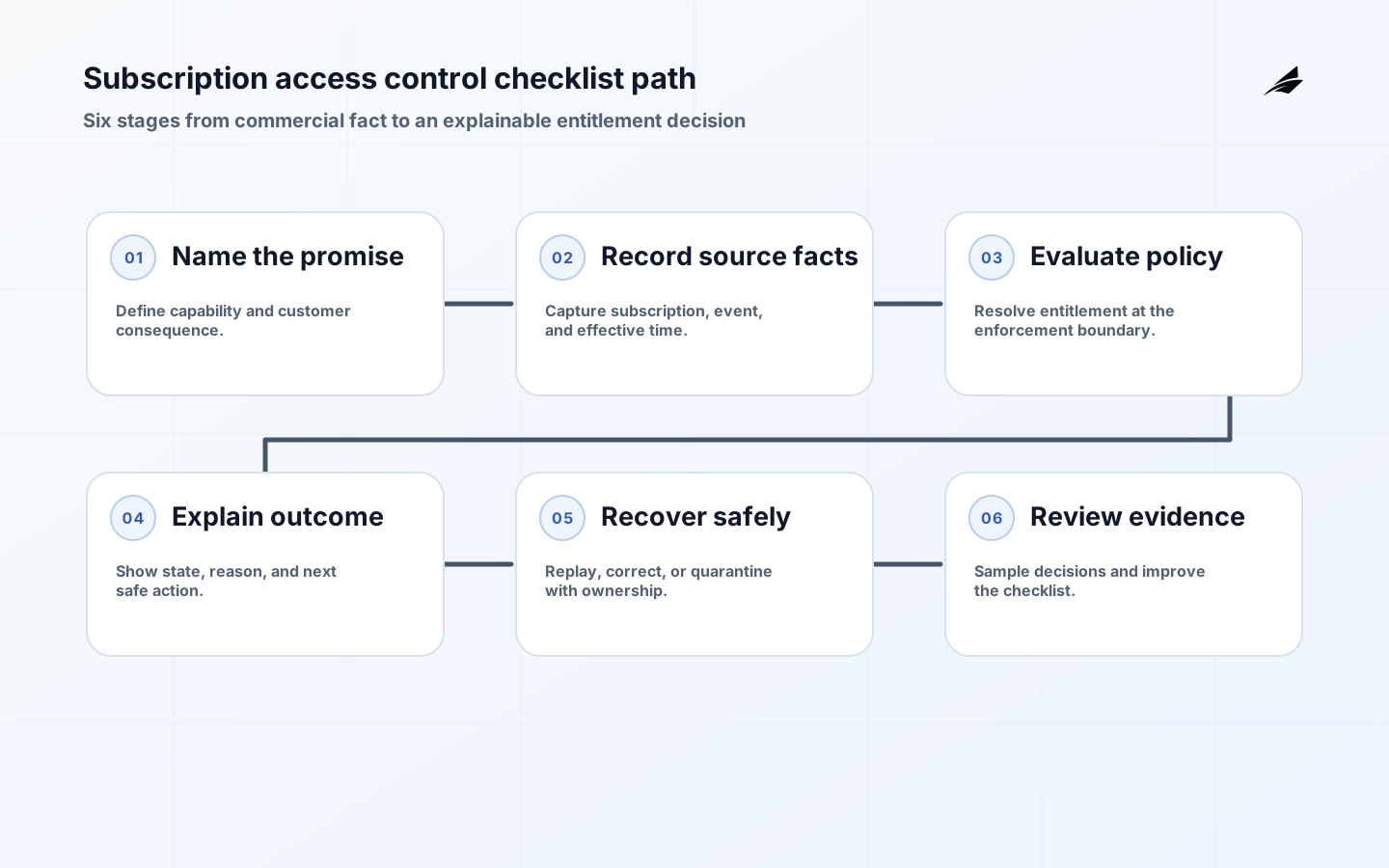
Subscription Access Control Checklist for Reliable Digital Operations
A subscription access control checklist is most useful when it answers a support question as clearly as it answers an engineering question: why did this account receive or lose a capability, and what is the safest next action? The checklist therefore has to follow the decision from billing fact to entitlement, authorization check, customer explanation, and recovery record. For an IT manager, the deliverable is not a pile of controls. It is a small operating contract that teams can test during normal delivery and during a late, duplicated, or disputed subscription event.
Subscription access control checklist for reliable digital operations: Define the subscription access control decision — for reliable digital operations workflow
For subscription access control, define the product rule and the evidence used to explain its result. Relevant objects are account, subscription, entitlement, seat assignment, and authorization decision. Billing events establish commercial state while the application interprets it as product capabilities. Record the state, evidence, and recovery path in the checklist.
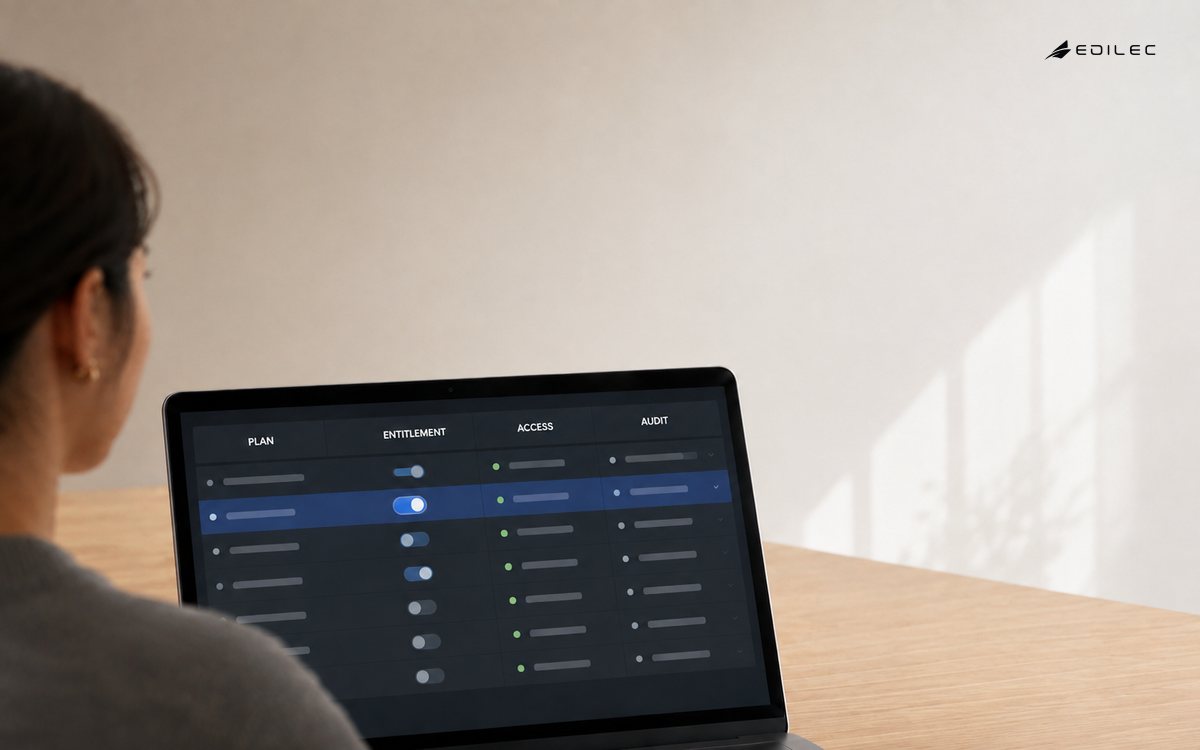
| Question | Design choice | Evidence to retain |
|---|---|---|
| What is decided? | The product rule for subscription access control and the evidence used to explain its result | Policy statement and acceptance examples |
| Which records matter? | Account, subscription, entitlement, seat assignment, and authorization decision | Identifiers, effective times, source ownership |
| Where does it apply? | Billing events establish commercial state while the application interprets it as product capabilities | Request, job, and operator paths |
| How is it corrected? | Named reversible exception path | Actor, reason, approval, expiration |
Model Subscription Access Control states before interfaces
A common failure is a stale client-side plan label decides access after a webhook delay or administrator change.
Build one observable Subscription Access Control path
The practical implementation is to model versioned entitlement bundles, resolve policy server-side, and preserve the event that changed state.
Put Subscription Access Control controls where work happens
For subscription access control, use deny-by-default authorization, short-lived claims, idempotent event handling, and auditable overrides. NIST Secure Software Development Framework is a useful baseline for repeatable development practice. OWASP Authorization Cheat Sheet and RFC 7519: JSON Web Token add protocol and operating detail. Keep the entitlement decision tied to its source event and policy version so support can explain and correct it.
| Control area | Practical check | Failure response |
|---|---|---|
| Policy and ownership | Can a reviewer identify actor and governing rule? | Block change or route to owner |
| Data and context | Does each operation carry required identifier and state | Reject safely and surface repair path |
| Observability | Can support connect a report to a product event? | Create correlation record and escalate |
| Recovery | Has reversal, retry, or rollback been rehearsed? | Use documented recovery and review gap |
Use sources to test Subscription Access Control decisions
For subscription access control, ask whether a reviewer could reproduce the decision from the source record, policy version, and event history.
Make Subscription Access Control evidence available at the point of action
For subscription access control, Operational evidence must travel with the decision: the relevant identifier, effective time, actor, state transition, and any human override.
Measure Subscription Access Control operating signals
Track entitlement latency, denied actions, webhook lag, overrides, and billing/product mismatches. Do not turn every metric into a target immediately. Review individual cases beside aggregate charts.
Roll out Subscription Access Control with customers and operators
That makes subscription access control routine operations rather than a fragile project artifact.
Turn the checklist into a repeatable operating contract
Start with a row for each capability that matters to the customer. Record the commercial trigger, entitlement state, enforcement point, safe fallback, owner, and evidence retained. The same row should drive API tests, support language, and a review query. This avoids the common split in which billing calls an account active while the product uses a stale cache and support sees only a screenshot. The contract should also state how long an intermediate state may remain before an operator is notified.
Use the checklist at three moments: before release, when an event is disputed, and after a correction. Before release, verify that every new capability has an explicit default and a test for a missing or stale entitlement. During a dispute, compare source event, policy version, decision record, and customer-visible state. After correction, record whether the fix was a replay, a policy change, or a manual exception. That classification is more valuable than a generic “resolved” label because it tells the team which part of the system needs improvement.
| Decision point | Required record | Safe review question |
|---|---|---|
| Boundary | Actor, resource, scope, and policy | Can the service decide without guessing? |
| State | Current value, effective time, and source | What does the customer see and why? |
| Recovery | Owner, reason, expiry, and result | Can the team correct or contain it safely? |
Evidence that changes Subscription Access Control
The OWASP Authorization Cheat Sheet supports least privilege, deny-by-default, and checking permissions on every request. RFC 7519 clarifies that a token carries claims but does not make a claim the whole authorization policy. Stripe subscription guidance is useful for lifecycle state, while the NIST SSDF helps place tests, review, and vulnerability response in the delivery process. Apply those references to the exact subscription states your product supports.
For adjacent planning, Compare the SaaS MVP delivery plan, SaaS product development guide, and multi-tenant SaaS architecture guide. Those routes add delivery and tenancy context without replacing the entitlement decision record.
Subscription Access Control: practical questions before rollout
How often should a subscription access control checklist be reviewed?
Review it whenever a plan, entitlement, billing integration, authorization boundary, or support correction path changes. A quarterly sample of real decisions is also useful because stale assumptions often survive ordinary unit tests.
Should an entitlement failure always deny access?
Use a safe result that matches the consequence. A missing permission for a high-risk action should fail closed, while a read-only status page may show a clearly labelled pending state and a recovery route. Document the choice per capability.
What should an operator capture during a manual correction?
Capture the account and entitlement identifiers, source event, policy version, actor, reason, duration, and resulting state. The record should make the correction reversible or at least explain why it cannot be reversed.
Key takeaways
- Subscription access control begins with a stated decision and a boundary between source facts and product policy.
- Related reading: the subscription access control guide connects entitlement policy to production enforcement and reconciliation.
Frequently asked questions
Should billing be the authorization system?
No. Billing publishes commercial facts; the product evaluates them through an entitlement policy that can be tested and explained.
What evidence should expand Subscription Access Control?
For subscription access control, Expand only after representative users complete the intended workflow without unexplained workarounds, operators can investigate and recover a failure, and the observed signal supports the original decision.
Conclusion: make Subscription Access Control explicit
Subscription access control becomes dependable when the product treats it as a decision with a model, owner, evidence trail, and recovery path.
Ownership is clearer when the subscription access control checklist separates the promise from the mechanism. Review its evidence with product, engineering, and support.
Before widening subscription access control, rehearse normal, denied, delayed, and corrected cases. Keep customer language aligned with the recorded state.
During normal handling, confirm the entitlement source, policy version, and customer-visible result. During a recovery drill, verify that a correction is recorded once and can be traced to its owner.
During a recovery drill, verify denied, pending, and restored states against the entitlement record. During normal handling, confirm that authorization uses the current subscription state.
For subscription access control checklist for reliable digital operations, review the for reliable digital operations evidence during normal handling.
A durable operating note for subscription access control records the authoritative source, effective time, permitted actor, protected resource, and recovery route. Review the checklist scope during a recovery drill.
Test a stale event before treating the first release as complete. Review checklist measurement when an event is late.
A practical example for subscription access control checklist for reliable digital operations is an incomplete setup.
For subscription access control checklist for reliable digital operations, review the for reliable digital operations recovery during a recovery drill.
For subscription access control checklist for reliable digital operations, review the for reliable digital operations scope during a support review.
Compare a successful entitlement grant with a changed-permission case. During a dependency failure, verify the last trusted state, record the recovery decision, and prevent an unintended access change.
For subscription access control checklist for reliable digital operations, review the for reliable digital operations scope during normal handling For subscription access control checklist for reliable digital operations, review the for reliable digital operations control during normal handling For subscription access control checklist for reliable digital operations, review the for reliable digital operations measurement during a measured rollout.
Use a recovery drill to test subscription access control. In a support review, confirm who owns the correction and what evidence is retained.
Compare a successful support resolution with a tenant-boundary case. Verify the account, tenant, entitlement, and owner before restoring access.
For subscription access control checklist for reliable digital operations, review the for reliable digital operations control during normal handling For subscription access control checklist for reliable digital operations, review the for reliable digital operations scope during normal handling For subscription access control checklist for reliable digital operations, review the for reliable digital operations scope during a dependency failure.
Use a dependency-failure test to rehearse subscription access control. In a support review, review the measurement and correction path.
Evidence for “Subscription Access Control Checklist for Reliable Digital Operations” is grounded in OWASP Authorization Cheat Sheet, RFC 7519: JSON Web Token, Stripe Billing: Subscriptions Overview, NIST Secure Software Development Framework; each source informs a specific decision, test, or operating trade-off described in this guide.