Product Analytics for SaaS Product Engineering: a Practical Guide
Product analytics is useful when it helps a team make a better product decision, not when it produces a larger event stream. A SaaS team may want to know whether onboarding reaches a first valuable outcome, whether a feature is used by the roles it serves, or where an export workflow fails. Each question needs a definition, a population, a trustworthy event path, and a person who will act on the result. This guide explains how to build product analytics that respects tenant boundaries, avoids misleading proxies, and connects instrumentation to customer outcomes and engineering work.
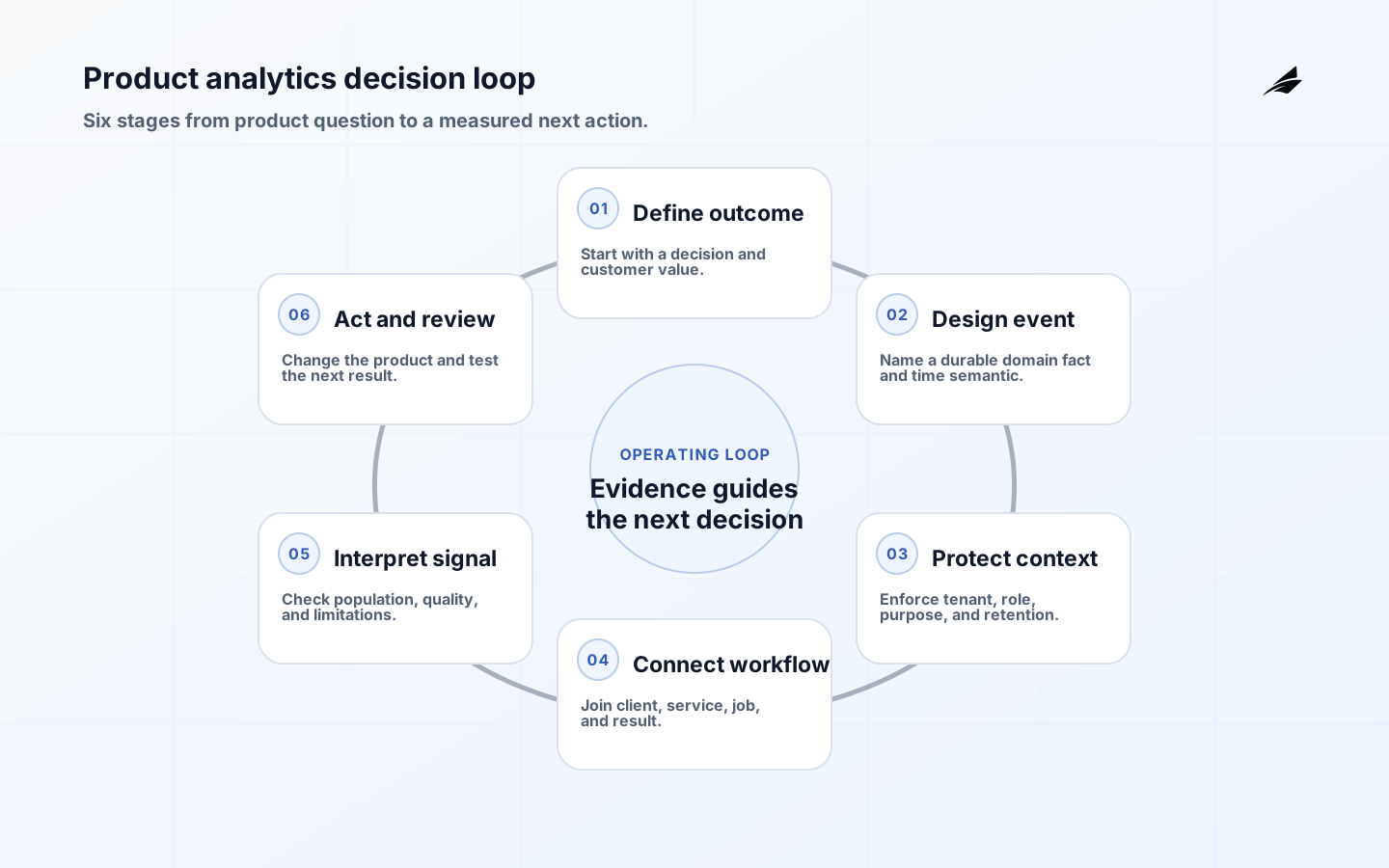
Start with a decision and an outcome
Write the decision before naming the event. “Should we improve the import flow? ” is broad; “should we simplify mapping for teams that abandon after the first validation error? ” is testable. Define the user or account population, the behavior that indicates progress, the failure that matters, the time window, and the action the team will take. Distinguish a product outcome from a proxy such as page view, click, or session length. A useful metric should change what a product or engineering team does and should have an owner who can explain its limitations.

| Analytics element | Question | Decision artifact |
|---|---|---|
| Outcome | What customer value or friction is being studied? | Plain-language definition |
| Population | Which roles, tenants, plans, or period? | Inclusion and exclusion rules |
| Event | What happened and when? | Name, properties, and source |
| Action | What will change if the signal moves? | Owner, threshold, and review date |
Design events as stable product contracts
An event should describe a meaningful domain fact, not a fragile interface detail. “Import validation completed” is more durable than “button clicked. ” Define a stable name, actor, tenant or workspace context, resource identifier, event time, outcome, reason code, and schema version. Document whether the event means an attempt, a successful transition, or a user-visible result. Validate required properties at collection and test a representative client, server, and background path. Keep source events distinct from derived metrics so a later analyst can understand whether a number came from a real transition or an inferred grouping.
| Event quality check | Good practice | Warning sign |
|---|---|---|
| Meaning | Names a domain fact or outcome | Names a screen or CSS action |
| Time | Stores occurrence and processing time | Only ingestion time exists |
| Scope | Carries tenant or workspace context | Context inferred from a dashboard filter |
| Schema | Versioned and validated | Properties change silently |
Protect tenant and user context
Analytics inherits the access obligations of the product. Carry tenant or workspace scope explicitly, enforce it in collection, storage, query, and export, and decide which analysts may see raw versus aggregated data. The OWASP Authorization Cheat Sheet is a useful baseline for server-side authorization and deny-by-default thinking. The NIST Privacy Framework adds a purpose and risk lens: collect what the decision needs, document retention, and give people a correction or inquiry path where appropriate. Do not use analytics as an excuse to copy every customer field into a general-purpose warehouse.
Instrument the complete workflow
A browser event rarely describes the complete outcome. Connect the user action to the server command, asynchronous job, durable state transition, and customer-visible result. Include a correlation ID that can be used by product, support, and engineering without exposing sensitive payloads. Record errors as typed outcomes rather than treating missing success as failure. For an import, useful stages may be initiated, file accepted, validation completed, rows committed, and user notified. That sequence distinguishes a confusing interface from a slow worker or a rejected data contract and helps the team choose a real intervention.
Choose analysis that matches the question
Use funnels when ordered steps matter, cohorts when timing or adoption matters, and segmentation when roles, plans, or product contexts differ. State denominators and exclusions in the metric definition. A rising completion rate can be caused by fewer eligible users, a changed event, or a shortcut that bypasses the intended value. Compare a simple baseline with a new experience and check qualitative cases before deciding. Avoid treating correlation as proof of cause; an experiment, controlled rollout, or carefully chosen comparison may be necessary for a consequential product decision.
Govern the data lifecycle and access
Assign an owner for each important event and metric. Maintain a catalog with definition, source, schema, sensitivity, retention, freshness, known gaps, and downstream uses. Review changes through product, engineering, privacy, and security roles proportionate to risk. The OWASP Logging Cheat Sheet provides practical reminders about useful security events, data minimization, and protecting logs. Treat deletion, correction, sampling, and provider exit as operating workflows. A metric that cannot be corrected or explained is not ready to drive a high-impact decision.
Operate analytics as a product capability
Monitor event volume, schema failures, missing context, processing delay, query freshness, access denials, and cost. OpenTelemetry semantic conventions offer shared naming patterns that can help connect product signals to service telemetry. Review the intended outcome beside data quality. If an event drops, a metric should be marked incomplete rather than quietly showing a clean trend. Put a stop condition on decisions driven by uncertain data and maintain a small set of known-good queries or reports that can be rerun after an instrumentation change.
Validate the metric with a decision review
Before a metric becomes a standing dashboard, ask the owner to use it in a real decision. Can they identify the eligible population, explain a surprising movement, and name the product change that would follow? If not, the event or definition may be interesting but not operationally ready. Keep a short decision record with the interpretation, known limitations, and next review date.
Compare the metric with a handful of actual customer journeys. A funnel may show that users completed setup while support records show they never reached a useful result. A feature may have high usage because the product forces it, not because it creates value. Join quantitative signals to state transitions and feedback without exposing more customer detail than the reviewer needs.
Test data changes as product changes. Rename an event, add a property, change a retry path, or move a job to another service, then inspect the historical trend and downstream queries. Mark breaks and backfill decisions explicitly. A clean-looking chart after a schema change can be more dangerous than an obvious gap because it invites false confidence.
Retire metrics that no longer drive a decision. Remove unused raw fields, reduce retention where appropriate, and tell consumers what replaces the old definition. A smaller, owned catalog is easier to protect and maintain. Product analytics should stay aligned with the questions the team is prepared to answer and the actions it is prepared to take.
Make one person accountable for metric meaning and another, where appropriate, for the data path. The first owner decides whether the signal answers a product question; the second keeps collection, validation, freshness, and access dependable. Both should be present when a schema change or provider change is approved.
Analytics review should also include what the metric cannot tell you. A completion event cannot prove satisfaction, a session cannot prove value, and a missing event cannot prove abandonment. Write those limits beside the definition so future readers do not turn a useful signal into an unsupported claim.
When a metric changes unexpectedly, check the product state, event schema, eligibility population, query logic, and collection health in that order. Ask whether the change reflects customer behavior, a release, a missing event, or a definition change. A short investigation record protects future readers from treating an instrumentation artifact as a product trend.
A practical analytics owner also maintains a “do not infer” list. State which conclusions require qualitative review, an experiment, or a source-system check. This protects the team from turning a convenient proxy into a claim about customer satisfaction, retention, or value without enough evidence.
Keep derived metrics reproducible. Store the definition, source event versions, filters, time zone, and backfill decision with the report or query. When a number is challenged, the owner should be able to show how it was calculated and which customer populations were excluded. Reproducibility is what turns analytics from a persuasive screenshot into usable product evidence.
Key takeaways
- Start with a product decision, customer outcome, population, and owner.
- Design stable domain events with explicit time, scope, outcome, and schema semantics.
- Enforce tenant and role boundaries across collection, storage, analysis, and export.
- Connect client action to server result and background completion before interpreting drop-off.
- For related product journeys, See onboarding flows, usage reporting, and customer feedback loops.
Frequently asked questions
Product analytics: What should product analytics measure first?
Choose one outcome that represents a customer promise and one decision the team can change. Define the eligible population, time window, success and failure conditions, and owner before adding instrumentation. A narrow question makes it possible to test whether the event and metric are actually trustworthy.
How should analytics handle tenant context?
Carry tenant or workspace scope as an explicit, validated property and enforce access in every layer. Separate raw customer-level data from aggregated reporting, document which roles may see each, and test that similar records from two tenants cannot mix in a query, export, or scheduled report.
What makes an event trustworthy?
It has a stable meaning, clear source and time semantics, required properties, schema ownership, privacy review, validation, and a tested downstream use. It should represent a real product fact or outcome rather than a transient interface detail, and its failure or delay should be visible to anyone relying on the metric.
Conclusion: measure decisions you are prepared to improve
Product analytics becomes valuable when its numbers remain connected to a real decision, a real customer context, and a real owner. Define the outcome, instrument the full workflow, protect tenant boundaries, document limits, and operate the data like a product. That discipline produces fewer charts, but better choices.
For product analytics for SaaS product engineering, a good handoff ends with observable evidence. Review scope during normal handling.
The smallest useful improvement to product analytics for saas product engineering is often a sharper boundary, not another feature. Make product analytics corrections visible, scoped, and reversible during a practical guide.
For product analytics for saas product engineering, test an incomplete setup before treating the first release as complete.
This decision also connects to how IT managers should think About Product Analytics, Usage Reporting for SaaS Product Engineering, How Operations Leaders Should Think About Customer Feedback Loops. Review those boundaries together when product analytics for saas product engineering shares identity, data, billing, or support evidence with another workflow.
Evidence for “Product Analytics for SaaS Product Engineering” is grounded in OWASP Authorization Cheat Sheet, OWASP Logging Cheat Sheet, NIST Glossary: Data Processing, OpenTelemetry semantic conventions; each source informs a specific decision, test, or operating trade-off described in this guide.