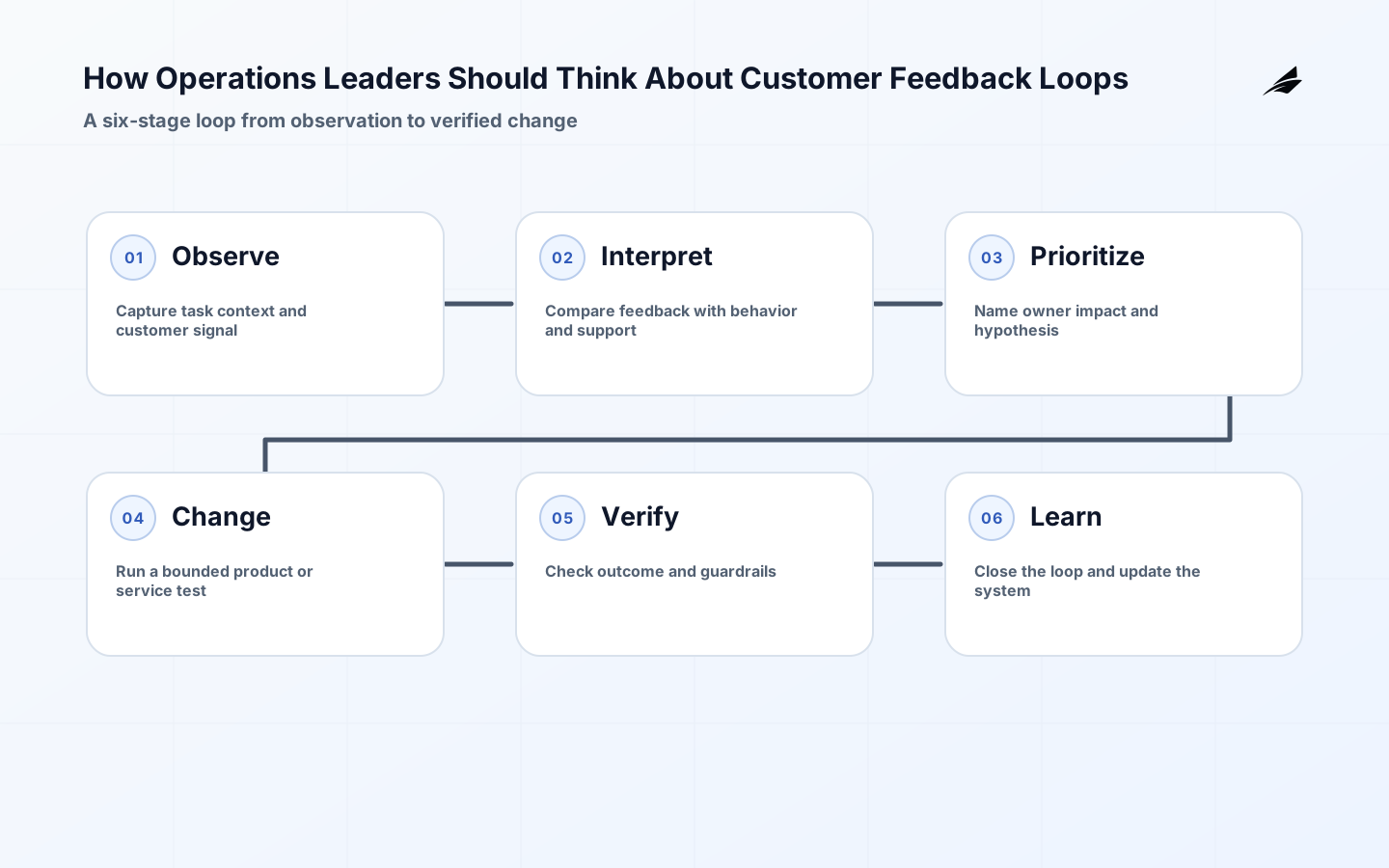
How Operations Leaders Should Think About Customer Feedback Loops
Customer feedback loops become a leadership concern when it changes who can act, what a customer experiences, and how the team explains a result under pressure. For operations leaders, the useful question is not whether a familiar pattern can be installed. It is whether the system makes signal intake, evidence quality, prioritization, response, and learning explicit enough to operate. The target is concrete: customer evidence changes product and operations decisions without becoming an untraceable queue of anecdotes. For this part of the system, name the accountable owner, supporting evidence, exception route, and next measurable check.
Make the customer feedback loops decision explicit
The central decision for customer feedback loops is that feedback is an operating input that needs a route back to the person who can decide or act. Those details make disagreements tractable. The earlier related guide, in-app guidance planning guide, is useful context when the work touches adjacent product operations, but it does not replace a decision record for this specific workflow.
| Decision area | Question to resolve | Evidence to keep |
|---|---|---|
| Authority | Which record can decide customer feedback loops now? | Owner, version, and effective time. |
| Boundary | Where is the rule enforced? | Policy result, actor, target, and reason. |
| Exception | Who may change the normal path? | Approver, expiry, and recovery action. |
| Review | How will drift be detected? | A trend tied to backlog age, repeat contact, theme recurrence, response time, and decision-to-evidence linkage. |
Build a Customer Feedback Loops model people can explain
A practical model for customer feedback loops have three layers: a stable business definition, an enforceable system rule, and an observable operating loop. Combine qualitative reports with product behavior while preserving their different meaning. A support ticket can explain a barrier but cannot prove prevalence; an event trend can show prevalence but may not tell the team why it changed. Give every feedback item a source, affected context, consent or sensitivity marker, owner, disposition, and link to the decision it informed. This prevents a loud request from masquerading as a representative pattern.
Implement the smallest dependable Customer Feedback Loops path
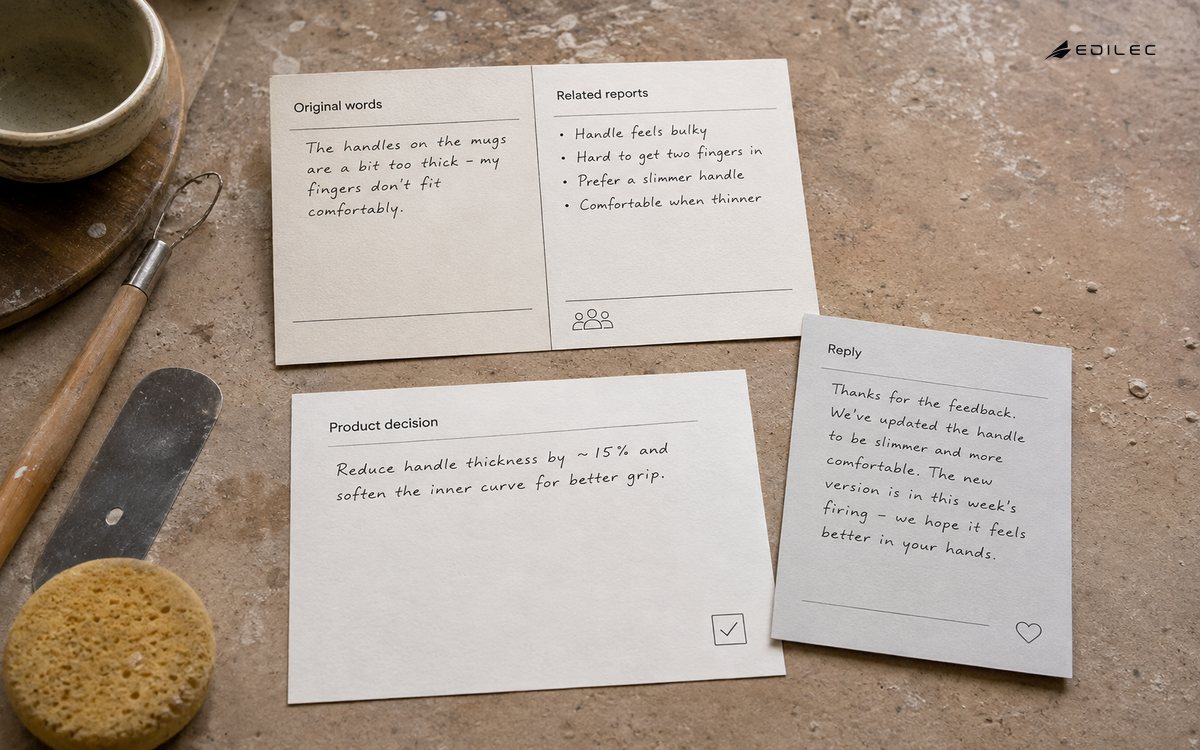
Add automated checks at the boundary where customer feedback loops can cause harm, and keep the customer-visible state aligned with the internal record. Create a consistent intake taxonomy with room for the customer's own words, then route it to discovery, support, defect handling, safety escalation, or account follow-up. Deduplicate related reports without erasing the original evidence. Establish response expectations for urgent harm and ordinary suggestions, and make the handoff visible to the reporting team. When product changes follow feedback, link the release or experiment to the evidence and define what would show the change helped.
- Write the customer feedback loops rule in plain language before encoding it.
- Name the source of truth and the state transition owner.
- Test a normal case, an invalid case, and a recovery case.
- Keep customer-facing status aligned with the authoritative record.
- Assign an expiry or review date to temporary exceptions.
Operate Customer Feedback Loops with evidence, not assumptions
Operating customer feedback loops requires a short, reviewable set of signals instead of a broad dashboard with no decision attached. Monitor backlog age, repeat contact, theme recurrence, response time, and decision-to-evidence linkage. Monitor backlog age, unresolved high-impact reports, repeat contact, response quality, source mix, and the proportion of decisions linked to evidence. Run recurring cross-functional reviews where support, product, engineering, and operations examine a small set of themes with both examples and quantitative context. Close the loop honestly: explain what changed, what did not change, and where more evidence is needed. Acknowledgement is useful, but it is not a substitute for accountable follow-through.
| Signal | What it can reveal | First response |
|---|---|---|
| Unexpected denial or failure | A boundary, context, or data-quality problem. | Inspect the decision record and affected scope. |
| Manual override | A missing path or unclear responsibility. | Require a reason, expiry, and follow-up review. |
| Stale or inconsistent state | A delayed dependency or weak reconciliation. | Compare source evidence and replay safely. |
| Customer confusion | A mismatch between system state and explanation. | Improve the visible state before adding more controls. |
Key takeaways for operations leaders
- Customer feedback loops should have a written business definition and a named owner.
- Enforce consequential decisions where the work happens, not only in the interface.
- Record reasons, effective times, and expiry for exceptional handling.
- Measure quality and recovery as well as completion or conversion.
- Use customer evidence to refine the model after a controlled release.
Customer feedback loops: Frequently asked questions about customer feedback loops — about customer feedback loops workflow
Where should the Customer Feedback Loops team start?
For customer feedback loops, a prototype is only persuasive when it uses representative identities, records, and failure conditions.
Who should own Customer Feedback Loops?
Ownership for customer feedback loops is shared but not vague.
What should trigger a Customer Feedback Loops review?
For customer feedback loops, Investigate when themes are repeatedly discussed but no one can point to the underlying reports, affected segment, decision owner, or response. Preserve the customer's wording and context while separating personal data or sensitive content from broad circulation. Then ask whether the signal is a defect, an onboarding gap, a request for capability, an account-specific configuration issue, or a safety concern with a faster escalation path. Pair themes with behavioral evidence where useful, but do not let a dashboard erase an important qualitative report. When a team declines or defers a request, record why and communicate a truthful status to the customer-facing team. A healthy loop produces fewer recycled debates because each decision links back to evidence, a measurable expected outcome, and a date for revisiting whether the result actually helped.
For customer feedback loops, review the about customer feedback loops control during a delayed handoff.
Within this part of the system, name the accountable owner, supporting evidence, exception route, and next measurable check.
For customer feedback loops, review the about customer feedback loops evidence during normal handling.
When implementing this part of the system, name the accountable owner, supporting evidence, exception route, and next measurable check.
For customer feedback loops, review the about customer feedback loops recovery during a delayed handoff.
For customer feedback loops, review the about customer feedback loops measurement during normal handling.
Before releasing this part of the system, name the accountable owner, supporting evidence, exception route, and next measurable check.
Before changing a customer feedback loop, compare a normal response with a changed-permission or missing-context case. Confirm that the loop still records the customer signal, routes it to an owner, and preserves a recoverable history.
While operating this part of the system, name the accountable owner, supporting evidence, exception route, and next measurable check.
A concrete operating test for how operations leaders should think about customer feedback loops is to rehearse about customer feedback loops during a recovery drill. When changing this part of the system, name the accountable owner, supporting evidence, exception route, and next measurable check.
In a support review, trace one feedback item from collection to triage and action. Check that the source, decision, owner, and correction are recorded so the loop remains useful after an exception.
During support for this part of the system, name the accountable owner, supporting evidence, exception route, and next measurable check.
Conclusion
Customer feedback loops earn trust when a customer, operator, and engineer can reach the same explanation of what happened and what should happen next. The result is not bureaucracy. Before changing a roadmap because a theme is loud, inspect a small, representative evidence packet: the original customer reports, affected contexts, relevant behavior data, support effort, and an owner who can respond. After release, revisit the same packet to learn whether the change reduced the underlying friction rather than simply moving it to another channel.
Choose one recurring theme each review cycle and follow it from intake to decision to customer response. Look for missing context, unnecessary collection, ownership gaps, and outcomes that were never measured. The exercise turns feedback operations into a learning practice instead of a repository of well-intentioned notes that cannot reliably influence the work.
Sources for customer feedback loops
- NIST Privacy Framework
- W3C Forms Tutorial
- W3C supportive forms pattern
- OpenTelemetry semantic conventions
Define the decision the loop serves
A customer feedback loop is not a mailbox with a sentiment score. It is a controlled path from an observed customer experience to a decision, a change, and evidence about the result. Start with the question the team needs to answer: why users abandon setup, which report is misunderstood, or whether support work is reducing a recurring failure? GOV. UK guidance on measuring success recommends combining performance metrics with user research and other operational data.
| Loop stage | Decision to make | Evidence |
|---|---|---|
| Observe | What happened and to whom? | Task, segment, channel, timestamp |
| Interpret | What pattern is credible? | Feedback plus behavior and support data |
| Act | What change is safe to try? | Owner, hypothesis, and scope |
| Verify | Did the outcome improve? | Before-and-after result |
| Learn | What should change in the system? | Decision record and next test |
Capture context without turning every interaction into surveillance. Record the task, product state, channel, account or workspace scope where necessary, and a reference to the feedback item. Avoid collecting free-form personal details unless the team has a clear use and retention rule. Separate identity needed for follow-up from the content used for aggregate learning.
Sample the whole experience
The GOV. UK user satisfaction guidance recommends gathering feedback at different stages, including when people drop out and at the true end point of a service. Apply that idea to product workflows. Ask after a meaningful outcome, inspect abandonment, and include assisted or support-mediated paths. Do not infer satisfaction from an intermediate thumbs-up when the customer later receives a failed export or unexpected invoice.
Combine structured signals with conversation. Completion rate can show where a task stops, support tickets reveal customer language, and open-ended responses explain cause. Tag themes with a small, versioned taxonomy and keep original context available to reviewers. Do not let a sentiment classifier decide priority without an owner checking evidence and impact.
Give operations a working model
The GOV. UK user support guidance treats support as an input to service improvement rather than an isolated reaction function. Route feedback to a team that can act, set a response expectation, and close the loop with the customer when a change or explanation is available. A queue needs ownership, status, duplicate handling, privacy controls, and escalation for safety, security, billing, or access issues.
Instrument the transition from feedback to change. The OpenTelemetry observability primer can inform the technical side: metrics measure volume and outcomes, traces connect a report to the affected workflow, and structured logs preserve a decision. Do not expose private feedback in broad telemetry. A compact evidence packet is enough for a reviewer to understand the case and verify the next release.
Review the loop honestly
At each review, ask whether the sample represents affected customers, whether the change addressed the cause rather than the wording, and whether guardrails moved. Track recurrence, resolution time, reopen rate, task completion, and customer-confirmed improvement. Close the loop when the team changes the product, changes the explanation, routes the issue elsewhere, or decides that evidence is insufficient. For adjacent operating context, compare Customer Feedback Loops: Operations Playbook, How Product Teams Should Think About Trial Conversion, and In-app Guidance Planning: A Hands-on Product Guide.
Evidence for “How Operations Leaders Should Think About Customer Feedback Loops” is grounded in Measuring success, Measuring user satisfaction, Set up and manage user support, Observability primer; each source informs a specific decision, test, or operating trade-off described in this guide.