What Changes When Product Analytics Moves into Production: A Reliability Guide
Product analytics changes character when it enters production. Events begin to influence onboarding, pricing, roadmap, support, and release decisions, so a missing or ambiguous event can create real customer and business consequences. Production analytics therefore needs a contract: what happened, when it happened, who or what produced it, which properties are allowed, how it is versioned, and which decisions it can support. This guide treats the event stream as a governed product surface that must remain useful, privacy-aware, accessible, and diagnosable under change.
Set the product analytics production boundary
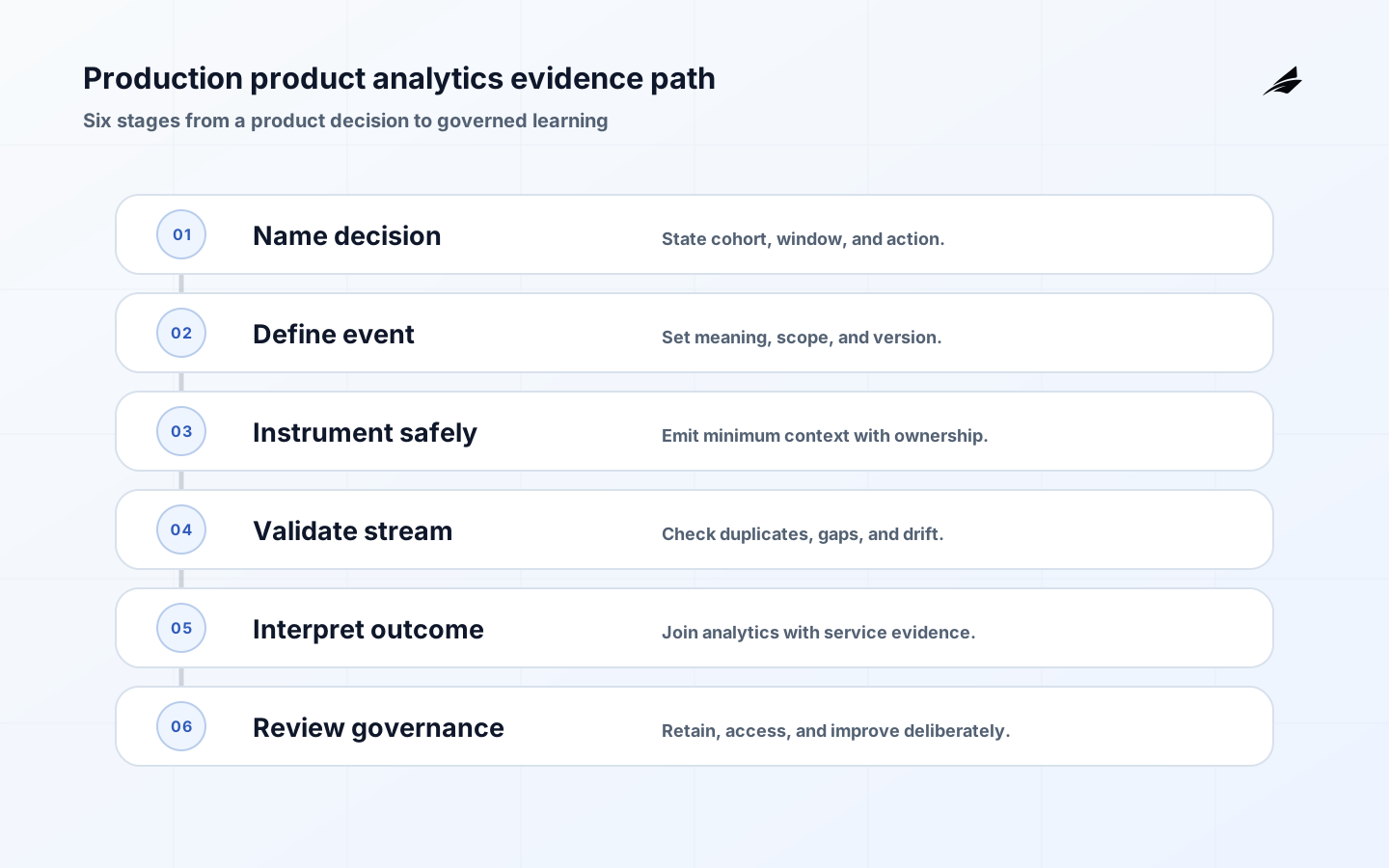
Start with a decision register. For example, “should we simplify team invitation? ” needs a task definition, affected cohorts, expected behavioural change, and a timeframe before it needs a dashboard. Define an event contract with name, version, occurrence rule, event time, actor or account reference, permitted properties, and producer. Versioning matters when an old client remains in the field after a new release. Attach data retention and access rules to the contract rather than treating analytics as exempt from normal governance.

| Decision | Question to answer | Evidence to retain |
|---|---|---|
| Scope | What account, role, resource, or period does this analytics event govern? | Stable identifier, effective time, and accountable owner. |
| Authority | Which service provides the fact used by the analytics event? | Source version, freshness, and reconciliation status. |
| Failure | What happens when the deciding fact is late or disputed? This creates a concrete recovery and review path for product analytics in production. | Safe state, user explanation, and escalation route. |
| Exception | Who can override the ordinary analytics event result? | Purpose, approver, narrow scope, and expiry. |
Write an explicit product analytics contract
Collect the minimum context needed to explain the decision. A stable account or workspace reference can be more useful than a raw person identifier; free text and sensitive fields often create risk without improving interpretation. Accessibility also matters: an interface may be technically visible but unusable with a keyboard or assistive technology, so a completion event alone cannot prove a task is equitable. The W3C WCAG 2.2 recommendation is a valuable companion when designing both the journey and the research around it.
- Name an accountable owner for the analytics event decision and its data contract.
- Version the rule or state transition that changes the analytics event outcome.
- Keep the user-facing explanation tied to a reason the system can reproduce. In this context, product analytics in production needs its own decision record.
- Define an expiry and review point for every manual exception. In this context, product analytics in production needs its own decision record.
Build controls around the product analytics decision
Validate semantics in code review and in production. Schema checks catch missing properties; reconciliation against server-side facts catches duplicate client events; distribution checks reveal sudden changes after a release. Instrument consent or collection state where applicable, and restrict raw-event access by role and purpose. Logs and analytics should not become a convenient archive of secrets or customer content. The OWASP Logging Cheat Sheet provides practical guardrails for deciding what event evidence belongs in operational records.
| Failure mode | Preventive control | Operating signal |
|---|---|---|
| Stale or absent context | Derive scope from a trusted server-side fact. | Decision failures by reason and source. |
| Duplicated work | Use durable identifiers and idempotent processing. | Duplicate suppression and retry outcomes. |
| Unexplained change | Record version, actor, target, and correlation. | Audit completeness and investigation time. |
| Unsafe override | Use narrow, expiring, reviewable exceptions. | Override age and post-expiry activity. |
Implementation decisions for product analytics
Attach an analyst-facing glossary to each important metric. It should state the unit, inclusion rules, owner, source tables or events, known caveats, and examples that clarify edge cases. The glossary avoids the common meeting where two teams agree on a metric name but compare different populations or time windows.
Use a small set of synthetic accounts and scripted journeys to test the telemetry pipeline. Their expected events, properties, and totals can be asserted after deployments without exposing customer data. When those fixtures fail, the team has a concrete regression to investigate instead of arguing from a dashboard trend.
Treat interpretation as a review practice, not a chart-rendering task. Pair product measures with qualitative research, support cases, accessibility evidence, and release notes. That context can show whether a falling completion rate reflects a defect, an intentional change in eligibility, seasonal demand, or an instrumentation break.
Release product analytics with observable limits
Treat a new event schema as a change that needs a migration window. Publish the contract, test it with known scenarios, deploy a small cohort where possible, and compare old and new measures before switching a business report. Monitor producer coverage, required-property completeness, duplicate rate, late-event distribution, and correlation with deployment versions. The GOV.UK performance guidance reinforces a useful discipline: measurements should help a service team improve a real outcome, not simply accumulate reporting.
Recover without obscuring the product analytics history
When data quality is suspect, label the affected period and stop automated decisions that depend on it. Backfills must identify source, transformation version, and uncertainty; they are not a license to silently rewrite history. Use issue reviews to improve event definitions, tests, and ownership. Retire events and properties when their decision has ended, because a smaller, trusted catalogue is easier to secure and interpret than an ever-growing stream.
- Keep a support-ready view of the facts behind an affected analytics event.
- Stop or narrow automated effects before a disputed decision spreads. For product analytics in production, a delayed result should remain distinguishable from a denial.
- Use a corrective action that references the original outcome rather than overwriting it. For product analytics in production, a delayed result should remain distinguishable from a denial.
- For related planning, see the related product analytics for SaaS product engineering: a practical guide. During review, treat a delayed result as distinct from a denial, and record the observed state before the owner chooses the next action.
Preflight review for product analytics
A useful preflight review for product analytics walks through event schemas, client producers, server facts, and reporting models. Keep customer language aligned with the recorded state, name the decision boundary and its owner, test normal, delayed, denied, and corrected cases, and preserve the state, evidence, and recovery path.
Use a scenario table built around a new client release emitting a changed property shape.
The minimum review evidence for this workflow is schema coverage, duplicate rate, and late-event distribution. This creates a concrete recovery and review path.
Plan now for consent changes and a backfill of historical measures.
Make event meaning testable before dashboards
Begin with a decision register rather than a dashboard request. Name the decision, cohort, expected change, observation window, and action threshold. Then define the smallest event contract that can answer it. “Invitation submitted” is different from “invitation accepted”; “screen rendered” is different from “task completed. ” Include event name, version, producer, occurrence rule, account or workspace scope, permitted properties, retention, and owner. A contract makes instrumentation reviewable in code and in data quality checks.
Production reliability also depends on what happens when a client is old, a network request is retried, consent changes, or an event arrives out of order. Use a stable event identity where deduplication matters, preserve event time and received time, and expose ingestion gaps rather than filling them with invented zeros. Sample traces and logs can connect a suspicious metric to a release or request, while a data-quality report should identify missing producers and schema drift. That is more useful than watching a single funnel percentage move.
| Decision point | Required record | Safe review question |
|---|---|---|
| Boundary | Actor, resource, scope, and policy | Can the service decide without guessing? |
| State | Current value, effective time, and source | What does the customer see and why? |
| Recovery | Owner, reason, expiry, and result | Can the team correct or contain it safely? |
Evidence that changes Product Analytics Moves into Production
OpenTelemetry documentation provides a shared vocabulary for signals and context. The GOV.UK Service Manual guidance on measuring success emphasizes measures tied to service outcomes rather than activity alone. WCAG 2.2 helps teams test whether a journey is usable, not merely clicked, and the OWASP Logging Cheat Sheet helps design useful, controlled evidence. Together they support analytics that can explain decisions without collecting everything.
For adjacent planning, Read the product analytics practical guide, roadmap systems guide, and usage reporting production guide. These links connect event meaning to planning, delivery, and customer-facing reporting.
Product Analytics Moves into Production: practical questions before rollout
How many product analytics events should a team define?
Define the smallest set needed to answer named decisions and verify the user journey. More events are not automatically more insight; ambiguous or duplicated events increase interpretation and governance cost.
Should analytics use user IDs everywhere?
Use the least identifying scope that supports the decision, such as account or workspace where appropriate. Document retention, access, consent, and the reason each property is needed.
How should a team detect production analytics drift?
Validate event schemas in tests, compare observed producers with the contract, monitor missing and late events, and review changes alongside releases. Sample raw events when an aggregate moves unexpectedly.
Key takeaways
- Product analytics must be owned as a production decision, not left as interface behavior.
- A versioned contract and evidence trail make changes explainable to customers and operators. Apply the rule to product analytics in production before widening the rollout.
- Release signals should measure both technical correctness and the user outcome the workflow serves. Apply the rule to product analytics in production before widening the rollout.
- Recovery is stronger when exceptions are narrow, attributable, and reconciled. Apply the rule to product analytics in production before widening the rollout.
Frequently asked questions
For product analytics, the first production test should exercise one normal path and one hostile or interrupted path with the same identifiers, then confirm that the result, audit evidence, and user explanation agree.
Who should own product analytics? Product owns the customer decision and success measure; engineering owns the dependable implementation; operations, security, finance, or support own the specialised controls that apply to their part of the workflow.
When is a manual override acceptable for product analytics? Only when its scope, purpose, approver, expiry, and reconciliation action are visible. A permanent informal bypass is a missing product analytics rule, not a reliable operating practice.
For product analytics in production, test an unexpected load spike before treating the first release as complete. Review ownership during a support review.
Conclusion
Production product analytics is evidence design. Teams get better decisions when events have explicit meaning, limited purpose, known quality, and
Evidence for “When Product Analytics Moves into Production” is grounded in OpenTelemetry Observability Primer, GOV.UK Service Manual: measure success, W3C Web Content Accessibility Guidelines 2.2, OWASP Logging Cheat Sheet; each source informs a specific decision, test, or operating trade-off described in this guide.