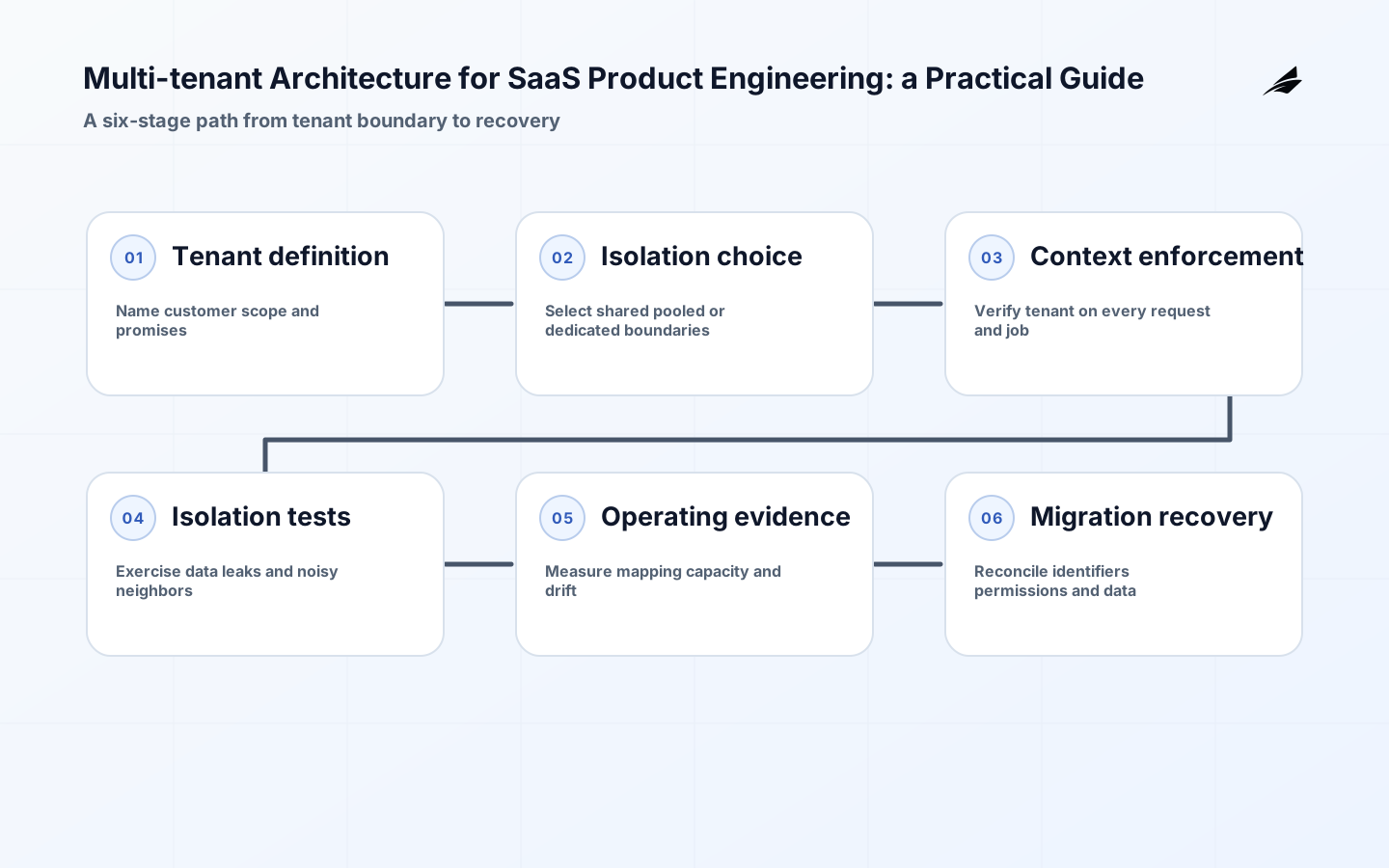
Multi-tenant Architecture: A Practical SaaS Engineering Guide
Multi-tenant architecture is not a feature label or a vendor setting. It is a product-engineering decision system that coordinates tenant context, resource ownership, and policy enforcement. For multi-tenant architecture, name the decision boundary and its owner. This guide treats multi-tenant architecture as a controlled workflow that has to survive real product use.
Multi-tenant architecture: Define the architecture decision with evidence for an engineering workflow.
For multi-tenant architecture, the relevant facts are tenant identity, membership, action, resource, and policy version. Put an owner and effective time beside each fact.
| Decision area | Question to settle | Evidence to retain |
|---|---|---|
| Authority | Which record decides the multi-tenant architecture outcome now? | Owner, version, source identifier, and effective time. |
| Scope | Who, which account, and which resource are affected? | Actor or system, target, environment, and correlation key. |
| Failure | What happens when data is late, absent, or inconsistent? | Safe state, visible explanation, retry path, and escalation owner. |
| Exception | Who can override the normal result? | Purpose, approver, narrow scope, expiry, and reversal action. |
Model Multi-tenant Architecture facts and transitions
For multi-tenant architecture, map the normal progression, cancellation or removal, retry, reconciliation, and manual correction paths.
Review multi-tenant architecture design choices
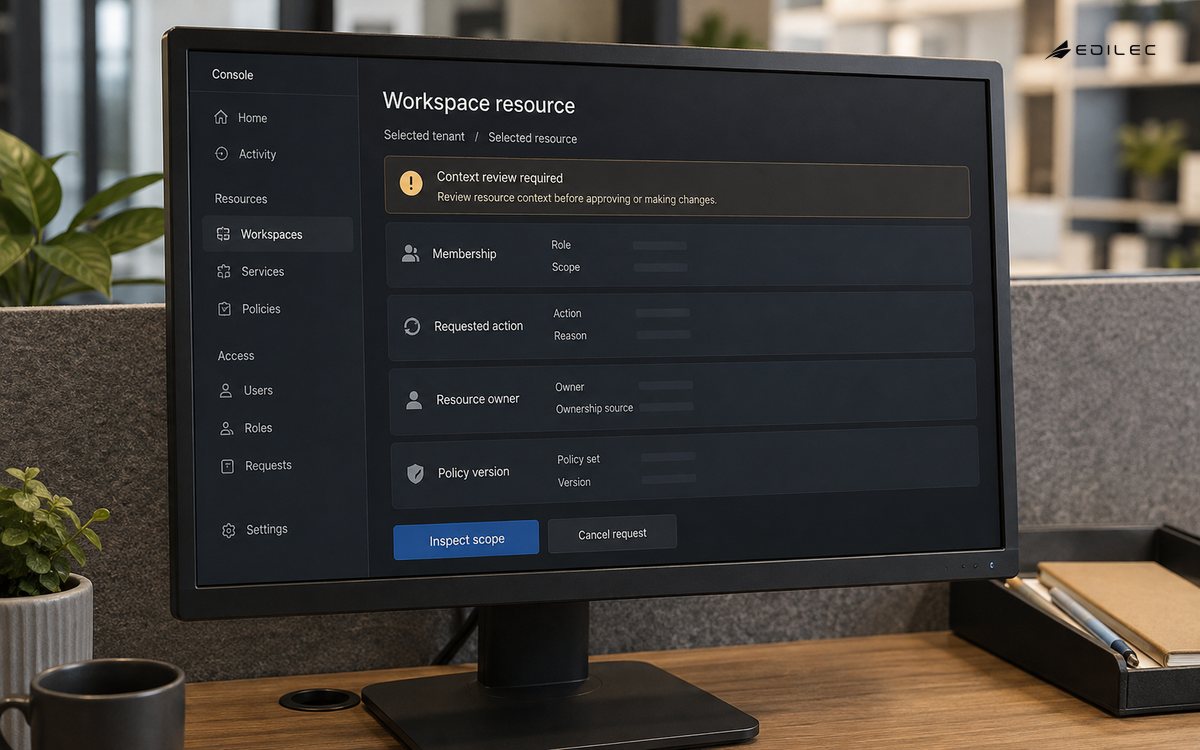
For multi-tenant architecture, Trace the tenant claim from sign-in through the API gateway, domain service, query predicate, object key, queue message, and audit record. The review should ask where a caller can substitute an identifier, where a process runs without a user session, and whether a cache or search index can return a result outside the active scope. The answer should be a concrete control at each boundary, not a promise that every developer will remember a convention.
Capacity is also an isolation concern. Record which resources are pooled, how noisy-neighbour pressure is measured, and which tenant-specific limits or tiers are available. A system that preserves confidentiality but lets one tenant exhaust a shared queue is still failing the product boundary. Discuss containment alongside recovery: rate limiting, back-pressure, targeted pause, and a way to prove the affected tenant was not silently charged for failed work.
A change review should include migrations and support operations. Adding a tenant column to new tables does not repair old exports, analytics datasets, service accounts, or snapshots. Inventory those paths and give each one a scope mechanism. When a migration backfills data, make its tenant selection and completion evidence reviewable. This is particularly important when a repair tool is run by a privileged human under time pressure.
Customer-facing language should accurately describe the boundary without making unsupported absolutes. Explain which organization is active, how switching works, and what a user should do after an unexpected denial. Support staff need a separate explanation of the diagnostic evidence they may consult. That clarity reduces the temptation to use broad impersonation or database access as the first response.
Implement one narrow Multi-tenant Architecture path
Do not record credentials or unrelated personal data. In a multi-tenant implementation, make the scoped data-access method the easy default, then prohibit unscoped methods in code review and automated tests. Review the non-obvious paths: search documents, generated files, scheduled reports, maintenance commands, and incident scripts. A good boundary still holds when a person is authenticated, a queue is retried, or a service is invoked without a browser session.
- Write multi-tenant architecture rules in plain language before encoding them.
- Attach an effective time and accountable owner to every state transition.
- Make the consequential server-side boundary enforce the decision.
- Give manual corrections a narrow scope, approver, expiry, and audit record.
- Keep the customer-visible state aligned with the authoritative record.
Verify Multi-tenant Architecture adverse and recovery cases
Use a two-tenant negative test suite across APIs, queues, storage, search, and exports.
| Scenario | Expected behavior | Review signal |
|---|---|---|
| Normal request | The decision follows the current authoritative record. | Outcome, scope, rule or version, and correlation identifier. |
| Delayed or duplicate input | Processing converges without repeating the business effect. | Suppression or reconciliation record tied to the source event. |
| Missing prerequisite | The system uses the documented safe state and a clear resolution route. | Reason code, work queue, or targeted alert. |
| Approved correction | The action is attributable, limited, and reversible where possible. | Actor, purpose, approval, effective time, and expiry. |
Multi-tenant architecture: Operate the architecture with evidence for an engineering workflow.
For multi-tenant architecture, watch for cross-tenant reads through jobs, exports, caches, or support tools.
Multi-tenant architecture: practical takeaways
- Multi-tenant architecture is dependable when the authority, scope, and safe failure behavior are explicit.
- Version facts and rules so an outcome can be explained after conditions change.
- Test denial, delay, retry, reconciliation, and correction rather than only success.
- Use a small operating review with accountable signals and an escalation route.
- For Multi-tenant Architecture: A Practical SaaS Engineering Guide, consult adjacent product context only at a documented boundary.
Frequently asked questions about multi-tenant architecture for Multi-tenant Architecture
For multi-tenant architecture, keep this review grounded in the specific authority, scope, and recovery path described above. For example, an export request should carry tenant scope into object storage and the audit trail, even when it is completed hours after the original browser session.
For multi-tenant architecture, review tenant scope during normal handling.
Before widening multi-tenant architecture, run a small rehearsal with normal, denied, delayed, and corrected cases.
For multi-tenant architecture, review isolation and capacity measurements during normal handling.
Measure tenant-specific load during delayed handoffs, then verify that the control preserves scope on the normal path.
Confirm ownership for delayed tenant operations and retain evidence for the normal path.
Retain evidence for delayed requests and test tenant-scoped recovery on the normal path.
Exercise recovery for delayed dependencies and confirm the owner of each normal-path decision.
Review tenant scope when a dependency delays a request.
Review tenant scope when a request is denied.
Compare a successful tenant-scoped request with a changed-permission case, then verify the evidence recorded for a denied request.
Review tenant scope during normal handling and verify the control when a request is denied.
Rehearse tenant-scoped recovery, then verify that denied requests preserve the correct scope.
Compare a successful tenant-scoped request with a support review, then verify recovery evidence for a denied request.
Review tenant control and scope during normal handling, and retain evidence for denied requests.
Rehearse recovery for a dependency failure, then verify that denied requests preserve the tenant control.
Compare a successful tenant-scoped request with a tenant-boundary case, then verify ownership for denied requests.
Conclusion
Multi-tenant architecture remains trustworthy when it is run as a sequence of accountable decisions rather than a configuration detail. In this case, the decisive details are the multi-tenant architecture facts and controls, not a generic implementation label.
Choose the isolation boundary
Multi-tenant architecture is a business and security decision before it is a database pattern. Define what a tenant means, which resources belong to it, which service promises differ by tier, and where isolation is enforced. Microsoft’s tenancy model guidance describes isolation as a spectrum from shared resources to dedicated infrastructure. That framing helps a team choose per component instead of arguing for one architecture everywhere.
| Decision | Shared option | Dedicated or stronger option |
|---|---|---|
| Data | Tenant key and policy in shared store | Database or storage boundary per tenant |
| Compute | Shared workers with quotas | Dedicated stamp or workload pool |
| Identity | Shared identity with verified context | Separate trust or account boundary |
| Operations | Common release and alerting | Tenant-specific capacity and controls |
| Cost | High density and lower unit cost | Higher isolation with explicit premium |
Use a tenant catalog or equivalent source of truth. Map tenant identity to deployment stamp, data location, plan, region, lifecycle state, and operational owner. Every request, job, event, and support action needs verified tenant context. A tenant identifier supplied by a browser is an input to validate, not permission to trust. NIST’s Zero Trust Architecture focuses controls on users, assets, and resources rather than network location.
Test isolation continuously
The AWS SaaS tenant isolation strategies whitepaper distinguishes silo, pool, bridge, tier, identity, and application-enforced strategies. Translate those patterns into tests: change a tenant ID in a request, replay a job under another context, inspect cache keys, export data through an integration, and invoke staff tooling. Test confidentiality and noisy-neighbor behavior; preventing cross-tenant reads does not prevent one tenant from consuming shared capacity.
Keep control-plane and data-plane operations distinct. Provisioning, configuration, lifecycle, and support actions can have different authority from customer workload requests. Require explicit scope and reason for staff access, use short-lived elevation, and preserve an audit trail. When a tenant is archived or transferred, define what happens to jobs, exports, webhooks, logs, and retained data before release.
Measure the operating boundary
The Azure multitenancy checklist calls out tenant mapping, isolation testing, noisy-neighbor risk, per-tenant consumption, lifecycle automation, and monitoring. Make those concrete: denied cross-tenant requests, tenant-specific latency, queue age, resource consumption, provisioning failures, and reconciliation drift. Keep enough correlation to investigate one tenant without copying tenant content into broad logs.
Plan change and recovery
A migration between tenancy models is a data and authorization change, not only an infrastructure move. Rehearse mapping, backfill validation, rollback, and customer-visible status. Freeze or narrow high-risk operations when mapping is disputed. Keep old and new tenant identifiers linked until reconciliation proves data, permissions, integrations, and billing references agree.
Review the model with product, security, finance, support, and infrastructure owners. Ask each to name the tenant boundary they rely on and the evidence they would need after an incident. If the answer is a different identifier or lifecycle state, resolve the mismatch before adding more tenants. Continue with The Plain-language Guide to Tenant Isolation, How CTOs Should Think About Multi-tenant Architecture, and How Operations Leaders Should Think About Tenant Isolation.
Evidence for “Multi-tenant Architecture: A Practical SaaS Engineering Guide” is grounded in Tenancy Models for a Multitenant Solution, Multitenancy Checklist on Azure, SaaS Tenant Isolation Strategies, SP 800-207, Zero Trust Architecture; each source informs a specific decision, test, or operating trade-off described in this guide.