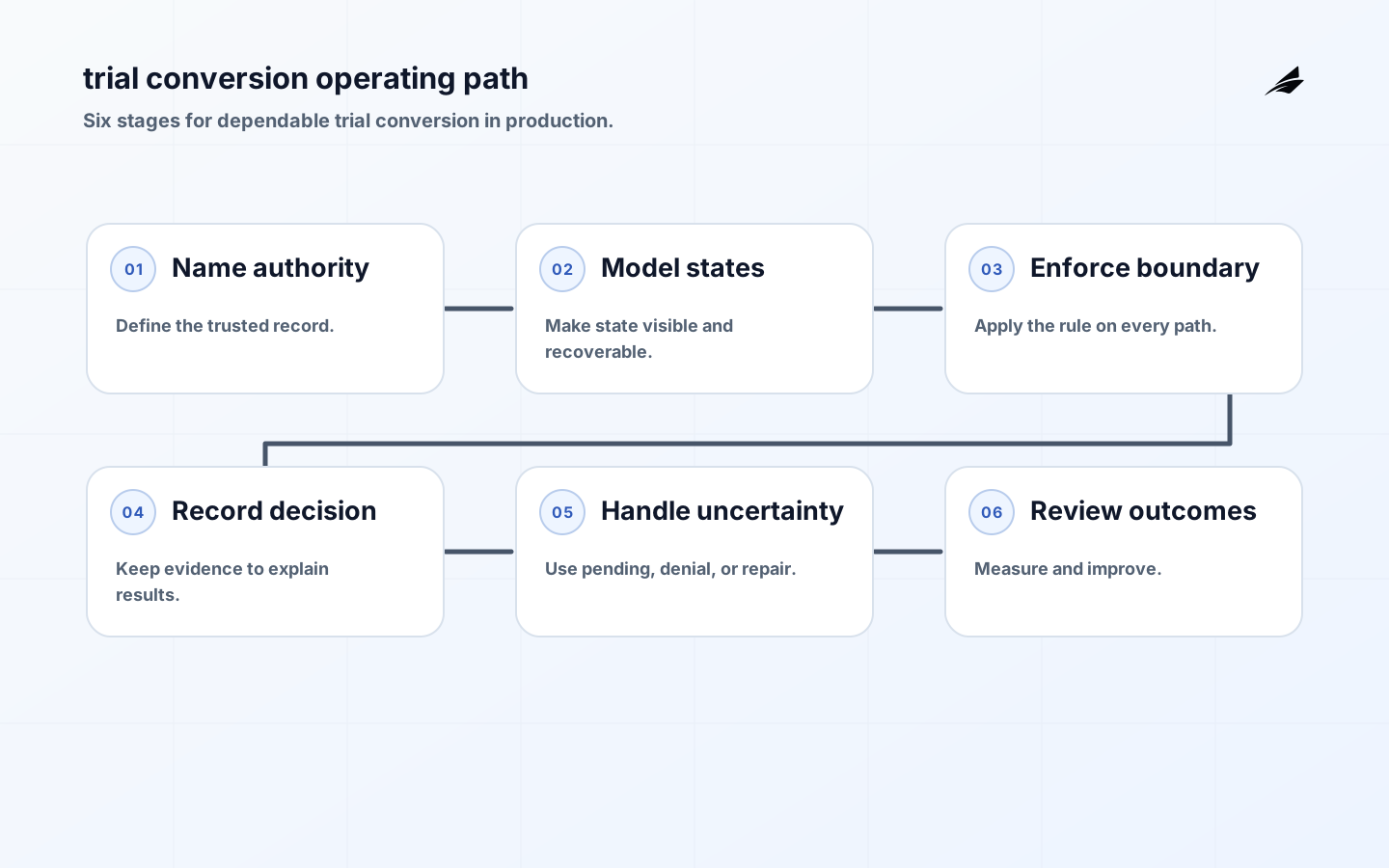
A trial conversion is easy to describe as a button that turns a prospect into a paying customer. In a real SaaS product, it is a coordinated change to a customer’s commercial relationship, workspace entitlements, invoice state, access rules, and operational obligations. During a prototype, one request may appear to handle all of those concerns. In production, payment confirmation can arrive late, a browser can retry, a webhook can be delivered twice, and a support agent may need to repair a partial result. The design therefore has to make the change explainable and recoverable, not merely successful in the usual case.
Key takeaways
- Treat conversion as a state transition with a durable owner, not as a front-end event.
- Separate payment confirmation, subscription status, and product entitlement while defining how they join.
- Make retries harmless with idempotency keys and durable external event identifiers.
- Give customers clear next actions when payment or provisioning is still pending.
- Keep an evidence trail that lets support explain, correct, and reverse an exceptional outcome.
Define what conversion actually changes
Start by naming the commercial and product states that matter. A workspace may be trialing, payment pending, active, past due, suspended, canceled, or awaiting a manual review. Those labels should describe observable business conditions rather than mirror whichever provider response was received most recently. For example, a successful checkout can create a subscription record while entitlement provisioning remains incomplete. Showing paid features before the product has safely recorded ownership creates a different risk from asking an already-provisioned customer to wait.
Write a conversion contract with the subject, workspace, selected plan, billing account, effective time, source of authority, and permitted next states. Decide whether the trial ends at checkout, at confirmed payment, or at a separately recorded effective time. Also decide what happens when a customer changes plans during the same window. The OWASP Authorization Cheat Sheet is useful here because it reinforces the need for server-side authorization checks and deliberate handling of missing or conflicting facts.
| State | Customer experience | System obligation |
|---|---|---|
| Payment pending | Explain that confirmation is still in progress. | Keep the request replayable and prevent duplicate provisioning. |
| Active | Show the plan and enabled capabilities clearly. | Record the authority, effective time, and entitlement version. |
| Provisioning incomplete | Offer a safe retry or support route. | Expose the failed dependency without granting an unsafe partial state. |
| Past due | Describe the access impact and payment next step. | Apply a documented grace or restriction policy consistently. |
Model the lifecycle and the source of truth
Use one durable lifecycle model even when several services contribute facts. The billing provider may own payment status; the product may own entitlement calculation; an identity service may own membership; and a worker may coordinate provisioning. Keep those responsibilities explicit. A product database should not infer that a customer is active solely because a browser returned from checkout, and a billing webhook should not silently decide which workspace receives access without a verified mapping.
Persist the provider event ID, account mapping, plan version, old state, new state, actor or source, received time, effective time, and processing result. Store a reason when a transition is rejected or held for review. An idempotency key should cover the customer action, while durable event IDs should protect the asynchronous consumer. These are related controls, but they solve different duplicate-delivery problems. Keep them both when the conversion path crosses a payment provider boundary.
Build a conversion path that survives retries
Resolve the workspace and acting user on a trusted server boundary. Treat plan and price details supplied by the browser as a request for a choice, then load the permitted offer and current account context from trusted storage. Authorize the action for that workspace, validate that the trial can still convert, and create a durable operation record before starting work that can be retried. Return a stable operation status rather than asking the browser to guess whether a timeout succeeded.
The worker that handles asynchronous confirmation should be safe to run more than once. Check the durable event ID, lock or compare the relevant state, apply the transition once, and record the result. If entitlement creation succeeds but a welcome message fails, do not roll back access merely because communication did not complete. If the payment provider reports a reversal after access was granted, route the new fact through the defined lifecycle rather than letting an unrelated retry overwrite it.
| Boundary | Decision to make | Useful test |
|---|---|---|
| Checkout request | Which workspace and offer may this user act on? | Change the workspace ID in the request. |
| Provider callback | Which durable account and event does this represent? | Deliver the callback twice and out of order. |
| Entitlement worker | Has this state transition already been applied? | Retry after a partial database failure. |
| Support repair | Who may correct this case and with what scope? | Expire a repair permission and inspect its record. |
Design the customer and support experience together
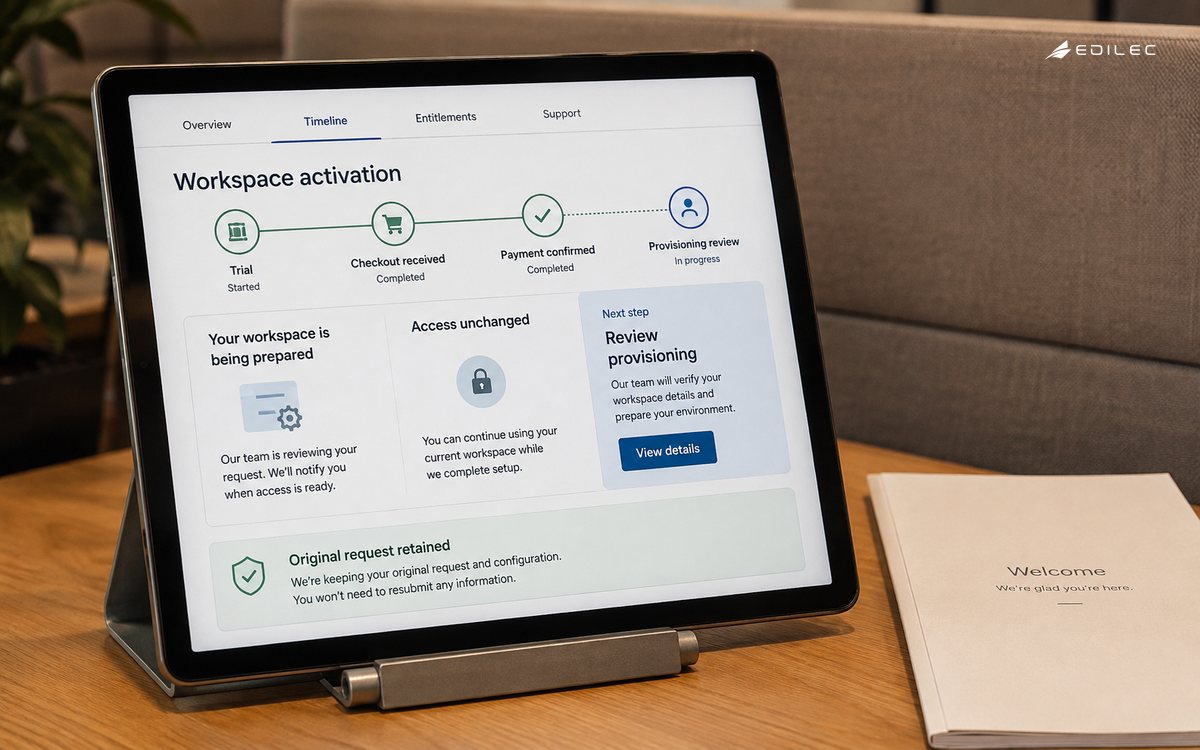
A production conversion needs language for the awkward middle states. “Your subscription is being confirmed” is more useful when paired with a refresh behavior, an expected follow-up channel, and a support reference. A failed payment message should distinguish a declined payment from a technical delay. An entitlement delay should name the affected capability without exposing internal queue names or provider payloads. These details reduce duplicate clicks and give support a shared vocabulary for the same state.
Support tools should show the timeline rather than only the current label: trial end, checkout attempt, provider event, entitlement update, and any repair. Make sensitive payment information unavailable unless it is genuinely needed. A support action should require a reason, have a narrow scope, and create a record that links to the original operation. The operator should be able to retry a safe step without inventing a new business outcome.
Decide how conversion interacts with an existing seat limit, a promotional offer, and a workspace that has more than one billing contact. Keep the commercial rule stable when the initiating user is not the person who receives invoices. If a plan change removes capability, give the workspace a clear transition state and protect data that no longer fits the plan until the policy says what should happen.
Release in controlled stages
Before broad exposure, exercise a representative set of real account shapes: an individual workspace, a multi-member workspace, an existing billing account, a customer with a changed plan, and a trial that is close to expiry. Verify the full path from request to entitlement and the reverse path for cancellation or payment reversal. A small cohort makes it easier to compare customer behavior, provider events, and internal records while the team still has time to contain a problem.
Operate from evidence, not assumptions
Measure the customer outcome and the integrity of the transition separately. Useful signals include time spent in payment pending, conversions that need support, entitlement mismatches, duplicate callbacks, failed provisioning attempts, reversals after activation, and the age of unresolved operations. Segment those signals by plan, provider path, and workspace type so a healthy aggregate does not hide a narrow failure. The OpenTelemetry documentation provides a practical vocabulary for connecting traces, metrics, and logs across the request and worker boundary.
Logs should explain a decision without becoming a second payment database. Record stable identifiers, state changes, reason codes, and correlation IDs, while excluding secrets and unnecessary personal data. The OWASP Logging Cheat Sheet is a useful reference for balancing investigation value with protection of the records themselves. Alert on a named response condition, such as a growing pending queue or entitlement mismatch, and assign the person who owns the next action.
Plan for the failures that change trust
The dangerous cases are often combinations rather than isolated errors. Test a browser timeout followed by a second click, a webhook arriving before the local checkout record, a trial expiring while payment is pending, a member losing workspace authority during checkout, and a provider reversal after a customer has used a paid capability. Decide whether each case waits, denies, preserves existing access, or starts a repair. Put that decision in the state model and customer language before the incident forces an improvised answer.
Frequently asked questions
Should the browser decide that a trial is converted?
No. The browser can request conversion and show a pending state, but the server or a trusted worker should decide whether the workspace, offer, payment fact, and entitlement transition are valid. A return from hosted checkout is useful evidence, not final authority.
What should the team inspect first after launch?
Inspect pending age, duplicate processing, entitlement mismatches, and support corrections alongside completed conversions. Those signals reveal whether the system can explain its decisions, not just whether a payment was accepted. Sample individual timelines when a metric changes.
For delivery teams working on trial conversion, this release decision should connect customer outcomes, tenant state, entitlements, release controls, support actions, and operating cost to evidence an accountable owner can inspect. For adjacent decisions, continue with Edilec's Multi-tenant SaaS Architecture: Production Boundaries That Hold and Feature Flags in Production: Safe Release and Rollback. In this production review, move beyond the release decision only after the owner can show the accepted result, the exception path, and the signal for another review.
Conclusion
Moving trial conversion into production changes the standard from “the happy path works” to “every important outcome has a trusted authority, a durable state, and a recovery route.” Separate billing facts from entitlement decisions, make asynchronous work idempotent, write useful pending states, and retain enough evidence for support to act within clear limits. That foundation lets pricing, plans, and payment providers evolve without making customer access mysterious.