This checklist helps a product team and development company move from a SaaS concept to a testable multi-tenant operating model. It is organized as evidence gates because tenant isolation cannot be accepted from code review or an architecture diagram alone. Each gate should produce artifacts, automated tests and operational proof.
Apply the checklist per component and revisit decisions as tenant profiles change. Shared compute does not require shared data, and dedicated data does not require a separate product version. For decision context, see the multi-tenant SaaS architecture development company FAQ.
1. Define the tenant and lifecycle
- Define the contractual customer, application tenant, user and workload identities separately.
- Model tenant membership, invitations, delegated administration and users with multiple memberships.
- Define onboarding, activation, suspension, reactivation, transfer, merge and offboarding states.
- Record data retention, residency, deletion, export and legal-hold obligations.
- Define product tiers and entitlements independently from infrastructure assumptions.
- Assign owners for tenant catalog, identity, billing or metering, data and support access.
Create a tenant state machine with allowed transitions and failure recovery. Onboarding may create identity configuration, data partitions, storage paths, entitlements and deployment placement. Make each step idempotent and reconcilable. Offboarding should revoke access promptly while preserving data according to policy; deletion is a separate controlled transition.
| Artifact | Acceptance evidence | Owner |
|---|---|---|
| Tenant definition | Business and technical terms are unambiguous | Product owner |
| Lifecycle state model | Interrupted workflows resume or compensate safely | Platform owner |
| Entitlement catalog | Features and limits map to product decisions | Product and commercial owners |
| Data obligation matrix | Retention, residency, export and deletion scope is explicit | Data owner |
| Responsibility model | Support and risk decisions have one accountable role | Program owner |
2. Choose isolation per component
For compute, data, cache, messaging, object storage, search, secrets, telemetry and deployment, compare pooled, siloed, stamped and hybrid options. Record isolation requirement, scaling unit, expected workload shape, failure domain, recovery granularity, cost allocation and migration trigger. Microsoft and AWS guidance both emphasize tradeoffs rather than a universal pattern.
| Component | Questions | Decision evidence |
|---|---|---|
| Compute | Can one tenant exhaust workers, threads or connections? | Quota, scheduling and isolation design plus load test. |
| Database | What are query, transaction, restore and residency boundaries? | Partition model, runtime role and recovery rehearsal. |
| Cache | Can keys, eviction or invalidation cross tenants? | Tenant-scoped key design and negative test. |
| Messaging | Can one tenant block or inspect another's work? | Partition, fair-consumption and dead-letter policy. |
| Object and search | Are paths, indexes and access policies tenant-safe? | Policy tests for read, write, list and export. |
| Telemetry | Can operators filter safely without exposing tenant content? | Tenant context, access control and cardinality budget. |
3. Establish trusted tenant context
Resolve tenant context from authenticated identity, server-side membership and request destination as appropriate. Reject conflicts rather than choosing a convenient value. Sign or otherwise protect propagated context between services and bind it to the workload identity. Never trust a tenant identifier from client input as authorization proof.
- Define canonical tenant and user identifiers that are not reusable after deletion.
- Validate issuer, audience, expiry and authentication strength for external identities.
- Check membership, role, entitlement, resource tenant and requested action.
- Separate platform administration from customer content access.
- Use short-lived, scoped service credentials and rotate them.
- Record safe audit events for membership, privilege and support-access changes.
4. Enforce data isolation and lifecycle
Select shared table, schema, database or deployment boundaries from requirements, not habit. If using shared tables, include tenant keys in uniqueness, indexes and query access patterns. Restrict runtime database roles. Database row-level security can add defense in depth, but verify owner and bypass behavior and run tests with deployed roles.
- Apply tenant boundaries to relational data, files, indexes, caches, analytics and derived datasets.
- Prevent cross-tenant identifiers from being accepted without resource authorization.
- Define backup, point-in-time recovery and tenant-level restore behavior.
- Test residency for replicas, backups, logs and support exports.
- Automate export and deletion with scope, approval, audit and verification.
- Keep migration scripts tenant-aware, restartable and observable.
A restore design deserves early attention. In a pooled database, restoring one tenant may require extracting and validating records into a clean target rather than rewinding the whole database. Decide whether that meets contractual recovery needs before scale makes the model difficult to change.
5. Protect shared capacity
Create per-tenant and per-tier budgets for concurrency, requests, background work, storage, expensive queries and third-party consumption. Use fair queues or partitioning where backlog from one tenant could delay others. Apply backpressure before shared resources saturate. Define behavior when a tenant exceeds an entitlement or technical safeguard.
| Resource | Control | Failure test |
|---|---|---|
| API | Per-tenant limits, cost-aware operations and bounded payloads | Burst one tenant while measuring another's service. |
| Worker pool | Fair scheduling, queue partitions and concurrency caps | Long-running jobs cannot starve short work. |
| Database | Connection budgets, query limits and workload isolation | Expensive tenant query reaches guardrail without platform collapse. |
| Storage | Quota, lifecycle and upload validation | Oversized or repeated upload fails safely. |
| External provider | Tenant attribution and global reserve | One tenant cannot exhaust shared provider allowance. |
| Control plane | Rate limits and idempotent lifecycle workflows | Repeated onboarding does not create duplicate resources. |
6. Build the control plane
Maintain a tenant catalog containing state, placement, tier, identity configuration and relevant policy references. Automate onboarding, configuration, deployment assignment, suspension and offboarding through idempotent workflows. Reconcile desired catalog state with actual resources, and alert on drift. Protect control-plane actions with stronger authorization and audit.
Keep product request handling in the data plane and management authority in the control plane. A control-plane outage should have a documented effect on existing tenants. Avoid a design where ordinary product requests require a globally privileged management call.
7. Make operations tenant-aware
Include trusted tenant and tier context in metrics, traces and logs where it is safe and useful. Control cardinality and avoid placing customer content in labels. Build global, stamp, tier and tenant views so operators can distinguish broad failure from one tenant's workload. AWS's SaaS Lens specifically calls for tenant-aware operational insight.
- Measure user journey success, latency and correctness by tenant or tier.
- Monitor throttling, queue age, consumption and error budgets for shared resources.
- Correlate deployments, configuration changes and lifecycle actions with service behavior.
- Provide time-bounded support access with approval and customer-aware audit.
- Define tenant incident scope and a method to identify affected tenants safely.
- Track consumption for architecture decisions without presenting estimates as billing truth.
8. Verify security and supply chain controls
Threat-model cross-tenant access, privilege escalation, confused-deputy behavior, insecure support access, resource exhaustion and control-plane compromise. Apply NIST zero trust principles by authenticating and authorizing users and workloads for each resource rather than trusting network placement.
- Run automated cross-tenant tests for every resource type and administrative route.
- Test list, search, export, batch and background operations, not only single-record endpoints.
- Protect build and deployment credentials; verify artifacts and dependencies.
- Scan infrastructure policy and prevent broad wildcard permissions.
- Review secrets, encryption keys and rotation boundaries.
- Exercise security incident containment for one tenant, one stamp and the global service.
9. Prove tenancy under failure
| Scenario | Expected property | Evidence |
|---|---|---|
| Tenant identifier tampering | Request is denied without revealing resource existence | API and audit test. |
| Cache collision | No key, value or invalidation crosses tenants | Concurrent isolation test. |
| Worker retry storm | Fairness and global capacity remain controlled | Queue and load telemetry. |
| Stamp failure | Affected tenants are identifiable and recovery follows policy | Recovery exercise. |
| Interrupted onboarding | Workflow resumes or reconciles without duplicates | Control-plane state report. |
| Support elevation | Access is approved, time-bounded, attributable and revoked | Access audit and expiration test. |
Kubernetes namespaces, database policies and cloud accounts are useful mechanisms, but none proves the complete product boundary. Test through the same identities, roles, network and deployment configuration used in production. Include malicious and accidental paths, and retain results against the release version.
10. Release through tenant cohorts
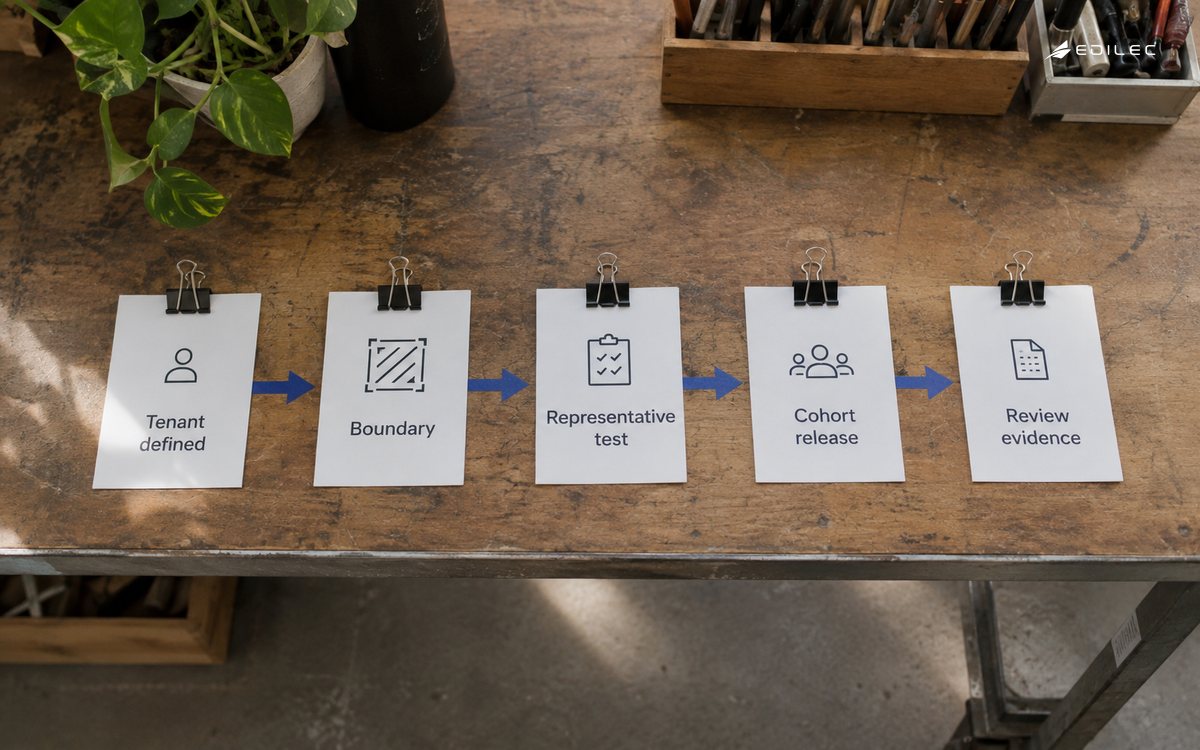
Begin with a thin vertical slice containing sign-in, tenant resolution, one data flow, one background job, telemetry, onboarding and offboarding. This slice reveals missing context earlier than building many features separately. Use an internal or controlled tenant and representative workload.
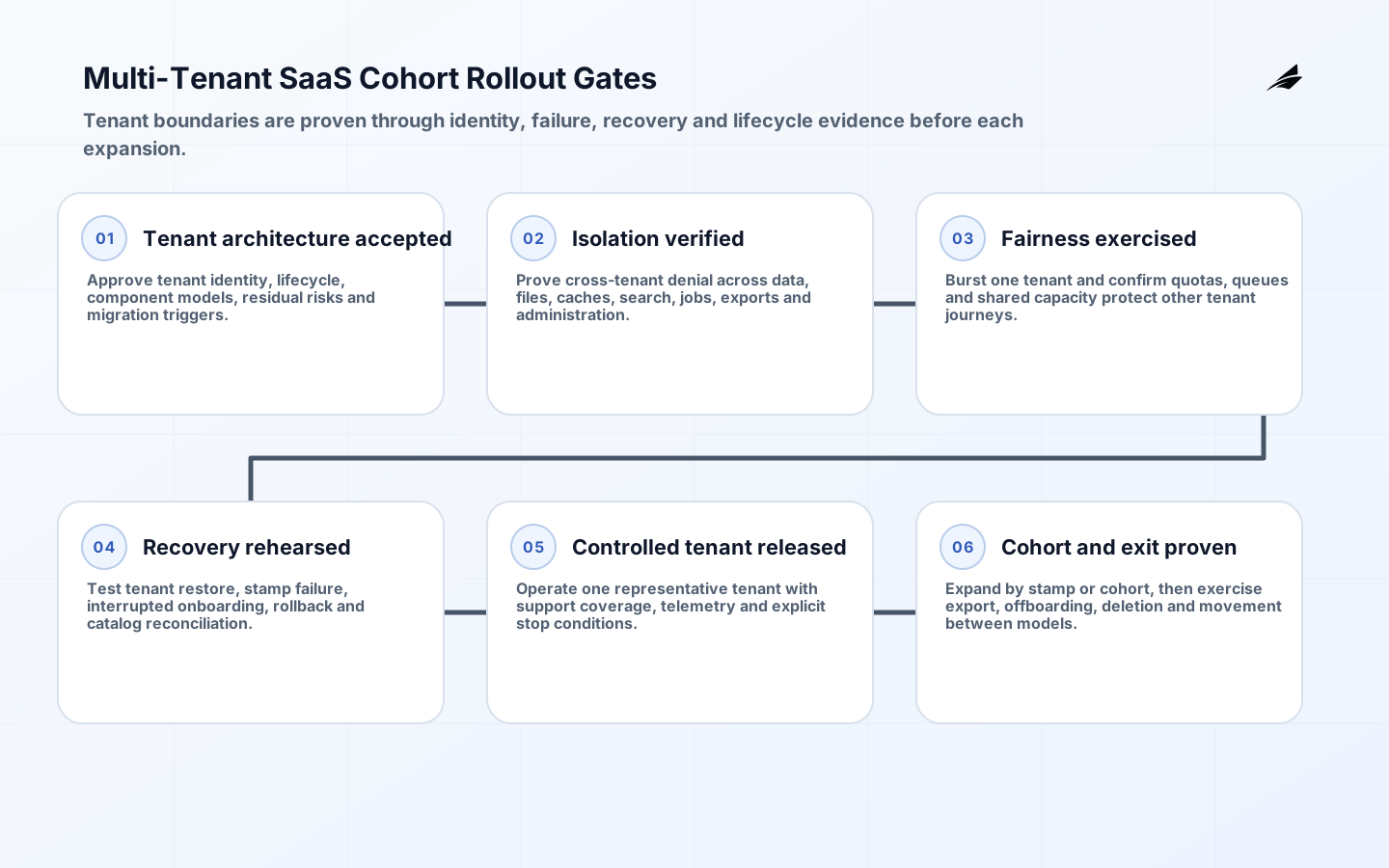
- Gate 1: architecture review accepts tenant definition, component models and residual risks.
- Gate 2: automated isolation, authorization and lifecycle tests pass in a production-like environment.
- Gate 3: restore, noisy-neighbor, control-plane recovery and deployment rollback exercises pass.
- Gate 4: controlled tenant runs with support coverage and explicit stop conditions.
- Gate 5: expand by cohort or deployment stamp while reviewing tenant-level service and consumption.
- Gate 6: exercise movement to another isolation model, tenant export and offboarding.
A rollback must preserve tenant placement and data authority. If a schema migration is not backward compatible, application rollback may be unsafe. Use expand-and-contract database changes, feature controls and versioned jobs to keep releases reversible. Record which tenants received each configuration and artifact version.
Example: implementing a document workflow tenant
The vertical slice signs in a user, resolves membership to one organization, creates a workflow record, stores an attachment, schedules a reminder and exposes tenant-scoped telemetry. Shared compute and database tables are used initially; restricted roles and row policies add defense in depth; storage paths and signed access are tenant-scoped.
Tests switch record, file, search and job identifiers across two test tenants and expect denial. A workload test fills one tenant's reminder queue while another continues within its objective. The control plane interrupts and resumes onboarding. A restore rehearsal reconstructs one tenant into a separate validation environment before the first cohort expands.
11. Hold the development company to evidence
- Require architecture decisions with assumptions, alternatives and migration triggers.
- Keep source, infrastructure definitions, schemas, tests and operational documentation in agreed repositories.
- Review deployed authorization and database roles, not only application code.
- Require reproducible environment creation and tenant inventory.
- Define defect, security, incident, knowledge transfer and exit responsibilities.
- Accept milestones through working isolation, recovery and lifecycle evidence.
Residual risks to record
| Risk | Possible treatment | Decision owner |
|---|---|---|
| Tenant-level restore is slow | Improve tooling, change data boundary or accept with workaround | Product and risk owners. |
| Dedicated tier increases fleet burden | Automate stamps and limit supported variants | Platform owner. |
| Telemetry cardinality grows rapidly | Aggregate, sample or constrain dimensions | Operations owner. |
| External identity varies by customer | Standardize federation profiles and test configuration | Identity owner. |
| Shared provider has global quota | Reserve capacity, isolate calls or add degradation | Service owner. |
| Deletion conflicts with retention | Separate access revocation, retention and final erasure states | Data and legal owners. |
Key takeaways
- Define tenant identity, lifecycle and data obligations before selecting technical partitions.
- Choose and document isolation for every component, including operational and derived data.
- Derive tenant context from trusted identity and authorize each resource and action.
- Prove fairness, recovery, lifecycle idempotency and cross-tenant denial under production-like failure.
- Release by tenant cohort and require the development company to deliver reproducible evidence and ownership.
Frequently asked questions
How much of this is necessary for an MVP?
Implement the smallest complete tenancy slice: trusted context, authorization, data boundary, lifecycle, telemetry and negative tests. Defer scale mechanisms only with explicit triggers. Retrofitting tenant identity after many features is usually harder than keeping the first slice narrow.
Is row-level security enough for shared tables?
No. It can be valuable defense in depth, but application authorization, restricted runtime roles, tenant-aware jobs, migrations, caches, files and tests remain necessary. Verify database-specific bypass behavior.
Does a penetration test replace isolation tests?
No. A penetration test provides periodic independent assessment. Automated cross-tenant tests should run continuously and cover domain-specific resources, background work and lifecycle paths as the product changes.
When is the architecture ready to scale?
When a representative tenant slice has passed isolation, fairness, recovery, rollout and offboarding evidence gates; operations can identify impact by tenant; and the team knows the triggers for changing component models. Readiness is specific to the next cohort, not unlimited scale.
Conclusion
A multi-tenant SaaS implementation is ready when tenant boundaries survive ordinary change and expected failure, not when the first shared table works. A disciplined checklist keeps product decisions, isolation, lifecycle and operations connected so each cohort adds learning without adding unmanaged variants.