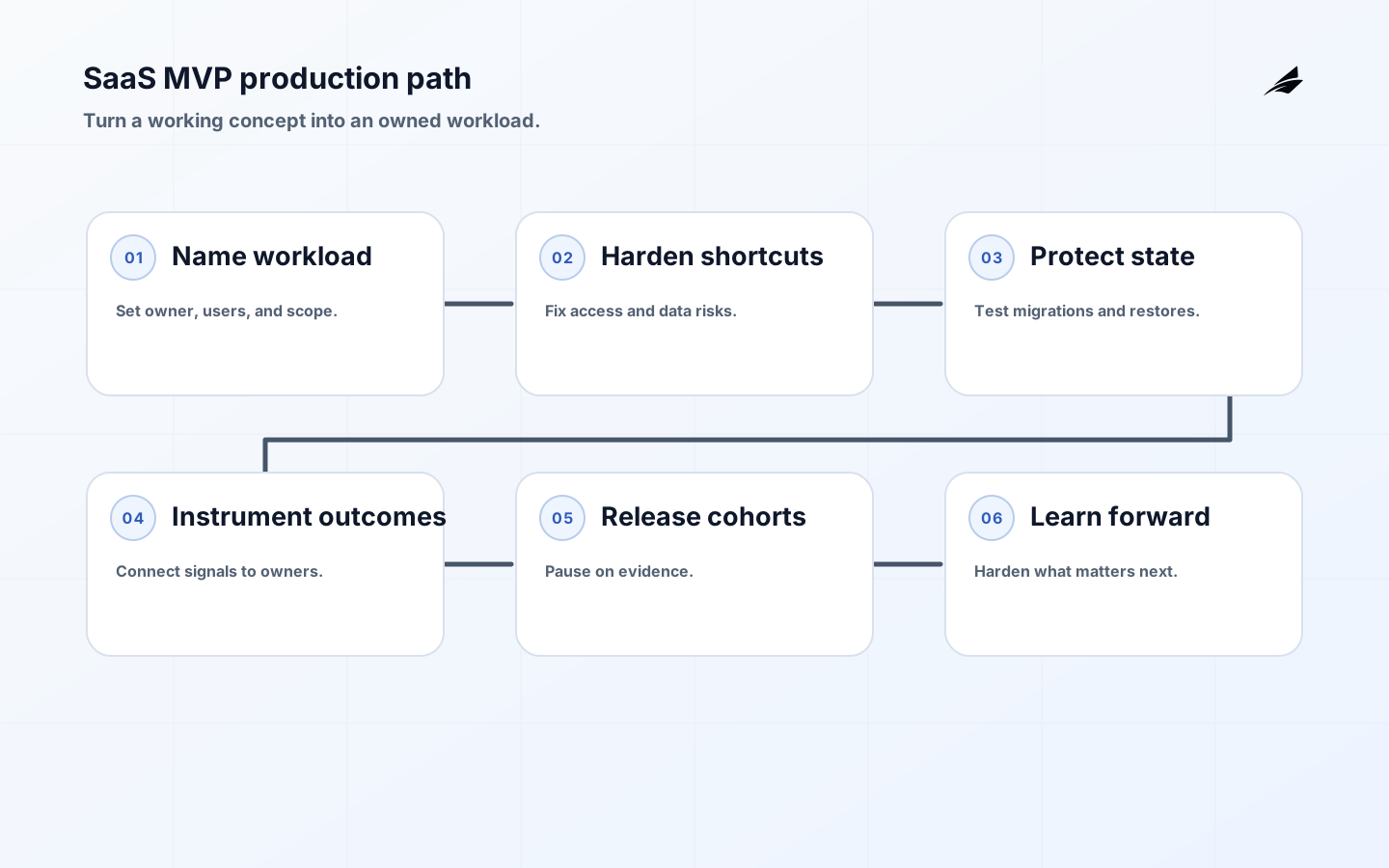
A SaaS MVP proves that a product idea can work; production proves that customers can rely on it while the team continues to change it. The transition is not a ceremony or a single infrastructure upgrade. It is a change in accountability. Someone must own the workload, its dependencies, its data, its support promise, its security posture, and its recovery. AWS describes a workload as more than resources: it includes people, processes, and runbooks that deliver business value. That is the useful definition for deciding what an MVP still needs before launch.
Use the related feature-flag guide, product analytics guide, and SaaS reliability guide to extend this production review. The goal is not to make an early product look enterprise-sized; it is to make customer dependence safe to grow.
Name the production workload and its owner
Write what the system does, who uses it, what happens if it stops, which environments and regions it occupies, what data it holds, and which dependencies it requires. Assign a person or team that can make a decision during an incident. Define what is deliberately outside the first production scope. A small, well-owned workload is safer than a broad MVP whose boundaries are only understood by its original builders. Add the support channel and escalation path to the definition because a customer-visible system is not complete when only the code can run.

| MVP assumption | Production question | Evidence |
|---|---|---|
| It works on my data | What data classes and volumes are supported? | Representative fixtures and limits. |
| The team can fix it | Who owns response and recovery? | On-call and support record. |
| The provider is reliable | What happens when it is slow or unavailable? | Timeout and fallback test. |
| We can change it later | How are schema and config changes reversed? | Compatibility and return plan. |
Remove insecure design shortcuts
OWASP’s 2025 risk list includes broken access control, security misconfiguration, insecure design, integrity failures, logging failures, and mishandled exceptional conditions. Those categories are a useful production checklist because MVP shortcuts often live there. Replace client-only authorization with server checks, document trusted inputs, protect secrets, validate tenant scope, and make error states explicit. Do not postpone logging of consequential actions because the system is small; small systems are still difficult to investigate once customer data and business decisions depend on them.
Make data and state changes deliberate
Identify the source of truth for each important object and the allowed lifecycle transitions. Add migration compatibility when old and new versions coexist. Backups are not a recovery plan until a restore has been tested and the team knows how to verify data correctness. For multi-tenant products, ensure a tenant identifier is derived and enforced across storage, caches, queues, exports, and background jobs. Decide what happens to partial work when a request fails. A production data model should make the safe state easier to reach than a silent, half-completed state.
- Assign owners for workload, data, identity, dependencies, support, and recovery.
- Document trusted inputs and server-side authorization decisions.
- Version migrations and configuration with a compatible return path.
- Test backup restoration and the correctness of recovered data.
- Keep an inventory of customer-impacting dependencies and their failure behavior.
Instrument the outcomes customers notice
A production MVP needs signals for successful workflows, errors, latency, freshness, queue age, capacity, and business-impacting correctness. Use a consistent correlation identifier across requests, jobs, deployments, and support cases. Add enough context to segment by version, region, tenant cohort, or dependency without exposing unnecessary customer data. Alerts need owners and responses; a page with no next action is noise. Instrumentation is not a promise of perfect visibility, but it should let a responder answer what changed, who is affected, and whether the return action worked.
| Readiness area | Minimum production decision | Test |
|---|---|---|
| Identity | Who may access which action and data? | Negative authorization suite. |
| Release | How can a change pause or return? | Staged rollout exercise. |
| Operations | Which signals page which owner? | Alert-to-runbook drill. |
| Support | How does a customer report and recover? | End-to-end case simulation. |
Release with evidence instead of optimism
NIST’s secure development framework and Google’s reliability guidance both support reducing uncertainty through repeatable practices and testing. For an MVP, that may mean a small but real pipeline: review the change, scan dependencies and configuration, run unit and integration tests, verify a migration against representative data, deploy to a bounded cohort, observe, and expand only when the evidence is healthy. Keep an immutable artifact and a known-good configuration. Test direct API and background paths because a successful browser flow does not prove the whole workload is safe.
Turn support into a feedback and recovery loop
A production MVP needs a support path that can identify the account, tenant, action, version, and current state without asking customers to repeat sensitive information. Give support a safe diagnostic view and a narrow escalation route. Record recurring questions, manual repairs, failed imports, and confusing messages. Those are not merely service costs; they are evidence about product boundaries. Avoid granting broad internal access to compensate for missing tooling. Improve the diagnostic and recovery flow instead, with least privilege and audit evidence.
Choose a bounded launch and a stop rule
Pick a cohort with stable ownership and a workflow that exercises the important path. Define baseline, observation window, stop conditions, communication plan, and return action before launch. Test load variation, provider delay, malformed input, stale permissions, partial migration, and a failed notification. Preserve customer state when pausing. A launch is not ready because the first accounts are enthusiastic; it is ready when the team can detect a problem, contain it, communicate, and restore a known behavior without improvising.
Let evidence decide what to harden next
After launch, review the error budget or equivalent reliability target, support load, security findings, deploy frequency, rollback rate, recovery time, and data-quality exceptions. Rank hardening work by customer impact and uncertainty reduced. Do not add architecture merely because a larger company might need it someday. Do not keep an MVP shortcut because it has not yet caused an incident. A production operating cadence lets the team make that distinction using evidence rather than fear.
- Simulate a dependency outage and verify customer-facing behavior.
- Restore a backup and validate business records, not just process startup.
- Attempt cross-tenant access through every entry point.
- Pause a release after a cohort signal crosses the stop condition.
- Turn recurring manual recovery into a runbook, test, or product fix.
A readiness review is strongest when it uses a small set of representative customer journeys rather than a long generic checklist. Follow sign-in, the core workflow, a failure from a dependency, a support request, a release, a data restore, and a permission change. For each journey, name the expected signal and the person who acts on it. If the team cannot demonstrate the path in a rehearsal, mark the assumption clearly and limit the launch scope. This makes production readiness a sequence of manageable decisions instead of an argument about whether an MVP feels finished.
Leadership can keep the transition proportionate by asking for proof on the small number of paths customers actually depend on. A narrow launch with strong identity, observability, support, data recovery, and release control is usually more valuable than a large feature set with no owner. Document the remaining limitations and communicate them internally so sales, support, and engineering do not make different promises. Production maturity can grow in slices when each slice has a clear boundary and a testable return action.
Key takeaways for moving an MVP to production
- Define the workload, owner, customer outcome, and supported boundary.
- Replace insecure shortcuts with explicit authorization, data, and exception controls.
- Instrument customer-visible behavior and connect signals to owners.
- Release in cohorts with compatible changes and a real return path.
- Use support and incident evidence to decide what to harden next.
SaaS MVP production FAQ
Moving an MVP to production is a change in accountability and evidence. Use these answers as prompts for a readiness review.
What changes first when an MVP enters production?
The team must name the workload owner, user outcomes, data boundaries, support path, release controls, and recovery expectations. The code may remain small, but the operating contract becomes explicit.
Does production require rebuilding the MVP?
Usually no. It requires making hidden assumptions explicit, removing unsafe shortcuts, and adding evidence and controls around the paths customers depend on.
What should be cut from an MVP before launch?
Cut unowned features and irreversible operations before cutting observability, access control, backup, or a usable support path. A smaller supported scope is healthier than a broad opaque one.
How should an MVP be rolled out?
Use a bounded cohort, explicit stop conditions, compatible migrations, observed behavior, and a return action that preserves customer state. Expand when evidence supports the original assumption.
A SaaS MVP changes when it meets real customers: usage becomes evidence, exceptions become support work, and a small design shortcut can become a durable operating obligation. Before launch, name the critical journey, its owner, its failure signal, and the simplest recovery action. Keep identity, authorization, data handling, and change control proportionate to the consequence of failure. A production review should also decide what the team will not build yet. That restraint protects learning speed while giving customers a clear promise and a dependable path when the normal flow does not work.
Conclusion: grow the operating contract with the product
A SaaS MVP moves into production when the team can explain its workload, protect its users, observe meaningful behavior, support failures, and recover without guessing. Those practices do not require a giant platform. They require deliberate boundaries and evidence around the paths that matter. Keep the scope small enough to own, make the dangerous assumptions visible, and let real production feedback guide the next investment.
The smallest useful improvement to the SaaS MVP production transition is often a sharper boundary, not another feature. Make the SaaS MVP production transition corrections visible, scoped, and reversible during moves into production.
For the SaaS MVP production transition, test an unexpected load spike before treating the first release as complete. Review the SaaS MVP production transition evidence with product, engineering and support before expanding scope.
A practical example for the SaaS MVP production transition is a customer-visible result remains pending. Reconcile the SaaS MVP production transition changes against the original record.
Ownership is clearer when the SaaS MVP production transition separates the promise from the mechanism. Give the SaaS MVP production transition a named owner and a review date.
For the SaaS MVP production transition, AWS Well-Architected Workload and Scope defines scope; AWS Operational Excellence Pillar supports the control; OWASP Top 10:2025 clarifies evidence; NIST SP 800-218 Secure Software Development Framework guides recovery; Google SRE: Testing for Reliability frames review. Use the SaaS MVP production transition support evidence to decide whether the workflow is ready.
A practical example for the SaaS MVP production transition is an unexpected load spike. For the SaaS MVP production transition, review the MVPs move into production ownership during a customer explanation.
Ownership for the SaaS MVP production transition is clearer when the customer promise is separated from the mechanism. For the SaaS MVP production transition, review the MVPs move into production measurement during a reconciliation pass.
Before widening the SaaS MVP production transition, rehearse normal, denied, delayed, and corrected cases with realistic identifiers. For the SaaS MVP production transition, review the MVPs move into production control during a release check.
Evidence for “What Changes When SaaS MVPs Move into Production” is grounded in AWS Well-Architected Workload and Scope, AWS Operational Excellence Pillar, OWASP Top 10:2025, NIST SP 800-218 Secure Software Development Framework, Google SRE: Testing for Reliability; each source informs a specific decision, test, or operating trade-off described in this guide.